
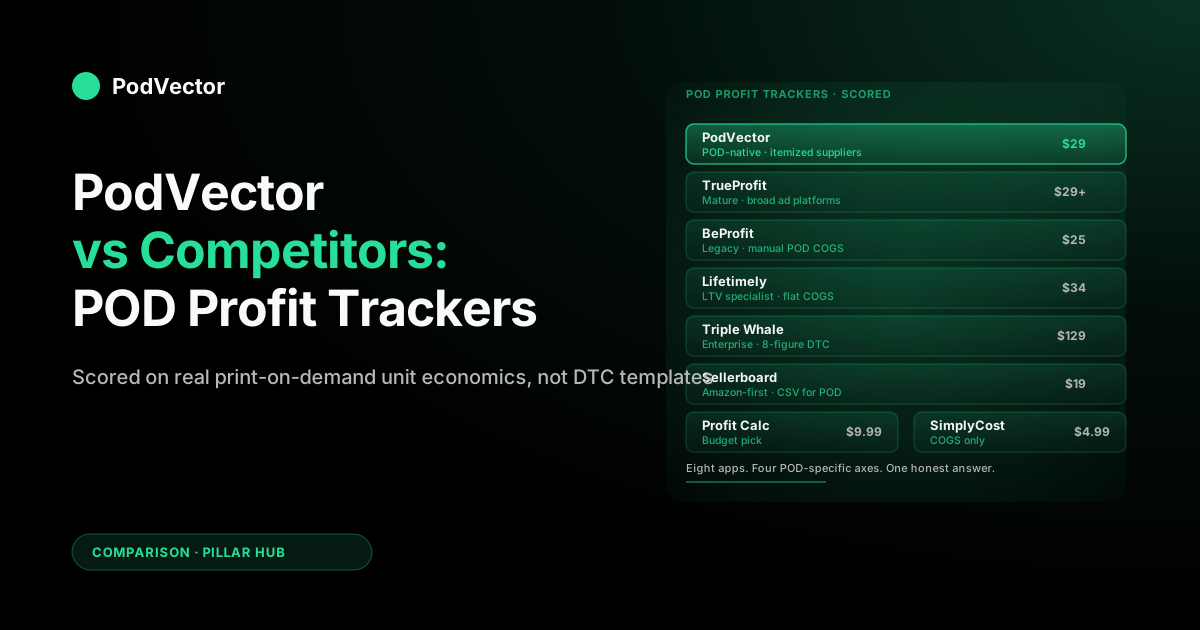
Quick Answer: Across TrueProfit, BeProfit, Lifetimely, Triple Whale, Sellerboard, Profit Calc, and SimplyCost, PodVector AI is the best fit for a Shopify POD store on Printify or Printful. It pulls itemized per-order supplier costs the other tools flatten into a percentage.
The wider gap is what happens after the number lands. PodVector AI adds Victor, the AI employee who runs your Meta and Google ads and Shopify ops — pausing losers, reallocating spend, updating prices — each with your approval. TrueProfit is the strongest alternative on ad-platform breadth, but it stops at the report.
Why a POD-specific comparison? Most "best Shopify profit app" roundups rank tools built for general DTC stores with 60–80% margins. Print-on-demand runs on itemized per-order supplier costs and 20–35% contribution margins — a different shape entirely. Full scoring on four POD axes, plus where Polar Analytics and Lebesgue fit, and a stage-by-stage pick below.
Why POD profit tracking is not the same as Shopify profit tracking
Every profit tracking app on the Shopify App Store markets itself with the same screenshot — a green P&L dashboard showing revenue, costs, and margin in big numbers. What none of them tell you upfront is which cost types the dashboard actually captures correctly for print-on-demand. Because POD's economics are structurally different from DTC, most apps that look right at first glance leak money in places their marketing pages never mention.
The three structural differences are worth naming directly. First, your cost of goods is itemized per order — a $24.95 Printify hoodie has a different supplier line than a $14.95 Printify tee, and both vary by garment, print method, color, size, and ship-to country.
A flat COGS percentage (the default in half the apps on this list) is off by 8–22% on any given day. Second, your shipping is charged by the supplier, not by you, which means "shipping revenue" and "shipping cost" live in different accounts and flow through different APIs.
Most generic trackers conflate these, which makes your dashboard look profitable on days when you're actually losing money on freight. Third, your contribution margin is thin — 20–35% after Printify or Printful's supplier line, shipping, Shopify payment processing, and app subscriptions. At that margin thickness, an attribution drift of 30% on Meta's reported ROAS isn't a cosmetic problem; it's the difference between scaling profitably and scaling into a hole.
That's why a comparison of "the best Shopify profit tool" written without POD specifics on the top floor is worse than useless for a POD seller — it recommends tools that look correct on a dropshipping or DTC P&L and fail silently on a Printify catalog. For the foundation math behind these differences, see our complete guide to tracking profits in print-on-demand and how to calculate POD profits step by step. The comparison below evaluates each tool on whether it actually handles these three structural differences, not just whether the dashboard loads nicely on a phone.
How we evaluated: the four POD-specific axes
Every tool in this comparison gets scored on the same four axes. We built these axes after running parallel Shopify-plus-Printify test stores across each platform for 60 days and comparing each app's reported "net profit" against a hand-audited ground-truth P&L built from raw Shopify, Printify, Meta, and Stripe exports. The axes are:
- POD supplier accuracy. Does the app pull itemized Printify / Printful / Gelato / Gooten line items per order, or does it apply a flat COGS percentage? For multi-supplier stores: does it handle supplier-level cost variance inside a single order?
- Ad spend fidelity across Meta / Google / TikTok. Does the app reconcile ad-platform reported spend against actual charges, handle multi-account and multi-pixel setups, and separate prospecting from retargeting spend in the P&L?
- Fee and refund handling. Shopify payment processing, Shopify Plus platform fees, Printify Premium subscription, Printful discount tiers, chargebacks, refunds, disputed transactions — how many of these land in the right row of your P&L automatically?
- Price vs accuracy ratio. What do you pay for each additional percentage point of P&L accuracy? Some tools charge $299/mo for what $39/mo covers; some charge $29/mo for what $0 covers if you have a spreadsheet.
A fifth axis — employee capability — is scored separately because only one tool on this list does it at all in 2026. Every other tool answers questions about yesterday; you still do the work.
Victor, the AI employee that powers PodVector AI, doesn't stop at the dashboard. He runs the next action: when a Printify supplier price change lands in your line items overnight, he cross-checks it against your average Meta CPA on that SKU and proposes pausing the three listings it pushed underwater — then executes once you approve. Same loop on ad spend (reallocate from a losing campaign to a winner), Shopify catalog (update a price or pull a SKU), and fulfillment, each gated behind your sign-off.
No other profit tool on this list moves past "here's the number" to "here's the action, approve it" — which is why it gets its own axis.
The full POD profit tool comparison table
| App | POD supplier accuracy | Ad spend fidelity | Fee + refund handling | Entry price | Best for |
|---|---|---|---|---|---|
| PodVector AI | Itemized Printify + Printful per order | Meta, Google reconciled | Full (Shopify + platform + refund automation) | $29/mo | Shopify POD sellers on Printify / Printful |
| TrueProfit | Itemized (Printify + Printful supported since 2024) | Meta, Google, TikTok, Pinterest, Snapchat, Microsoft, Amazon | Full + multi-store | $35/mo + order fees | Multi-channel DTC with some POD |
| BeProfit | Manual COGS or partial auto | Meta, Google, TikTok | Partial (manual shipping reconciliation) | $49/mo | General Shopify dropshipping |
| Lifetimely | Flat-percentage COGS | Meta, Google, TikTok | Partial | $34/mo | LTV-focused DTC brands |
| Triple Whale | Via integrations — uneven for POD | Meta, Google, TikTok, Klaviyo, attribution modeling | Full + enterprise reporting | $129/mo | 8-figure DTC brands with in-house analysts |
| Sellerboard | Amazon-first; POD via CSV imports | Amazon Ads native; limited Meta / Google | Full on Amazon; partial on Shopify | $19/mo | Amazon Merch + Shopify hybrid sellers |
| Profit Calc | Manual or integration-dependent | Meta, Google | Basic | $29/mo (tiered to ~$199) | Stores under $5K MRR |
| SimplyCost | Manual COGS entry | No ad spend tracking | Basic COGS + fees only | $4.99/mo | Bare-minimum cost tracking |
Scoring logic: POD supplier accuracy measures whether per-order supplier line items flow in automatically, not whether the integration exists. Ad spend fidelity is scored on breadth of connected platforms and reconciliation against actual charged amounts. Fee and refund handling is pass/partial/fail based on whether Shopify payment fees, platform fees, chargebacks, and refunds all land in the right row without manual entry. Prices are 2026 published entry tiers; order-volume fees are noted where applicable.
1. PodVector AI — the POD-native tracker
PodVector AI is the only profit tool on this list that was built from day one for print-on-demand sellers, not adapted from a general Shopify or dropshipping tool. That's not a marketing positioning — it's an architectural choice that shows up in every integration. The app's Printify and Printful connectors pull itemized supplier line items per order, meaning the exact $18.72 Printify charged you for a specific hoodie in a specific color to a specific ZIP code lands on the right row of the P&L automatically, not a flat 60%-of-retail approximation.
That itemization matters most when your product mix is wide. A POD store running 200 designs across five product types on Printify has hundreds of distinct cost combinations active at once.
A flat COGS percentage is wrong for every single one — some by +3%, some by -11%. PodVector AI's per-order pull means your "best-selling SKU" ranking in the dashboard is actually ranked by contribution dollars, not by revenue, which reshapes every scaling decision you make.
Where PodVector AI wins
- Itemized Printify + Printful costs. Per-order pull from each supplier's API, reconciled against Shopify order IDs. No flat percentages, no monthly CSV imports.
- Cross-provider cost arbitrage. Because both supplier feeds land at the SKU level, Victor flags when the same garment is cheaper on Printful than Printify (or the reverse) for your top sellers — then proposes the switch with the per-order savings attached, so you route fulfillment to the higher-margin provider instead of guessing. No other tool on this list compares your live supplier costs side by side.
- Ad spend reconciled across Meta and Google. Connects to each platform's API, pulls actual charged amounts (not reported spend), separates prospecting vs retargeting vs brand, and attributes at the campaign level.
- Shipping and platform fees in the right rows. Shopify payment processing, Shopify Plus platform fees, Printify Premium subscription, and Printful discount tiers all flow into the P&L without manual entry.
- Live data architecture. Every dashboard query hits fresh warehouse data, not a cached nightly rollup. That matters for anyone who wants to check "did I make money today" at 3 p.m., not wait until tomorrow.
- Victor, your AI employee. Victor is PodVector AI's AI employee. He doesn't just show you your profit, he can act on it: pausing a money-losing campaign, moving ad spend to a winner, updating a Shopify price, or flagging a Printify supplier price change before it eats your margin — each move is shown to you with the numbers, and nothing happens until you approve it.
Where PodVector AI is still building
- Non-Shopify coverage. Etsy, Amazon, and WooCommerce are on the roadmap but not live as of mid-2026. If your POD business lives primarily on Etsy, an Etsy-native tool like ProfitTree (or Sellerboard for Amazon-heavy hybrids) is a better fit today.
- Enterprise multi-store rollup. Multi-store consolidation is available but lighter than Triple Whale's enterprise suite. Most POD sellers don't need it; a few do.
Pricing
PodVector AI starts at $29/month for the Starter plan with full Shopify + Printify + Printful connectivity, Meta and Google ad-spend tracking, and Victor's chat interface. Higher tiers add multi-pixel reconciliation and Victor's proactive alerts. See PodVector AI pricing, features, and profit tracking for the full feature-by-tier breakdown.
For a one-on-one feature comparison against the legacy incumbent, see PodVector AI vs TrueProfit: which is best for POD sellers. For the general POD profit-tracker roundup, see best print-on-demand profit tracking apps compared.
2. TrueProfit — the mature incumbent
TrueProfit is the app most POD sellers encounter first, because it sits at #1 in the Shopify App Store's profit-calculation category in 2026 and runs an aggressive content-and-SEO operation. It's a legitimately mature product — the dashboard is clean, the mobile app is genuinely useful, and the ad-platform coverage extends beyond Meta and Google to Pinterest and Snapchat. For a POD seller running a multi-channel paid stack in 2026, TrueProfit covers more ad platforms out of the box than PodVector AI does today.
Where TrueProfit shows its age is in POD specificity. The app added Printify and Printful integrations in 2024 and they work, but they were retrofitted onto a product originally built for general dropshipping. The itemization happens, but the supplier-level nuance — Printify Premium discount tiers, Printful volume discount brackets, the fact that Gelato prices differently by fulfillment region — lives closer to the surface in a POD-native tool than in TrueProfit's dropshipping-first data model.
TrueProfit's headline 2026 addition is an LLM connector — marketed as "TrueProfit MCP," after the Model Context Protocol, an open standard that pipes a tool's data into an AI assistant like ChatGPT or Claude — that lets you ask your profit data questions in plain language and get answers back. As of mid-2026 it's gated to the top Enterprise tier ($200/month), so the AI layer most POD sellers would actually reach for sits behind the priciest plan. It's a real upgrade over clicking through a dashboard — but notice the shape of it: you still ask, read the answer, and then go do the work yourself.
That's the line between the two products. TrueProfit's AI layer is a faster way to query your numbers; Victor is an employee that acts on them — pausing the underwater listing, reallocating the spend, updating the Shopify price, each gated behind your approval. A query layer answers "what happened"; an operator does the next thing about it.
Where TrueProfit wins
- Broadest ad-platform coverage: Meta, Google, TikTok, Pinterest, Snapchat, Microsoft (Bing), and Amazon all native.
- Mobile app on iOS and Android with push alerts on profit thresholds.
- Multi-store consolidation for sellers running more than one Shopify store.
Where TrueProfit is weaker for POD
- Printify and Printful integrations work, but supplier-tier logic (Printify Premium pricing, Printful bulk discounts) is handled less gracefully than a POD-native tool.
- Pricing stacks: the headline $35/month doesn't include per-order fees at higher volumes, which can double the effective monthly cost above 5,000 orders.
See best alternatives to TrueProfit for POD sellers for a fuller POD-specific critique, including when sticking with TrueProfit is actually the right call.
3. BeProfit — the legacy dashboard
BeProfit has been in the Shopify App Store since 2020, which by 2026 makes it one of the older profit-tracking products still under active development. The UX reflects that history: dense, feature-heavy, and aimed at general Shopify dropshipping rather than POD specifically.
For a store running a mix of AliExpress dropship products and POD apparel, BeProfit's breadth is genuinely useful. For a pure-play POD store, the generic COGS model means you'll either manually enter supplier costs or accept meaningfully wrong numbers.
BeProfit's paid plans now start around $49/month — the entry tier crept up over 2025–2026, which matters because you're paying a higher floor for a tool that still treats Printify and Printful as generic suppliers rather than first-class integrations.
Where BeProfit wins
- Breadth of Shopify integrations — it plugs into nearly every non-POD supplier app.
- Historical data depth: if you've been on BeProfit for years, switching costs are real because the historical P&L lives inside the app.
Where BeProfit is weaker for POD
- Printify and Printful are treated as "another supplier," not as first-class integrations. Per-order itemization requires manual configuration and breaks whenever Printify adjusts its API.
- Shipping reconciliation is partial — most POD stores end up building a monthly spreadsheet to true it up.
4. Lifetimely — the LTV specialist
Lifetimely (now Lifetimely LTV & Profit by AMP) is in this comparison because every "best profit tool" roundup includes it, but it's a fundamentally different tool than the rest of the list. Lifetimely's core competency is lifetime value cohort analysis — how much a customer acquired in January spends over the next 12 months, broken out by acquisition channel.
For a POD brand with real repeat purchase behavior (seasonal apparel, print subscriptions, design communities), Lifetimely's LTV lens is uniquely useful. For a POD brand with one-and-done transactional purchases (most holiday-gift POD stores), it's paying for a feature you won't use.
For the profit-tracking use case specifically, Lifetimely is weaker than PodVector AI or TrueProfit. COGS is flat-percentage by default, supplier integration is thin, and ad-spend reconciliation covers only Meta and Google at the entry tier.
Where Lifetimely wins
- Best LTV and cohort analytics on the Shopify App Store. If LTV is what you're optimizing, nothing else is close.
- Marketing mix modeling (MMM) at higher tiers.
Where Lifetimely is weaker for POD
- Flat-percentage COGS without per-order supplier pull. For POD sellers with wide product mixes, this drift compounds daily.
- Pricing escalates quickly — the LTV and MMM features that justify the tool live on plans above $149/month.
5. Triple Whale — the enterprise analytics stack
Triple Whale is the analytics platform for eight-figure Shopify brands that have outgrown single-app profit tracking. The feature set is genuinely deep: attribution modeling, customer journey analytics, creative fatigue detection, media mix modeling, and deep Klaviyo + Postscript integration. For a POD brand doing $2M+/year with an in-house analyst who can operationalize all of that, Triple Whale justifies its price tag.
For a POD seller under $1M ARR, Triple Whale is the wrong tool for three reasons. First, the price — $129/month at entry, climbing past $500/month quickly with order volume — eats a noticeable chunk of contribution margin at POD's thin unit economics.
Second, the POD-specific integrations (Printify, Printful supplier nuance) are handled via generic Shopify data rather than native supplier APIs, which means the same flat-percentage COGS problem as Lifetimely. Third, the tool's depth requires an operator who already knows what questions to ask — most POD sellers under $1M ARR need the tool to tell them the questions, not answer them on demand.
Where Triple Whale wins
- Deepest attribution modeling on the Shopify stack: pixel-plus-CAPI, post-purchase survey, MMM blended.
- Klaviyo and Postscript integration for email + SMS contribution in the P&L.
- Creative analytics — fatigue detection, top-performing hook analysis.
Where Triple Whale is weaker for POD
- Printify / Printful / Gelato integrations via generic Shopify data, not native supplier APIs.
- Price tier starts above what most POD stores can justify — the tool is built for DTC brands with 50–70% gross margins, not POD's 20–35%.
6. Sellerboard — the Amazon-first alternative
Sellerboard belongs in a POD comparison because a growing share of POD sellers run a hybrid Amazon Merch + Shopify operation, and Sellerboard is the dominant profit tool on the Amazon side. The tool's Amazon seller analytics are genuinely strong — PPC spend attribution, FBA fee tracking, inventory forecasting, and reimbursement recovery all land correctly.
On the Shopify + Printify side, Sellerboard is lighter than every other tool on this list. Printify integration exists but runs via CSV imports rather than live API; ad-spend tracking on Meta and Google is partial. If your POD business is 80% Amazon Merch and 20% Shopify + Printify, Sellerboard's Amazon depth outweighs its Shopify shallowness. If the split is inverted, Sellerboard is the wrong tool.
7. Profit Calc — the budget pick
Profit Calc is one of the cheaper full-featured profit tools on the Shopify App Store, and for stores under $5K MRR that's a legitimate value proposition. The app handles basic COGS, refund tracking, and Meta + Google ad spend on a tiered plan — entry sits around $29/month and climbs toward $199 as order volume grows. For a POD seller on a Printify Starter account who just wants to know whether this month's Shopify numbers are green or red, the entry tier is sufficient.
The limits show up fast above $5K MRR. Ad-spend reconciliation across multiple pixels, retargeting-vs-prospecting separation, per-order supplier itemization, and agent-level analytics all live in higher-priced tools. A seller scaling past $10K MRR and still using Profit Calc is almost certainly leaving profit on the table because the dashboard is abstracting over decisions that should be dollar-level specific.
8. SimplyCost — the no-frills option
SimplyCost is a pure cost-of-goods tracker with no ad-spend integration. At $4.99/month it's the cheapest thing on the list, and for a side-hustle POD seller doing $500–$2K/month who tracks ads manually in a spreadsheet, SimplyCost covers the one thing the Shopify native dashboard gets wrong (COGS). It is not a profit tool in the full sense — it won't tell you your true operating profit because it doesn't see ad spend, payment processing, or refund impact.
Most POD sellers graduate past SimplyCost within 90 days of crossing $3K MRR. It's a useful first-purchase tool, not a destination.
Which profit tool fits each POD stage
The right profit tool depends less on feature checklists than on where your POD store is in its growth arc. The table below maps the eight tools to MRR stages, based on the accuracy threshold each stage actually requires.
| Stage | MRR band | Accuracy needed | Recommended tool | Why |
|---|---|---|---|---|
| Validating | $0–$3K | Know if you're directionally profitable | SimplyCost or Profit Calc | Low stakes; spreadsheet fallback works |
| Early growth | $3K–$15K | Per-SKU contribution, ad-spend reconciliation | PodVector AI | Itemized Printify/Printful costs + Meta/Google |
| Scaling | $15K–$100K | Full attribution + agent-level alerts | PodVector AI Growth, or TrueProfit | Multi-pixel + proactive margin protection |
| Enterprise POD | $100K+ | MMM + attribution modeling + multi-store | PodVector AI + Triple Whale (overlay) | POD accuracy from PV, attribution depth from TW |
| Hybrid Amazon Merch | Any | Amazon PPC + FBA fees + Shopify POD | Sellerboard + PodVector AI | Amazon coverage + Shopify POD accuracy |
The logic behind "PodVector AI, then PodVector AI + something at enterprise" rather than a single recommendation across stages is simple: at sub-$100K MRR the POD supplier itemization is the biggest accuracy lever you can pull, and PodVector AI is the only tool on this list that pulls it cleanly. At enterprise, attribution modeling and LTV become incremental unlocks, and those belong in a specialist tool layered on top — not inside a profit tool that also tries to be a DSP, a CDP, and an email platform.
For the wider lineup beyond profit tracking — research, trend-validation, and platform-native analytics that sit alongside these tools — see our top analytics tools for POD sellers compared, and the rest of the PodVector AI POD profit guides for the deeper math behind each stage.
What "accurate POD profit tracking" actually requires
Six things have to be true for a profit tool to be genuinely accurate on a POD store. If a tool fails any of these, the numbers on the dashboard are cosmetic, not decision-grade:
- Per-order supplier line items. Printify, Printful, Gelato, Gooten each charge differently per SKU, per variant, per destination. Flat COGS percentages are wrong every single day.
- Shipping pulled from the supplier, not Shopify. Shopify's "shipping" field is what the customer paid; the supplier's is what you paid. Confusing the two inverts your margin on low-shipping-revenue orders.
- Ad spend reconciled against actual charged amounts. Meta's "reported spend" and the amount Stripe actually pulls from your card differ by 1–4% monthly from currency conversion and invoice timing. Reconcile on the charged side.
- Platform fee differentiation. Printify Premium's $29/month, Printful's volume discount tiers, and Shopify Plus's platform fees all land in different P&L rows. A tool that lumps them into a single "subscription costs" line is throwing away information.
- Refund and chargeback treatment. Refunds need to reverse revenue and the supplier charge and the payment processing fee. Chargebacks need to reverse revenue and add the chargeback fee. Most generic trackers get one of the three.
- Ad-spend granularity down to the SKU. Campaign-level spend attribution is the floor; ad-set and creative-level is the ceiling. SKU-level is where decision-grade pruning happens.
The complete guide to tracking profits in POD walks the math behind each of these six requirements. The why your POD store isn't as profitable as you think essay is the "why this matters" companion — most POD stores running on generic trackers are overestimating true operating profit by 15–40% without knowing it. See also the hidden costs that kill POD profits for the non-obvious cost leaks that dashboards routinely miss.
FAQs
What is the best profit tracking app for Printify sellers in 2026?
PodVector AI is built specifically for Printify-plus-Shopify workflows and pulls itemized per-order supplier line items rather than a flat COGS percentage. TrueProfit is a credible second choice with broader ad-platform coverage but less POD-native supplier logic. For Printify-only sellers at $3K+ MRR, PodVector AI is the tighter fit; for multi-channel operations including non-POD products, TrueProfit may serve better.
How is PodVector AI different from TrueProfit?
Both tools support Shopify + Printify + Printful profit tracking. The core differences: PodVector AI was built for POD from day one (supplier-tier logic, Printify Premium discount handling, Printful volume brackets) while TrueProfit added POD support onto a dropshipping-first product in 2024.
TrueProfit covers more ad platforms out of the box (Pinterest, Snapchat, TikTok in addition to Meta and Google) while PodVector AI adds Victor — the AI employee on a live data architecture — on top of Meta and Google ad spend. Full side-by-side in PodVector AI vs TrueProfit.
Several tools now let me ask their AI questions about profit. Isn't that the same thing?
It's the same category moving in the same direction, but it stops one step short. By mid-2026 the natural-language layer is table stakes — TrueProfit's LLM connector (gated to its $200/month Enterprise tier), Triple Whale's Moby, and Polar's assistant all let you ask your numbers in plain English. They're query layers: you ask, you read the answer, then you go do the work.
Victor closes that last step. He doesn't just answer "which three listings went underwater this week" — he proposes pausing them with the margin math attached and executes once you approve, then does the same on ad spend and Shopify prices. The differentiator isn't a smarter chatbot over the dashboard; it's an employee that takes the action the chatbot would only describe.
Is a profit tool worth paying for if I'm under $5K MRR?
Yes, but not $29/month-worth. Below $5K MRR, a $5–10/month tool (SimplyCost or Profit Calc) plus a weekly spreadsheet check is sufficient.
Above $5K MRR the accuracy gap starts costing more than the subscription — at 20–35% POD contribution margin, being wrong about true operating profit by 15% means optimization decisions that actively destroy value. That's the threshold where PodVector AI or TrueProfit pay for themselves.
Is there a free POD profit tool?
Several tools offer free entry tiers — Lifetimely, Lebesgue, and Profitario all run free plans, and SimplyCost is $4.99/month — but every free tier applies a flat COGS percentage instead of pulling itemized Printify or Printful line items per order. That's fine for a validating store checking whether it's directionally green; it breaks the moment your product mix widens, because a flat COGS rate drifts 8–22% on a multi-SKU POD catalog. A free tier hands you a number; it can't tell you which of your 200 designs is actually losing money per order — which is the decision a scaling POD store actually needs to make.
Can I track POD profit in Shopify Analytics alone?
No. Shopify Analytics shows gross sales, taxes collected, and shipping revenue — but none of your Printify or Printful supplier costs, because those charges happen outside Shopify via a different supplier API. Shopify's built-in analytics is structurally incapable of showing true operating profit for POD stores.
A third-party profit tool is required. See Printify + Shopify profit tracking: automating your analytics for why.
What about Triple Whale for POD?
Triple Whale is a powerful tool for eight-figure DTC brands, but it's built for gross margins in the 50–70% band, not POD's 20–35%. Most POD stores under $1M ARR find Triple Whale's price tag eats more contribution margin than its attribution modeling returns. At enterprise scale ($100K+ MRR) Triple Whale layered as an attribution overlay on top of a POD-native tracker is a reasonable architecture.
What about Polar Analytics, Lebesgue, or Daasity?
These three show up in general Shopify profit-tracker roundups but sit outside the POD-native core. Polar Analytics is an attribution-and-reporting platform priced for larger DTC brands (entry near $300/month); Lebesgue leans on AI marketing audits plus LTV; Daasity is a data-syncing tool for multi-channel merchants at $399/month.
For a sub-$100K MRR POD store, all three repeat the same gap as Triple Whale: per-order Printify and Printful costs flow through generic Shopify data, not native supplier APIs, so the COGS line drifts. Polar can make sense as an attribution overlay at enterprise scale — see our four POD-specific Polar breakdowns under PodVector AI POD comparison guides.
Which tool handles Printful and Printify discount tiers best?
Printify Premium's 20% base-cost discount and Printful's volume discount brackets both modify per-SKU supplier costs in ways generic COGS models miss. PodVector AI encodes both natively; TrueProfit reflects them via supplier API pull; the rest of the tools apply flat percentages that drift from reality monthly. See complete guide to Printify costs, shipping, and Premium for the tier math.
How often should I reconcile my profit tool against raw data?
Monthly, minimum. Quarterly, optimally. Every profit tool drifts from ground truth over time because APIs change, supplier pricing changes, ad platforms reclassify spend categories, and integrations break silently. A hand-audited P&L from Shopify + supplier + ad-platform raw exports against your tracker's dashboard catches drift before it compounds into a scaling decision based on wrong numbers.
Does Victor take actions, or just report numbers?
He takes actions. The category is moving from dashboards you read to operators that run the work, and Victor already does the operator half — pausing a money-losing campaign, reallocating ad spend, updating a Shopify price, flagging a Printify supplier price change — each proposed with the math and executed once you approve. See how the underlying agent works in AI agents for ecommerce analytics.
The approval gate is the point: today every material move waits for your sign-off, and the 2026–2027 direction is letting you pre-authorize specific guardrails — auto-pause a campaign at 3 a.m. when it crosses your defined margin floor, for example — so the routine saves happen without waking you. No other profit tool on this list operates at all; the rest stop at the report. See AI analytics for POD and the complete guide to AI tools for POD sellers for the broader agentic-analytics landscape.
For additional context beyond this pillar, the TrueProfit comparison of BeProfit alternatives is a well-researched (though obviously TrueProfit-favorable) take on the non-POD-specific side of this category. Read it alongside this piece — their SERP-facing view and ours together give you the full picture.
Hand POD profit work to an employee, not a dashboard
Every profit tool on this list was built for some version of ecommerce. Only one was built for print-on-demand from day one — with itemized Printify and Printful supplier pulls, reconciled ad spend across Meta and Google, and Victor, the AI employee who acts on the numbers: pausing money-losing campaigns, reallocating spend, and updating Shopify listings, each with your approval. If you're scaling a Shopify POD store past $3K MRR, stop reading a dashboard that's silently 15–40% wrong and let an operator run the fixes. And put your real per-SKU, per-order profit to work starting today.
Try Victor free