
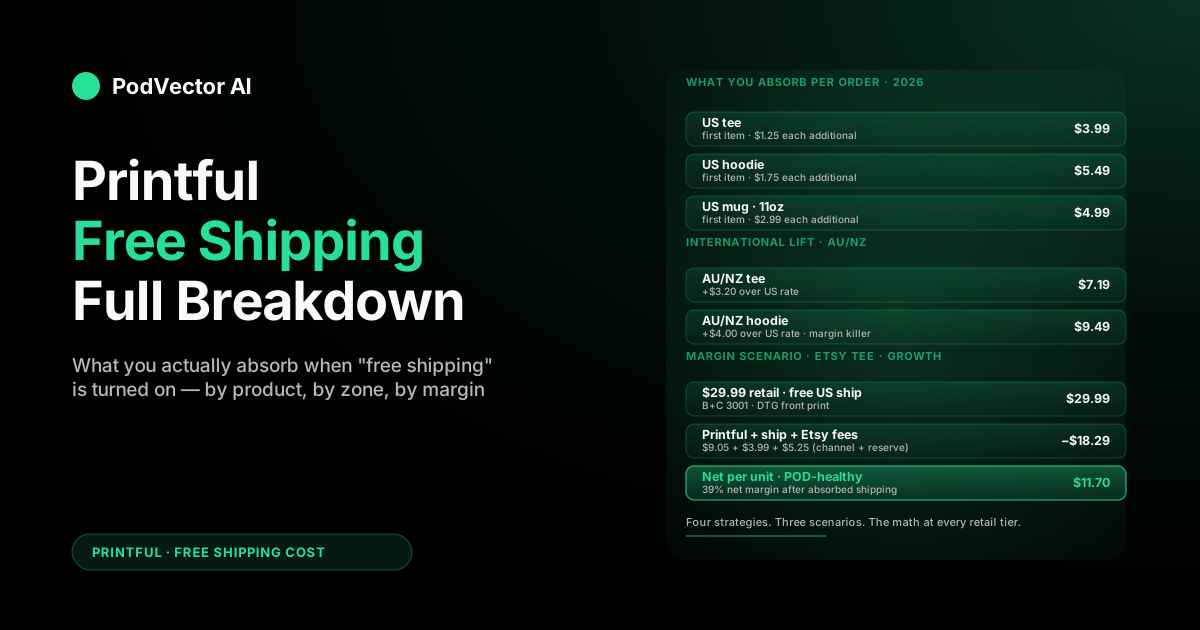
Quick Answer: Printful does not offer free shipping to you, the seller. "Free shipping" in POD means you absorb Printful's shipping fee — typically $3.99 per US tee, $5.49 per US hoodie, $4.99 per US mug — and bake it into your retail price so the customer doesn't see a line at checkout.
The math that matters: on a $24.99 tee with free US shipping, you eat $3.99 of margin — 16% of revenue, roughly 30% of gross profit on the Free plan. On an international order to Australia at $14.99 shipping, free shipping wipes out the margin entirely. The right strategy isn't "free shipping yes/no" — it's where and above what cart size free shipping still leaves a margin.
This guide breaks the actual per-order shipping cost by product and zone, runs three margin scenarios with free shipping turned on, and shows the four strategies that work for POD without quietly losing money.
What "Printful free shipping" actually means
Free shipping in print-on-demand is a marketing label, not a discount from your supplier. Printful charges you a shipping fee on every order — regardless of what the customer paid at checkout.
If you toggle "free shipping" on a product in Printful, what changes is presentation, not cost. Printful's storefront integrations (Shopify, Etsy, WooCommerce) hide the shipping line from the customer's checkout and roll it into the product price. You still pay Printful the full shipping fee when the order routes through fulfillment.
The customer sees: "Free shipping." Your P&L sees: a $3.99 to $14.99 line item per order that didn't exist when you charged shipping separately.
This is identical to how every major brand "offers free shipping" — Amazon, Target, Nike all bake shipping into product pricing or accept it as a CAC line. The mechanic is fine. The problem is that POD operators frequently forget to raise retail prices when they enable free shipping, and the absorbed shipping cost quietly eats 15–40% of gross profit until someone runs the math.
For the broader fee structure that sits underneath free shipping, see Printful fees: full breakdown for POD sellers.
What each free-shipping order costs you (by product and zone)
Printful's shipping pricing is zone-based and product-category-based. There's a flat rate for the first item of a category in an order, plus a smaller additional-item rate when more units of the same category ship together.
Here's what you absorb per order when you offer free shipping, by the most common POD product categories and shipping destinations (2026 rates):
| Product | US first item | US each additional | EU first item | UK first item | AU/NZ first item |
|---|---|---|---|---|---|
| T-shirt / tank | $3.99 | $1.25 | €4.69 (~$5.00) | £4.49 (~$5.65) | $7.19 |
| Sweatshirt / hoodie | $5.49 | $1.75 | €5.99 (~$6.40) | £5.49 (~$6.95) | $9.49 |
| Ceramic mug (11oz) | $4.99 | $2.99 | €4.99 (~$5.30) | £4.49 (~$5.65) | $8.99 |
| Hat / cap | $3.99 | $1.50 | €4.69 (~$5.00) | £4.49 (~$5.65) | $8.99 |
| Poster (18×24) | $5.99 | $2.50 | €7.99 (~$8.50) | £6.99 (~$8.85) | $11.99 |
| Sticker (kiss-cut) | $3.99 | $0.50 | €2.99 (~$3.20) | £2.49 (~$3.15) | $5.99 |
Two patterns are worth pulling out before the scenarios.
Bundling crushes per-unit shipping cost. A 2-tee US order ships at $3.99 + $1.25 = $5.24 — that's $2.62 per shirt, not $3.99. A 3-tee order drops to $2.16 per shirt. Free shipping on bundles is meaningfully cheaper than free shipping on single items, which is the math behind every "buy 2 get free shipping" promo you've ever seen.
For exact estimated delivery times tied to these shipping rates, see Printful free delivery estimated shipping time.
International free shipping is where margins die. Australian and New Zealand shipping on a hoodie is $9.49 — at a $39.99 retail price with Free-plan product cost, that's the gap between $7.55 of gross margin and a $1.94 loss. Most POD sellers either restrict international shipping or charge for it explicitly. Few can absorb international free shipping profitably.
Margin scenarios with free shipping turned on
Three realistic scenarios with full Printful pricing, channel fees, and free shipping absorbed. 2026 US fulfillment unless noted.
Scenario A — $24.99 Etsy tee, Free plan, free US shipping
| Retail price (free shipping included) | $24.99 |
| Printful base (Bella+Canvas 3001, Free) | −$12.95 |
| Shipping (you absorb) | −$3.99 |
| Etsy transaction + listing fee (~8.5%) | −$2.12 |
| Refund reserve (5%) | −$1.25 |
| Payment processor (~3% + $0.30) | −$1.05 |
| Net per unit | $3.63 |
$3.63 net on a $24.99 tee. That's 15% net margin — workable, but tight. If Etsy Offsite Ads catch this listing (another 15% take), you're losing $0.13 per unit on every Offsite Ads conversion. Most Free-plan sellers either disable Offsite Ads on free-shipping listings or move to Growth.
Scenario B — $29.99 Etsy tee, Growth plan, free US shipping
| Retail price (free shipping included) | $29.99 |
| Printful base (B+C 3001, Growth) | −$9.05 |
| Shipping (you absorb) | −$3.99 |
| Etsy fees (~8.5%) | −$2.55 |
| Refund reserve (5%) | −$1.50 |
| Payment processor | −$1.20 |
| Net per unit | $11.70 |
$11.70 net per tee with free shipping. That's a healthy 39% margin. After amortizing the $24.99 Growth subscription across ~13+ orders/mo, real net lands closer to $10/unit. This is what "free shipping that actually works" looks like on Etsy — Growth plan, retail price moved up to $29.99 to absorb the shipping, B+C 3001 with single front print.
Scenario C — $44.99 Shopify hoodie, Growth plan, free shipping to US only
| Retail price (free US shipping included) | $44.99 |
| Printful base (Gildan 18500, Growth) | −$19.45 |
| US shipping (you absorb) | −$5.49 |
| Shopify + processor (~3.5%) | −$1.58 |
| Refund reserve (5%) | −$2.25 |
| Meta CAC (assumed $7) | −$7.00 |
| Net per unit | $9.22 |
$9.22 net on a $44.99 hoodie with free US shipping and ads. That's 20% net margin — workable. The same hoodie at $39.99 with free US shipping nets $4.22 instead; the $5 retail-price lift to cover shipping is what makes the math survive. Free shipping isn't free for the operator — the retail price has to move up by the absorbed shipping amount, or close to it.
If you'd run the same hoodie at $39.99 with free shipping to Australia ($9.49), the unit would lose $0.27. International free shipping on a hoodie at a $39.99 retail price is structurally unprofitable on the Free plan and barely breakeven on Growth.
Four free-shipping strategies that work for POD
Free shipping isn't a single decision. It's a menu of four strategies, each with different margin trade-offs.
1. Universal free shipping, retail price raised
Bake the shipping cost into every product's retail price. Customer sees "free shipping" on every SKU; you're effectively pricing the bundle.
This works when shipping costs are consistent across your catalog (mostly tees, mostly US) and you want a clean store presentation. It breaks down when you have heavy items (hoodies, posters) priced at the same retail tier as light items (stickers) — the heavy items eat margin disproportionately.
When to use: single-product-category stores. T-shirt-only brands, sticker-only shops, mug-only gift stores.
2. Free shipping above a cart minimum
Customer gets free shipping at $50+ orders (or whatever threshold matches your AOV). Below the threshold, normal shipping applies.
This is the most margin-efficient free-shipping strategy because the additional-item shipping rate is much lower than the first-item rate. A 2-tee order ships at $5.24 total instead of $7.98 if shipped separately — bundling shifts the math in your favor on every cart that clears the threshold.
The right threshold is usually 1.4–1.6× your average order value. If your AOV is $32, set free shipping at $50. Customers add a second item to qualify; you get a higher AOV with proportionally lower shipping cost per unit.
When to use: multi-product stores with mixed price points. Default strategy for most POD stores once they're past the launch phase.
3. Free shipping to one region only
Free domestic shipping; standard rates internationally. The cleanest way to offer free shipping without dying on international margin.
For US-based stores, free US shipping + paid international is the default. International customers expect to pay shipping — most international ecommerce buyers don't even notice a shipping line as friction, while US customers do. You preserve the marketing benefit where it converts and avoid the margin hit where it kills you.
When to use: any store with meaningful international order volume. If >15% of your orders ship outside your home country, region-restricted free shipping is the default.
4. Free shipping as a coupon code (promotional)
Run free shipping as a time-bound promo (Black Friday, store anniversary, launch week) instead of a permanent offer. Customer enters a code at checkout; you absorb shipping only during the promo window.
This is the highest-margin path because you're not raising retail prices permanently. The trade-off is that "promotional free shipping" doesn't show up in product listings, so it doesn't help with conversion on first-time visitors browsing the catalog — it only converts customers already in the cart flow.
For the code-specific setup, see Printful free shipping code: full breakdown.
When to use: stores running quarterly promotional cycles. Higher-margin storefronts that don't want permanent free shipping baked into the catalog.
How to set up free shipping on Shopify with Printful
Three minutes of setup once you've picked your strategy.
- Open Shopify admin → Settings → Shipping and delivery → General shipping rates.
- Add a new rate: name it "Free shipping" (or "Free US shipping" if region-restricted), set price to $0.00. For threshold-based, add a minimum order value (e.g., $50).
- Under the relevant shipping zone (US, EU, etc.), make sure the free rate applies. Remove or disable any conflicting paid rates in that zone if you want free shipping universal.
- If using strategy #3 (region-only), set free shipping only on the US zone and leave the international zone with Printful's calculated rates.
- In Printful's Shopify integration settings, leave shipping prices set to "Calculated by Printful" — Shopify will display your free rate to the customer while Printful continues to charge you the actual shipping fee on each order.
Test by adding a product to cart and walking through checkout in an incognito window. The shipping line should show $0.00 (or "Free") at the right cart value.
How to set up free shipping on Etsy with Printful
Etsy's free shipping mechanic is different from Shopify's, and the platform rewards it harder. Etsy gives a search-ranking boost to US listings that offer free US shipping, which is why most Etsy POD sellers default to free shipping.
- In Printful, open the product → Pricing tab → toggle "Include shipping in product price." Printful auto-raises the retail price by the shipping amount.
- Push the updated product to Etsy. The retail price the customer sees is now the all-in price.
- In Etsy seller dashboard → Settings → Shipping settings → set up a "Free shipping guarantee" for US orders at the cart-value threshold of your choice (or $0 for universal).
- Confirm the listing on Etsy displays the "Free shipping" badge in search results — that's where the ranking benefit lives.
Etsy's free-shipping ranking boost works on US orders to US destinations only. International listings still need to display shipping costs unless you're absorbing them too.
When free shipping breaks your margin
Four signs your free-shipping offer is bleeding profit:
- You enabled free shipping but didn't raise retail prices. The most common failure mode. Free shipping costs you $3.99–$9.49 per order — if your retail prices didn't move up by roughly that amount, you absorbed the cost out of your existing margin. Run the per-SKU comparison and adjust prices.
- Free shipping on international destinations. Almost always unprofitable on POD apparel under $50 retail. Restrict to domestic or build international pricing 30%+ higher than domestic.
- Free shipping on heavy items at the same retail tier as light items. If your $24.99 store sells both tees ($3.99 ship) and hoodies ($5.49 ship), the hoodie absorbs $1.50 more in shipping at the same price — you're cross-subsidizing hoodies with tee margin. Either raise hoodie retail or split tiers.
- Free shipping below a cart minimum that's lower than your AOV. A $35 free-shipping threshold on a store with $42 AOV is a giveaway, not a strategy. You'd hit free-ship-cart by default. Set the threshold at 1.4–1.6× AOV to actually drive bundling.
The single highest-leverage check: pull last month's orders, calculate per-order net margin after the absorbed shipping cost, and look for any SKU running below 20% margin. Those are the SKUs that need a price lift or a free-shipping exclusion.
Tracking the real cost of free shipping at scale
One free-shipping SKU is easy. Thirty SKUs across multiple product categories, multiple zones, and a moving Printful catalog price is a spreadsheet problem most operators never solve cleanly.
The structural issue: Printful's per-order shipping line shows up in your order export, but reconciling it against retail price and channel fees to compute true per-SKU net margin is a manual exercise. Most stores do this once at launch and never again, which is why margin drift on free-shipping SKUs is one of the most common quiet profit leaks in POD.
Two ways to track it:
Manual: Once per month, export Shopify orders and Printful order costs. Match by order ID. Compute net margin per SKU after absorbed shipping. Flag any SKU below 20% net margin or any SKU where margin moved >3% since last month. Takes ~30 minutes if disciplined; most sellers do it for one month, then stop.
Automated: Victor already tracks your Printful costs and shipping charges next to your Shopify prices, channel fees, and ad spend. He watches each product line and lets you know when its profit margin starts to slip. You don't have to build any of this yourself — Victor does it for you.
PodVector AI's Victor is an AI employee built for print-on-demand stores. He checks your Printful costs — base price, add-ons, and shipping — against what you earn through Shopify, and tells you which products stopped making good profit after a Printful price change or a free-shipping offer. When Victor spots a product losing money, he suggests a clear fix, like raising the price on your hoodie line by $2.50, and makes the change once you approve it. You can always see exactly what changed and why. This mix of real store know-how, live data, and the power to act on it is what sets Victor apart from a plain report.
For the Printful-vs-Printify side-by-side that informs whether to keep Printful as primary, see is Printful or Printify better and is Printify or Printful better.
FAQs
Does Printful give sellers free shipping?
No. Printful charges you shipping on every order, regardless of what your customer paid at checkout. "Free shipping" in POD means you, the seller, absorb Printful's shipping fee and build it into your retail price.
How much does free shipping actually cost me per order?
Depends on the product and destination. US tee: $3.99 first item, $1.25 each additional. US hoodie: $5.49 first item, $1.75 each additional. International rates run 60–250% higher than US. The rate table above covers the most common categories and zones.
Should I offer free shipping on Etsy?
Usually yes for US orders only. Etsy gives a search-ranking boost to US listings with free US shipping, and the ranking benefit typically outweighs the absorbed shipping cost — but only if you've raised retail prices to absorb it. Free shipping without a retail price lift turns into margin compression on every order.
What's the best free-shipping threshold for POD?
1.4–1.6× your average order value. If your AOV is $30, set free shipping at $45. Below that, customers add a second item to qualify, which uses Printful's lower additional-item shipping rate. Above that, you're just giving margin away.
Does free shipping work for international orders?
Rarely on POD apparel under $50 retail. International shipping on a hoodie to Australia is $9.49 — that's larger than most POD operators' margin on a $39.99 hoodie. Region-restricted free shipping (domestic only) is the standard play.
How do I set up free shipping in Printful without losing margin?
Two steps. First, toggle "Include shipping in product price" in Printful's product settings — this auto-raises the retail price by the shipping amount. Second, check your channel-side fees afterward: Etsy's 8.5% take applies to the new higher retail price too, so you may need a small additional retail lift to fully offset the absorbed shipping plus the additional take. Run the per-SKU margin math after, not before.
Will Printful charge me less if I offer free shipping?
No. Printful's shipping fee is independent of what you charge the customer. The fee is calculated from the product category and shipping destination only.
Can I offer free shipping on Printful samples?
Printful doesn't waive shipping on sample orders. Samples ship at the same rate table as any other order, with the standard sample discount applied to the product cost but not the shipping line.
What's the difference between free shipping and a free shipping code?
Free shipping (universal or threshold-based) is a permanent listing-level offer baked into retail prices. A free shipping code is a time-bound promo where customers enter a code at checkout to remove the shipping line for that order. The code variant doesn't show up in product listings and is best for promotional cycles, not always-on offers. See Printful free shipping code breakdown for setup specifics.
Does free shipping change the estimated delivery time?
No. Free shipping is a pricing presentation; the delivery method is still standard Printful shipping with the same fulfillment SLA. For zone-by-zone delivery time estimates, see Printful free delivery estimated shipping time.
How does this compare to free shipping on Printify?
Mechanically identical — Printify also charges you per-order shipping regardless of customer-facing pricing. Rates differ: Printify's US tee shipping runs $3.99–$4.50 depending on the Print Provider, with similar additional-item discounts. The strategy menu (universal, threshold, regional, promo code) applies to either supplier. For the full Printful vs Printify cost comparison, see the Printful costs & charges cluster and the full Printful topic hub.
See whether your free-shipping SKUs are actually profitable
Free shipping is the easiest POD margin leak to miss. The shipping fee shows up on every Printful order; the retail-price lift to absorb it shows up only on the SKUs you remembered to update. The drift compounds.
Victor is PodVector AI's agent for POD operators. He reads itemized Printful costs — base, add-ons, shipping — against Shopify revenue, identifies which SKUs dropped below margin after free shipping went live or after the last Printful price cycle, and proposes specific Shopify price changes you can approve and execute in one click. Built specifically for POD — Printful and Printify cost models are baked into the agent.
For Printful's own guide to free-shipping pricing strategies, see Printful's ecommerce shipping pricing guide.
Try Victor free