
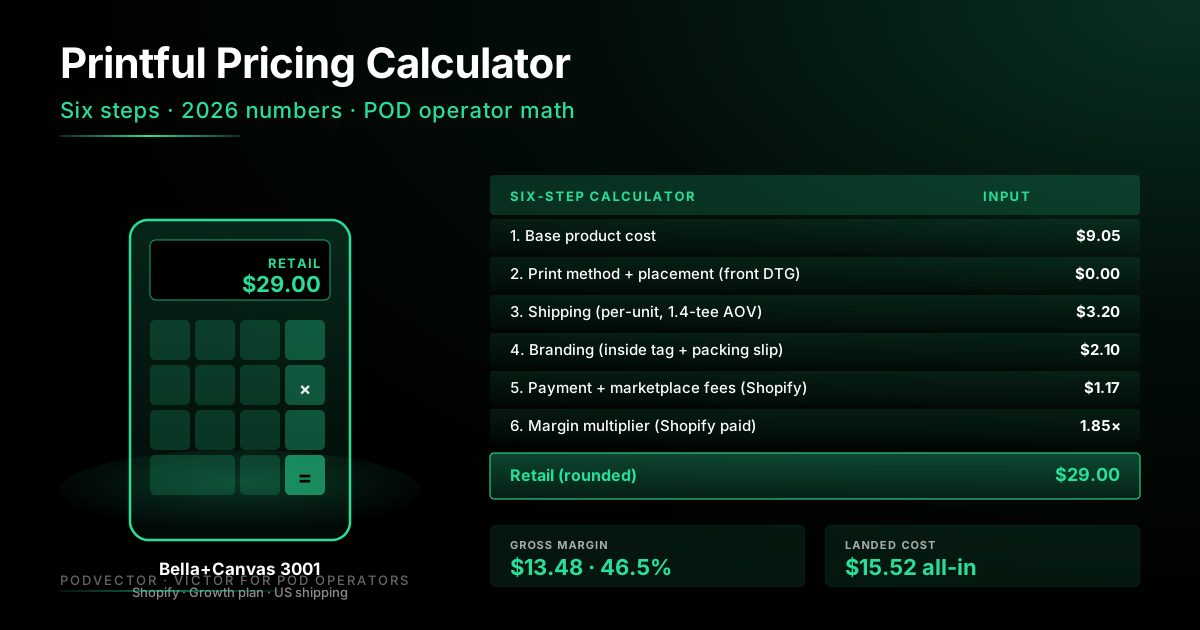
Quick Answer: A real Printful pricing calculator runs a six-step stack: base product cost, print and placement, shipping, branding, payment and marketplace fees, then a target margin multiplier. Catalog base ÷ retail is not enough — it skips half the cost layers.
The fastest formula is Retail = (Base + Print + Shipping + Branding + Fees) × Margin multiplier. For Shopify, use a 1.85× multiplier to clear 45% gross margin. For Etsy, drop to 1.65× because the fee stack already takes a bigger bite.
This walkthrough shows the exact six steps with 2026 numbers, a worked example on a Bella+Canvas 3001 tee, and how to keep the calculation accurate as Printful and platform fees drift over the year.
Why a pricing calculator beats guessing
Most Printful sellers price by feel — pick a retail number that "looks right" next to the catalog base, and hope margin works out. It almost never does.
The reason is that Printful's invoice is only one of three cost piles. The platform you sell on takes a second pile in transaction and payment fees. Returns, samples, and your subscription take a third quietly in the background.
A proper Printful pricing calculator forces all three piles onto the worksheet before you set retail. That's the difference between a $32 tee that nets $13 contribution margin and one that nets $4 — same product, same retail, just one priced with all the costs in view.
The six-step Printful pricing calculator
Every reliable POD pricing calculator runs the same six steps. The tools differ on how much they ask you to input versus auto-pull — the math doesn't.
| Step | What you add | Typical range (2026) |
|---|---|---|
| 1 | Base product cost | $3.50–$32.00 |
| 2 | Print method and placement | $0–$7.45 |
| 3 | Shipping (per-unit share) | $1.25–$9.99 |
| 4 | Branding (tags, labels, packaging) | $0–$3.48 |
| 5 | Payment + marketplace fees | $1.10–$5.50 |
| 6 | Margin multiplier | 1.55×–2.00× |
Steps 1–5 build the all-in landed cost per unit. Step 6 turns that into a retail price that clears your margin target. Skip any of the first five and you're flying blind on the last one.
Before you start: confirm whether you're on the Free plan or the Growth plan. Growth gives roughly 30% off apparel and 9% off branding, which changes the inputs for steps 1 and 4. For a deeper plan-fee breakdown, see does Printful cost money.
Step 1: Pull your real base product cost
Open the Printful catalog. Pick the product, the brand, the color, and the size you actually sell. The price shown is your starting input.
A few things to check before you write it down:
Color upcharge. Black, heather, and tri-blend colors run $0.50–$2.00 higher than white on most apparel. If your best seller is a black tee, use the black price, not the catalog default.
Size upcharge. Sizes 2XL and 3XL typically add $2–$5 to the base. If 25% of your sales are 2XL+, use a blended base or run two separate calculations and weight them.
Growth plan discount. If you're on Growth, the displayed price already reflects the discount when you're logged in. Make sure that's the number you grab — Free plan numbers will overstate your true base by 25–30%.
For 2026 reference, common tee blanks land at: Gildan 5000 at $9.25 Free / $6.95 Growth, Bella+Canvas 3001 at $12.95 Free / $9.05 Growth, Stanley/Stella STTU169 at $19.05 Free / $13.45 Growth.
Step 2: Add print method and placement cost
Printful bundles a single front DTG print into the catalog base on most apparel. The moment you add a second placement, the price moves.
| Placement add-on (DTG) | Free plan | Growth plan |
|---|---|---|
| Back print | $5.25 | $3.70 |
| Sleeve print (each) | $2.20 | $1.55 |
| Left chest small print | $2.95 | $2.05 |
| All-over print (instead of DTG) | +$5.95 | +$4.15 |
| Embroidery (per location) | $5.50–$8.50 | $3.85–$5.95 |
Embroidery also has a one-time digitization fee per design ($2.95–$6.50) — amortize it over your expected unit volume on that design and add the per-unit slice here.
Two-sided tees are the most common upcharge mistake. Sellers price the front-only design at $24, then add a back design without bumping retail, and silently lose $3.70–$5.25 of margin on every shirt.
Step 3: Add shipping (per-unit, not per-order)
Printful's shipping has a first-item rate and a much lower additional-item rate. Whether you charge customers for shipping or absorb it inside retail, the cost is the same — you have to put it on the worksheet.
| Region | First tee | Each additional tee |
|---|---|---|
| US | $3.99 | $1.25 |
| EU | $4.79 | $1.55 |
| UK | $5.20 | $1.80 |
| Canada | $5.99 | $2.10 |
| Australia | $9.99 | $3.25 |
The right number to use here depends on your average order quantity. If 80% of your orders are one tee, use $3.99 (US). If they're typically two tees, use the blended per-unit number — about $2.62 each.
For destination-by-destination shipping math, see Printful shipping times, costs, and what to expect and the EU-focused Printful shipping times in Europe.
Don't confuse "free shipping" offers with zero shipping cost. The offer just shifts where shipping sits on the worksheet. For how Printful's free shipping promotions actually work, see does Printful offer free shipping, and for whether the displayed product price includes shipping or not, does Printful price include shipping.
Step 4: Add branding cost
Most stores add at least one branding option. They're cheap on paper but they stack fast.
| Branding option | Free plan | Growth plan |
|---|---|---|
| Inside neck label (printed) | $2.49 | $1.45 |
| Outside woven label | $3.48 | $2.65 |
| Packing slip (custom) | $0.99 | $0.65 |
| Branded sticker | $0.59 | $0.45 |
The default branding mix for most POD stores — inside tag plus packing slip on Growth — comes to about $2.10 per shirt. That's roughly 7% of a $30 retail price gone before you even look at fees.
Hero SKUs justify outside labels. Long-tail SKUs almost never do.
Step 5: Add payment and marketplace fees
This is the step most spreadsheet calculators understate, because it's expressed as a percentage rather than a dollar number — so it scales with retail and surprises sellers who set the retail price first.
| Channel | Payment processing | Marketplace fee | Total bite |
|---|---|---|---|
| Shopify + Shopify Payments | 2.9% + $0.30 | None | ~3.5% of retail |
| Shopify + 3rd-party gateway | 2.9% + $0.30 | 2% transaction | ~5.5% of retail |
| Etsy | 3% + $0.25 | 6.5% transaction + $0.20 listing | ~10% of retail |
| Etsy Ads (Offsite, top tier) | 3% + $0.25 | +12% on Offsite sales | up to ~22% |
| Amazon Merch on Demand | Bundled | Royalty model | ~50–70% of retail |
Use the column that matches the channel you're calculating for. If you sell on both Shopify and Etsy, run two separate worksheets — Etsy needs a noticeably lower base cost or higher retail to clear the same margin as Shopify.
Step 6: Apply your margin multiplier
Sum steps 1–5. That's your all-in landed cost per unit. Multiply by your channel-appropriate margin multiplier to get your retail price.
The two clean formulas:
Margin-first: Retail = Landed cost × Margin multiplier
Markup-first: Retail = Landed cost ÷ (1 − Target gross margin %)
Both produce the same number. The multiplier form is faster mentally — 1.85× cost gives roughly 45% gross margin, which is the band most Shopify POD stores need to absorb a $4–$7 ad CAC and still post a healthy contribution.
Worked example: Bella+Canvas 3001 tee
Channel: Shopify with Shopify Payments. Plan: Growth. One-sided front DTG print. Inside tag and packing slip branding. Shipping to a US customer, average order quantity 1.4 tees.
| Step | Line item | Cost |
|---|---|---|
| 1 | Bella+Canvas 3001 white, M, Growth base | $9.05 |
| 2 | Front DTG print (bundled) | $0.00 |
| 3 | US shipping per-unit (1.4-tee avg order) | $3.20 |
| 4 | Inside tag ($1.45) + packing slip ($0.65) | $2.10 |
| 5 | Shopify Payments at $30 retail ($30 × 2.9% + $0.30) | $1.17 |
| Landed cost | $15.52 | |
| 6 | 1.85× margin multiplier | $28.71 |
| Round to clean retail | $29.00 |
At a $29 retail, this tee posts $13.48 of gross margin (46.5%) before marketing CAC. That's the band you want to be in to fund $4–$6 ad acquisition and still net $7–$9 contribution per shirt.
For the underlying per-shirt cost math on different blanks — Gildan 5000, Bella+Canvas 3001, Comfort Colors, Stanley/Stella — see Printful cost per shirt: full breakdown.
Margin multipliers by channel
Different channels need different multipliers because their fee stacks are different. Use the table as a starting point and adjust for your actual ad CAC and return rate.
| Channel | Recommended multiplier | Gross margin % | Why this level |
|---|---|---|---|
| Shopify (paid traffic) | 1.85×–2.00× | 46–50% | Has to absorb $4–$7 ad CAC and still net contribution |
| Shopify (organic/email) | 1.65×–1.75× | 40–43% | Lower CAC means less margin headroom needed |
| Etsy (no Offsite) | 1.65× | 40% | Etsy fees pre-strip 10% of retail |
| Etsy (with Offsite) | 1.85× | 46% | Plus 12% on Offsite-attributed sales |
| Wholesale | 2.00×–2.20× | 50–54% | Retailer takes another 50% on top |
Printful's own Etsy calculator is a good sanity check on the Etsy line specifically — it auto-pulls listing and transaction fees once you enter the cost and retail. Use it after you've run the six-step worksheet, not as a substitute for it.
Hidden costs most calculators skip
Three line items rarely show up in pricing calculators but materially shift your real margin. Add them as a reserve percentage on top of the landed cost in step 5.
Return and replacement reserve. Most apparel POD shops run 1.5–3% return-or-reprint rates. At 2%, on a $30 tee, you're losing about $0.60 per shirt to reprints and refunds. Bake that in.
Sample amortization. Every new SKU needs samples — typically 1–3 units for design QA and product photography. Spread that $30–$90 across your expected first-year volume on that SKU; for a SKU that ships 100 units, that's $0.30–$0.90 per unit.
Subscription share. If you're paying $24.99/month for Growth, divide that by your monthly Printful shipment volume. At 50 units/month, that's $0.50 per shirt. The cleaner break-even rule: Growth pays for itself once you ship more than ~10 tees a month, and the per-unit subscription share trends toward zero as you scale.
A conservative practice: add 4–6% as a reserve on top of steps 1–5 to cover these together. On a $15.52 landed cost, that's another $0.62–$0.93. Now the worksheet reflects the actual cost of putting a shirt in a customer's hands.
Common pricing calculator mistakes
Using Free plan prices when you're on Growth. The discount changes inputs for steps 1, 2, and 4 — about $3–$5 of cost per shirt depending on blank and branding. Use the plan-correct numbers.
Pricing the first product and copying retail across the catalog. A Gildan 5000 calculator output ($22 retail) does not apply to a Bella+Canvas 3001 ($29 retail) does not apply to a Stanley/Stella organic ($38 retail). Each SKU needs its own worksheet.
Setting retail first, backing into cost. This is how sellers end up with $24.99 retail on a $17 landed cost — single-digit contribution before any ad spend. Always run the calculator cost-first, then test whether the resulting retail is defensible against competitors.
Forgetting AOV in shipping math. A two-tee AOV halves your per-unit shipping cost. If you push bundles in your store, your calculator should use the bundle per-unit number — not the single-shirt $3.99 default.
Skipping fees entirely. "3% payment processing" sounds small. On 1,000 orders at $30 retail, it's $900 of margin. Put it on the worksheet.
Keeping the calculator accurate over time
The six-step calculator is easy to run once. It's hard to keep accurate.
Inputs drift in ways that don't show up on any dashboard. Printful raises a blank price by 40 cents. Your real return rate moves from 1.8% to 2.7% after a fit complaint cluster. Etsy adjusts Offsite fees. Your average order quantity shifts as you push bundles. Each one of those is a 1–3% margin event that compounds across every shirt you ship for months.
Most operators run the calculator at launch, again at the quarterly P&L review, and never in between. By Q3 of the year, half your SKUs are mispriced and you don't know which ones.
This is where Victor — PodVector AI's AI business employee for POD stores — closes the gap. Victor reads your itemized Printful invoices and Shopify orders and works out the true cost and margin on every order automatically, using the actual fees and shipping that hit that order, not catalog defaults, and flags SKUs that quietly dropped below your margin floor. He answers questions like "which SKUs dropped below 30% gross margin this month, and what's driving it?" — then suggests a specific fix, like a price change or a bundle promo, that you approve and he runs on Shopify in one click.
The combo of a POD playbook, live data on your own store, and the ability to act is what turns the pricing calculator from a launch ritual into a continuous operating habit.
Stop pricing from a spreadsheet you update twice a year
Printful raises a blank price. Your return rate creeps up. Etsy tweaks fees. Your $30 hero SKU quietly slips from 46% margin to 32% and you don't notice for six months.
Victor reads your Printful and Shopify data live, runs the full six-step calculator on every order, and tells you which SKUs flipped below margin — then proposes the price change to fix it.
Try Victor freeFAQs
Does Printful have a built-in pricing calculator?
Yes — for Etsy specifically. Printful's Etsy Calculator takes a product cost and a target Etsy retail price and shows estimated profit after Etsy's listing, transaction, and payment fees. It does not model Shopify, return reserves, sample amortization, or subscription share — use it as one input in the six-step worksheet, not as a full calculator.
What margin should I target on Printful products?
For Shopify with paid traffic, aim for 45–50% gross margin (1.85×–2.00× landed cost). For Etsy without Offsite, target 40% (1.65× landed cost) — Etsy's fee stack already eats roughly 10% of retail before you see the customer. These bands leave enough room to absorb a $4–$7 ad CAC and still post $5–$10 of contribution margin per unit.
How do I calculate Printful pricing for Etsy specifically?
Run all six steps with the Etsy column in step 5: 3% + $0.25 payment processing, 6.5% transaction fee, $0.20 listing fee. If you run Etsy Ads with Offsite, add 12–15% to step 5 on Offsite-attributed sales. Then apply a 1.65× margin multiplier on no-Offsite, 1.85× if you run Offsite heavily.
What's a good profit margin per shirt on Printful?
A healthy POD shirt nets $3–$8 contribution margin after Printful, shipping, processing, return reserve, and ad CAC. Premium positioning on Shopify with soft retail tees at $32+ retail can hit $10–$15. Etsy at $24 retail and budget blanks typically nets $2–$4 — viable only at high volume.
Does the Printful pricing calculator include shipping?
It depends which calculator. Printful's Etsy Calculator does not — you enter your Printful product cost (which includes shipping if you're using their preset cost number) and Etsy retail, and it shows Etsy fees and profit. The six-step worksheet here adds shipping as step 3 explicitly, with first-tee and additional-tee rates by region.
How often should I re-run the calculator?
At minimum quarterly, more often if Printful raises a base price, your average order quantity shifts, or your return rate moves more than 0.5%. Each of those changes shifts margin by 1–3% on every shirt — small per unit, large over 1,000 units shipped.
Where can I see all my Printful costs in one place?
Printful's billing dashboard shows past invoices. For a clean cost-per-shirt and cost-per-SKU view across your entire catalog over time, you need to join Printful invoice data with your Shopify order data. The full topic-level cost reference is the Printful costs and charges cluster and the broader Printful topic hub.