
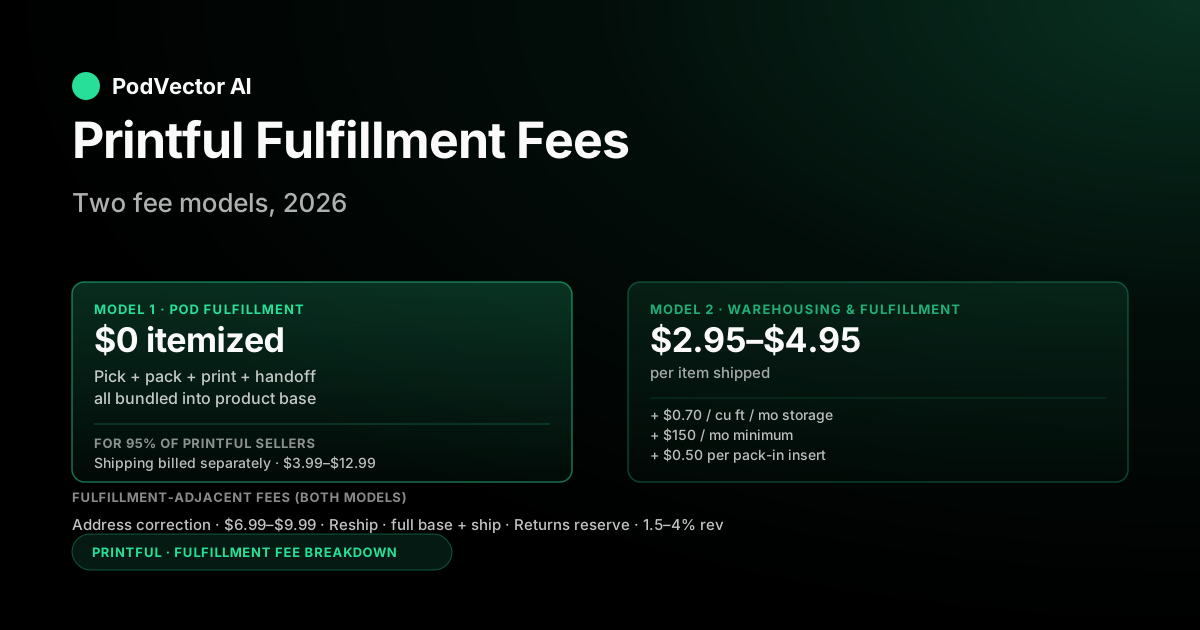
Quick Answer: Printful's "fulfillment fee" isn't one line — it's a bundle. For standard print-on-demand orders, fulfillment is baked into the product base price (printing, picking, packing, and labor are all included). Shipping is billed separately. There is no per-order pick-and-pack surcharge for normal POD.
The exception is Warehousing & Fulfillment — Printful's separate service for shipping your own non-printed inventory. That service does charge a discrete $2.95–$4.95 fulfillment fee per item plus storage ($0.70/cu ft/mo, $150/mo minimum).
This guide walks both definitions with 2026 numbers, shows the hidden fulfillment-adjacent fees most sellers miss (address corrections, reships, packing add-ons), and gives you a working margin model.
The two things "Printful fulfillment fee" can mean
Most sellers searching for "Printful fulfillment fees" are actually asking one of two completely different questions. The answers don't overlap.
The first question is: "How much does Printful charge to print, pick, pack, and hand my order to USPS?" For standard print-on-demand, that's zero on a separate line — it's already inside the product base price. You don't see it itemized because Printful doesn't itemize it.
The second question is: "How much does Printful charge to store and ship my own inventory through their Warehousing & Fulfillment service?" That's a different product entirely, with discrete pick-pack fees, storage rates, and a monthly minimum. It's used by brands that hold their own stock and use Printful as a 3PL.
| If you mean... | Fee structure | Typical 2026 size |
|---|---|---|
| POD fulfillment (printed-on-demand) | Bundled into product base | $0 itemized |
| Warehousing & Fulfillment (your inventory) | Discrete pick-pack + storage | $2.95–$4.95 per item + $150/mo min |
| Shipping (both models) | Per-order, by region | $3.99–$12.99 per order |
| Adjacent fees (both models) | Per incident | $0.50–$9.99 per event |
If you're a typical Printful seller — design uploaded, store connected, no inventory of your own — you live in row 1. The "fulfillment fee" is invisible because it's already inside the $12.95 you pay for a Bella+Canvas 3001.
The rest of this guide treats both definitions, but spends most of its time on row 1 because that's where 95% of the audience lives.
POD fulfillment: what's inside the base price
When you sell a t-shirt on your Shopify store and the order routes to Printful, the base price you pay covers seven labor and material steps. None of them are separate line items.
Here's what's actually bundled into a $12.95 Bella+Canvas 3001 base price (Free plan, white, S–XL):
| Step | What it covers | Separate fee? |
|---|---|---|
| 1. Blank product | Bella+Canvas wholesale unit | Bundled |
| 2. Front print (DTG) | Direct-to-garment ink + machine time | Bundled |
| 3. Picking | Pulling the right size/color from racks | Bundled |
| 4. Quality check | Print clarity, garment defects | Bundled |
| 5. Folding & bagging | Polybag packaging | Bundled |
| 6. Label application | Default Printful tag | Bundled |
| 7. Carrier handoff | Sortation, manifest, USPS pickup | Bundled |
This is the "fulfillment" in fulfillment-on-demand. Printful absorbs the operational complexity and prices it as one number — the base. That's the model.
The trade is transparency. Compared to a 3PL invoice — where you'd see a $0.40 pick fee, a $0.55 pack fee, and a $0.15 SKU storage charge — you can't see what Printful actually spends per step. You see the all-in.
For POD sellers this almost never matters. You can't negotiate the steps anyway. What matters is that the base price already includes everything from print to USPS handoff, so don't double-count "fulfillment" in your margin model. The next surcharge after base is shipping, not pick-pack.
Add-ons that change the base — not the fulfillment fee
Some upgrades bump the base price. These are printing and product surcharges, not fulfillment surcharges, but they get conflated.
| Add-on | 2026 cost | What it actually is |
|---|---|---|
| Back print | $5.25–$5.95 | Extra DTG placement (more ink, more machine time) |
| Sleeve print | $2.20–$2.49 | Extra DTG placement |
| Inside neck label | $0.99 | Branded label swap |
| Outside neck print | $2.49 | Extra DTG placement, inside neck |
| Embroidery digitization | $2.95–$6.50 | One-time design prep, not per order |
None of these are fulfillment fees. They're printing or branding line items that ride on top of the base. The fulfillment work (picking, packing, handoff) is still bundled.
Warehousing & Fulfillment: the discrete fee model
If you ship your own inventory through Printful — say, you have screen-printed shirts from another vendor and want Printful's logistics network to fulfill them — you're on Warehousing & Fulfillment (W&F). This is a separate service with separate pricing.
W&F has two fee types: storage and fulfillment.
| Fee | 2026 rate | Trigger |
|---|---|---|
| Storage | $0.70 / cubic foot / month | Whatever you have in the warehouse |
| Minimum monthly storage | $150 / month | Always, even on light months |
| Fulfillment (apparel) | $2.95 per item | Each order shipped |
| Fulfillment (non-apparel) | $3.95–$4.95 per item | Each order shipped |
| Pack-in / insert pick | $0.50 per pack-in | Per insert added to an order |
| Pack-in storage | $0.70 / cu ft / month | Branded inserts in storage |
The $150/month minimum is the gotcha. If your stored inventory takes less than ~214 cubic feet of warehouse space, you're paying the minimum regardless. That's roughly the cost ceiling for a small Etsy-scale brand experimenting with W&F — it's not designed for stores fulfilling fewer than a few hundred units a month.
The fulfillment fee itself is straightforward: $2.95 per apparel unit shipped. So a customer order for two of your warehoused shirts costs $2.95 × 2 = $5.90 in fulfillment, plus shipping. Pack-ins (a sticker, a thank-you card) add $0.50 per insert per order.
Most POD sellers never touch W&F. It's a hybrid model for brands that want Printful's logistics without using Printful's print floor for some SKUs.
Shipping fees vs fulfillment fees
Shipping is the line most often confused with fulfillment. They're not the same fee, and bundling them in your margin model will mislead you on which products to push.
Shipping is what Printful pays the carrier (USPS, UPS, DPD, etc.) plus their handling spread. It scales with destination, weight, and dimensions. Fulfillment is what Printful charges to do the work before the carrier shows up.
| Region | T-shirt, first item | Additional items | Hoodie, first item |
|---|---|---|---|
| United States | $3.99 | $2.00 each | $4.69 |
| European Union | €4.39–$4.79 | $2.20 each | $6.99 |
| United Kingdom | $4.79 | $2.20 each | $7.49 |
| Canada | $8.29 | $3.39 each | $11.99 |
| Rest of world | $9.49–$12.99 | $2.50–$5.00 | $13.99–$18.99 |
The 2026 update: stickers and postcards went from $3.99 to $4.29 in the US, and knitted products (sweaters, beanies) bumped from $10.49 to $11.49. If your model still uses Q4 2025 shipping costs, your margin assumptions are 4–10% off on the affected SKUs.
Two-item orders are the easiest fulfillment-cost win. The fulfillment work is bundled into product base, so adding a second item costs you another base price but only an incremental $2.00 in shipping. AOV climbs, fulfillment-cost-per-dollar drops.
Hidden fulfillment-adjacent fees
The fees that quietly tax fulfillment aren't on Printful's pricing page. They show up on incident — a bad address, a damaged unit, a return — and aggregate into 1–4% of revenue if you don't watch them.
| Fee | 2026 cost | Trigger | Avoidable? |
|---|---|---|---|
| Address correction | $6.99–$9.99 | Carrier rejects address, package returned to Printful | Yes (validation at checkout) |
| Reship | Full base + shipping again | Customer-fault wrong address | Yes (validation) |
| Quality reprint | $0 (Printful covers) | Print defect verified by Printful | N/A — covered |
| Customer return reserve | 1.5–4% of revenue | Sizing/fit returns; no refund from Printful | Partially (sizing UX) |
| Pack-in pick (W&F only) | $0.50 per pack-in | Each branded insert added | Yes (skip inserts) |
The reship fee is the worst one. A customer types in the wrong unit number, the package bounces, Printful charges you $7.99 for the address correction and rebills the full base + shipping for the replacement. A $25 order can suddenly cost you $35 fulfilled.
Address validation at checkout (most Shopify themes support it; Printful's plugin doesn't enforce it) cuts this to almost zero. It's the single highest-ROI fulfillment-cost intervention available to a small POD store.
Per-order fulfillment math: a worked example
Take a Bella+Canvas 3001 tee, Free plan, US customer, retail price $24.99. Walk the full fulfillment cost.
| Line | Amount | Includes fulfillment? |
|---|---|---|
| Product base (Free plan) | $12.95 | Yes — all 7 steps bundled |
| Shipping (US, 1 item) | $3.99 | No — carrier cost |
| Subtotal (visible) | $16.94 | — |
| Address correction reserve (5% incidence × $7.99) | $0.40 | Indirect fulfillment cost |
| Return reserve (2% × $16.94) | $0.34 | Indirect fulfillment cost |
| True fulfilled cost | $17.68 | — |
| Retail | $24.99 | — |
| Gross margin | $7.31 (29.2%) | — |
The gap between $16.94 (what your spreadsheet probably shows) and $17.68 (what you actually pay across the cohort) is $0.74. On a 200-order month that's $148 — small enough to ignore once, big enough over a year to cover three months of Growth plan subscription. Build the reserves into the model from day one.
Switch to Growth ($24.99/mo, base drops to $9.05) and the math shifts hard:
- Base: $9.05
- Shipping: $3.99
- Adjacent reserves: $0.65
- Subscription amortized (200 orders): $0.12
- True fulfilled cost: $13.81 — gross margin jumps to $11.18 (44.7%)
The "fulfillment fee" didn't change. The product base did. But in margin terms, that's the lever — not the fulfillment line itself.
Where fulfillment sits in the full Printful cost stack
For a complete picture of every fee Printful charges (subscription, base, placement, shipping, branding, samples, returns, FX, customs), see the full Printful fees breakdown — fulfillment is one of eleven cost lines, and it's the one most often bundled invisibly.
For the broader pricing model — plans, tiers, when the Growth subscription pays back — read the Printful pricing guide. For the structural logic of how Printful's pricing works at the plan level, our Printful pricing model breakdown compares the Free, Growth, and Business tiers side by side. The monthly fee analysis tells you the exact volume at which Growth pays itself back.
The full Printful costs and charges cluster covers every cost-side question. For broader Printful coverage, browse the Printful hub.
Cost only matters if the product is good enough to sell. If you're new to Printful, also read our honest Printful print quality review and the broader Printful quality review — fulfillment economics are wasted on a product customers return for fit or fade.
For external context, Avada's 2026 Printful pricing guide covers the broader plan-and-base-price math at a generalist level.
How to reduce effective fulfillment cost
You can't negotiate the bundled per-step fulfillment work. You can shrink the cost the work loads onto each order. Three levers move it.
1. Push AOV with multi-item carts
The base price is fully loaded with fulfillment. The second item only adds shipping. A two-tee cart cuts fulfillment-cost-per-dollar by roughly 11–14% vs two single-item orders.
Bundles, "buy 2 save $5" offers, and Shopify upsell apps are direct fulfillment-cost optimizations. They're usually framed as AOV plays, but the underlying math is fulfillment-cost amortization.
2. Upgrade to Growth at 10+ apparel orders / month
The Growth plan's 33% product discount cuts the base — which is where fulfillment is bundled — by $3–$8 per unit. At ~9 tees a month, the $24.99 subscription is recovered. Above that, every order is structurally cheaper.
3. Eliminate address-bounce reships
Enforce address validation at checkout. Use Shopify's Apps section to find a validator (most run $5–$15/mo and integrate in 10 minutes). For a store doing 200 orders/month with a 5% bounce rate, you're saving ~$80 in reships and ~$50 in lost units. The math is brutal in favor of installing one.
Tracking fulfillment cost per SKU
The hardest thing about Printful fulfillment isn't paying for it — it's seeing it per SKU, per month, after the fact. The base is bundled, so your "cost of goods" report mixes printing labor, picking labor, packaging, and the blank itself. None of it itemizes.
Most sellers rebuild this in a spreadsheet once a quarter. That works at 50 orders a month. It breaks at 500, and it's actively dangerous at 2,000 because Q4 2025-priced rows quietly produce wrong margins after Printful's February 2026 price update on Cotton Heritage.
What you actually need: something that pulls in your Printful invoices and your Shopify orders, and works out the true fulfilled cost for each product on every order. Then a question like "which products drop below 25% margin after fulfillment?" gets answered right away instead of costing you a Saturday afternoon.
That's the gap Victor, PodVector AI's AI employee, fills for POD store owners. He pulls together your Shopify orders, Printful invoices, and ad spend, so you can ask margin questions in plain English and get an answer. Stage-1 stores can build the same thing by hand; everyone else burns Saturdays.
FAQs
Does Printful charge a separate fulfillment fee on POD orders?
No — for standard print-on-demand orders, picking, packing, and labor are bundled into the product base price. There is no discrete pick-pack line. Shipping is billed separately.
What's the difference between Printful's fulfillment fee and shipping fee?
Fulfillment is the labor and materials to print, pick, pack, and hand the order to the carrier — bundled into base price. Shipping is what the carrier (USPS/UPS/DPD) charges to move the parcel, billed separately per order.
How much does Printful's Warehousing & Fulfillment service cost?
$2.95 per apparel item shipped, $3.95–$4.95 for non-apparel. Storage is $0.70 per cubic foot per month with a $150/month minimum. Pack-in inserts cost $0.50 each. This is separate from POD fulfillment.
Is there a minimum order or monthly fee for Printful POD fulfillment?
No. Standard POD has no minimum order quantity, no setup fee, and no monthly cost on the Free plan. You only pay when a customer places an order. Growth ($24.99/mo) and Business ($49.99/mo) are optional.
Why do my fulfilled costs come out higher than base + shipping?
Address corrections, customer-fault reships, and sizing returns add 1–4% of revenue on top of the visible fees. Most sellers don't reserve for them and report margin that's too high until Q4 cash flow disagrees.
Can I see Printful's per-step fulfillment cost — pick, pack, labor, etc.?
No. Printful prices fulfillment as part of the bundled base. You can't see the picking-vs-packing-vs-printing split. That's by design — POD pricing is opaque relative to a 3PL invoice.
Do fulfillment fees change between the Free, Growth, and Business plans?
The fulfillment work doesn't change. The product base — which has fulfillment bundled in — changes. Growth cuts base by up to 33%, Business adds another ~3% off. Per-order fulfillment work is identical across plans.
Are 2026 Printful fulfillment costs different from 2025?
The bundled fulfillment work is unchanged. Product bases on Cotton Heritage products (hoodies, heavyweight tees, sweatshirts) went up 0.4–1.7% in February 2026. Shipping on stickers, postcards, phone cases, and knitted goods bumped up $0.30–$1.00. Update any pre-March 2026 cost model.
Does Printful charge a fulfillment fee on samples?
No discrete fee — samples are bundled the same way customer orders are. Free plan gets 20% off base, Growth gets 25% off, both pay regular shipping. The fulfillment work is the same.
Stop guessing which SKUs drop below margin after fulfillment
Printful's bundled fulfillment pricing makes per-product margin hard to see in a spreadsheet. Victor — PodVector AI's AI employee — pulls your Shopify orders and Printful invoices together and answers margin questions whenever you ask.
Ask "which SKUs lost money last week after shipping and reships?" Get a list. Ask "what's the breakeven price on my new hoodie at 200 units/month?" Get a number. No spreadsheet rebuild after every February price update.
— your full Printful + Shopify cost stack, live, queryable, and built for POD operators specifically.
Try Victor free