
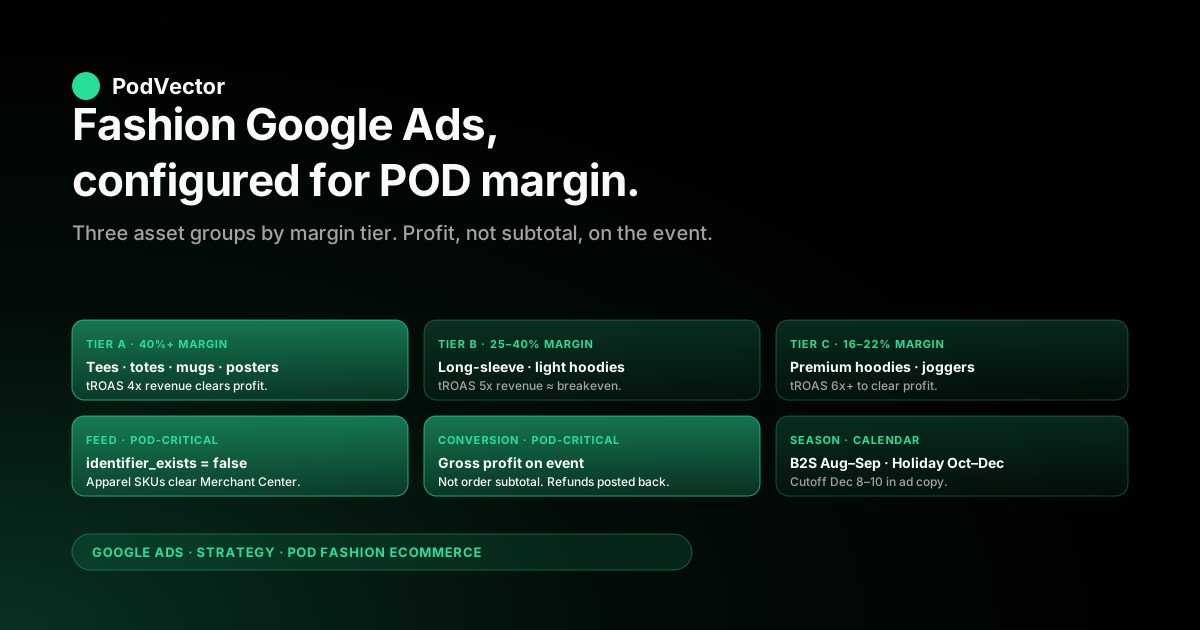
Quick Answer: Standard fashion ecommerce Google Ads playbooks — segment by intent, run Performance Max with a margin-aware feed, push lifestyle creative, schedule around drops — apply to a print-on-demand apparel store with three changes that the standard advice misses. POD apparel from Printify and Printful does not carry GTINs, which forces an identifier_exists = false setting on most apparel SKUs or the feed silently disapproves.
POD apparel margin spreads from 16% on a $35 hoodie to 38% on a $25 unisex tee from the same supplier, so the same Smart Bidding tROAS that works for a traditional fashion store loses money on a POD store unless gross profit is sent as the conversion value rather than order subtotal. And POD apparel return rates run 4–8% (defect-driven, no free returns) versus the 25–30% return rate the standard fashion ecommerce playbook assumes — which sounds like good news but actually changes the right CPA ceiling and the right retargeting window. This guide walks the campaign structure, feed setup, creative direction, seasonality calendar, and measurement loop tuned for a POD fashion store rather than for a traditional apparel brand.
Why POD fashion ecommerce is not traditional fashion ecommerce on Google Ads
Most "Google Ads for fashion ecommerce" guides — including the genuinely useful ones from AdSpyder, Vervaunt, and the agency landing pages from Searchflex and similar shops — assume the unit economics of a traditional fashion brand. That brand owns inventory, holds 50–65% gross margin per unit before promotions, ships from a warehouse with consistent fulfillment cost, accepts a 25–30% return rate as the cost of a "free returns within 30 days" policy, and sells the same SKU month after month while it is in season. A print-on-demand fashion store is a different business with the same product photos.
Four structural facts shape the Google Ads playbook for POD fashion specifically:
- Margin spreads from 16% to 65% inside one Printify or Printful catalog. A $35 unisex hoodie from Printify lands at 16–22% gross margin after supplier cost. A $25 cotton tee from the same Printify shop is 32–38%. A $22 cotton tote bag is 45–55%. A $14 ceramic mug — if you carry mugs alongside the apparel — is 60–70%. Smart Bidding optimizing on order subtotal scales toward whichever SKUs ring up the highest revenue, which is the hoodies, regardless of contribution margin. Revenue grows; profit shrinks.
- POD apparel does not have GTINs. Printify and Printful do not assign UPCs or EANs because each piece is made to order at print time. Google Merchant Center treats apparel as a category that requires a GTIN for ranking unless the seller sets
identifier_exists = falseon the feed entry. POD fashion stores that set up the feed without this metafield see apparel disapprovals in confusing patterns — some SKUs clear, others do not, depending on the apparel sub-category — and the impressions never materialize. - POD apparel returns run 4–8%, not 25–30%. POD stores typically operate final-sale or defect-only return policies because the supplier does not accept returns on made-to-order items. Returns happen for genuine fulfillment defects (wrong size shipped, print quality, damaged in transit). The lower return rate is real economic upside for the store, but it changes how the bidder should be configured: the standard fashion-ecommerce CPA target assumes 25% of orders will be refunded inside the attribution window, so the campaign tolerates a higher cost-per-conversion than the actual unit economics would justify. A POD store with 6% return rate has a structurally lower CPA ceiling because more revenue is real revenue.
- "Drop calendars" are different. Traditional fashion ecommerce schedules drops 6–8 weeks ahead, builds inventory, then advertises against the drop. POD has no inventory cost — designs can launch the same week and scale or kill based on early conversion data. The advertising calendar should reflect the POD operator's ability to move fast on trend rather than the traditional fashion brand's need to recoup inventory commitment.
None of that means Google Ads is wrong for a POD fashion store. It is usually right — fashion is a high-intent search category and Performance Max delivers Shopping inventory efficiently — but the configuration that wins for a traditional fashion brand misconfigures for a POD apparel catalog.
The rest of this piece walks the configuration that holds. For the broader frame, the cluster hub is the Google Ads strategy cluster and the topic hub is at Google Ads for POD; the pillar is the complete Google Ads playbook for POD sellers.
Campaign structure for a POD fashion catalog
The standard fashion ecommerce campaign structure — one Performance Max for the whole catalog, optionally split by brand vs. generic Search, sometimes a Smart Shopping campaign for the legacy fashion brands that have not migrated — is the wrong shape for POD. The right structure follows the margin tiers, not the product categories.
Three Performance Max asset groups split by margin tier. Tag your products in Shopify by gross margin band: tier-A (40%+ — typically tees, totes, mugs, posters), tier-B (25–40% — long-sleeve tees, light hoodies, leggings basics), tier-C (15–25% — premium hoodies, joggers, fleece outerwear). Build one Performance Max campaign with three asset groups, one per tier, and set a different tROAS on each.
Tier-A can carry a 4x revenue tROAS profitably; tier-C needs 6x or higher to clear breakeven on profit. The same campaign learns one set of audiences but bids appropriately by tier.
Branded Search as a separate small-budget campaign. Once your store has even modest organic brand traffic, branded search converts at 8–15x the rate of non-branded with low CPC because the searcher already knows you. Run a small ($5–10/day) branded Search campaign to defend the brand SERP and capture cheap conversions. This stays separate from PMax so the cheap branded conversions do not artificially inflate the PMax campaign's apparent ROAS during the learning window.
Standard Shopping as the warmup campaign for new stores. If your POD fashion store has under 30 conversions in the trailing 60 days, Performance Max will sit in perpetual learning mode and bid inefficiently. Start with Standard Shopping — which is more transparent (you see every triggering query), learns faster on small data, and gives you negative-keyword control — for the first 60–90 days. Migrate to Performance Max once the conversion baseline supports it.
Demand Gen for design launches, not for the steady-state catalog. Demand Gen (the channel formerly known as Discovery) is fashion-friendly because the placements are visual and the audience is in a browsing mindset. Use it for new design launches where you want to seed awareness on a specific drop. Do not run it as the always-on demand-capture channel — that is what PMax and Shopping are for.
For deeper detail on each campaign type's POD tradeoffs, see the Google Ads for Shopify store strategy piece on the Shopify-side setup and the broader Google Ads for ecommerce strategy piece for the cross-platform picture.
Feed work: variants, GTINs, custom labels, lifestyle images
The Shopify-to-Merchant-Center feed is automatic via the Google & YouTube app, but the auto-feed sends whatever Shopify has, and what Shopify has by default does not get POD apparel ranked. Five feed-level decisions move POD fashion performance disproportionately.
Set identifier_exists = false on every apparel SKU at setup. In Shopify Admin → Product → Custom data, add the metafield google: identifier_exists with value no. Bulk-tag your apparel collection in one pass — most stores can apply this metafield to every product in the apparel collection in under five minutes via Shopify's bulk editor.
Disapprovals clear within 24–48 hours of the next feed sync. This single fix is responsible for unlocking 30–60% of the impression volume for POD apparel stores in our customer cohort because most disapprovals at setup come from this one issue. The full Merchant Center setup walkthrough is in Shopify Google Merchant Center strategy.
Variants: each size and color combination is a separate feed entry. Google Shopping treats every variant as a separate item, but only if the feed exposes them. The Google & YouTube app handles variant generation automatically when product variants are set up in Shopify with size and color attributes.
Verify in Merchant Center → Products that your $25 unisex tee shows as roughly 18 separate items (3 sizes × 6 colors) rather than as 1 item with no variant breakdown. Variant-aware feeds rank for queries like "black oversized tee small" that the consolidated feed misses entirely.
Titles: front-load fit, fabric, and color before brand. Shopify product titles often default to "MyBrand — Cozy Crewneck Sweatshirt". Google's title-match algorithm front-loads the first 70 characters; the brand prefix wastes most of those.
A POD-fashion-optimized title reads "Cozy Cabin Crewneck Sweatshirt — Unisex Cotton Blend, Fleece-Lined, Black". Same product, dramatically more click-through on a search like "fleece-lined crewneck unisex". Include fit (unisex, women's, oversized, slim), fabric (cotton, fleece, jersey), and the most-searched color modifier (black, white, neutral) in the first 70 characters.
Custom labels for margin tier and seasonality. Use custom_label_0 for margin tier (tier-a, tier-b, tier-c) and custom_label_1 for seasonality bucket (evergreen, spring-summer, fall-winter, holiday). Performance Max asset groups and Standard Shopping product groups can then be built against these labels without re-tagging products every season. The campaign structure stays the same; the label assignments shift.
Primary image: lifestyle photo, not the Printify mockup. Printify and Printful generate clean white-background mockups by default. Those mockups belong as secondary images.
The primary image — what shows in the Shopping ad placement — should be a lifestyle photo: the product on a person, in context, at the angle a fashion shopper expects. A lifestyle primary outclicks a flat mockup at roughly 1.5x in our customer cohort, and the cost is one photo shoot per design (or one pass through a generative-AI lifestyle tool). Shopify's image-reorder feature handles the swap.
Search intent map for POD fashion
Fashion search queries split into four intent clusters that need different ad treatment. Lumping them into one Search campaign is the most common cause of the "we ran Google Ads, it didn't work for our fashion store" outcome. The intent map below works for both Standard Shopping product groups and Search ad groups when you migrate beyond Performance Max alone.
Bottom-funnel branded queries. "[Brand name] hoodie", "[brand name] discount", "[brand name] reviews". Highest converting, lowest CPC, defended via the small Branded Search campaign. Convert at 12–18% in our customer cohort.
Bottom-funnel category + modifier queries. "Black oversized hoodie women", "men's linen shirt under $50", "unisex cotton tee". The searcher knows what they want; they are picking between brands.
POD fashion can compete on style differentiation and lifestyle imagery. Convert at 2–4%. The right campaign for these queries is Performance Max with rich product titles or Standard Shopping with variant-aware feed.
Mid-funnel design-themed queries. "Cabin sweatshirt", "vintage band tee", "cottagecore hoodie", "anime crewneck". This is where POD fashion has structural advantage — POD operators can spin up designs around emerging themes faster than inventory-based brands.
Convert at 1.5–3%. Performance Max with descriptive product names captures these. Search campaigns work here too if you build keyword groups around the design theme rather than the product category.
Top-funnel browsing queries. "Cute sweatshirts", "trending t-shirts", "fall fashion ideas". Low intent, low conversion (under 1%), high competition. Skip these unless you are running a specific awareness campaign for a drop. Add as account-level negatives if PMax keeps surfacing on them and the Insights tab shows they are draining budget.
The negative keyword work is non-trivial for fashion. Recurring off-intent queries to add as account-level negatives include: "free", "wholesale", "bulk", "design template", "DTG file", "PNG download", "SVG cricut", and the names of large competing platforms (Etsy, Amazon, Redbubble, Teepublic) if you do not want to bid against them on generic queries. Sweep monthly via the Performance Max Insights tab.
Creative and PDP: where POD fashion ads convert or do not
Fashion ecommerce conversion happens at the product detail page, and the gap between a fashion-quality PDP and a default Shopify POD PDP is wide. Three creative inputs and four PDP elements move conversion materially.
Three creative inputs that move click-through:
- Lifestyle photography as primary. Already covered above as a feed item; worth restating because it is the highest-leverage single creative change. Click-through on Shopping ads roughly 1.5x for lifestyle vs. mockup primary in our customer cohort.
- Two-to-three creative variants per product for Performance Max. PMax assets are mixed and matched at serve time; giving the algorithm variety lets it pick combinations. For each product, supply: lifestyle hero, lifestyle context (on a person, in setting), product flat or mockup, and a detail close-up (fabric texture, print detail). Four images per product.
- Headlines that name fit, fabric, and use case. "True-to-size crewneck — heavyweight cotton, made to order" outperforms "Buy our cool sweatshirt" because the first headline answers the implicit fashion-shopper question (will it fit, what is it made of, what is it for) before the click.
Four PDP elements that move on-site conversion:
- Sizing chart visible above the fold. Fashion shoppers will not buy without knowing the fit. A POD product with the size chart hidden in a tab loses 20–35% of conversion compared to one with the chart visible above the fold. Printify and Printful provide size charts per product; surface them.
- Material and care details, not just "100% cotton". "Heavyweight 8.5oz cotton, ring-spun, side-seamed, machine wash cold" reads as quality. "100% cotton" reads as commodity. POD apparel from Printify and Printful is often genuinely premium (Bella+Canvas, Comfort Colors, Champion blanks); say so on the PDP.
- Realistic shipping expectation. POD has 5–10 day production plus shipping, versus the 2–3 day delivery a traditional fashion brand offers from inventory. Hide this and you take the abandoned-cart hit at checkout. Show it on the PDP — "Made-to-order: ships in 5–7 business days, delivers in 10–14 days" — and you lose some shoppers to the timeline but you keep the ones who buy.
- One-product-page-per-design. POD operators sometimes consolidate variants of the same design across product types into one page. Google Shopping ads need one PDP per Shopping ad destination; the variants on that PDP should be size and color, not "tee vs. hoodie vs. sweatshirt of the same design". Split product-type variants into separate PDPs so each Shopping ad lands on the matching product.
Seasonality calendar: spring, back-to-school, holiday, January
Fashion ecommerce is the most seasonal vertical in retail, and POD fashion inherits the same seasonality with two structural advantages: zero inventory commitment to designs that do not sell, and faster design-to-launch cycle than inventory-based brands. The Google Ads calendar should reflect both.
January (post-holiday slump and refresh). Apparel demand drops 30–45% the first three weeks of January as consumers recover from holiday spend. Pull back PMax budgets to 50–60% of December levels through January 20; ramp back up the last week as gym-membership and "new year, new wardrobe" demand returns. Push activewear and basics, not graphic statement pieces.
February to April (spring transition and Easter/spring break). Demand for lighter-weight apparel — short-sleeve tees, light hoodies, athletic wear — rises 20–30% from mid-February through April. Spring break and Easter create two demand peaks (last two weeks of March, first week of April). Launch designs around vacation themes, beach motifs, and outdoor recreation.
May to July (summer and Fourth of July). Lightweight apparel demand peaks. Patriotic designs see a 60–80% lift the two weeks before July 4. POD's design-launch speed is an advantage here — themes can launch the week before with only Google Ads spend at risk, no inventory commitment.
August to September (back-to-school). Largest second-half demand window after holiday. College town geo-targeting often outperforms broad national bidding for collegiate-themed apparel. PMax budgets should ramp 40–60% above baseline from August 1 through September 15.
October to December (holiday). Largest sustained demand window. Holiday-themed graphic apparel, gift-bundle product groupings, and family-set designs (matching family pajamas, etc.) see lifts of 100–200% over baseline.
Ad budget should reflect: typically 40–55% of full-year ad spend lands in this window for fashion POD stores. Order cutoff dates matter — POD's 5–10 day production plus shipping means Christmas-delivery cutoffs are usually December 8–10 for standard shipping, December 13–15 for expedited. Communicate cutoffs in ad copy starting December 5; switch to "ships after Christmas" messaging once cutoffs pass to avoid abandoned-cart from delivery-expectation mismatch.
For more on how the Google Ads calendar interacts with promotions and offers, the planned Google Ads for ecommerce promotions strategy piece in this cluster covers promo-period ad mechanics in depth.
Measurement: profit ROAS, tier-by-tier, refund-adjusted
The standard fashion ecommerce dashboard reads cost, revenue, and revenue ROAS. For a POD fashion store, that view consistently overstates profitability and underweights the high-margin SKUs. Three changes to the measurement loop produce decisions that hold up against the bank account.
Send gross profit per order as the conversion value, not order subtotal. This is the single highest-leverage configuration change for any POD store, fashion or otherwise. Gross profit = selling price minus Printify or Printful supplier cost minus payment processing minus shipping if you bundle it.
Server-side via a Shopify app like Elevar handles it natively with Printify/Printful integrations, or a custom server-side script reading Shopify webhooks and posting via the Google Ads API. The full setup walkthrough is in Set Up Google Ads conversions on Shopify; the broader conversion strategy in Shopify Google Ads conversion strategy.
Read ROAS by margin tier, not by overall campaign. The campaign-level ROAS averages across tiers and hides whether the budget is going to the right SKUs. Pull the report split by custom_label_0 (the margin tier label) and look at ROAS per tier separately.
Tier-A at 5x revenue ROAS is excellent; tier-C at 5x revenue ROAS is breakeven. Same number, very different decisions.
Post refund adjustments — even at 4–8% it matters. Lower POD return rates than traditional fashion does not mean refund posting is optional. Even at 6%, refunds compound over a 30–60 day window into a meaningful waste line because the bidder treats refunded orders as good signal forever otherwise. Conversions → Adjustments → upload refunds either via vendor (Elevar, Littledata) or via custom job reading Shopify refund webhooks.
Walking the profit ROAS by tier with refund adjustment, daily, across Shopify, Printify, Printful, and Google Ads, is exactly what Victor answers — the live data warehouse view stitches together the four data sources and surfaces "which campaigns made profit ROAS over 1.5x net of returns last week" in seconds. For the broader benchmark frame and how these numbers stack against what we see across the customer cohort, see best practices for Shopify Google Ads (compared) and the recent Shopify Google Ads performance 2025 piece for current cohort benchmarks.
Five POD-fashion-specific mistakes that drain the budget
The same five configurations show up in account audits often enough to be worth flagging explicitly. Each is fixable in under an hour; collectively they typically reclaim 20–40% of waste in our customer cohort.
- Apparel SKUs missing
identifier_exists = false. Half the catalog disapproved silently. Fix in Shopify Admin → bulk metafield edit on the apparel collection. Disapprovals clear in 24–48 hours after the next feed sync. - One Performance Max for the entire catalog with one tROAS target. The hoodies eat the budget at 18% margin while the tees and totes at 35–45% margin sit underbid. Tier the catalog by margin via custom labels and set per-tier asset groups with per-tier tROAS targets.
- White-background mockups as primary product images. Click-through tax versus lifestyle photography is roughly 1.5x in our cohort. The fix is one lifestyle shot per design moved to Shopify image position 1.
- Conversion value sent as order subtotal. Smart Bidding scales toward whichever SKUs ring up the highest revenue, which on a POD fashion catalog is the lowest-margin large-format apparel. Replace with gross profit per order at the conversion event.
- Holiday cutoff dates not communicated in ad copy. POD's 5–10 day production lead time means Christmas-delivery cutoffs are December 8–10 for standard shipping. Ad copy that does not communicate this through December 5–10 attracts clicks that will abandon at checkout when the customer realizes the timeline. After cutoffs pass, switch to "ships after Christmas — perfect for January gifting" rather than running cutoff-aware copy and losing the click.
When Google Ads is not the right channel for your POD fashion store
Three patterns where Google Ads will not save the campaign and the channel mix should shift toward Meta, TikTok, or organic content.
Catalog of under 15 designs across one product type. Google Shopping and Performance Max need surface area to optimize across; below 15 SKUs on one product type the campaign cannot find a stable bid pattern. Use this window to build the catalog via Meta or organic, then launch Google Ads when the catalog supports it.
Hyper-niche subcultural designs with no baseline search volume. Google Ads is a demand-capture channel. If your designs target a niche where the search volume is functionally zero — extremely specific subcultural references, in-jokes, micro-fandom — there is no demand to capture.
Meta and TikTok create demand for designs people did not know they wanted; Google Ads captures demand that already exists. Most POD fashion stores need both channels, sequenced by stage of catalog maturity.
Average order value below $20 with under 25% gross margin. The unit economics on a $15 product at 22% margin produce $3.30 of contribution before any ad cost. The math says the channel does not work at this AOV/margin combo regardless of campaign craft; either reposition the catalog upmarket (heavier-weight blanks, premium product lines) or run channels with lower per-conversion cost.
For diagnosis on whether your POD fashion catalog fits the Google Ads channel profile, the Google Ads for Shopify strategy piece walks the channel-fit assessment.
FAQs
How is Google Ads for a POD fashion store different from a traditional fashion ecommerce store?
Three structural differences change the configuration. POD apparel from Printify and Printful does not have GTINs and disapproves in the feed unless identifier_exists = false is set.
POD margin spreads from 16% on a hoodie to 38% on a tee from the same supplier, which makes the Smart Bidding target dependent on per-SKU economics rather than category economics. POD return rates run 4–8% versus the 25–30% traditional fashion ecommerce assumes, which lowers the right CPA ceiling because more revenue is real revenue. The campaign structure should be margin-tiered Performance Max asset groups rather than one PMax for the catalog.
What budget should a POD fashion store start with on Google Ads?
$25–35/day per Performance Max campaign as the floor — Smart Bidding needs roughly 30 conversions per week to clear the learning window. For a POD fashion store with a $35 average order value, that is approximately $1,050–1,470 per week of revenue at a 4x revenue ROAS.
The more useful framing is per-SKU acquisition cost ceiling: for a $35 hoodie at 18% gross margin, the ceiling is $6.30 per acquisition before the SKU loses money on a per-unit basis. Set the campaign daily budget against the conversion threshold and the per-SKU ceiling against your profit-margin distribution.
Performance Max or Standard Shopping for my POD fashion store?
Standard Shopping for the first 60–90 days if you have under 30 historical conversions; Performance Max once the conversion baseline supports it. Standard Shopping is more transparent (every triggering query is visible), it learns faster on small data, and you keep negative-keyword control.
Performance Max is the right answer for established stores with at least 30 SKUs, $25+/day of spend per campaign, and four weeks of historical conversion data. Most stores graduate from Standard Shopping to PMax around month 3.
How do I handle GTINs for Printify or Printful apparel in Merchant Center?
Set the metafield google: identifier_exists to no on every apparel SKU. In Shopify Admin → Product → Custom data → add the metafield in bulk via the bulk editor.
Disapprovals clear within 24–48 hours of the next feed sync. Mugs, posters, totes, and most home-goods categories do not require this fix because Google does not require GTINs for those categories. Apparel — tees, hoodies, sweatshirts, joggers, leggings — needs the metafield on every SKU.
Should I run separate Google Ads campaigns by season or by collection?
Neither — run one campaign structure that uses custom labels for seasonality, and let the asset groups or product groups change which labels they target as seasons shift. The bidder benefits from continuous learning on the same campaign rather than fresh learning on a per-season campaign launched and killed every quarter. Tag products with custom_label_1 = "spring-summer" / "fall-winter" / "evergreen" / "holiday" and adjust which label is included in the active asset group as the calendar moves.
Why are my POD fashion ads getting clicks but no conversions?
Three common patterns. First, the PDP shows the production lead time only at checkout, and the customer abandons when they see the 10–14 day delivery — fix by surfacing lead time on the PDP.
Second, the size chart is hidden in a tab, so fashion shoppers cannot evaluate fit pre-add-to-cart — fix by surfacing the chart above the fold. Third, the lifestyle imagery promised in the ad does not match what the customer sees on the PDP because the ad shows a lifestyle hero and the PDP leads with the white-background mockup — fix by aligning ad creative to the PDP's image order.
Do I need a fashion-specific landing page for Google Ads or is the product page enough?
The product page is enough for Shopping ads — the click goes directly to the PDP. For Search campaigns and Demand Gen creative, a category landing page (e.g., a "spring tees" collection page) often outperforms direct-to-product because the searcher is browsing rather than buying a specific item. Build the collection page in Shopify, point the Search campaign at it, and let the customer drill into individual products from the collection.
How does the holiday cutoff affect my Google Ads strategy for a POD fashion store?
POD's 5–10 day production lead time plus shipping means Christmas-delivery cutoffs land around December 8–10 for standard shipping and December 13–15 for expedited. From December 5 onward, ad copy should communicate the cutoff explicitly — "Order by Dec 10 for Christmas delivery" — so customers self-select against the timeline mismatch that otherwise produces high abandoned-cart rates. After the cutoff passes, swap copy to "Ships after Christmas — perfect for New Year and January gifting" so the campaign keeps converting through the post-holiday gift-card spending window.
What return rate should I plan for as a POD fashion store?
4–8% is the typical range in our customer cohort, driven mostly by genuine fulfillment defects — wrong size shipped, print quality, damage in transit. The lower rate versus traditional fashion ecommerce (25–30%) is because POD operators usually run final-sale or defect-only return policies.
Whatever your actual rate, post the refunds back as Google Ads conversion adjustments via the Conversions → Adjustments tab. Even at 4–6%, the compounding waste over a 30–60 day window is meaningful if the bidder never sees refunded orders reverse.
Reading whether your POD fashion campaigns made profit on Monday morning, not Sunday night.
Once your fashion-POD Google Ads is configured the way this guide walks — margin-tiered Performance Max asset groups, gross profit on the conversion event, refund adjustments flowing back, custom labels driving seasonal targeting, lifestyle creative on every SKU — the question every Monday morning is which campaigns made money on profit ROAS net of returns last week, which to scale, which to pause. Victor connects Shopify, Printify, Printful, and Google Ads into one live data warehouse view and answers in seconds. No spreadsheet, no Looker build, no Sunday-night reconciliation. Victor answers your questions and acts on them — with your approval.
Try Victor free