
Quick Answer: The headline 2025 numbers for Shopify Google Ads — 18% YoY CPC inflation, Performance Max delivering ~25% conversion-value lift over Standard Shopping, free Shopping listings up 70% in clicks since 2020 — are real, but they are not the right benchmarks for a print-on-demand store. POD catalogs have wide margin spread (a $14 mug at 65% margin sitting next to a $35 hoodie at 18% margin from the same Printify supplier), apparel return rates of 4–8% versus the 2–3% ecommerce average, and SKU counts 5–20× higher than typical Shopify stores because of color and size variants.
Those three structural facts mean the standard "Shopify Google Ads performance" playbook — turn on Performance Max, send subtotal as conversion value, scale by ROAS — produces growing revenue and shrinking contribution margin for most POD operators. This piece walks the five 2025 benchmarks that actually matter for POD, the three places performance breaks down, the campaign-type and feed choices that hold up at scale, and the profit-true ROAS framework that prevents Smart Bidding from scaling the wrong SKUs.
Why Shopify Google Ads performance in 2025 is a different problem for POD
Search "Shopify Google Ads performance 2025" and the top results — Blackbelt Commerce's best-practices piece, Nord Media's setup-and-scale blueprint, MercadoKit's 8,000-word guide — all answer the same question for the same kind of store: a Shopify merchant with a small-to-mid catalog, single-digit-percent return rates, and gross margins clustered tightly around 50%. Their advice (set up Merchant Center cleanly, enable enhanced conversions, lean into Performance Max, optimize the feed, mind the bidding) is broadly correct for that store. It is broadly insufficient for a print-on-demand operator.
POD breaks the assumptions of the standard Shopify Google Ads playbook in three structural ways. First, margin spread inside a single catalog is unusually wide because Printify, Printful, Gelato, and SPOD charge very different unit costs across products that look similar to a buyer — a 11oz ceramic mug, an all-over-print hoodie, and a poster sit on the same product grid at retail prices that vary by 3–4× and contribution margins that vary by 4–5×.
Second, SKU counts run 5–20× higher than typical Shopify stores because each design ships in 4–10 colors and 3–6 sizes, and Google Shopping treats every variant as a distinct offer requiring a feed entry, an MPN, and a price. Third, return rates on apparel run 4–8% — well above the 2–3% ecommerce baseline — and POD does not resell returned units, so a return is a full-value reversal, not a partial cost recovery. The combined effect is that Smart Bidding gets a signal that systematically over-credits low-margin high-AOV products, scales the SKUs with the highest return propensity, and leaves the high-margin core invisible inside Performance Max's asset-group black box.
This piece addresses Shopify Google Ads performance in 2025 from the operator-side reality of running a POD store. For the strategic frame on what Google Ads should be doing inside a POD account at all, the complete Google Ads playbook for print-on-demand sellers is the pillar. The cluster hub is the Google Ads strategy cluster; the broader topic context lives at the Google Ads for POD topic hub.
The five 2025 performance numbers that actually matter for POD
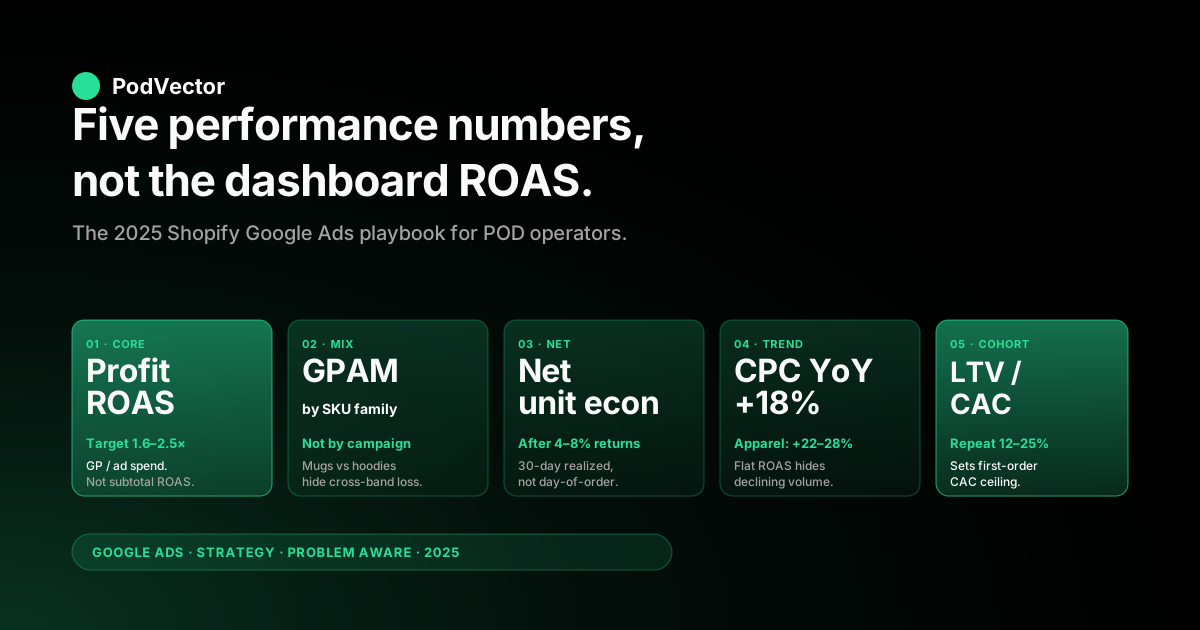
The numbers your Google Ads dashboard surfaces — Impr., Clicks, CTR, Avg. CPC, Conv., Conv. value, ROAS — are not wrong, but they are misleading on a POD catalog. ROAS based on subtotal will look healthy on the same campaign whose contribution margin is negative. Five different numbers, computed weekly, tell you whether 2025 is actually working.
- Profit ROAS (gross profit / ad spend). Not revenue ROAS. Compute gross profit per order as selling price minus Printify or Printful supplier cost minus Shopify Payments fees minus shipping cost where bundled. Divide weekly gross profit by weekly Google Ads spend. A POD account at break-even contribution sits around 1.0; sustainable accounts run 1.6–2.5 depending on mix. Anything reported as "8x ROAS" on subtotal usually translates to 1.4–1.8 profit ROAS.
- GPAM (gross profit after marketing) by SKU family. Aggregate gross profit minus ad spend at the product-family level (mugs, hoodies, posters), not the campaign level. POD operators routinely run a 4× revenue ROAS Performance Max campaign whose hoodie GPAM is positive and whose mug GPAM is negative — the campaign averages out fine while the mug is bleeding. Looking only at the campaign average hides this.
- Net unit economics post-returns. Apparel returns run 4–8% on POD. A return reverses the order's full gross profit and adds back the supplier cost as a write-off (POD does not restock). Compute weekly contribution margin on a 30-day-realized basis (orders placed 30 days ago, with returns now visible), not on the day-of-order basis Google Ads reports.
- 2025 CPC trend in your specific apparel category. Average ecommerce CPCs rose ~18% YoY in 2025; apparel and accessories ran higher in our customer cohort, with print-niche head terms ("custom mug", "personalized hoodie") seeing 22–28% YoY CPC increases. Knowing your category's trend matters because flat ROAS in a 22% CPC inflation environment means Smart Bidding is winning fewer clicks per dollar — you are losing volume even as the dashboard looks unchanged.
- Cohort LTV / first-order CAC ratio. POD repeat-buyer rates run 12–25% on apparel-niche stores, lower on novelty-niche. The Performance Max-driven first-order CAC must clear contribution margin on order one if your repeat rate is below ~15%. Above 20% repeat rate, you can run order-one CAC at 1.2× contribution margin and recoup on order two. Most POD operators we work with do not segment this and end up either under-bidding (high-LTV niches with first-order tightness) or over-bidding (low-LTV niches treating second-order revenue as guaranteed).
The five numbers above do not appear in any default Google Ads report. They are the numbers Smart Bidding would use if it could; the workaround is to feed it gross profit as conversion value (covered in the tracking stack section below) and to run the GPAM and cohort views weekly outside Google Ads against your live Shopify and Printify data.
Where Shopify Google Ads performance breaks down for POD specifically
Three breakdown patterns recur across the POD accounts we audit. Each is invisible in default Google Ads reporting and each costs meaningful contribution margin.
Breakdown 1: Performance Max scaling the high-AOV low-margin SKU. A typical POD apparel store sells $14 mugs at 65% margin and $35 hoodies at 18% margin from the same Printify supplier. The Google & YouTube app sends subtotal as conversion value by default, so Smart Bidding sees the hoodie as a $35 win and the mug as a $14 win.
It bids harder on hoodies, scales hoodie traffic, and the campaign's revenue ROAS climbs from 4× to 5×. The store's contribution margin shrinks because the mix shifted toward the lower-margin product.
This is structural, not a bug — Smart Bidding is doing exactly what it was told. The fix is sending gross profit as conversion value (Issue 5 in our Shopify Google Ads tracking issues walkthrough), not a campaign-structure change.
Breakdown 2: Variant-feed dilution. A 30-design POD store typically has 1,500–4,000 variant rows in Merchant Center because of color and size combinations. Each variant is a separate offer for Google's auction.
If the parent product has thin individual-variant click history (most variants do), Performance Max struggles to assemble enough signal to bid effectively, and the campaign defaults to bidding on the catalog-level signal — which over-weights whichever variant happened to convert first. Mug colors that have never sold sit at the same bid level as the bestseller.
Fix: a properly structured item_group_id at the design-color level, not the design-only level, plus feed rules that suppress out-of-stock or never-converting variants. We walk this in the feed-optimization section below.
Breakdown 3: Returns silently degrading Smart Bidding. A 6% return rate on apparel, never adjusted in Google Ads' conversion API, means 6% of every campaign's reported conversion value is fictional after 30 days. Smart Bidding optimizes against the unadjusted number.
Over a quarter, the audiences and SKUs with the highest return propensity (loud designs, edge sizes, certain color-shift fabrics) get the most aggressive bidding and produce the most dollar-value loss. The dashboard shows steady ROAS; the P&L shows declining margin.
Most POD stores under $20K/month spend never run refund adjustments at all. The operator-side mechanic is in our tracking issues piece (Issue 6).
Performance Max in 2025: what's working for POD
Google reports a 25% average lift in conversion value when merchants switch from Standard Shopping to Performance Max. That number is real on most catalogs and somewhat true on POD — but the lift is concentrated on the high-AOV low-margin SKUs (Breakdown 1 above), which is exactly the wrong direction for a POD catalog optimizing for contribution margin. A POD-aware Performance Max setup looks different from the default Google & YouTube app pattern.
What we see working in 2025 across our POD customer cohort:
- Asset groups split by margin band, not by product category. Group your supplier-cost-low items (mugs, posters, stickers, tote bags — typically 50–70% gross margin) into one asset group; your high-cost apparel items (all-over-print hoodies, athletic wear — typically 15–25% gross margin) into another; your mid-margin items (standard tees, sweatshirts — 30–45% margin) into a third. Same campaign, different asset groups, different ROAS targets per asset group. This contains the cross-margin-band scaling problem inside the asset-group boundary.
- tROAS targets calibrated to gross profit, not subtotal. If you have not migrated to gross-profit-as-value yet, run a transitional calculation: divide your asset group's blended margin (e.g., 35%) into your contribution-margin-target (e.g., 1.6× profit ROAS), giving a subtotal-based tROAS target of ~4.6× for that asset group. Different asset groups get different subtotal tROAS numbers because their blended margin differs. This is awkward and the right end state is sending gross profit on the conversion event itself, but the transitional math closes most of the leak.
- Customer-acquisition Performance Max as a separate campaign. Google's "new customer acquisition only" toggle inside Performance Max under-performs against a fully separate new-customer campaign with new-customer-only signal feeding it. POD repeat-buyer LTV is meaningful enough to support a higher first-order CAC inside the new-customer campaign (1.0–1.2× contribution margin instead of 1.5×+). Splitting it surfaces the LTV asymmetry; bundling it averages it away.
- Asset-group exclusions for variant-thin products. Performance Max will burn budget on the long tail of low-click variants if you let it. Use feed rules to exclude variants with fewer than 10 clicks in the last 30 days, or consolidate to representative variants. Less inventory in the auction, more signal per remaining offer.
For more on the Performance Max specifics inside Shopify, see our Shopify Google Ads strategy for POD piece, which covers the campaign-structure decisions further. For comparing Shopify-side tooling that handles asset-group splits cleanly, the Shopify Google Ads apps strategy piece compares native, GA4-fed, and third-party app options.
Standard Shopping for variant-heavy POD catalogs
Standard Shopping still has a place in 2025, despite Google's push toward Performance Max. POD catalogs benefit from Standard Shopping in two specific situations.
First, when you need granular bid control over individual products or product groups — Performance Max's asset-group abstraction does not let you bid one mug design at $0.40 and another at $0.85 in the same campaign. Second, when you want pure search-intent traffic without YouTube, Discover, or Display arms inflating click volume on lower-intent placements.
The 2025 standard-shopping pattern that works on POD:
- Product groups split by margin band first, then by design family. Same logic as Performance Max asset groups — segregate the low-margin apparel from the high-margin print-and-ship items so bid changes are surgical. Inside each margin band, group by design family or theme so cohorts of variants share bids.
- Manual CPC for new product groups, target ROAS once they have 30+ conversions. Performance Max wants 50+ conversions per 30 days to bid effectively. Standard Shopping can run on Manual CPC during the cold-start phase and switch to tROAS once enough signal has accumulated. POD product launches benefit from this — a new design with no click history gets an explicit bid rather than starving inside Performance Max's auction.
- Negative keywords against your own brand and lookalike searches. Standard Shopping participates in branded queries by default; if you also run a brand search campaign, the Shopping campaign cannibalizes it at higher CPCs. Add your brand as a negative on the prospecting Shopping campaign.
The general rule we use across the cohort: Standard Shopping for the design-launch and bid-control phase, Performance Max for the scale-the-winners phase. Crossing over too early into Performance Max gives away the bid control before you have signal; staying too long in Standard Shopping leaves the YouTube and Discover demand on the table. Our best practices for Shopify Google Ads (compared) piece covers the tradeoffs across campaign types in more depth.
Search campaigns: keyword and ad-copy choices that pay back
Search Network campaigns get less attention than Shopping in 2025 because the conversion-rate gap is real — Shopping lands shoppers on a product page with a price and an image; Search lands them on a landing page they have to navigate. For POD, Search remains valuable in two specific lanes:
- Branded search defense. If your designs or brand names appear in queries, competitor stores will bid on them — especially other Printify and Printful sellers running similar designs. A small branded search campaign at low CPCs prevents this from being free for the competitor and captures buyers who already know your brand. Profit ROAS on branded campaigns runs 6–12× consistently.
- Long-tail design-intent queries Performance Max can't see. Performance Max bids against the auction Google's algorithm chooses; you cannot see the search terms it bid against in 2025 except in aggregate. A focused Search campaign targeting long-tail queries you know convert ("custom name mug birthday gift", "[niche] hoodie women") gives you query-level visibility and bid control on intent your Performance Max may be missing. Negative-keyword the broad terms that Performance Max already covers.
Ad copy for POD Search ads should match the buyer's specificity. Generic "Shop Now - Free Shipping" copy under-performs against the specific design or niche language that the query implied — "Personalized [niche] mugs, dishwasher safe, ships in 3 days" beats a brand-generic ad. Responsive Search Ads with 8–12 headlines per ad and 3–4 descriptions, varied along the dimensions of (1) the design specificity, (2) the use case (gift, wardrobe staple, novelty), and (3) the practical detail (shipping time, return policy, material) consistently win against single-asset ads.
Feed optimization for POD's color-and-size SKU explosion
Feed quality is the unglamorous half of Shopify Google Ads performance and the half that compounds. A POD store with 30 designs, 8 colors per design, and 5 sizes per color generates 1,200 variant rows that Merchant Center treats as 1,200 distinct offers. The 2025 patterns that materially move performance:
item_group_idat the design-color level, not the design-only level. A black hoodie and a white hoodie of the same design have different visual appeal and convert at different rates. Grouping them into the same item_group_id forces Google to pick one as the "canonical" variant and under-shows the other. Group at design-color (e.g.,navy-mountain-mugaggregating S/M/L) rather than design-only (mountain-mugaggregating all colors and sizes).- Title structure that matches search intent. Google's title relevance ranking weighs the first 70 characters most heavily. POD titles often start with the design name and bury the product type — "Mountain Sunset" instead of "Mountain Sunset Ceramic Mug 11oz". Restructure to lead with the high-intent search-term shape: "[Product Type] [Defining Attribute] [Design Name]" — "Ceramic Mug 11oz Personalized Mountain Sunset" outperforms the design-first variant for non-branded queries.
- Custom labels for the margin band. Use
custom_label_0for margin band (high/mid/low),custom_label_1for product family (apparel/drinkware/wall art),custom_label_2for return-rate band (low/mid/high),custom_label_3for design tenure (new/proven/evergreen). This gives Performance Max asset groups and Standard Shopping product groups handles to filter against without hard-coding product IDs. - Suppression rules for never-converting variants. A feed rule that excludes any variant with zero clicks in the last 90 days reduces auction noise and concentrates Smart Bidding signal on variants that actually move. Re-evaluate quarterly so seasonal designs are not permanently suppressed.
- Image quality and consistency. Mockups vary across Printify and Printful's mockup library — some have lifestyle backgrounds, some are flat. Mixed mockup styles inside one product family confuse Google's image-relevance signal. Pick one mockup style per family (lifestyle for apparel, flat-product for drinkware is a common pattern) and apply it consistently.
For the broader integration setup that feeds this — Shopify to Merchant Center sync, sales channel configuration, automatic vs. manual feed updates — our Shopify Google Merchant Center strategy for POD piece walks the operator-side mechanics.
The 2025 tracking stack POD performance depends on
Most of the campaign-side optimizations above only pay off if the conversion signal feeding Smart Bidding is correct. The 2025 tracking stack POD operators need has four layers, in increasing order of difficulty and increasing order of payoff:
- Tag firing reliably (Layer 1). Google & YouTube app installed and connected, Customer Events configured, Tag Assistant verifying the conversion event fires on a real test order. Roughly 30% of POD stores we audit have a partial Layer 1 failure (tag firing intermittently after the Checkout Extensibility migration). The fix is mechanical and takes an afternoon.
- Recovery for blocked clicks (Layer 2). Enhanced conversions on for hashed-identifier match-back, plus a server-side relay (Elevar, Stape, Littledata, or custom Cloud Run reading Shopify webhooks) for the 15–25% of paid traffic running ad blockers. Recovers most of the structurally lost conversions.
- Profit-as-value (Layer 3). Conversion event sends gross profit per order — selling price minus Printify or Printful supplier cost minus payment processing minus shipping if bundled — instead of subtotal. This is the layer that fixes Breakdown 1 (Performance Max scaling the wrong SKUs) and is the highest-leverage tracking change a POD operator can make. The implementation requires a per-line-item cost lookup and either an Elevar-style app or a custom backend job. Plan for a 14-day Smart Bidding relearning window after the switch.
- Refund adjustments (Layer 4). A job that listens for Shopify's
refund/createwebhook and posts conversion adjustments via the Google Ads API — RETRACT for full refunds, RESTATE for partials. POD's 4–8% return rate makes this the difference between Smart Bidding chasing the actual P&L and chasing a 6%-fictional version of it. Adjustments must post within 55 days of the original conversion to be accepted.
For the full walk-through of tracking failure modes that need addressing before Layers 3 and 4 will pay back, see our Shopify Google Ads tracking issues piece. For the strategy-level frame on the four-layer stack, the Shopify Google Ads tracking strategy piece explains how each layer feeds the next. The conversion-action setup specifics are in Shopify Google Ads conversion strategy.
Scaling profitably: the weekly "scale or pause" decision
The performance question every POD operator wrestles with on Sunday or Monday is the same one: which campaigns made money last week, which are bleeding, scale or pause? In 2025 the answer is harder than it was in 2022 because Performance Max hides the campaign-level structure inside its asset groups, modeled conversions blur the observed-versus-modeled line, and the gap between revenue ROAS (what the dashboard shows) and profit ROAS (what your P&L cares about) widens as the catalog skews toward variant-heavy apparel.
The scale-or-pause framework that holds up across POD accounts:
- Compute profit ROAS at the asset-group level, weekly, on a 7-day-realized basis. 7 days back captures the Smart Bidding feedback loop without being polluted by ongoing returns. Aggregate orders attributed to each asset group, subtract Printify or Printful supplier cost per line, subtract payment processing, subtract shipping if bundled. Divide by ad spend on that asset group for the same week.
- Scale: profit ROAS > 1.6 and trending stable or up over 3 weeks. Increase budget by 15–20% per week; Performance Max needs gradual scaling to relearn without volatility. Larger jumps trigger a learning reset and the campaign under-performs for 7–10 days before recovering.
- Pause: profit ROAS < 1.0 for 2 consecutive weeks. Below 1.0 means contribution margin is negative net of ad spend. Two weeks rules out a noisy single week. Pause the asset group, examine which products and audiences drove the loss, restructure or remove the underperformers, restart with a smaller budget.
- Hold: 1.0 < profit ROAS < 1.6. Marginal but not bleeding. Don't scale, don't pause. Examine the SKU mix inside the asset group — usually one product family is dragging the whole asset group down and segregating it would lift the rest above the scale threshold.
This is the operator-side decision the SERP top-3 articles do not address. They cover setup and scaling-by-revenue-ROAS; they do not cover the weekly profit-ROAS judgment call that sits between the two.
The numbers required — supplier cost per line, payment processing per order, shipping cost if bundled, ad spend per asset group, return adjustments to date — live across Shopify, Printify, Printful, and Google Ads. Most operators reconcile them in a spreadsheet on Sunday morning.
For the structural background on each metric driving this — profit ROAS, GPAM, contribution margin, cohort LTV — our Google Ads for Shopify store strategy piece covers the metric definitions, and the Shopify Google Ads strategy piece covers how they tie back to weekly campaign decisions. For a useful outside-perspective benchmark on what 2025 ecommerce CPC inflation looks like across categories, the Blackbelt Commerce 2025 best-practices piece aggregates a similar cohort.
FAQs
What is a good ROAS for Shopify Google Ads in 2025 for a POD store?
The headline answer the SERP gives — 4–6× revenue ROAS — is misleading for POD because revenue ROAS does not subtract supplier cost. The correct benchmark is profit ROAS (gross profit divided by ad spend) of 1.6–2.5× for sustainable operation, with break-even at 1.0×.
A POD account reporting "5× ROAS" on subtotal typically translates to 1.5–2.0× profit ROAS once Printify or Printful unit cost, payment processing, and shipping are subtracted. If you are not yet computing profit ROAS, the transitional rule is: take your blended gross margin (often 35–45% on apparel-heavy POD), and target a revenue ROAS of (target profit ROAS) ÷ (margin) — e.g., for a 1.6× profit ROAS target on 35% margin, you need 4.6× revenue ROAS.
How much have Shopify Google Ads CPCs risen in 2025?
Average ecommerce CPCs rose ~18% YoY in 2025 across categories, with apparel and accessories running higher (22–28% in our POD customer cohort, depending on niche). Print-on-demand head terms ("custom mug", "personalized t-shirt", "[niche] hoodie") have seen the steepest climb because POD competition has increased and Performance Max bidders aggressively pursue any positive ROAS signal. The implication for performance: flat ROAS in a 22% CPC inflation environment means you are winning fewer clicks per dollar, so volume is declining even when the dashboard looks unchanged. Profit-true ROAS measurement matters more in this environment because the cost side of the equation is moving against you.
Is Performance Max better than Standard Shopping for POD in 2025?
Better at scale, worse during launch and bid-tuning phases. Performance Max delivers a measurable lift in conversion value once it has 50+ conversions per 30-day window to optimize against, and it accesses YouTube and Discover demand that Standard Shopping cannot reach.
During the cold-start phase of a new design or product family, Standard Shopping's manual CPC control is more useful because Performance Max will burn budget while it accumulates signal. The pattern that works on POD: launch new designs in Standard Shopping with manual CPC, migrate to Performance Max once conversion volume supports tROAS, run both side by side with negatives between them to prevent cannibalization. Asset groups in Performance Max should be segmented by margin band rather than product category so the high-AOV low-margin SKUs do not dominate the bidding.
Why does my Google Ads ROAS look good but my Shopify profit looks bad?
Almost certainly because your conversion event is sending order subtotal as the value, not gross profit. POD catalogs have wide margin spread within a single product family (a $14 mug at 65% margin and a $35 hoodie at 18% margin from the same Printify supplier).
Smart Bidding optimizing on subtotal scales whichever SKU has the higher subtotal — usually the lower-margin product — and revenue grows while contribution margin shrinks. The fix is replacing subtotal with gross profit on the conversion event itself, via a server-side stack like Elevar or a custom backend job that does per-line-item cost lookup.
Plan for a 14-day Smart Bidding relearning window after the switch. We walk this in detail in our Shopify Google Ads tracking issues piece (Issue 5).
How do I optimize my Google Shopping feed for variant-heavy POD catalogs?
Five changes consistently move performance: (1) set item_group_id at the design-color level, not the design-only level, so colors compete on their own merits; (2) restructure titles to lead with product type ("Ceramic Mug 11oz Personalized Mountain Sunset") instead of design name; (3) use custom labels to encode margin band, product family, return-rate band, and design tenure for asset-group filtering; (4) suppress variants with zero clicks in 90 days to concentrate auction signal; (5) standardize mockup style within product families. POD-specific because POD catalogs have 5–20× the variant count of typical Shopify stores, and the auction noise without these structures dilutes the signal Smart Bidding sees on each remaining offer.
Should I use Performance Max for new customer acquisition or for retargeting?
Both, in separate campaigns, with different signal feeding each. Google's "new customer acquisition only" toggle inside a single Performance Max campaign under-performs against a fully separate new-customer campaign with a customer-list audience signal feeding it.
POD repeat-buyer rates of 12–25% on apparel mean the LTV asymmetry between first-order and repeat buyers is meaningful enough to warrant separate budgets and separate ROAS targets. A first-order CAC of 1.0–1.2× contribution margin is acceptable in a high-LTV niche; a 1.5×+ first-order CAC is the right ceiling in low-LTV novelty niches. Bundling new-customer and retargeting in one campaign averages this asymmetry away and over-bids retargeting against weak first-order economics.
How do POD return rates affect Google Ads performance reporting?
They degrade Smart Bidding accuracy by the return percentage, silently. POD apparel returns run 4–8%; if those refunds are not posted back to Google Ads as conversion adjustments, 4–8% of every campaign's reported conversion value is fictional after the 30-day adjustment window.
Smart Bidding bids against the unadjusted number, which means the audiences and SKUs with the highest return propensity get the most aggressive bidding because they post the highest pre-return ROAS. Over a quarter the contribution margin erodes while the dashboard ROAS looks stable.
Fix: server-side job listening to Shopify's refund/create webhook and posting conversion adjustments via the Google Ads API (RETRACT for full refunds, RESTATE for partials) within the 55-day adjustment window. Most POD stores under $20K/month spend never run this layer — it is the single most underweighted piece of the 2025 POD tracking stack.
What's the right weekly cadence to evaluate Shopify Google Ads performance?
Weekly review on a 7-day-realized basis is the right cadence for Performance Max and Shopping campaigns; daily review introduces too much noise and triggers reactive changes that destroy Smart Bidding's relearning. Compute profit ROAS at the asset-group level, segment by margin band, decide scale (profit ROAS > 1.6 trending stable, increase 15–20%), pause (profit ROAS < 1.0 for two consecutive weeks), or hold (1.0–1.6, examine SKU mix).
The cadence matters because Performance Max needs roughly 7–10 days to absorb a budget change without volatility, so weekly decisions land at the right rhythm. Monthly is too slow for a 22% CPC inflation environment; daily is too fast for Smart Bidding's learning loop.
Profit ROAS, weekly, across every campaign and asset group — without the spreadsheet.
Shopify Google Ads performance in 2025 lives or dies on whether you can answer "scale or pause?" against profit ROAS, not subtotal ROAS, every week. That answer requires Shopify orders, Printify and Printful supplier costs, Shopify Payments fees, return data, and Google Ads spend joined into one view — typically a Sunday-morning spreadsheet rebuild. Victor connects all five into a live data warehouse view and answers the question in seconds, segmented by campaign, asset group, SKU family, and margin band. Victor answers your questions and acts on those answers — gated through your approval.
Try Victor free