
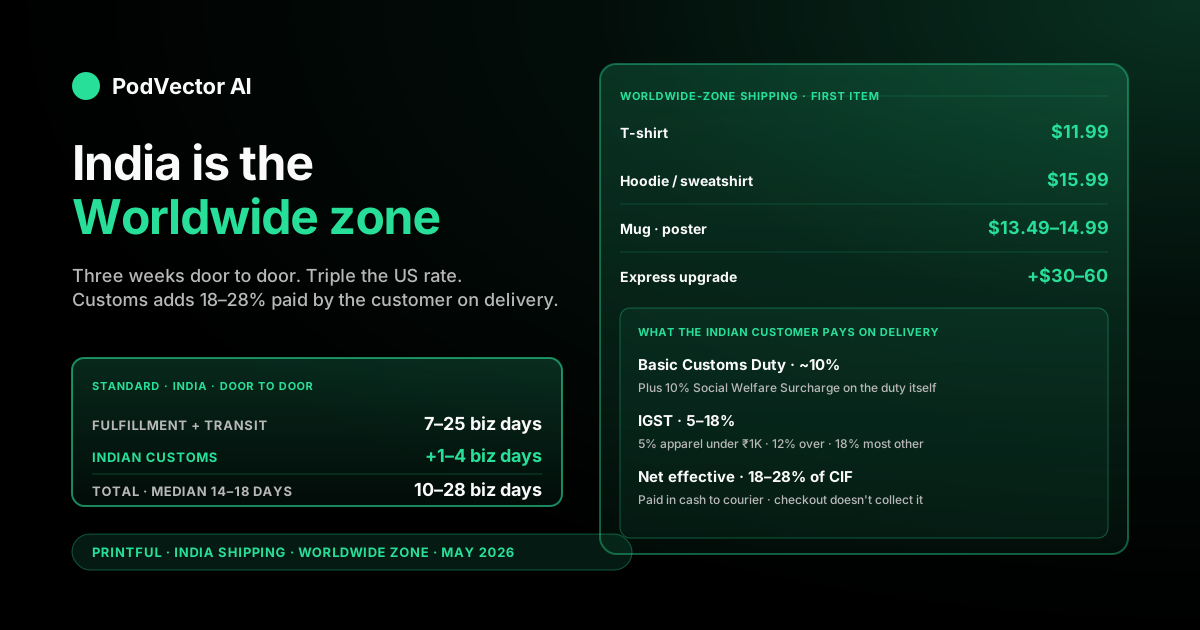
Quick Answer: Printful does ship to India, but India sits in Printful's "Worldwide" zone — the highest-cost, longest-transit tier in the system. A standard order to an Indian address typically lands in 10–28 business days door to door (2–5 fulfillment + 5–20 carrier transit + 1–4 days Indian customs clearance), per Printful's published Worldwide-zone windows.
International express to India uses DHL or FedEx end to end and compresses the carrier leg to 1–3 business days, but the realistic door-to-door window is still 4–10 business days because fulfillment and customs don't change. Note that Printful's named "Express" service is a US-domestic-only upgrade — it does not apply to Indian addresses.
The bigger surprise is cost. According to Printful's official rate card (as reported by PodVector's Printful shipping rates guide), a standard t-shirt to a Worldwide-zone country like India costs $11.99 for the first item, versus approximately $4.75 for a US domestic address. That gap compounds fast on multi-item carts. On top of that, Indian customers pay customs duty and GST on delivery — and Printful ships all Worldwide orders DDU (Delivered Duties Unpaid), with no DDP option. Most sellers lose money on multi-item India carts unless shipping copy and pricing are tuned for the Worldwide zone.
Rate note: Printful pushed rate changes on February 26, June 4, and August 27, 2026, per Printful's shipping price updates page. Always verify current figures against the live Printful rate calculator before publishing storefront prices.
Does Printful actually ship to India?
Yes. Printful has no fulfillment facility in India, but the platform accepts Indian shipping addresses and routes them through its "Worldwide" zone — the catch-all tier for every country outside the eight named regions (USA, Canada, Europe, UK, EFTA, Australia/New Zealand, Japan, and Brazil). According to PodVector's Printful Worldwide shipping guide, the Worldwide region includes most of Asia (India, Indonesia, Vietnam, Thailand, the Philippines, South Korea, Taiwan, Singapore, Malaysia), the Middle East, Africa, and parts of Latin America.
An Indian order is fulfilled at the Printful facility closest to the carrier handoff — usually a US facility (California, North Carolina, or Dallas) or occasionally Mexico for certain product categories. EU fulfillment is rare for India-bound orders.
The carrier on the India leg varies. Standard shipments hand off to a global mail consolidator and arrive in India via India Post; express shipments use DHL, UPS, or FedEx end to end. The carrier choice mostly affects transit time and tracking quality, not Indian customs treatment.
One important nuance: Printful's named "Express" upgrade — the one in your dashboard — is a US-domestic-only service, per the Printful Express shipping breakdown. For India, "express" means requesting a premium international carrier (DHL/FedEx) at checkout, which is a separate surcharge and a different product entirely.
Also critical: Printful ships all Worldwide-zone orders DDU (Delivered Duties Unpaid). According to PodVector's Printful global shipping guide, DDP (Delivered Duty Paid) is only available for the UK, EU, and Canada — not India. Every Indian order arrives with a duty bill waiting for the customer.
The realistic India shipping window
Printful publishes a 5–20 business day standard transit window for Worldwide-zone destinations. India sits at the wider end of that range because the route involves both an international air leg and Indian domestic delivery. According to PodVector's Printful global shipping guide, customs holds in places like India can stretch the window to 25+ business days.
The honest door-to-door breakdown:
- Standard: 10–28 business days door to door (2–5 fulfillment + 5–20 carrier transit + 1–4 days Indian customs), per Printful's published Worldwide-zone windows
- International express (DHL/FedEx): 4–10 business days door to door (2–5 fulfillment + 1–3 carrier transit + 1–2 days Indian customs)
- Typical median: 14–18 business days standard, 6–8 business days express
The Indian customs step is the most variable. Air freight clearance through Delhi, Mumbai, Bangalore, and Chennai usually clears in 1–2 business days. Smaller airports and second-tier cities can sit at customs for several business days during peak periods. Sellers underestimating this leg generate the bulk of their late-delivery complaints.
Calendar-day math runs longer. A 14-business-day median lands at roughly 20–22 calendar days — around three weeks from order placement. Indian customers accustomed to fast domestic delivery often perceive that as unreasonably slow, even when it matches what was quoted at checkout.
According to PodVector's Printful Worldwide shipping guide, transit after fulfillment for Worldwide destinations is 10–20 business days, with remote destinations pushing longer — and there is no DDP option for any Worldwide country, including India.
Printful India shipping costs
India ships under Printful's Worldwide-zone rate card — the most expensive shipping tier in the system. According to Printful's official rate card (as reported by PodVector's Printful shipping rates guide), a standard t-shirt to a Worldwide-region country like India costs $11.99 for the first item, versus approximately $4.75 for a US domestic address.
Per PodVector's Printful shipping prices breakdown, international rates run roughly $7.19 (Australia) to $11.99 (Worldwide) for a first t-shirt. The Worldwide-zone rate is the ceiling. For heavier items, PodVector's Printful Worldwide shipping guide notes that hoodies and backpacks climb significantly above the t-shirt rate.
Important rate context: According to Printful's shipping price updates page, a new batch of rate changes went live on August 27, 2026 — on top of changes on February 26 and June 4, 2026. Always cross-check against the live Printful shipping rate page or the live checkout calculator before publishing storefront prices, as snapshots go stale quickly.
Current Worldwide-zone rate guidance for common POD products (verify against the live rate page before use):
- T-shirt: $11.99 first item (vs approximately $4.75 US domestic), per Printful's official rate card as reported by PodVector's shipping rates guide
- Hoodie / sweatshirt: significantly higher than the t-shirt rate — check the live Printful rate page, as rates updated in February, June, and August 2026
- Mug, poster, all-over-print apparel: all sit in the Worldwide tier; consult the live rate calculator for current figures
- International express upgrade: per PodVector's Printful shipping prices breakdown, express adds roughly $9.50–$22 on top of the flat rate — but this is US domestic express; international DHL/FedEx to India carries its own surcharge structure
Multi-item orders make the math harder quickly. The Worldwide-zone structure charges a high first-item rate and a lower additional-item rate — a two-shirt order to India already exceeds the total for a three-shirt US order. By the second or third item, the shipping line often exceeds the markup on the products unless retail pricing has been tuned for the Worldwide zone.
Per PodVector's Printful shipping rates guide, if you set up a Shopify "International" shipping zone with a single flat rate, you will lose money on Worldwide-region orders. Set India up as its own Shopify shipping zone.
For the per-product Printful base costs you need to do the markup math, see the Printful fulfillment fees breakdown and the full Printful cost breakdown for POD sellers.
DDU vs DDP: the duty-unpaid problem
This section is the most commonly missed piece of the India shipping picture. According to PodVector's Printful global shipping guide, DDP (Delivered Duty Paid) covers the UK, EU, and Canada — meaning duties are pre-collected at checkout and the customer gets no surprise bill at the door. India is not covered by DDP. Every Printful order to India ships DDU (Delivered Duties Unpaid).
DDU means the carrier or India Post presents a duty and handling bill to the customer when delivering the parcel. The customer must pay before taking possession. This is not an edge case or a customs exception — it is the standard operating mode for every Printful India shipment. There is no workaround available within Printful's default checkout to prepay Indian duties.
Some express carriers offer a DDP service on Indian shipments at the carrier level, but this is not surfaced in Printful's checkout. If you want to offer a duty-paid experience to Indian customers, you would need to negotiate that directly with DHL or FedEx outside of Printful — and the cost typically makes it uneconomical for individual POD orders.
The practical implication: if you don't disclose this in product copy, your Indian customers will get a surprise bill at delivery that they will associate with your store, not with the carrier. Chargeback and refund pressure from DDU surprises is the most common India-specific operational problem Printful sellers encounter.
Customs duty, GST, and what the Indian customer pays on delivery
India does not have a tax-free import threshold for commercial e-commerce shipments. Every Printful order arriving in India is subject to Basic Customs Duty (BCD) plus Integrated Goods and Services Tax (IGST), with a small handling fee from India Post or the courier on top.
For most POD apparel and merchandise, the typical breakdown is:
- Basic Customs Duty (BCD): roughly 10% on apparel (HS codes 6109, 6110), 10–20% on home goods, 10% on most printed items
- Social Welfare Surcharge: 10% of the BCD amount
- Integrated GST (IGST): 5% on apparel under ₹1,000, 12% on apparel over ₹1,000, 18% on most other categories
- Carrier handling fee: a flat fee per parcel, charged on delivery by India Post or the express courier
The net effective rate runs roughly 18–28% of the declared CIF value (cost + insurance + freight). On any order where shipping is a meaningful portion of the declared value — and on Worldwide-zone orders it always is — the duty bill surprises customers who only see the product price at checkout.
Two things go wrong in practice. First, Printful's checkout doesn't collect Indian duties — the customer pays them in cash to the courier or postal worker on delivery. Second, most sellers don't disclose this in product copy. The result is high refund and chargeback rates from customers who didn't expect a surprise bill at the door.
If you sell into India at any volume, the only clean play is to disclose the duty bracket clearly in product copy: "Indian customers should expect an additional 18–28% in customs and GST on delivery, paid to the courier." A DDP prepayment path through Printful does not exist for India.
Tracking and the lost-package risk
Tracking quality on Indian shipments is among the weakest of any region Printful serves. Standard mail-consolidator shipments hand off to India Post once the parcel arrives in country, and India Post's tracking is regionally inconsistent — some pin codes update tracking events reliably, others go dark for many days mid-transit.
Express shipments via DHL or FedEx track end to end. The premium pays for itself in customer-service hours saved on "where is my order" tickets, which run significantly higher per India order than per US order under standard shipping.
According to PodVector's Printful global shipping guide, a premium carrier upgrade that still sits in customs for days is worse than a standard order that arrives on schedule — disable express for India if customs is the bottleneck, not transit time.
Lost-package incidents are rare but materially higher than the US baseline. Printful's loss-claim process applies globally — you file a claim after the carrier's stated transit window has elapsed — but reaching that window takes longer in India, so claim resolution lags by several weeks.
Margin math: what to charge an Indian customer
The honest answer for most POD sellers: a Printful product priced for the US market does not work in India once shipping and duties are layered on. Consider the all-in landed cost to an Indian customer on a mid-priced apparel item:
- Product price (your charge): whatever you've set
- Shipping (your charge): Worldwide-zone rate — $11.99 first-item for a t-shirt, per Printful's official rate card as reported by PodVector's Printful shipping rates guide
- Indian customs + GST (customer pays on delivery): roughly 18–28% of the declared CIF value
- Total customer outlay: meaningfully above what a US customer pays for the same product
At that price point, the customer is comparing against locally fulfilled alternatives that ship domestically at a fraction of the cost and without a customs leg. Conversion suffers unless your product carries a brand premium that justifies the gap.
The Worldwide-zone shipping cost is the lever that breaks first. If you set shipping to free and bake it into product price, a one-item Indian order may still work at a higher retail price, but a two-item order loses margin because the per-item shipping cost doesn't reset proportionally. Per PodVector's Printful shipping rates guide, setting a flat "international" shipping rate below the Worldwide zone silently inverts your margin.
For sellers serious about India volume, the practical play is region-specific pricing — a separate Shopify market for India with shipping baked in and pricing set substantially higher than the US store. Most POD operators don't run that complexity for low India volume, which is why the cleaner default is to disclose the Worldwide-zone cost and let customers self-select.
Tracking realized margin on India orders is also the kind of thing spreadsheets do poorly. Printful invoices you in USD, your store may collect in INR or USD depending on payment processor, and refund rates and customs incidents skew the per-order economics. Victor — PodVector's AI employee — connects to your Printful and Shopify accounts, reads fulfillment timestamps, shipping costs, and refund events into a live data warehouse, and can answer questions like "what's my actual gross margin on Indian orders this quarter?" in plain English, without manual reconciliation. See the Printful fulfillment fees breakdown for the full cost-side picture.
If you're running paid traffic to drive Indian orders, the margin math on ad spend layers on top of the fulfillment math. The Google Ads vs Facebook Ads cost comparison for POD sellers covers which channel tends to be more cost-efficient for international traffic targeting.
When Printful is the wrong tool for India
Three signals tell you Printful is the wrong fulfillment fit for serious India volume:
- India is more than a small fraction of your order volume. The economics are tight enough that a local Indian POD provider (Qikink, Printrove, Blinkstore, OOWIA) wins on cost, speed, and customs avoidance. Local providers typically deliver in a few business days via domestic couriers at a fraction of Printful's Worldwide-zone rate, with no customs leg and no DDU surprise.
- You sell to India and a US/EU market from the same Shopify store. A single store with US-tuned pricing under-quotes India shipping. Use Shopify Markets or a separate store for India and keep Printful for the rest. Per PodVector's Printful shipping rates guide, a single "International" Shopify shipping zone will lose money on Worldwide-region orders and overcharge on Europe/UK/Canada orders — set them up as separate zones.
- You're getting customs-bill complaints from Indian customers. If the DDU surprise is generating chargebacks or 1-star reviews, the issue is structural to Printful's Worldwide-zone routing, not a fixable Printful setting. Switch to a local provider for India SKUs.
For most US-anchored POD operators, India represents a small share of order volume — small enough that the Printful Worldwide-zone route is acceptable with disclosed expectations. Once it grows meaningfully, the margin math turns negative against locally fulfilled alternatives.
For context on how Printful stacks up against Printify for cross-border orders, see the comparison of stores like Printify. For Printify's own cost structure, the Printify hoodie base cost breakdown shows how the economics differ. For broader cross-border context, the Printful US vs EU shipping comparison walks the two dedicated regions in detail.
For sellers running Meta Ads to Indian audiences, ad fatigue and audience saturation can accelerate fast in a smaller addressable market — the ad fatigue in Meta Ads guide covers how to diagnose and address it before it tanks your India campaign ROAS.
What this means for store operations
Three operational practices keep India shipping from becoming a margin leak:
Disclose the DDU and customs bracket in product copy. Indian customers don't blame the seller for shipping time — they blame the seller for surprise duties. A one-line disclosure in the product page footer ("Indian customers: Printful ships to India DDU — expect approximately 18–28% additional customs and GST on delivery, paid to the courier on arrival") cuts refund pressure materially.
Quote the right window. "Standard shipping to India: 14–22 business days door to door, including Indian customs clearance" is honest and matches reality. A generic "ships within 5–20 days" line under-quotes the customs leg and tanks trust when the customer expected delivery far sooner.
Track India performance separately from the rest of the store. Indian late-delivery rate, refund rate, customs-bill complaint volume, and gross margin per order all run materially different from US baseline. Reporting tools that bucket all "International" together hide what's actually happening on the India leg — usually a margin and customer-experience problem hiding inside an "International is a small share of volume so it's fine" narrative.
Victor reads your Printful and Shopify data into a live warehouse and can surface per-country differentials in plain English — answering "what's my gross margin on India orders this quarter?" or "which Worldwide-zone countries are losing me money?" without a manual export cycle. For sellers running Google Ads to drive Indian traffic, the Shopify Google Ads strategy for print-on-demand covers campaign setup, including attribution configuration that keeps your ad cost data clean. And for understanding how attribution affects what Victor reads from your Google Ads data, see the Google Ads data-driven attribution overview for POD sellers.
If you're thinking about the broader PodVector platform and what Victor can do with your store data, the PodVector strategy guide covers how the AI employee model works — Victor reads your Shopify, Meta Ads, Google Ads, Printify, Printful, and Klaviyo data, proposes the next profit move as a structured action, and executes it only after you approve.
FAQs
Does Printful ship to India?
Yes. India is in Printful's "Worldwide" zone — the catch-all tier for countries without dedicated regional rates. Orders fulfill from a US facility (sometimes Mexico) and ship via a global mail consolidator for standard or DHL/FedEx for international express. Standard transit is 10–28 business days door to door; express is 4–10 business days, per Printful's published Worldwide-zone windows. All Worldwide orders ship DDU — Indian customers pay customs and GST on delivery.
How much does Printful shipping to India cost?
According to Printful's official rate card as reported by PodVector's Printful shipping rates guide, a t-shirt to a Worldwide-zone country like India costs $11.99 first item, versus approximately $4.75 for a US domestic address. Rates for other categories (hoodies, mugs, posters, all-over-print) are on the live Printful rate page — always check there before publishing prices. Printful pushed rate changes on February 26, June 4, and August 27, 2026, per Printful's shipping price updates page.
How long does Printful take to ship to India?
Standard: 10–28 business days door to door, with a typical median of 14–18 business days. International express: 4–10 business days door to door, typically 6–8. The window includes 2–5 days fulfillment, 5–20 days carrier transit, and 1–4 days Indian customs clearance, per Printful's Worldwide-zone published windows. The customs step is the most variable and is the leg most sellers under-quote. Per PodVector's Printful global shipping guide, customs holds in India can stretch orders to 25+ business days.
Will my Indian customer pay customs duty on a Printful order?
Yes, always. Printful ships all Worldwide-zone orders DDU (Delivered Duties Unpaid) — there is no DDP option for India. Per PodVector's Printful global shipping guide, DDP only covers the UK, EU, and Canada. India does not exempt commercial e-commerce imports from duty. Expect roughly 10% Basic Customs Duty plus 5–12% IGST on apparel, plus a small handling fee — a net effective 18–28% of the CIF value (product + shipping declared on the parcel). The customer pays this on delivery.
Can I prepay Indian duties so the customer doesn't get a surprise bill?
Not through Printful's standard checkout. DDP is not available for India via Printful. Some express carriers offer DDP on Indian shipments at the carrier level, but that's not exposed in Printful's checkout flow. The practical workarounds are: (1) disclose the duty bracket prominently in product copy so customers know to expect it, or (2) set a higher India-specific retail price and note in copy that duties are the customer's responsibility. Sellers running serious India volume should evaluate a local Indian POD provider instead.
Is express shipping to India worth the upgrade cost?
Often yes for tracking quality alone. Express shipments use DHL or FedEx end to end with reliable tracking and faster Indian customs clearance, cutting door-to-door time from 14–22 business days to roughly 6–8. However, per PodVector's Printful global shipping guide, a premium carrier upgrade that still sits in Mumbai customs for days is worse than a standard order that arrives on schedule — disable express for destinations where customs is the bottleneck, not transit.
Why is Printful shipping to India so expensive compared to local Indian POD providers?
Printful has no Indian facility, so every Indian order is fulfilled abroad and shipped internationally. Local providers like Qikink, Printrove, and Blinkstore fulfill domestically and ship via local couriers at a fraction of the cost, with no customs leg. The economics aren't comparable — Printful's India route is built for occasional global coverage, not for serving an Indian customer base at volume.
What happens if a Printful order to India gets stuck in customs?
Standard customs delays of a few business days resolve themselves; the parcel clears and delivers normally. Longer holds usually require the recipient to provide additional documentation — a PAN card or KYC details for higher-value parcels. Printful's customer service can supply commercial invoices on request, but the recipient handles the Indian customs interaction directly. Build a worst-case 28-business-day window into your shipping copy to avoid refund pressure during this leg.
Can I use Printful as my primary fulfillment for an India-focused store?
Generally no. The shipping cost, transit time, DDU duty surprise, and tracking gaps stack against the seller at volume. An India-focused store almost always nets better margins, faster delivery, and higher repeat-purchase rates with a local Indian POD provider. Printful makes sense for India as a secondary fulfillment route for global stores serving Indian customers occasionally — not as the primary path to the Indian market.
How do I track shipping cost as a real number across my Printful India orders?
Printful's per-order shipping cost is in the order export, but realized margin requires you to also bring in your store's collected shipping revenue, refund events, and customs-bill incident data. Spreadsheets struggle with the cross-source reconciliation. Victor — PodVector's AI employee — reads your Printful and Shopify data into a live warehouse and answers "what's my gross margin on India orders this quarter?" in plain English, without the export-and-pivot cycle. See the PodVector strategy guide for how the platform works.
Does Printful's rate card change often? How do I stay current?
Yes, more frequently than most sellers expect. According to Printful's shipping price updates page, Printful pushed rate changes on February 26, June 4, and August 27, 2026 — three rounds in under seven months. The Worldwide zone (which covers India) is affected alongside other regions. Always verify current rates against the live Printful shipping rate page or the live checkout calculator before publishing storefront prices. Snapshots in articles or spreadsheets go stale within weeks of a rate push.
India shipping is where Worldwide-zone economics hide a margin leak that aggregate "International" reports miss.
Printful tells you the per-order shipping cost. It doesn't tell you that your India late-delivery rate ran well above the US baseline last month, that a meaningful share of your India support tickets are DDU customs-bill complaints driving chargebacks, or that the average Indian order is netting you almost nothing in margin after refunds.
Victor — PodVector's AI employee — connects to your Printful and Shopify accounts, reads fulfillment timestamps, shipping costs, and refund events into a live data warehouse, and answers questions like "what's my India gross margin this quarter?" or "which Worldwide-zone countries are losing me money?" in plain English. Then, with your approval, he can take Shopify-side actions like repricing your worst-margin SKUs or raising your free-shipping threshold. No spreadsheet reconciliation, no end-of-quarter surprise.
Try Victor free