
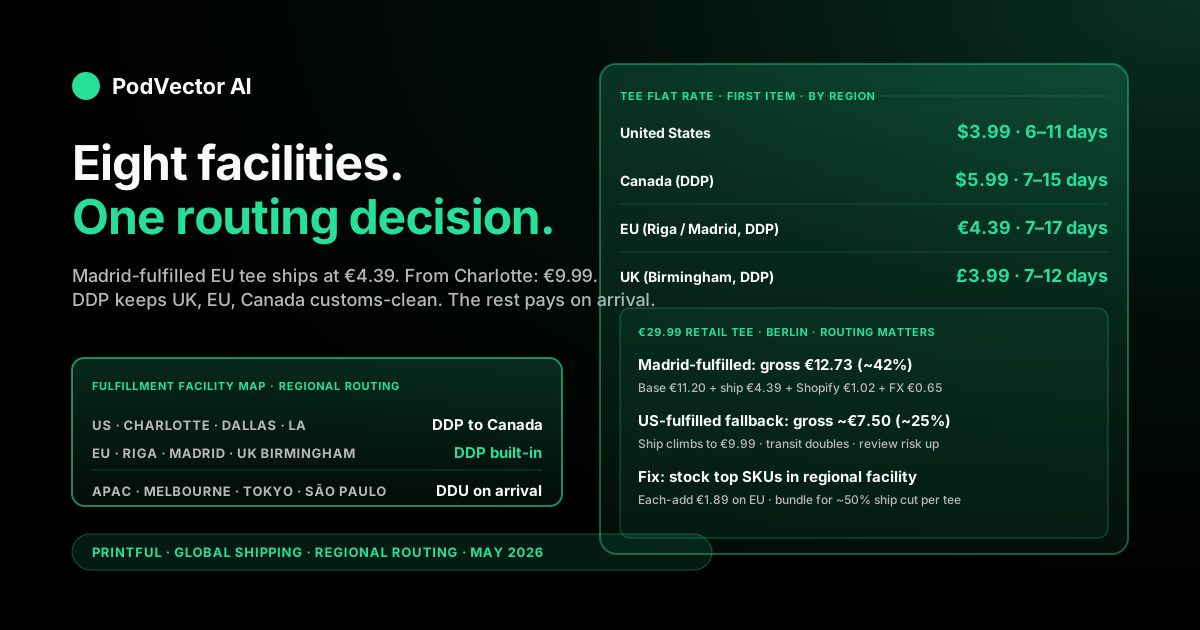
Quick Answer: Printful routes each order to the closest regional facility — US (Charlotte, Dallas, LA), EU (Latvia, Spain), UK (Birmingham), Canada, Australia, Japan, Mexico, and Brazil — so standard delivery reaches most major markets in 5–12 business days door-to-door after a 2–5 business day fulfillment window.
Printful uses flat regional rates in a "first item + each additional" structure. According to our Printful shipping rates and zones guide, a US t-shirt ships at approximately $3.99 first item; a US hoodie runs $8.49 first item / $2.50 additional (verified after the June 4, 2026 rate update, per Printful's shipping price updates page). Europe apparel starts at €4.79 first item; Australia/NZ at AUD $10.49 first item (up from AUD $9.80 in February 2026, per Bootstrapping Ecommerce). International Worldwide-region tees reach $11.99 for the first item, per Printful's official rate card. DDP (Delivered Duty Paid) covers the UK and EU so customers get no customs surprise on arrival; Australia, Japan, and ROW ship DDU.
The line nobody draws clearly: cross-border POD margin lives or dies on which region your order routes through. A Madrid-fulfilled EU tee costs you roughly half the shipping of the same tee shipped from Charlotte to Berlin. This guide walks the global network, the regional rate cards, the customs rules, and the margin math underneath all of it.
Printful's global fulfillment network
Printful's pitch on global shipping isn't "we'll ship anywhere from one warehouse." It's the opposite: regional facilities that route each order to the closest production site with capacity.
That routing decision is what drives both your shipping cost and the customer's delivery window. A German customer ordering a tee triggers fulfillment in Riga (Latvia) or Madrid (Spain) — not a 6,000-mile haul from Charlotte. That single architectural choice is why Printful can quote 5–12 business days to most of Europe instead of 15–25.
According to our Printful shipping rates and zones guide, Printful uses nine named shipping regions — USA, Canada, Europe, UK, EFTA, Australia/New Zealand, Japan, Brazil, and Mexico — with separate flat rates per region per product category, and a tenth catch-all Worldwide region for every country not in the named nine. Here's the current facility map:
- United States: Charlotte (NC), Dallas (TX), Los Angeles (CA), plus a few smaller print partners for specialty items
- Canada: Toronto fulfillment partner for select apparel
- European Union: Riga (Latvia) is the primary EU facility; Madrid (Spain) handles overflow and some specialty categories
- United Kingdom: Birmingham — opened post-Brexit specifically to ship UK orders DDP and avoid customs delays
- Australia: Melbourne fulfillment partner for apparel
- Japan: Tokyo partner for select categories
- Mexico: Mexico City for select apparel
- Brazil: São Paulo for the LATAM market
The routing logic prioritizes the facility closest to the shipping address. If that facility doesn't carry the SKU your customer ordered, the order falls back to the next-closest facility that does. This is why one customer in Berlin might see a 7-day delivery and another in Berlin sees 11 days — depending on whether the all-over-print product they bought is stocked locally or has to ship from the US.
Countries not covered by a named region — including Morocco, Pakistan, Argentina, and the Philippines — land in the Worldwide bucket and ship from the nearest US facility. That routing difference has real cost and delivery-time consequences covered in the country-specific section below.
For a deeper teardown of the standard transit windows and rate card without the regional breakdown, see our base Printful shipping times guide.
Global shipping rates by region and product
Printful publishes flat rates per product category and region. The structure is consistent: a higher "first item" rate plus a lower "each additional" rate. Rates have been updated twice in 2026 — in February and again on June 4, 2026 — so always cross-check against the live Printful shipping page and the Printful shipping price updates log before publishing rates to customers.
The following rates are sourced from our own rate-card tracking verified against Printful's shipping page after the June 4, 2026 update (per our Printful shipping rates and zones guide). Always verify against Printful's live calculator before using in your store settings — rates for specific product categories can and do move independently between update batches.
US domestic (first item / each additional):
- T-shirt / tank: approximately $3.99 first item (per our Printful shipping rates and zones guide)
- Hoodie / sweatshirt: $8.49 / +$2.50 (per our Printful shipping rates guide)
- Mug: $4.69 / +$2.55 (per our Printful shipping cost breakdown)
- Stickers / postcards / patches: $4.29 first item (increased from $3.99 in February 2026, per Bootstrapping Ecommerce)
- Phone case: $4.99 first item (increased from $4.59 in February 2026, per Bootstrapping Ecommerce)
- Knitted products: $11.49 first item (increased from $10.49 in February 2026, per Bootstrapping Ecommerce)
Canada (CAD, first item / each additional):
- T-shirt / apparel: CAD $8.29 first item (per our Printful shipping cost breakdown)
- Hat: CAD $9.75 first item (increased from CAD $8.95 in February 2026, per Bootstrapping Ecommerce)
European Union (EUR, first item / each additional):
- T-shirt / apparel: €4.79 / +€1.45 (per our Printful shipping rates and zones guide)
- Hoodie: €7.79 / +€1.99 (per our Printful shipping rates and zones guide)
United Kingdom (GBP, DDP, first item / each additional):
- T-shirt / tank: £3.99 / +£1.79
- Hoodie: £6.99 / +£1.89
Australia / New Zealand (AUD, first item / each additional):
- Apparel: AUD $10.49 first item (increased from AUD $9.80 in February 2026, per Bootstrapping Ecommerce)
- Australia/NZ via local fulfillment where stocked: AUD $7.69 / +$1.40 (per our Printful shipping rates and zones guide)
Worldwide / ROW (USD, first item / each additional):
- T-shirt: $11.99 first item, per Printful's official rate card (as reported by our Printful Worldwide shipping guide)
- Hoodie / sweatshirt: verify current figure on Printful's live shipping page — heavier items climb significantly higher than the tee rate to Worldwide destinations, per our Printful Worldwide shipping guide
The pattern is clear: local fulfillment cuts shipping cost significantly versus cross-ocean US fulfillment. If your customer base skews European or Australian, getting your SKUs stocked in the regional facility is the single highest-leverage move on the margin side.
One multi-category trap worth flagging: according to our Printful Worldwide shipping guide, a buyer who orders a t-shirt and a hat in the same cart doesn't pay the t-shirt first-item rate plus an additional-item rate — each product category gets its own first-item charge. This applies globally and is a common source of checkout-price miscalculation for sellers modeling profitability in a spreadsheet.
Note that Printful periodically adjusts international rates by different amounts across regions — the February and June 2026 updates affected accessories, select apparel categories, and international zones unevenly. Standard Bella+Canvas and Gildan apparel shipping to the US was not affected by the February 2026 round, per Bootstrapping Ecommerce.
For the European-specific deep-dive on rate-card behavior and DDP/VAT treatment, see Printful shipping times Europe. For the full rate table across all product categories, see our complete Printful shipping rates and zones guide.
Shipping times by destination
Every Printful order has two clocks. Fulfillment is the time between the order coming in and Printful handing the parcel to the carrier. Transit is the time between carrier hand-off and the customer's doorstep.
Fulfillment window: 2–5 business days for DTG apparel, 3–7 for embroidery, and 1–3 for non-print items like mugs or stickers. Holiday peaks (mid-November through mid-January) routinely stretch fulfillment by an additional 1–2 days. Fulfillment time is generally the same regardless of which facility ships the order.
Standard transit windows (after fulfillment):
- US domestic: 3–8 business days transit (per our Printful shipping rates guide). Door-to-door expect 5–13 business days on standard.
- Canada (from US or Toronto): 5–10 business days transit. Faster from Toronto when stocked locally.
- EU (from Riga / Madrid): 5–12 business days depending on country. Germany/France/Netherlands trend faster; Greece, Cyprus, and the Nordics trend longer.
- UK (from Birmingham, DDP): 5–7 business days, often closer to the low end. DDP means no customs delay.
- Australia / New Zealand: 5–20 business days. 5–10 if locally fulfilled in Melbourne; up to 20 if shipping from the US.
- Japan: 7–14 business days, often locally fulfilled for apparel.
- Mexico: 7–14 business days from the Mexico City facility when the SKU is stocked locally; longer if falling back to US fulfillment.
- Latin America (Brazil locally fulfilled): 7–14 business days inside Brazil; 14–25 to the rest of LATAM from the US.
- Rest of world / Worldwide: 10–20 business days, per our Printful Worldwide shipping guide. Customs holds in places like India, Saudi Arabia, and parts of Southeast Asia can stretch this to 25+.
The takeaway: the "global shipping" promise is regionally honest where Printful has local capacity, and significantly slower everywhere else. If your store sells to ROW customers in any volume, set delivery expectations explicitly on the product page — that's where return-rate creep starts. Also note: a separate EFTA region exists for Switzerland, Norway, and Iceland, with its own rate tier; verify the live rate before adding those countries to a European shipping zone.
Country-specific notes: Poland, Morocco, Pakistan, Argentina, Philippines
These five markets come up frequently in seller questions because they sit at the intersection of growing consumer demand, ad-platform reach, and tricky customs or routing realities. None of them has a Printful local facility, so all orders ship from the nearest facility that stocks the SKU — typically a US site or, for Poland, the EU (Riga).
Poland
Poland is an EU member state, so orders route through Riga or Madrid and ship under EU regional rates (apparel at €4.79 first item, per our Printful shipping rates and zones guide) with DDP treatment. Transit from Riga is typically 5–10 business days. This is one of the better-positioned ROE markets for POD — competitive shipping cost, no customs surprise, growing ecommerce spend. If you're running Meta ads into the EU, Poland often shows strong ROAS relative to its ad CPMs.
Morocco
Morocco falls in the Worldwide region and ships DDU from the US. Customs clearance in Morocco can be slow and unpredictable — expect 14–25 business days door-to-door on a good run, with occasional holds stretching to 30+ days. Import duties apply on arrival. Disclose this explicitly on the product page. Morocco is not an ideal primary market for POD without a meaningful local community or influencer pull justifying the customs risk.
Pakistan
Pakistan is a Worldwide region / DDU destination. Transit from the US runs 14–25 business days. Pakistani customs applies import duties on apparel; graphic-print products occasionally face additional scrutiny. The Worldwide rate applies — a standard tee ships at $11.99 first item, per Printful's official rate card (as reported by our Printful Worldwide shipping guide). Given that shipping cost alone often exceeds the product base cost, unit economics for low-ticket SKUs are typically negative unless the retail price is set significantly above standard US market rates.
Argentina
Argentina is a Worldwide region / DDU destination with an additional complication: Argentina's import regulations and currency controls have historically created customs delays and unpredictable duties on international parcels. Transit of 20–30+ business days is common. Refund and dispute rates on Argentine orders tend to run higher than other LATAM markets due to these delays. Consider geofencing Argentina at checkout unless you have a demonstrated audience with realistic delivery expectations already set.
Philippines
The Philippines is a Worldwide region / DDU destination. Transit runs 14–25 business days from the US. Customs clearance is generally more consistent than Morocco or Argentina, but duties still apply on arrival. The Philippines has a growing Shopify-adjacent buyer market and English-language comfort that makes it a reasonable secondary market — but set delivery expectations clearly on the product page and disable express for this destination, since the transit bottleneck is customs, not the carrier leg.
For the full breakdown of Worldwide-region shipping costs, customs behavior, and margin impact across all non-named-region countries, see our Printful Worldwide shipping guide.
DDP vs. DDU: who pays customs
Cross-border shipping has two pricing models for import duties and taxes. Printful uses both, depending on destination.
DDP (Delivered Duty Paid): Printful collects estimated duties and taxes at checkout via the shipping rate, then handles the customs paperwork. The customer pays nothing extra on arrival.
DDP is currently the default for: UK, EU (most countries), Canada. According to Printful's own blog, when live rates are enabled, customers in DDP-eligible destinations see a "standard DDP" option at checkout with customs duties and taxes included in the shipping price. The Birmingham facility was opened specifically to keep UK shipments DDP and dodge the post-Brexit customs complexity.
DDU (Delivered Duty Unpaid): Printful ships the order without prepaying duties. The carrier collects import fees from the customer on arrival before releasing the package.
DDU is the default for: Australia, Japan, most of LATAM, ROW — including Morocco, Pakistan, Argentina, and the Philippines. Your customer might owe import taxes when DHL or the local postal service delivers — the exact amount varies by country, declared value, and product category.
This is the single largest source of negative-review complaints on POD stores selling internationally. A customer pays full price at checkout, expects nothing else, and then gets a customs invoice from their local courier. Most write a negative review or initiate a chargeback before reading the fine print.
Two countermoves:
- Disclose customs liability explicitly on the product page and at checkout. Not in a buried policy footer. "Import duties may apply on delivery and are the customer's responsibility — typical amounts vary by country and order value." This isn't a conversion killer when phrased plainly. Burying it is.
- Stock SKUs locally in your top non-DDP markets. If you sell heavily to Australia, get your top tees and hoodies fulfilled from Melbourne where the duty exposure drops significantly on domestic apparel orders.
For the checkout conversion impact of shipping disclosures and free-shipping thresholds, see our guide on CRO techniques for ecommerce. And for the broader benchmark context on how checkout drop-off compares across the industry, see our average checkout completion rate benchmarks.
Express vs. standard: when each makes sense
Printful offers express shipping on top of its standard tier across most destinations. Express delivers in 1–3 business days after fulfillment, per our Printful shipping rates and zones guide. The trade is faster transit at a meaningful premium.
Express transit windows (after fulfillment):
- US domestic: 1–3 business days after fulfillment (per our Printful shipping rates guide)
- Canada: 3–5 business days
- UK / EU: 3–7 business days
- Australia: 5–10 business days
- ROW: 3–7 business days (often faster than standard due to DHL Express vs. local postal handoff, per our Printful global shipping guide)
Important: express shipping speeds up the carrier leg only — it does not skip the 2–5 business day fulfillment window. As our Printful shipping prices guide notes, a "next-day express" order placed Monday evening typically delivers Friday at the earliest, not Tuesday. Set customer expectations accordingly.
For some destinations, express shipping won't be available — in that case, customers see only the standard option at checkout, per Printful's blog. Always check availability for your target markets before advertising express as a feature.
Express rate premium: according to our Printful shipping cost breakdown, express shipping adds approximately $9.50–$22.99 per order on top of standard rates, scaling with destination and weight. A hoodie shipped express to Australia can run $30+ in total shipping, per our Printful global shipping guide.
The honest call: offering express at checkout converts well for gift orders (birthdays, holidays, last-minute), but the customer who picks express is paying for speed they value above the cost. Don't subsidize it. Set the express rate to what Printful charges you plus a small buffer, and let demand sort itself.
Where express loses: ROW destinations with consistent customs delays — Morocco, Pakistan, Argentina, and similar markets. A premium express upcharge to destinations where customs is the bottleneck, not transit, delivers a poor customer experience regardless of what the carrier does. Disable express for those destinations or add a clear disclaimer.
Restricted countries and known limits
Printful does not ship to: Russia, Belarus, Cuba, Iran, Syria, North Korea, plus specific occupied regions of Ukraine. These are sanctions-driven and non-negotiable.
Other operational limits worth knowing:
- India: Ships but customs delays are routine. Plan for 15–25 business days transit even on express. See our dedicated Printful shipping time to India guide for the full customs and cost breakdown.
- Saudi Arabia, UAE: Standard apparel ships fine; customs scrutiny is heavy on graphic prints with religious or political imagery.
- Argentina: Ships but customs and currency-control delays are common. See the country-specific section above.
- Morocco / Pakistan / Philippines: Ships DDU via Worldwide region — see the country-specific section above for transit and duty expectations.
- Brazil (outside São Paulo fulfillment): Imports from the US face heavy duties and slow customs. The São Paulo facility doesn't carry every SKU — check before assuming local fulfillment.
- EFTA (Switzerland, Norway, Iceland): These fall outside EU DDP rules; they have their own rate tier and customs requirements. Treat them as separate zones from EU in your Shopify shipping settings.
- Africa, broadly: Ships to most countries but with 20–30+ business day transit and high customs variance. Set explicit expectations or geofence at checkout.
The cross-border margin trap most POD sellers walk into
The flat-rate card looks contained until you stack it against currency conversion, payment processor fees, and ad spend allocated by region. The core issue: two orders that look identical on the retail line item can deliver vastly different margins depending on which facility picked them up and which rate zone applies.
Consider a cross-border tee order to Germany, sold via Shopify and fulfilled from Madrid, versus the same order routing to Charlotte because the SKU isn't stocked in Madrid:
- EU-fulfilled (Madrid): Standard EU apparel shipping of €4.79 first item (per our Printful shipping rates guide), 5–12 business day delivery, no customs hold, full DDP coverage.
- US-fulfilled (Charlotte fallback): Worldwide-zone apparel shipping of $11.99 first item, per Printful's official rate card (as reported by our Printful Worldwide shipping guide), 14+ business day delivery, potential customs delay even under DDP, customer review risk goes up.
The shipping-cost difference alone between those two routes is material. Stack in FX fees, a longer delivery window that drives customer service tickets, and a higher refund rate on delayed orders, and the margin gap between a Madrid-routed and Charlotte-routed EU order is significant — yet most operators only see "shipping" as a single line on their quarterly Printful invoice.
A second, quieter margin trap: the Worldwide drift. As our Printful Worldwide shipping guide describes, a viral post or one ad campaign in a new market can quietly push a growing share of monthly orders into the Worldwide bucket, dropping blended margin before the next P&L review catches it. If you're not tracking region-mix week over week, this drift is invisible until it hurts.
The per-order, per-region, per-SKU breakdown is where the actual margin lives — and where the conversation about which SKUs to stock locally starts. Understanding your true net profit margin per order (not just gross margin) is essential to knowing whether a regional ad push is actually profitable. See our net profit margin benchmark guide for the framework, and our guide on increasing AOV with AI for how average order value interacts with fixed shipping costs across regions.
For the costs cluster that goes deeper on Printful's pricing tiers and membership math, see the Printful pricing membership breakdown and the Printful Pro membership cost teardown. For a side-by-side comparison of Printify's cost structure, see our dropshipping and supplier cost guide.
Strategies for selling globally with Printful
Five moves operators use to keep cross-border POD profitable, ordered by leverage:
1. Stock top SKUs in regional facilities before scaling ad spend by region. A tee that sells well in the US won't auto-route through Madrid until you've enabled European fulfillment for that SKU. Check the SKU-by-facility availability matrix in your Printful dashboard before pointing Meta ads at Germany. Running ads to a region before confirming local fulfillment is the fastest way to compress margin before you've generated a single data point.
2. Geofence at checkout for destinations with customs friction. Don't ship to a country where your refund rate exceeds an acceptable threshold due to customs surprises. Disable shipping to that destination in Shopify's settings until you can solve the disclosure problem. Use Shopify's country-level shipping zone controls — they're built for exactly this. Argentina, Morocco, and Pakistan are prime candidates for geofencing until you have reliable delivery data.
3. Disclose duties clearly on every product page for DDU destinations. One short sentence in plain English: "Orders to Australia, Japan, Morocco, Pakistan, Argentina, the Philippines, and other non-EU/UK destinations may incur import duties payable on arrival — typical amounts vary by country and order value." Burying this in a policy footer is the single largest source of negative reviews on global POD stores.
4. Build shipping into the retail price for primary markets. "Free shipping" at a higher retail price converts better than a lower base price plus a shipping line item at checkout. Cart abandonment at the shipping reveal is the largest single drop-off in cross-border POD funnels. For the CRO mechanics behind that drop-off and how to test it, see our CRO techniques guide. And for the email recovery flow when customers still abandon, see our guide on Klaviyo browse abandonment flow setup.
5. Use bundle SKUs to leverage the each-additional rate. The each-additional rate on EU apparel (€1.45 per our Printful rates guide) is a fraction of the first-item rate (€4.79). A two-tee bundle to Germany costs significantly less in shipping than two separate single-item orders. Bundle pricing is the most undermarketed lever in POD checkout design. Victor can help set up a buy-one-get-one discount or raise your free-shipping threshold in Shopify — those are live Shopify-side write actions available today. For the broader POD strategy context, see our PodVector POD strategy guide.
For the broader picture beyond shipping — base costs, membership pricing, and the full Printful cost stack — see the Printful costs cluster. For everything shipping-related across regions, see the Printful shipping cluster. And the Printful topic hub covers the platform end-to-end.
FAQs
Does Printful ship to every country?
No. Printful ships to roughly 200 countries and territories, but excludes Russia, Belarus, Cuba, Iran, Syria, North Korea, and occupied regions of Ukraine. India, Saudi Arabia, parts of Africa, and some LATAM destinations (including Argentina) ship but with significant customs delays and variable transit times.
How does Printful decide which facility fulfills my order?
Routing prioritizes the facility closest to the shipping address that has the SKU in stock. If the local facility doesn't stock that product, the order falls back to the next-closest facility that does — typically a US site for unusual or specialty SKUs. According to our Printful shipping rates and zones guide, Printful operates across nine named shipping regions (USA, Canada, Europe, UK, EFTA, Australia/NZ, Japan, Brazil, Mexico) plus a Worldwide catch-all.
What is DDP and which countries does Printful ship DDP?
DDP (Delivered Duty Paid) means Printful collects duties and taxes upstream and the customer pays nothing on arrival. Per Printful's own documentation, when live rates are enabled, DDP is available as a checkout option for the UK and Canada. EU orders from regional facilities also ship DDP. Australia, Japan, LATAM (outside Brazil locally), and ROW — including Morocco, Pakistan, Argentina, and the Philippines — typically ship DDU, meaning the customer owes import fees on arrival.
How long does Printful shipping take internationally?
Standard transit ranges from 3–8 business days (US domestic, per our Printful shipping rates guide) to 5–12 days (EU), 5–7 days (UK), and up to 5–20 business days for Australia/NZ depending on whether the order ships locally or from the US. Worldwide / ROW is typically 10–20 business days; add 2–5 business days fulfillment to all of these to get door-to-door windows. Express shipping reduces transit to 1–3 business days after fulfillment but does not speed up the fulfillment phase.
What changed in Printful's 2026 shipping rate updates?
Printful ran two rate updates in 2026. In February 2026, accessory and select international rates increased: US sticker/postcard/patch shipping rose from $3.99 to $4.29, phone case shipping rose from $4.59 to $4.99, knitted product shipping rose from $10.49 to $11.49, Australia/NZ apparel rose from AUD $9.80 to AUD $10.49, and Canada hat shipping rose from CAD $8.95 to CAD $9.75 — per Bootstrapping Ecommerce. Standard Bella+Canvas and Gildan apparel rates to the US were not affected. A second update went live June 4, 2026 — see Printful's shipping price updates page for the full tables. Always verify against the live calculator before updating storefront pricing.
How does Printful ship to Poland, Morocco, Pakistan, Argentina, and the Philippines?
Poland is an EU member state and routes through Riga or Madrid under EU regional rates with DDP treatment — it's one of the better-positioned European markets for POD. Morocco, Pakistan, Argentina, and the Philippines all fall in the Worldwide region and ship DDU from the US, with transit typically running 14–25+ business days and import duties payable by the customer on arrival. See the country-specific section above for the full breakdown of each market.
Why is shipping cheaper from Madrid than from Charlotte for an EU customer?
Local fulfillment cuts the carrier handoff and customs friction. A Madrid-to-Berlin tee ships intra-EU with no customs hold and a lower carrier cost than a transatlantic shipment. The EU apparel rate of €4.79 first item versus the Worldwide rate of $11.99 first item (per Printful's official rate card, as reported by our Printful shipping rates guide) is the rate-card consequence of that routing difference.
Does Printful charge VAT on international shipments?
For DDP destinations (UK, EU, Canada), VAT and duties are bundled into the shipping rate at checkout. For DDU destinations, the customer pays VAT on arrival to their local customs authority. Your Printful invoice reflects what Printful collected and remitted; check it against your store's tax remittance to avoid double-charging.
Can I offer free shipping globally with Printful?
You can, but you'll absorb the rate differences across regions. Most operators offer free shipping in primary markets only (US, EU, UK) and apply standard rates or geofence ROW destinations. Building shipping into the retail price works for the markets where the rate-card variance is small. Victor can raise your free-shipping threshold in Shopify — that's one of his live Shopify-side write actions available today.
Does Printful include tracking on international shipments?
Yes. All Printful shipments include carrier tracking — though tracking detail and quality vary by destination. UK, EU, US, and Canada have full milestone tracking. ROW destinations (Morocco, Pakistan, Argentina, Philippines, etc.) often show "departed origin facility" and then nothing until delivery, which can spike customer service inquiries.
How do I check which SKUs are stocked in which Printful facilities?
In your Printful dashboard under each product's settings, the fulfillment region matrix shows which facilities carry that SKU. The default for new products is typically US-only; you have to opt SKUs into European, UK, Australian, and other regional facilities individually. This is a critical step before scaling ad spend into any non-US region. For AI-powered analytics to evaluate which regions are worth the SKU-enablement work, see our guide to the best AI chatbots for ecommerce and the broader PodVector POD strategy guide.
See where global shipping is eating your margin — by SKU, by region, by week
Printful's rate card is published. Which orders routed through Madrid vs. Charlotte, which SKUs you're shipping ROW at a loss, and where your DDU complaints are clustering — that lives across a Printful CSV, a Shopify export, and a payment processor statement. Nobody is going to assemble that on demand.
Victor is PodVector's AI employee for intermediate-to-advanced POD sellers on Shopify. He reads your Printful, Shopify, and ad spend data into one live data warehouse and answers questions like "what did Australia shipping cost me last month, net of refunds?" in plain English. He also flags which SKUs you should stock in Melbourne before the next ad push — and can reprice products to a target margin or raise your free-shipping threshold with your approval.
Try Victor free