
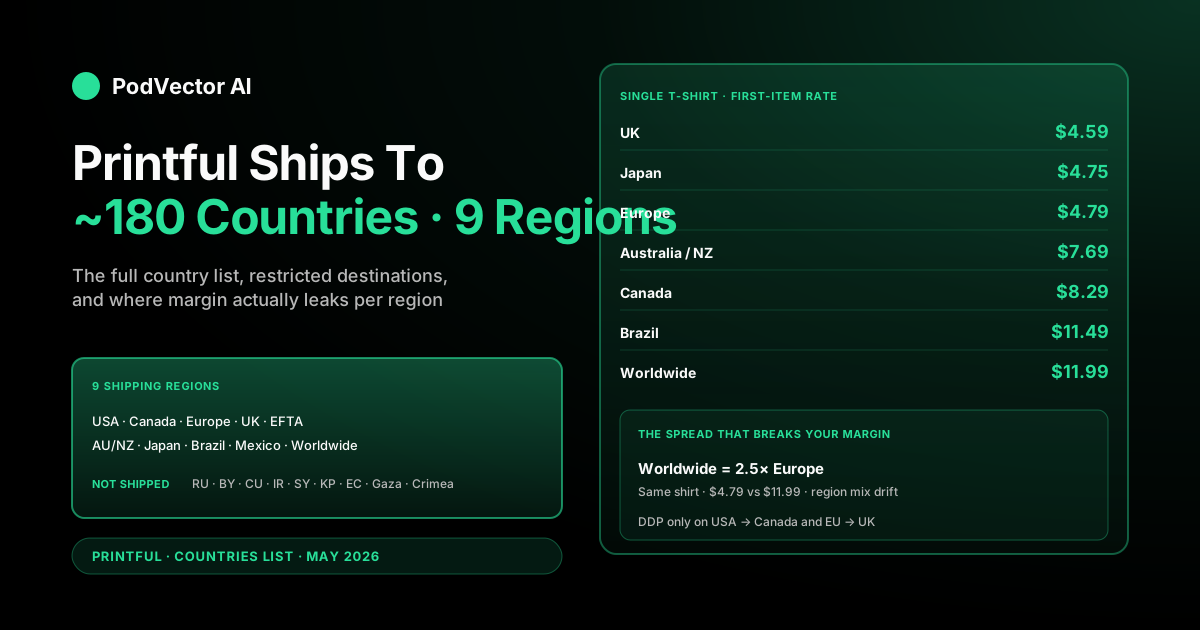
Quick Answer: Printful ships to most countries worldwide, grouped into 9 shipping regions: USA, Canada, Europe, UK, EFTA states, Australia/New Zealand, Japan, Brazil, Mexico, and a "Worldwide" catch-all for everything else.
The eight named regions get faster transit and cleaner customs paths. The Worldwide bucket — most of Asia, Africa, the Middle East, and chunks of Latin America — is slower, more expensive, and where refused-package rates spike.
According to Printful's own help documentation, Printful does not ship to the Crimea Region, Donetsk People's Republic, Luhansk People's Republic, Russia, Belarus, Cuba, Iran, Syria, and North Korea, among others. Carrier-driven pauses can also affect additional destinations at any time depending on world events. Ukraine and Kosovo receive Printful orders only via the Latvian facility, with a limited catalog. Check Printful's live shipping page for the current list.
The 9 Printful shipping regions, country by country
Printful doesn't quote shipping country by country at checkout. It groups every destination into one of nine regions, then sets one flat shipping rate per product per region.
Knowing which countries fall into which region matters because the region — not the country — determines what you pay and how long the order takes. According to Printful's help center, shipping restrictions may change based on world events or carrier updates, so cross-check the live shipping page at least once a quarter.
USA. The 50 states, plus DC. Puerto Rico, Guam, and US Virgin Islands ship at US domestic rates but with longer transit windows. APO/FPO/DPO military addresses also fall under US domestic. Note: according to Printful's shipping page, Quick Stores only support orders shipping to US addresses.
Canada. All 10 provinces and 3 territories. Canada has its own DDP shipping option from the US, so duties can be pre-paid at checkout rather than billed on arrival.
Europe. Most EU member states — Austria, Belgium, Bulgaria, Croatia, Cyprus, Czechia, Denmark, Estonia, Finland, France, Germany, Greece, Hungary, Ireland, Italy, Latvia, Lithuania, Luxembourg, Malta, Netherlands, Poland, Portugal, Romania, Slovakia, Slovenia, Spain, and Sweden. Monaco, Andorra, and San Marino route through this region for most products.
UK. England, Scotland, Wales, and Northern Ireland. Carved out from the EU region after Brexit, with its own flat rate and a separate DDP option.
EFTA states. Norway, Switzerland, Iceland, and Liechtenstein. Treated as their own region because they're outside the EU customs union but inside the European logistics network.
Australia and New Zealand. Both countries share one shipping region. AU/NZ orders are increasingly fulfilled at a local partner facility, which dramatically improves transit times when stock is available.
Japan. Single-country region. Local partner fulfillment is available for select products, which makes Japan one of the faster international destinations from the buyer's perspective.
Brazil. Single-country region with its own rate, primarily because Brazilian customs and import processes are unique enough to warrant their own pricing line.
Mexico. Single-country region, supported by Printful's Tijuana fulfillment facility.
Worldwide. The catch-all. Everything not in the eight named regions: most of Asia (India, Singapore, South Korea, Thailand, Vietnam, the Philippines, Indonesia, Malaysia, and dozens more), all of Africa, the Middle East, the Caribbean, and the parts of Latin America outside Brazil and Mexico. The widest range of destinations and the most variable customs experience.
Printful's official shipping page publishes the per-region rate cards and the full country lookup. Cross-check it once a quarter — the country-to-region mapping does change as new partner facilities come online.
Countries Printful does not ship to
The hard-blocked list is short, but it's the one to memorize. According to Printful's help center, if your store accepts checkout from any of these destinations, those orders will not be fulfilled, produced, or shipped regardless of which carrier you select.
As of August 2026, according to Printful's official shipping restrictions documentation, Printful does not ship to:
- Russia. Blocked. Both shipping and product orders.
- Belarus. Blocked alongside Russia.
- Crimea Region, Donetsk People's Republic, and Luhansk People's Republic. Carrier-level restriction per Printful's help center.
- Cuba. US sanctions.
- Iran. US sanctions.
- Syria. US sanctions.
- North Korea. US sanctions.
Printful's help documentation notes that the list of restricted countries may change depending on world events, and that some shipping carriers also pause international deliveries because of natural disasters or other disruptions. Check the Printful shipping restrictions page for current additions — carrier-driven pauses come and go quarter to quarter.
The cleanest fix on the seller side: configure your storefront to block checkout from these countries before the order is placed. According to Printful's help center, if an order is imported from a connected integration, placed through the API, or otherwise makes it through to production, Printful won't be able to print a shipping label for it — the order will most likely be placed on hold. A failed order after the customer has paid creates a refund cycle, a support ticket, and a chargeback risk if the buyer escalates.
On Shopify, the cleanest path is Settings → Markets: per Printful's own guidance, deselecting a country under the Countries/regions section prevents checkout from those destinations entirely.
Special-case countries with limits
Several countries technically receive Printful orders but only under restricted conditions. These are the ones that surprise sellers most.
Ukraine (outside Crimea/Luhansk/Donetsk). According to Printful's help center, because of the ongoing war, most shipping carriers have suspended delivery services to the region, so Printful is only able to ship orders fulfilled at its facility in Latvia. A customer in Kyiv ordering a non-EU-stocked product will see the order fail to fulfill even though shipping appears available at checkout. Pre-filter your Ukraine SKUs to what Latvia actually prints.
Kosovo. According to Printful's help center, the same restrictions apply to Kosovo — Printful only ships products from its Latvian facility, and the available products are limited. Same operational pattern as Ukraine.
Brazil. Ships, but customs is the longest pole in the international shed. Standard transit can run well into double-digit business days, and the Brazilian Receita Federal frequently holds packages for inspection. Operators should expect a higher-than-average rate of "where is my order?" tickets from Brazilian buyers.
India. Falls under Worldwide. The country accepts Printful packages, but high customs duty rates on apparel and a high refusal rate mean operators should think twice before defaulting India to the catalog. Region-specific pricing is almost mandatory if you want to ship there profitably.
China. Falls under Worldwide. Shipping works, but the small percentage of Chinese buyers ordering POD apparel from Western stores often face import-side delays. Transit windows can stretch considerably during customs backlogs.
Israel. Falls under Worldwide. Shipping is operational but transit can be erratic depending on regional conditions. Cross-reference Printful's published carrier-status notices before quoting Israeli buyers a tight delivery window.
South Korea. Falls under Worldwide. One of the better-behaved Worldwide destinations — customs is efficient and transit typically lands in the 10–14 day range. Worth monitoring after any year-end Korean import-tax assessment changes.
For country-specific transit-time breakdowns, the Printful shipping time to France guide, the shipping time to India guide, and the shipping time to US guide cover the practical math by destination.
Outsourced-product shipping restrictions
Beyond the country-level restricted list, Printful imposes a separate layer of destination limits on certain outsourced catalog items. According to Printful's help documentation, due to regional partner limitations, some outsourced products have specific shipping destinations and cannot be delivered worldwide.
The categories affected include footwear, all-over-print outerwear, pajama sets, pet accessories, and select bags. Printful's shipping page shows which countries are eligible for a given product at the product level — check it before adding a new outsourced SKU to an international catalog. A product that appears available at checkout can still fail to fulfill if the buyer's country is outside the product's approved destination list.
This is a separate failure mode from the country-level block — the order isn't refused at the country level, it gets held after production assignment because no partner facility can ship it to that address. The operational result is the same: a held order, a refund, and a support ticket.
What each region actually costs to ship to
Flat rates per region, per product. The first item in each shipping bucket carries the higher rate; additional items in the same bucket add a smaller incremental charge. Check Printful's live shipping page for current rates — these figures are subject to change when carrier contracts roll over.
Relative ordering of standard rates for a single t-shirt (verify exact dollar amounts on the current rate card before building your pricing model):
- UK: lowest first-item rate among all regions
- USA, Japan, Europe: comparable first-item rates, within a narrow range of each other
- EFTA (Norway/Switzerland/Iceland/Liechtenstein): moderately higher than Europe
- Australia / New Zealand: higher than EFTA
- Canada: higher than AU/NZ
- Mexico: comparable to Canada
- Brazil and Worldwide: the two most expensive regions, with Brazil close to Worldwide on apparel
Two patterns matter. Europe and the UK ship nearly as cheaply as US domestic because Printful runs facilities in Latvia and Spain. Worldwide carries a substantially higher first-item rate than Europe for the exact same shirt — verify the current spread on Printful's shipping rate card before building your pricing model.
The spread compounds on heavier products. A hoodie that ships within the US at one rate can cost materially more to a Worldwide destination. A backpack or pillow follows the same multiplier.
One pattern that catches operators off guard: multi-category orders split into separate shipping buckets at the facility level. A t-shirt and a mug to the same Australian buyer don't share a single shipping charge — they get two first-item rates because they print at different facilities. The all-in shipping bill on multi-product international orders is consistently higher than the rate card suggests.
For the broader fee picture across the catalog, the Printful pricing and fees breakdown walks through every cost line beyond shipping.
Delivery times by country and region
Total delivery time is fulfillment plus transit. Fulfillment runs several business days for most apparel. Transit is what changes country by country.
Typical transit windows after fulfillment (verify current windows on Printful's shipping page, as carrier performance shifts seasonally):
- USA domestic: 3–4 business days
- Canada: 5–10 business days standard; DDP routes tend to clear faster
- Europe (intra-EU): 3–7 business days
- UK: 4–8 business days standard; DDP routes tend to clear faster
- EFTA states: 5–10 business days
- Australia / New Zealand: 7–14 business days
- Japan: 5–12 business days
- Brazil: 10–20 business days (customs is the long pole)
- Mexico: 5–12 business days
- Worldwide: 10–20 business days; longer for remote destinations
Within the Worldwide region, transit times vary wildly by country. A South Korean buyer typically sees 10–14 days. An Indian buyer often sees longer. A buyer in a smaller African or Caribbean market can see 20 or more days.
Express shipping is available to most regions and cuts the transit leg substantially. It does not touch fulfillment, so the floor on any Printful order remains the fulfillment window regardless of the shipping method chosen.
According to Printful's help documentation, for international shipments from US facilities you can check the most recent carrier disruption information on the USPS Service Alerts page — carrier-level pauses can extend transit windows without warning.
Set your product page expectations against the upper end of each range. A customer who gets their package faster than quoted is happy. A customer who waits one day past the quote opens a ticket.
Which facility ships to which country
Printful's routing logic picks the closest facility that prints the ordered product. The facility, not your store, decides the carrier and customs path.
The facility footprint as of August 2026:
- USA: Charlotte (NC), Dallas (TX), Los Angeles (CA), plus partner locations
- Canada: Toronto
- Europe: Riga (Latvia) and Barcelona (Spain)
- Mexico: Tijuana
- Partner facilities: Japan, Brazil, and Australia for select products
Typical routing by destination:
- EU and EFTA orders: usually Riga or Barcelona. Short transit, intra-EU customs path.
- UK orders: usually Riga or Barcelona, with a customs clearance step at the UK border.
- Canadian orders: Toronto when stocked, US facility when not.
- Mexican orders: Tijuana when stocked, US facility when not.
- AU/NZ orders: Australian partner facility for in-stock products, US facility otherwise.
- Japanese orders: Japanese partner facility when available, US otherwise.
- Brazilian orders: Brazilian partner facility for select products, US for the rest.
- Ukraine/Kosovo orders: Latvian facility only, per Printful's restrictions documentation.
- Worldwide orders: almost always the US.
The mismatch case is the expensive one. A product not stocked at the closest facility ships from the next-closest, sometimes thousands of miles farther. An all-over-print item rare at the EU facility can leave the US for a UK destination, doubling transit time and pushing the order into a different customs path.
You don't get to pick the facility. You do see, on each Printful order detail, which facility printed it. Worth checking once a month to spot products that consistently route the wrong way — they're candidates to drop or to swap for an alternative SKU.
Customs, VAT, and duties by region
Every region has its own customs rules. Three patterns to know.
DDP regions (Canada, UK). Printful pre-pays duties at the carrier handoff. The buyer pays nothing extra at delivery. DDP costs slightly more upfront but eliminates the surprise-bill refusal problem. For both Canada and the UK, DDP is almost always worth the premium.
EU under €150 (IOSS). If your platform handles Import One-Stop Shop registration — Shopify and Etsy typically do — VAT is collected at checkout and the package clears EU customs without a surprise bill. If you sell direct through WooCommerce or a custom checkout, you're on the hook for IOSS registration through an intermediary.
UK under £135. Similar regime to EU IOSS. VAT collected at checkout, remitted by the seller or marketplace. Above £135, VAT and duty are assessed at the border regardless of what you collected at checkout.
Everywhere else. Delivered Duties Unpaid by default. The buyer might owe nothing under their country's de minimis threshold, or they might owe a significant percentage of the order value plus a customs broker fee. They don't know until the package arrives.
Country-level duty patterns to watch:
- Australia: GST assessment rules vary by seller registration status and order value; verify the current threshold with an Australian tax adviser.
- Canada (non-DDP): De minimis threshold is low. Most POD orders exceed it, so duty applies.
- Brazil: Among the highest import tax rates in the Printful network on personal goods. The single most expensive customs path for most POD products.
- India: High duty rates on apparel plus IGST. The reason Indian orders refuse so often.
- Japan: Consumption tax on imports above a threshold; local partner fulfillment avoids this for in-stock items.
- South Korea: Customs duty plus VAT above a value threshold.
The cheapest preventive measure for non-DDP regions is a one-line notice on international product pages: "Additional duties and taxes may apply at delivery, depending on your country." It doesn't fix the duty. It pre-empts the surprise, which is what triggers most package refusals.
Printful vs. Gelato: shipping country coverage compared
One of the top questions sellers ask when evaluating Printful's country reach is how it compares to the alternative. Gelato is the most commonly cited competitor on coverage.
The key structural difference: Printful operates its own named facilities and routes Worldwide orders almost always from the US. Gelato uses a network-routing model — according to Gelato's own homepage, it offers local production in 32 countries, and according to a BusinessWire review citing Gelato's network data, it has more than 140 production hubs across those 32 countries. Orders are automatically routed to a nearby print provider.
What that means in practice for sellers:
- Coverage breadth: Gelato's delivery footprint is larger on paper. Whether the products you actually sell are available at the local hub closest to your customer is a separate question — check the product catalog, not just the country count.
- Russia: Gelato's current availability for Russian orders should be verified directly with Gelato; do not assume any historical network expansion equates to current active shipping given the evolving sanctions environment post-2022.
- Catalog depth: Printful's in-house facilities give it tighter quality control on a narrower catalog. Gelato's partner model gives it broader geographic reach at the cost of more production variability — as one 2026 independent review noted, Gelato is typically the best fit for EU/UK sellers who want fast regional delivery.
- For Shopify sellers on Printful: The 9-region model is predictable and priceable. You know exactly which bucket an order falls in, and the rate card is flat per product. Gelato's per-order routing makes blended shipping cost harder to model in advance.
If your store ships primarily to the US, EU, UK, Canada, Japan, and AU/NZ — the regions where Printful has dedicated facilities — the coverage difference is irrelevant. The gap opens up if your growth is in markets like Southeast Asia, the Middle East, or Eastern Europe outside the EU, where Gelato's partner network may offer faster transit.
For a broader look at how to structure a profitable POD business on these platforms, see the PodVector POD strategy guide and the net profit margin benchmark for POD sellers.
How country mix quietly drifts your POD margin
Country mix is the single most overlooked margin variable on a POD store. It moves week to week, and it moves without anyone noticing.
Mix shifts after a viral post. Your store starts US-heavy. A TikTok or Reels post pulls a wave of EU, UK, and Worldwide orders. Blended shipping cost per order moves up several dollars over a few weeks. Retail prices haven't changed. Gross margin drops before the next P&L review.
The Worldwide bucket grows quietly. Worldwide shipping runs materially higher than the equivalent European rate for the same shirt. If a meaningful share of your orders shifts from named regions to Worldwide, you're losing margin on shipping alone before accounting for product cost.
Refusal-rate drift. A region that worked fine in spring starts refusing a higher share of orders in late autumn as duty assessments tighten. You see the refund volume go up. You don't see, in the same view, that the rejection cost — outbound shipping plus return plus restocking — is the real margin hit, not the refund itself.
DDP/DDU price changes. Printful re-prices international shipping when carrier contracts roll over. If you priced your store a year ago, your international shipping cost is almost certainly higher than your spreadsheet says it is.
Outsourced-product destination failures. A new outsourced SKU (footwear, all-over-print outerwear, pet accessories) added to an international catalog can trigger held orders in countries outside that product's approved destination list — a failure mode that looks like a fulfillment delay, not a margin problem, until you track the refund cost.
Product mix drift inside international orders. Your international channel starts as mostly t-shirts. A new hoodie launch shifts it toward heavier items. International hoodie shipping runs several dollars more per order than international t-shirt shipping. The blended international per-order shipping cost just moved without anyone updating the model.
Static spreadsheets don't catch any of these because the inputs change but nobody re-runs the math. The fix is the same as it is for any drifting line in a P&L: pull every itemized shipping line — region, country, product, DDP/DDU, refusal status — into the same place as your revenue and product cost, and watch per-country margin over time. See the average checkout completion rate benchmarks and the AOV-lifting tactics for complementary levers to offset the shipping cost drag.
For the wider Printful operator picture beyond shipping, the Printful topic hub indexes every guide. The Printful shipping cluster hub indexes every shipping-specific breakdown.
FAQs
How many countries does Printful ship to?
Printful ships to most countries worldwide — grouped into 9 shipping regions: USA, Canada, Europe, UK, EFTA states, Australia/New Zealand, Japan, Brazil, Mexico, and a Worldwide catch-all. The exact list of countries inside each region changes occasionally as new partner facilities come online and as world events affect carrier availability. Check Printful's live shipping page for the current country lookup.
Which countries does Printful not ship to?
According to Printful's shipping restrictions documentation, the hard-blocked list includes Russia, Belarus, Cuba, Iran, Syria, North Korea, and the Crimea Region, Donetsk People's Republic, and Luhansk People's Republic. Printful's help center notes the list may change depending on world events, and some carriers also pause deliveries to additional countries due to natural disasters or other disruptions — always check the live page for the latest.
Does Printful ship to Russia?
No. Printful does not ship to Russia. Both product orders and shipments to Russian addresses are refused at the fulfillment step. Sellers should restrict Russian addresses at checkout — on Shopify, go to Settings → Markets and deselect Russia under Countries/regions to prevent failed orders and refund cycles.
Does Printful ship to Ukraine?
Yes, with significant limits. According to Printful's help center, because of the ongoing war, most shipping carriers have suspended delivery services to Ukraine, so Printful can only ship orders fulfilled in its Latvian facility. The Crimea Region, Donetsk People's Republic, and Luhansk People's Republic are not deliverable at all. Customers in other parts of Ukraine ordering products not stocked in Latvia will see the order fail to fulfill.
Does Printful ship to India?
Yes, India falls under the Worldwide shipping region. Transit can take considerably longer than named regions. Indian customs assess high duty rates on imported apparel plus IGST, which drives high refusal rates. Most operators either price India-specific or restrict the catalog they offer there.
Does Printful ship to Brazil?
Yes, Brazil is its own shipping region with a dedicated rate. Transit can run into double-digit business days because Brazilian customs frequently hold packages for inspection. A Brazilian partner facility handles select products with much shorter transit windows.
What is the cheapest country to ship Printful products to?
The UK carries the lowest first-item rate among all regions — narrowly below the US domestic, Japan, and Europe rates — because Printful routes UK orders through its Latvia and Spain facilities. Check the current rate card before building your pricing model, as rates change when carrier contracts renew.
What is the most expensive country to ship Printful products to?
Anywhere in the Worldwide region carries the highest first-item rate. Brazil is close behind. Heavier products like hoodies and backpacks amplify the spread further. Verify the current differential on Printful's live rate card before setting international retail prices.
Does Printful pay customs and duties on international orders?
Only on the two DDP routes: USA-to-Canada and EU-to-UK. Every other international route is DDU, meaning the buyer is responsible for any import fees, VAT, or duties imposed at delivery. For low-value orders, duties are often waived under de minimis thresholds; for higher-value orders, buyers can owe a significant percentage of the order value plus a customs broker fee.
Can I restrict which countries my Printful store ships to?
Yes, and you should. According to Printful's help center, there is no way to restrict countries directly through Printful settings — you need to set this up within your ecommerce platform. On Shopify, go to Settings → Markets and deselect countries under the Countries/regions section. The cleanest setup is to allow only the regions where you've priced retail correctly and accept the customs path. Auto-restricting the sanctions-blocked countries prevents failed orders and refund cycles.
Are there Printful products that can't ship to all countries?
Yes. According to Printful's help documentation, some outsourced products — including footwear, all-over-print outerwear, pajama sets, pet accessories, and select bags — can only be shipped to a limited list of countries due to regional manufacturing partner limitations. Check the product-level destination list in Printful's catalog before adding any outsourced SKU to an international storefront.
Which shipping region am I in?
Printful classifies your destination based on the shipping address country, not the buyer's billing or store country. A US-based store shipping to a German customer routes through the Europe region. The Printful checkout shows the region and rate before order confirmation, so verify it matches what you priced your store against.
How does Printful's country coverage compare to Gelato?
Gelato operates a partner-hub model with local production across 32 countries, according to Gelato's homepage, with more than 140 production hubs routing orders to the facility closest to the end customer. Printful operates its own facilities in the US, Canada, Europe, and Mexico, and uses partner facilities in Japan, Brazil, and Australia. For sellers primarily targeting the US, EU, UK, Canada, Japan, and AU/NZ, the gap is minimal. It widens meaningfully for Southeast Asia, the Middle East, and parts of Eastern Europe outside the EU, where Gelato's partner network may offer faster local transit.
Your country mix changes every week. Your shipping cost line changes with it.
The Printful rate cards tell you what one order to one country costs today. They don't tell you which share of your orders are now routing through Worldwide where margins are tight, or that a carrier-driven restriction just blocked a new destination, or that your Brazil refusal rate has crept up.
Victor — PodVector's AI employee — reads your Printful account alongside your Shopify, Meta Ads, Google Ads, and Klaviyo data and pulls every relevant signal into a live data warehouse. Ask "which countries are eating my margin this week?" in plain English and Victor surfaces the answer, then proposes a concrete next move — like repricing your worst-margin SKUs to a target margin or raising your free-shipping threshold — as an approval card showing the old and new values. You approve or reject. No spreadsheet. No quarterly P&L surprise.
See how POD sellers use live data to find their next profit move in the PodVector strategy guide, or explore how CRO techniques can offset international shipping drag on your conversion rate.
Try Victor free