
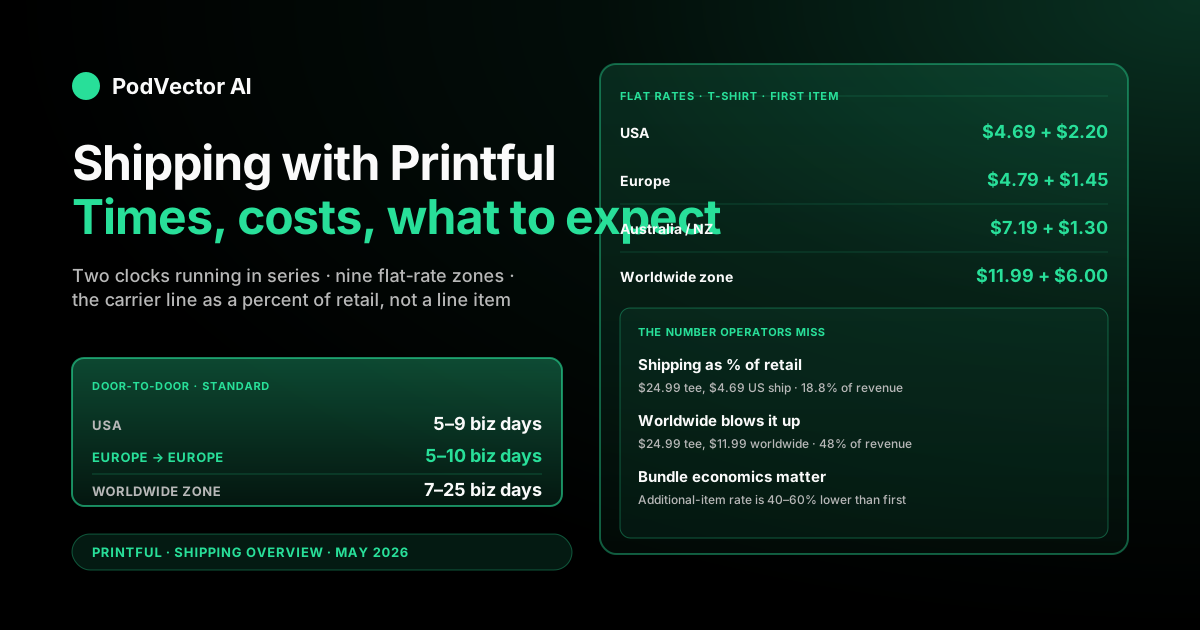
Quick Answer: Shipping with Printful means two windows stacked back to back — fulfillment, then carrier transit. According to PodVector's Printful shipping cost breakdown, total US delivery runs 5–13 business days (2–5 fulfillment + 3–8 transit); international orders run 8–25 business days. Express shipping shortens the transit leg to 1–3 business days (US) or 3–5 business days internationally but does not speed up fulfillment.
Rates are flat per shipping zone and per product category. Per PodVector's breakdown, a US t-shirt ships for $3.99 first item, $1.90 each additional; a hoodie runs $7.19 first item, $1.80 additional; a mug is $4.69 first item, $2.55 additional. These reflect the June 4, 2026 rate update — always verify current rates on Printful's official shipping page before repricing.
For POD operators, the number to plan around isn't the headline rate — it's the percentage of retail that shipping consumes per SKU, per region, and per month. That figure lives in your order data, not on Printful's rate card.
Shipping with Printful is two clocks, not one
Every Printful order has two timers running in series, not in parallel. Misreading them is the single biggest source of customer-service friction on POD orders.
Clock one — fulfillment. The order lands in Printful's queue, gets routed to a facility, gets printed, cured, folded, and packed. The carrier picks up the finished package. As PodVector's shipping breakdown documents, Printful's fulfillment window for apparel is 2–5 business days.
Clock two — transit. The carrier moves the package from the facility to the customer's door. Per PodVector's breakdown, standard US transit runs 3–8 business days; Europe-to-Europe transit is typically 4–6 business days; worldwide transit can run considerably longer.
The two clocks add. A customer reading "ships in 3–4 days" on a product page expects the package on day 4. Printful means the package leaves the facility in that window — and only after fulfillment ends. Build the headline number on your product page as the stacked total: fulfillment plus transit, in business days.
The easiest copy fix is one line: "Standard shipping is 5–13 business days door to door (2–5 fulfillment + 3–8 carrier transit)." Stores that put that line on the product page, in the cart, and in the order confirmation cut their "where's my order?" ticket volume substantially.
Note on 2026 rate changes. Printful has adjusted shipping prices twice in 2026. Per PodVector's express shipping guide, there was a round of increases on select categories in February 2026, then a broader batch of first-item and additional-item price changes that went live on June 4, 2026. Always verify current rates on Printful's official shipping page before setting retail prices.
The 9 Printful shipping zones explained
Printful splits the world into nine flat-rate zones. Each zone has its own per-product rate card. The zones are:
- USA — All 50 states, DC, Puerto Rico, US Virgin Islands, plus military APO/FPO routes
- Canada — All provinces and territories
- Europe — EU member states plus most non-EU European countries
- United Kingdom — Separate zone since Brexit; carries customs implications for EU-bound orders
- EFTA States — Switzerland, Norway, Iceland, Liechtenstein
- Australia and New Zealand — Single combined zone
- Japan — Standalone zone with its own rate card
- Brazil — Standalone zone, longest delivery windows
- Worldwide — Everywhere else, including most of Asia, the Middle East, Africa, and South America outside Brazil
As Printful's own shipping pricing guide explains, the flat-rate model means Printful charges the same rate regardless of which facility fulfills the order — a t-shirt shipped to Berlin and one shipped to Madrid cost the seller the same on the carrier line. The customer's country determines the zone; the zone determines the rate.
Restricted destinations stay outside the zone map. Printful does not ship to embargoed countries (Russia, North Korea, Iran, and others as US/EU sanctions evolve). The current list lives in Printful's help center and shifts with sanctions updates.
Real rates by product and region
The rates below reflect the June 4, 2026 Printful rate update, as documented by PodVector's Printful shipping cost breakdown. Printful pushed two rounds of rate changes in 2026, so any rate card published before June 2026 may be stale. Always confirm current rates on Printful's official shipping page before repricing products.
T-shirts (DTG-printed).
- USA: $3.99 first item, +$1.90 each additional (per PodVector's breakdown)
- Canada: verify current rate on Printful's shipping page
- Europe: €4.79 first item (per PodVector's breakdown)
- UK: verify current rate on Printful's shipping page
- Australia/NZ: AUD $10.49 first item (per PodVector's breakdown)
- Worldwide: $11.99 first item (per PodVector's complete shipping guide)
Hoodies and sweatshirts.
- USA: $7.19 first item, +$1.80 each additional (per PodVector's breakdown)
- Europe and Worldwide: verify current rates on Printful's shipping page
Mugs and ceramics.
- USA: $4.69 first item, +$2.55 each additional (per PodVector's breakdown)
- Europe and Worldwide: verify current rates on Printful's shipping page
Select accessories (updated February 26, 2026). Per PodVector's breakdown, Printful raised shipping on stickers/postcards/patches ($3.99 → $4.29), phone cases ($4.59 → $4.99), and knitted apparel ($10.49 → $11.49) in February 2026 — with further category-level changes in the June 4, 2026 batch. For posters and all other categories, verify on Printful's shipping page.
The additional-item rate is what makes bundles work on Printful. Per PodVector's complete shipping guide, a 3-tee order to a US address ships for $4.75 + ($2.20 × 2) = $9.15 rather than three separate first-item charges — which is why "buy 2, get a discount" promotions often outperform flat sitewide discounts in POD by shifting more shipping cost onto a single first-item charge per dollar of revenue.
For a deeper US-specific rate teardown with itemized math, the US t-shirt rates breakdown walks through every domestic apparel rate against retail price points. For European stores, the Europe t-shirt rates guide covers the EU-zone variance and the post-Brexit UK split.
Standard, express, and CO2-offset tiers
Once an order finishes fulfillment, Printful offers multiple transit tiers. The tier compresses the carrier leg — it does not change fulfillment.
Standard. The default. Per PodVector's shipping breakdown, standard transit runs 3–8 business days on US domestic orders, typically 4–6 days within Europe, and up to 25 business days on worldwide routes. USPS, UPS, DHL, or local equivalents handle the last mile depending on weight, destination, and carrier zone.
Express. Available on most product categories and most destinations. Per PodVector's breakdown, express shipping reduces delivery to 1–3 business days after fulfillment (US) or 3–5 days internationally, for an extra $9.50–$22 per order on top of the standard rate. Per PodVector's express shipping guide, Printful prices express through a live-rates engine — real carrier quotes pulled at checkout, not a static rate card — so the premium varies by product weight and destination. Express is the right call for gift deadlines, replacement orders, and event merch with hard dates. It is not the right call as a default checkout option, since the premium over standard is significant and most POD buyers won't pay it without a clear reason.
Note: per PodVector's express shipping guide, express is not available for APO/FPO military addresses, and buyers with PO box addresses will see express silently disappear from checkout without an error message.
CO2-offset. Same transit window as standard, a small offset surcharge baked into the rate to cover emissions accounting. Available on most US and European routes. The transit time is identical to standard — the offset is a financial layer, not a carrier upgrade.
Most stores offer standard and express at checkout and let the customer choose. Surface standard as the highlighted default and express as a paid upgrade; let cart value or "guaranteed-by-date" copy drive express selection on orders that need it.
Flat rates vs live rates at checkout
Printful lets sellers run shipping in one of two modes. Pick wrong and you either bleed margin or lose conversions to a high shipping line at checkout.
Flat rates. Your storefront charges a fixed amount per zone. Printful charges you their published flat rate per order. You keep the spread on simple orders and absorb the gap on multi-item or remote-zone orders.
As Printful's shipping pricing guide notes, when you use flat rates, Printful selects the best available carrier at the time of the order — balancing quality, speed, and cost within the flat rate. Flat rates work when your catalog is narrow — mostly one product category — and your customer base sits inside one or two zones. The math is predictable; customers see a single, simple shipping line at checkout.
Live rates. Your storefront queries Printful in real time at checkout. Per Printful's own guide, live rates are calculated using the location of the fulfillment facility and the customer's destination address, and order weight influences the final price. In some cases the rate may be lower than the flat rate when the destination is near a production facility; in other cases it can be higher. You pass the actual cost through; you neither lose money nor make a spread.
Live rates work when your catalog spans multiple product categories with very different shipping cost profiles, or when you sell into many zones at once. They eliminate the risk of a customer in a remote zone ordering multiple heavy items on a flat-rate setup and costing you far more than the shipping revenue collected.
The decision rule: flat rates if your variance per cart is low, live rates if it's high. A poster-only store can run flat with confidence. A multi-category apparel-plus-mugs-plus-bags store should run live unless the operator is prepared to monitor the spread regularly.
For Shopify-specific live-rate setup, the Shopify shipping rates walkthrough covers the carrier-service API config and the common edge cases (cart minimums, free-shipping thresholds, split-fulfillment pricing). For automation around Shopify-side pricing changes, see the guide to Shopify Admin API store modifications and automation.
What changes on international orders
Three things change once an order crosses a border, and each one has a cost dimension that domestic-focused sellers often overlook.
Transit time stretches. Per PodVector's shipping breakdown, international orders run 8–25 business days total. Brazil and worldwide-zone destinations can run at the long end of that range, with occasional outliers when customs at the destination is slow.
DDP vs DDU by region. Per PodVector's global shipping guide, Printful ships the UK, EU, and Canada on a DDP (Delivered Duty Paid) basis — customers in those regions do not receive a surprise customs invoice at the door. Australia, Japan, and the rest-of-world zone ship DDU (Delivered Duty Unpaid), meaning the buyer pays import fees on arrival. This distinction is critical for setting customer expectations by region.
UK and EU customs sit on a knife edge. Brexit split the UK and EU into separate customs territories. An order from a Latvian Printful facility to a UK customer can trigger UK VAT and potentially import duty, depending on the order value. Most stores route UK orders to Printful's UK facility (when SKU availability allows) to avoid the cross-border tax stack. As PodVector's global shipping guide notes, a Madrid-fulfilled EU tee costs meaningfully less per order than the same tee shipped cross-border from a non-EU facility.
Mitigation playbook: show the estimated landed cost (product + shipping + likely customs) on the product page for DDU destinations, or route to a regional facility that keeps the order inside the customer's customs zone. The published rate card doesn't tell you which orders will trigger customs friction — that's a routing and SKU-availability question your fulfillment dashboard answers.
What shipping actually costs your margin
The headline rate is the wrong number to track. The number that matters is shipping as a percentage of retail — per SKU, per zone, per month.
Consider a t-shirt retailing at a standard POD price point with a US shipping cost of $3.99 (per PodVector's breakdown). The carrier line consumes a meaningful slice of revenue before you've paid for the print. Add the Printful print cost and your COGS-plus-shipping leaves a gross margin that must still cover card processing, app fees, returns, and ad spend.
Now run the same math on a mug with $4.69 US shipping (per PodVector's breakdown) against a lower retail price point. The mug looks like a casual upsell on a product page; on a P&L, it can be a margin sink unless bundled with something else.
Worldwide-zone orders run worse. Per PodVector's complete shipping guide, the same tee that ships for $3.99 domestically costs $11.99 to ship to a worldwide-region country — a dramatically higher share of revenue on the carrier line. Most POD stores either subsidize that with a flat-rate setup that loses money on remote zones, quietly raise prices for international customers, or geo-block the worst zones at checkout.
The decision the operator actually wants to make — "should I keep selling SKU X to zone Y?" — depends on three live numbers: average cart value to that zone, average shipping cost per order to that zone, and gross margin per order after shipping. Those three numbers are not on any Printful dashboard. They live in your store data, your Printful order log, and your refund records, and they have to be joined to be useful.
Tracking ad attribution alongside that shipping margin is equally important. If your Google Ads ROAS looks healthy but shipping costs to certain zones are quietly eroding the margin, you're optimizing on incomplete data — see the guide on why Google Ads ROAS doesn't match Shopify and the companion piece on why Facebook Ads ROAS doesn't match Shopify for the reconciliation work that sits alongside shipping margin analysis.
For the seller-side cost stack that sits alongside shipping, the Printful shipping cost full breakdown walks through every line of the bill, and the US t-shirt cost breakdown works the per-unit margin math end to end. The Printful shipping cluster covers the rest of the shipping decision tree, and the Printful operator library ties cost, fulfillment, and product decisions together.
Five operational mistakes that cost POD sellers money
The published rate card is fixed. What separates a high-margin store from a low-margin one running the same SKUs is the operations layer around shipping.
Quoting transit as door-to-door. The single most common mistake. Setting a fulfillment-only window as the delivery promise on a product page when the actual door-to-door window stacks fulfillment and transit together. This inflates "where's my order?" tickets and drives refund requests from customers who feel misled.
Running flat rates without monitoring spread. A flat-rate setup that worked at launch starts losing money once the catalog adds heavier SKUs (hoodies, multi-item bundles) or expands into remote zones. Monitor the spread regularly: actual Printful carrier line vs the shipping revenue your store collected, broken down by SKU and zone. A negative spread on any category is a price increase or a tier change waiting to happen. Per PodVector's complete shipping guide, Printful pushed rate changes twice in 2026 — sellers on static flat rates need to recheck their spreads after each update.
Treating express as a default. Offering express as the only or default tier drops conversion. POD buyers expect standard shipping as the cheap default and express as a paid upgrade. Surface both, with the standard tier highlighted; let cart value or "guaranteed by" copy drive express upgrades on the orders that need them.
Ignoring customs friction on DDU international orders. Selling to worldwide-zone or Australian/Japanese customers on flat rates without warning them about customs fees is a slow-burn refund machine. The order ships fine; the customs invoice arrives later; the customer refuses the package; you absorb the loss. Either show estimated landed cost or geo-block the worst DDU zones at checkout.
Not bundling. The additional-item rate is the cheapest line on Printful's bill — substantially lower than the first-item rate. Per PodVector's complete shipping guide, multi-item orders to a US address ship for far less than the same items as separate orders. Stores that don't run "buy 2, save on shipping" or threshold-free-shipping promos leave that economics on the table. Bundles ship in one package (when fulfilled from one facility), so the door-to-door window doesn't change for the customer.
FAQs
How long does shipping take with Printful?
Plan for 5–13 business days door to door on a standard US order: 2–5 business days fulfillment plus 3–8 business days carrier transit, per PodVector's Printful shipping breakdown. International orders run 8–25 business days total. Express upgrades cut the carrier leg to 1–3 business days (US) or 3–5 days internationally but do not change the fulfillment leg.
How much does shipping cost on Printful?
It varies by zone and product. Per PodVector's breakdown (reflecting the June 4, 2026 rate update), a US t-shirt ships for $3.99 first item plus $1.90 each additional; a hoodie is $7.19 first item; a mug is $4.69 first item. European apparel starts at €4.79; Australia/NZ at AUD $10.49; worldwide at $11.99+. The additional-item rate is substantially lower than the first-item rate across all categories. Always verify current rates on Printful's official shipping page.
Does Printful offer free shipping?
Printful charges the seller a published flat rate on every order — there's no free-shipping option from Printful's side. As PodVector's breakdown notes, sellers who advertise "free shipping" are absorbing the carrier line into product pricing. Free-shipping promos run on the seller's margin, not Printful's.
What's the difference between flat shipping rates and live shipping rates?
Flat rates set a single shipping price per zone on your storefront, regardless of cart contents. You collect a fixed amount, Printful charges their flat rate, and you keep or lose the spread. Per Printful's shipping pricing guide, live rates are calculated at checkout using the fulfillment facility's location and the customer's address, with order weight as an additional factor. Flat rates work for narrow catalogs in one zone; live rates work for multi-category catalogs selling across zones.
Does Printful ship internationally?
Yes, to most countries. Printful has nine shipping zones covering USA, Canada, Europe, UK, EFTA, Australia/New Zealand, Japan, Brazil, and Worldwide. Restricted destinations (countries under US or EU sanctions — Russia, North Korea, Iran, and others) are excluded. Per PodVector's global shipping guide, the UK, EU, and Canada ship DDP (no customs surprise for the customer); Australia, Japan, and rest-of-world ship DDU (buyer pays import fees at the door).
Who pays customs and VAT on international Printful orders?
It depends on the region. Per PodVector's global shipping guide, UK, EU, and Canada orders are shipped DDP — duties and VAT are handled so the customer doesn't receive a surprise bill. Australia, Japan, and worldwide-zone orders ship DDU — the carrier presents the customs bill at the doorstep. Refused DDU shipments are among the highest-cost customer-service events on a POD store. Warning customers about likely landed cost on the product page reduces refused-shipment rates substantially.
Can I track my Printful order?
Yes. Printful provides carrier tracking on every shipped order. The tracking link lands in the customer's confirmation email and is visible in the order details page on the seller's dashboard. Tracking activates the day the carrier picks up the package — anything before that is "in production" in Printful's queue.
Why does shipping cost the same to Texas as it does to Maine?
As Printful's shipping pricing guide explains, Printful charges a single flat rate per zone, not per state or per carrier mile — the same rate applies regardless of which facility fulfills the order, with Printful absorbing the internal variance. The full continental US is one zone. Hawaii, Alaska, and Puerto Rico may carry small remote-zone surcharges on top of the flat rate.
Does Printful ship to APO/FPO military addresses?
Yes, via USPS on most apparel and accessories. APO/FPO orders ship at the standard US flat rate. Transit times run longer than civilian US addresses, and not all product categories ship to military addresses (heavier items can be excluded by carrier rules). Per PodVector's express shipping guide, express shipping is not available for APO/FPO/DPO military addresses — military mail moves through USPS only.
Why is shipping so expensive on worldwide-zone orders?
Worldwide-zone destinations sit outside Printful's established fulfillment regions, so every order ships from a US or European facility on international carrier routes. Per PodVector's complete shipping guide, the same tee that ships for $3.99 domestically costs $11.99 to ship to a worldwide-region country. The realistic margin floor on worldwide-zone POD orders is much tighter than on regional zones — many stores either raise prices for those destinations or geo-block the worst routes at checkout.
Shipping is the line item POD operators feel most and measure least — track it once and the decisions get easier.
Printful shows you the rate card. It doesn't show you which SKUs are running negative shipping margin this month, which zones are quietly subsidizing the rest of the catalog, or which carrier-line trends are eating your repeat-purchase rate.
Victor connects to your Printful and Shopify accounts, pulls every order's fulfillment cost, shipping cost, and retail line into a live data warehouse, and answers questions like "what's shipping as a percent of revenue per SKU this quarter?" or "which zones lost money after refunds last month?" in plain English. He can also propose and execute Shopify-side changes — like repricing your worst-margin SKUs or raising your free-shipping threshold — with your approval. The data you already have, finally joined, queryable, and actionable.
Try Victor free