
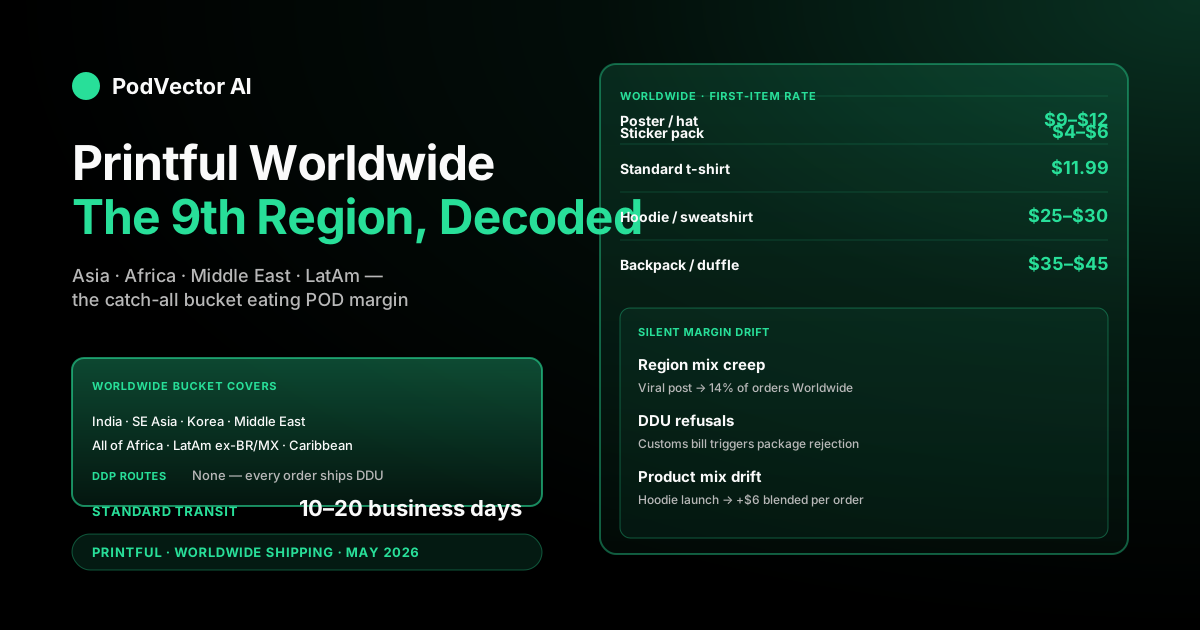
Quick Answer: "Worldwide" is Printful's catch-all shipping region for every destination that doesn't fit into the nine named buckets (USA, Canada, Europe, UK, EFTA States, Australia/NZ, Japan, Brazil, Mexico). It covers most of Asia, Africa, the Middle East, and parts of Latin America.
Worldwide is the most expensive and slowest of Printful's regions. According to Printful's official shipping page, a standard t-shirt runs $12.49 for the first item to a Worldwide destination, with each additional item adding $6.00. Transit after fulfillment is 10–20 business days for most destinations, longer for remote ones, and there is no DDP option — every Worldwide order ships duties-unpaid (DDU).
The trap for POD sellers isn't a single Worldwide order. It's the silent drift: a viral post or one ad campaign in a new market quietly pushes a growing share of monthly orders into the Worldwide bucket, dropping blended margin before the next P&L review catches it.
What "Worldwide" actually means on Printful
Printful organizes its shipping rates into ten geographic regions, not country by country. Nine are named: USA, Canada, Europe, UK, EFTA States (Switzerland, Norway, Iceland), Australia/New Zealand, Japan, Brazil, and Mexico. The tenth — "Worldwide" — is the catch-all for every destination that doesn't fit one of the named nine.
If your customer's country isn't on the named list, their shipping cost falls into the Worldwide bucket automatically. You don't pick it. The store checkout doesn't ask. The address resolves into a region at order time, Printful charges you the corresponding flat rate, and your storefront either ate the difference or passed it through.
This matters because Worldwide is the most expensive region on every product Printful sells. It's also the slowest, and the most exposed to customs friction. A store that accepts checkout from any country is taking Worldwide-rate orders whether it knows it or not.
For the broader regional picture, Printful's official shipping page lists the full breakdown by product. The country composition inside each region changes occasionally — check it once a quarter rather than memorizing. And for the complete view of every region side by side, the PodVector POD strategy hub links out to the full Printful shipping cluster.
Which countries fall into the Worldwide bucket
The Worldwide region is large and uneven. It includes:
- Most of Asia — India, Indonesia, Vietnam, Thailand, the Philippines, South Korea, Taiwan, Singapore, Malaysia, and the rest of South and Southeast Asia outside Japan
- The Middle East — UAE, Saudi Arabia, Israel, Turkey, Qatar, Kuwait, Oman, and similar (note: not all Middle East products ship to every destination — availability varies by product, per Printful's current shipping page)
- Africa — every country on the continent
- Latin America (excluding Brazil and Mexico) — Argentina, Chile, Colombia, Peru, Costa Rica, the Caribbean, and similar
- Eastern Europe outside the EU — Serbia, Bosnia, North Macedonia, and similar
- Oceania outside Australia/NZ — Fiji, Papua New Guinea, and other Pacific island nations
What's excluded entirely: Printful does not ship to all countries due to legal restrictions or carrier limitations, per Printful's official policy. Commonly excluded destinations include Russia, Belarus, Cuba, Iran, Syria, and North Korea. The restricted country list changes based on world events — always confirm current exclusions on Printful's shipping page before accepting orders from a new market.
The asymmetry inside the Worldwide bucket matters operationally. A package to Singapore moves quickly and clears customs cleanly. A package to a remote African destination can take twice as long and gets stuck in customs at a much higher rate. Same first-item rate. Very different real-world experience.
Some newer product lines — particularly specialty items — ship to a narrower slice of Worldwide destinations than standard apparel. Check per-product availability in the Printful catalog rather than assuming Worldwide coverage applies universally across your catalog.
Worldwide shipping costs by product
Worldwide rates follow Printful's standard flat-per-product-per-region structure. The first item in a shipping bucket carries the higher rate. Each additional item in the same bucket adds a smaller incremental charge.
According to Printful's official shipping rate page, the Worldwide region currently uses a $12.49 first-item / $6.00 additional-item structure for standard apparel (including t-shirts). This rate matches the Brazil region rate on the same rate card. Always verify current figures on Printful's shipping page before pricing your store, as rates change when carrier contracts roll over.
Approximate per-category guidance based on the current rate card (verify all figures on Printful's shipping page before pricing decisions):
- Standard t-shirt: $12.49 first item / $6.00 additional (per Printful's published rate card as of the date of this article)
- All-over-print t-shirt: higher than standard tee — check rate card for current figure
- Hoodie or sweatshirt: significantly higher than the tee rate — verify current figure on Printful's shipping page
- Hat or beanie: verify current figure on Printful's shipping page
- Tote bag: verify current figure
- Backpack or duffle: among the highest Worldwide rates — verify current figure
- Mug: not always available to all Worldwide destinations — check per-destination availability
- Poster (small): verify current figure
- Sticker pack: verify current figure
The directional comparison that matters: Worldwide t-shirt shipping is substantially higher than the same product to the EU, UK, or USA. According to Printful's published rate card, a US t-shirt ships at $4.95 for the first item — meaning Worldwide adds more than $7 of shipping cost per order on the same product to the same customer cart. Heavier products amplify the spread further. Always verify current rates on Printful's shipping page before updating your store's pricing.
One cost pattern that catches sellers off guard: multi-category carts split into separate shipping buckets, each with its own first-item charge. A buyer in Thailand who orders a t-shirt and a hat doesn't pay the t-shirt first-item rate plus a small add-on. They pay two separate first-item charges — one for the shirt and one for the hat — because Printful prints them at different facilities and ships them as two parcels.
For a side-by-side comparison of how Printful and Printify international shipping economics differ, see the net profit margin benchmark guide for how international shipping lines feed into your overall margin picture.
Worldwide delivery times and the customs question
Total delivery time on a Worldwide order is fulfillment plus transit plus customs. Each leg has its own range, and the ranges widen the farther the destination sits from a Printful facility.
Standard transit windows after fulfillment (fulfillment itself typically runs 2–5 business days for most apparel, per Printful's help documentation):
- Worldwide standard: 10–20 business days transit after fulfillment
- Worldwide expedited (where available): faster than standard, but adds meaningfully to the shipping line — check current availability and pricing on Printful's shipping page, as not every Worldwide destination has an expedited option
- Remote Worldwide destinations: 15–25 business days or longer when customs holds the package
Add 2–5 business days of fulfillment, plus 0–10 days of potential customs hold at the destination, and the total door-to-door window on a Worldwide order is realistically 3–7 calendar weeks for most destinations.
Customs is the wildcard. For low-value parcels, many destination countries clear under their de minimis threshold with no fee. For higher-value orders, customs can hold the package for inspection — sometimes days, sometimes weeks — before either releasing it with a duty bill or returning it for refusal.
Set your product page expectations to the upper end of the range. A customer who was quoted 4 weeks and received delivery in 3 is happy. A customer who was quoted 2 weeks and received delivery in 4 opens a refund ticket.
De minimis changes and what they mean for Worldwide orders
De minimis thresholds — the declared-value floor below which customs duties are not assessed — have been shifting globally and are no longer safe to assume from memory. Thresholds vary by country and have been moving, so check the destination's current rules rather than relying on remembered figures.
The practical consequence for Worldwide sellers:
- A destination country that previously cleared most POD shipments duty-free may now assess duties on orders above a lower threshold — a pattern that has been accelerating across Asia-Pacific and the Middle East.
- Buyers hit with an unexpected duty bill on arrival are more likely to refuse the package — converting a low-margin Worldwide order into a net-loss refusal event.
- Your product page and checkout copy needs to reflect the current reality: duties are possible and the buyer is responsible (DDU). Generic "international orders may be subject to duties" language is the minimum. Specific per-country estimates, where you can source them, reduce refusal rates materially.
- The Middle East in particular has seen product availability and duty rules shift frequently, as reflected in seller feedback on Printful's own app listing — always confirm availability and duty exposure per destination before running paid traffic there.
The de minimis landscape is a reason to review Worldwide destination economics at least quarterly, not annually. A market that worked fine six months ago may now carry a material refusal risk if the threshold changed. For how these costs compound into your overall contribution margin, see the checkout completion rate benchmark — Worldwide DDU surprise costs are one of the fastest ways to erode completed-order profitability.
Which facility ships your Worldwide order
According to Wikipedia's Printful entry, Printful runs fulfillment centers in Charlotte NC, Dallas TX, Toronto (Canada), Riga (Latvia), Barcelona (Spain), Birmingham (UK), and Tijuana (Mexico), plus partner facilities in Rio de Janeiro (Brazil), Amakusa (Japan), and Brisbane and Melbourne (Australia).
For a Worldwide order, the routing logic picks the geographically closest facility that stocks the ordered product.
In practice, most Worldwide orders ship from one of two places:
- The EU (Riga or Barcelona) — for destinations in the Middle East, Africa, Eastern Europe, and parts of South Asia where EU outbound transit is shorter
- The US (Charlotte or Dallas) — for most Asian and Latin American Worldwide destinations
The routing isn't always obvious. A Singapore order can ship from the EU on one day and the US on another, depending on stock levels. A South African order usually ships from Riga; a Chilean order usually from a US facility.
The facility choice quietly drives the actual transit time. A Worldwide order from Riga to Bangkok takes longer than the same order from a facility closer to Southeast Asia — but closer facilities don't always stock every product for Worldwide routing. You can see the actual fulfilling facility on every order's detail page in the Printful dashboard. Worth scanning monthly for any product that consistently routes the wrong way.
No DDP, all DDU — what that means for your buyer
Printful offers Delivered Duties Paid (DDP) on a limited set of routes. According to PodVector's global shipping guide, DDP covers the UK, EU, and Canada so customers don't get a customs surprise on those routes. Every other international route — including every Worldwide destination — is Delivered Duties Unpaid (DDU).
DDU means the buyer is responsible for any import fees, VAT, or duties imposed at delivery. For small Worldwide orders, the package often clears under the destination's de minimis threshold and the buyer pays nothing extra. For larger orders, the buyer can be hit with a duty plus a customs broker fee — the exact amount depends on the destination country's current rules.
The economic problem with DDU on Worldwide orders isn't the duty itself. It's the surprise. A buyer who paid for a product and receives an unexpected bill at delivery often refuses the package or files a chargeback.
You eat the shipping cost twice — once outbound, sometimes again on the return — plus the product cost if the item comes back damaged or never returns at all. On a Worldwide t-shirt order, a refusal can quickly turn a thin-margin order into a net loss. The cheapest preventive measure is a single line on international product pages: "Additional duties and taxes may apply at delivery, depending on your country." It doesn't change the duty. It pre-empts the surprise, which is what triggers the refusal.
For tactical ways to protect margin on international orders — including free-shipping threshold adjustments that account for Worldwide cost exposure — see how to increase AOV, which covers threshold mechanics directly applicable to international order economics.
Refused packages and the lost-order window
Most Worldwide Printful orders arrive cleanly. The small percentage that don't fall into three buckets, each with its own economic shape.
Lost in transit. Tracking stops updating. The package doesn't arrive on the expected date. Printful's policy on international orders is a 6-week waiting window past the expected delivery date before a lost-order claim is eligible. They reprint and reship at no cost once the window passes.
What this means operationally: when a Worldwide customer reports a missing order at day 21, you can't immediately reship. You acknowledge, set the 6-week expectation, and check back in. Most "lost" Worldwide packages clear customs and arrive between weeks 3 and 6 — slow-tracking, not truly lost.
Damaged or wrong product. Photo evidence required, typically within 30 days of delivery. Printful reprints free of charge. The transit time on the reprint is the same as the original, which on a Worldwide route means a lengthy total resolution window from the customer's first complaint.
Refused or undeliverable. The most expensive failure mode on Worldwide. The buyer rejects the package — usually because of a customs bill they didn't expect — or it's returned for a bad address. Printful does not automatically reship returned international packages. You decide whether to refund (eating the outbound shipping) or charge a reship.
Refusal rates on Worldwide DDU orders run higher than refusal rates inside the EU or to the UK on DDP routes. If your refusal rate in a specific Worldwide country becomes material, your retail price for that country needs to absorb the cost — or stop shipping there. For tactical CRO approaches that can improve overall conversion and reduce the friction that leads to abandoned or refused orders, see the CRO techniques guide.
Worldwide orders during peak season
October through December stretches every assumption in this guide. Worldwide orders feel it hardest because they already run longest.
Fulfillment stretches. The standard 2–5 business day fulfillment can stretch significantly by mid-December. A Worldwide order placed on December 1 that would normally arrive by Christmas slips past the deadline more often than not.
Customs slows. Holiday import volume backs up customs offices in every destination country. A Worldwide route that takes 14 transit days in October can take considerably longer by mid-December.
Carrier capacity tightens globally. Even after the package leaves Printful's facility, regional carriers run at peak load. Standard Worldwide windows can stretch materially through December.
The pragmatic move on Worldwide for the holiday season: publish a hard cutoff date of December 1 (not December 5 or December 10) on any product page that ships internationally. After December 1, swap product copy to "ships in January, arrives mid-to-late January" for Worldwide destinations.
The conversion hit on late-December Worldwide orders is smaller than the cost of every refunded "didn't arrive by Christmas" ticket plus the chargeback risk on packages that never deliver in time.
Printful publishes its peak-season fulfillment notices in the seller dashboard each October. Read them, then add a buffer on Worldwide transit on top of whatever Printful quotes.
Peak season is also the moment when Worldwide region-mix drift accelerates fastest — holiday ad campaigns spill into new geographies quickly. For how to set up Klaviyo flows that can recover abandoning Worldwide shoppers without compounding refusal risk, see the Klaviyo browse abandonment flow setup guide.
How Worldwide orders quietly eat margin
Worldwide is the region most likely to drift in your channel mix without you noticing. The drift is what costs money, not any single order.
Region mix shifts. Your store starts US-heavy. A creator post or one ad campaign brings a wave of orders from India, Thailand, the Philippines, and South Africa — all Worldwide. Your blended shipping cost per order moves up, your retail prices haven't changed, and your gross margin drops over a few weeks. Nothing in the dashboard flags it because the per-order metric still looks normal. The mix is what shifted, not the per-order economics inside any region.
Refusal-rate drift. A Worldwide country that worked fine in spring starts refusing orders at a higher rate in late autumn as duty assessments tighten or a local carrier change affects customs clearance. You see the refund volume go up. You don't see, in the same view, that the rejection cost (outbound shipping + return + restocking) is the actual margin hit.
Product mix drift inside Worldwide. Your Worldwide channel starts t-shirt heavy. A hoodie launch shifts the mix. Worldwide hoodie shipping is substantially higher than Worldwide t-shirt shipping. Your blended Worldwide per-order cost just moved up without anyone updating the model.
Rate changes. Printful re-prices international shipping when carrier contracts roll over. The Worldwide t-shirt first-item rate on Printful's current published rate card is $12.49 — if you priced your store against an older figure, your Worldwide shipping cost may be higher than your spreadsheet says. Always verify current rates before pricing decisions.
Static spreadsheets don't catch any of these because the inputs change but nobody re-runs the math. The fix is the same as for any drifting line in a POD P&L: pull every itemized shipping line — region, product, DDP/DDU, refused-package costs — into a single source of truth alongside your revenue and product cost. Then watch per-region margin over time, with Worldwide isolated as its own line.
For how to think about the contribution margin math underneath these shipping lines, see the net profit margin benchmark for how region-level shipping cost feeds into a proper per-order contribution figure. For the data reconciliation question of whether splitting fulfillment across suppliers actually helps your Worldwide economics, see the Etsy-to-Shopify dropship analysis — the margin math applies to any multi-supplier international setup. And for naming and positioning your store in a way that travels well across Worldwide markets, see POD business name ideas for how brand clarity reduces friction at international checkout.
Operators who track it catch the drift early. Operators who don't see it in the quarterly P&L review, after the damage compounded.
Catching the drift before it compounds
The margin problem with Worldwide orders isn't any single line item — it's that the relevant data lives across three different systems. Printful has your shipping costs. Shopify has your revenue and order count by country. Your Meta or Google Ads account has the campaign that started pushing Worldwide traffic in the first place. No single dashboard joins them, so the drift is invisible until the quarterly P&L review.
Victor — PodVector's AI employee — reads your Printful, Shopify, Meta Ads, and Google Ads data into a live data warehouse and answers questions like "which geographic regions are compressing my blended margin this month?" in plain English. When the numbers point to a fix on the Shopify side — repricing your worst-margin Worldwide SKUs to a target margin, adjusting your free-shipping threshold, or updating a discount code — Victor proposes the move as a structured approval card showing the old and new values, and executes it after you approve. No spreadsheet. No manual exports.
Victor doesn't act autonomously. Every material action waits on your approval. And because his read surface spans Printful and Shopify together, he can surface the Worldwide shipping drift before it shows up in a quarterly P&L surprise — not after.
For the broader strategy picture on how PodVector fits into a Printful-based store, see the PodVector strategy guide.
FAQs
What does "Worldwide" mean on Printful?
"Worldwide" is Printful's catch-all shipping region for every destination that doesn't fit into the nine named regions (USA, Canada, Europe, UK, EFTA States, Australia/NZ, Japan, Brazil, Mexico). It covers most of Asia, Africa, the Middle East, and parts of Latin America. It is the most expensive and slowest of Printful's regions.
How much does Printful charge for Worldwide shipping?
According to Printful's published rate card, the standard apparel (including t-shirts) first-item rate to a Worldwide destination is $12.49, with each additional item in the same shipping bucket adding $6.00. Heavier or bulkier products carry different rates. Always verify current figures on Printful's official shipping page before setting store prices, as rates change when carrier contracts roll over.
How long does Printful Worldwide shipping take?
Add 2–5 business days of fulfillment to a 10–20 business day transit window, plus 0–10 days for potential customs holds. Total door-to-door is typically 3–7 calendar weeks for a Worldwide order. Remote destinations sit at the upper end. Expedited options where available reduce transit time but add meaningfully to the shipping line and are not offered to every Worldwide destination.
Does Printful ship to every country in the world?
Almost. Printful ships to a large number of countries globally. Some destinations are excluded due to legal restrictions or carrier limitations — and per Printful's official policy, the restricted country list changes based on world events. Always confirm current exclusions and per-product availability before accepting orders from a new market.
Does Printful pay customs and duties on Worldwide orders?
No. According to PodVector's global shipping guide, Printful offers DDP (Delivered Duties Paid) on the UK, EU, and Canada routes. Every Worldwide order ships Delivered Duties Unpaid (DDU). The buyer is responsible for any import fees, VAT, or duties imposed at delivery. De minimis thresholds vary by country and have been shifting — check the destination's current rules rather than relying on remembered figures.
What happens if a Worldwide order gets refused at customs?
The buyer typically refuses when they receive an unexpected duty bill. Printful does not automatically reship returned international packages. You decide whether to refund the customer (eating the outbound shipping cost) or charge a reship. Refusal rates on Worldwide DDU routes run higher than on DDP routes, so factor a refusal-cost buffer into Worldwide retail prices for markets with higher duty exposure.
How long do I have to file a lost-order claim for a Worldwide order?
Printful's international lost-package waiting window is 6 weeks past the expected delivery date. Most "lost" Worldwide packages arrive between weeks 3 and 6, slow-tracking through customs rather than truly missing. File the claim after the window, and Printful reprints and reships at no cost.
Does Printful offer expedited shipping to Worldwide destinations?
To some Worldwide destinations, expedited options are available. Faster transit does not touch fulfillment time, so the floor on a Worldwide expedited order is still 2–5 business days of production plus transit. Check Printful's current shipping page for availability by destination, as not every Worldwide country has an expedited option.
Which Printful facility ships my Worldwide order?
According to Wikipedia's Printful entry, Printful's fulfillment centers include Charlotte NC, Dallas TX, Toronto, Riga, Barcelona, Birmingham (UK), and Tijuana, plus partner facilities in Rio de Janeiro, Amakusa (Japan), and Brisbane and Melbourne (Australia). For a Worldwide order, routing picks the geographically closest facility that stocks the product — in practice usually the EU facilities (Riga or Barcelona) for Middle East, Africa, and Eastern Europe destinations, or a US facility (Charlotte or Dallas) for most Asian and Latin American destinations. You can see the actual fulfilling facility on each order's detail page in the Printful dashboard.
Is it worth offering Worldwide shipping on my POD store?
Depends on your retail pricing and how carefully you track refusal rates and region mix drift. Worldwide orders carry the highest shipping cost, longest transit, and highest refusal risk of any Printful region. If your retail price absorbs the fully-loaded cost (shipping + expected refusal rate buffer) and you monitor the channel regularly, it expands your addressable market meaningfully. If either condition fails, the Worldwide channel can quietly turn negative-margin without showing up on a per-order dashboard view.
How do de minimis threshold changes affect my Worldwide orders?
De minimis thresholds — the declared-value floor below which customs duties are not assessed — vary by country and have been shifting globally. A market where most orders previously cleared duty-free may now generate duty bills at delivery, increasing buyer surprise and refusal rates. Review the current thresholds for your top Worldwide destination countries at least quarterly, and ensure your product pages set correct buyer expectations about potential duties.
How does Worldwide shipping affect my net profit margin?
Worldwide shipping is the single largest per-order cost variable for stores that accept international orders without region-segmented pricing. The combination of high flat-rate shipping, DDU duty exposure, and elevated refusal rates means Worldwide orders can carry materially lower net margin than the same product sold domestically — even at the same retail price. For how to benchmark your store's margin against sector norms, see the net profit margin benchmark guide.
Worldwide is the region most likely to drift without you noticing. The drift is what costs you.
The rate cards on Printful's website tell you what one Worldwide t-shirt costs to ship. They don't tell you that your Worldwide order share has been climbing, that hoodie mix inside Worldwide just doubled, or that your refusal rate in Southeast Asia is climbing — all of which quietly compress your blended margin.
Victor — PodVector's AI employee — reads your Printful and Shopify data into a live data warehouse and answers questions like "how is Worldwide shipping eating my margin this week?" in plain English. When the numbers point to a fix on the Shopify side — repricing your worst-margin SKUs to a target margin, adjusting a free-shipping threshold, or updating a discount code — Victor proposes the move as a structured approval card showing old and new values, and executes it after you approve. No spreadsheet. No quarterly P&L surprise. Every action waits on your approval.
Try Victor free