
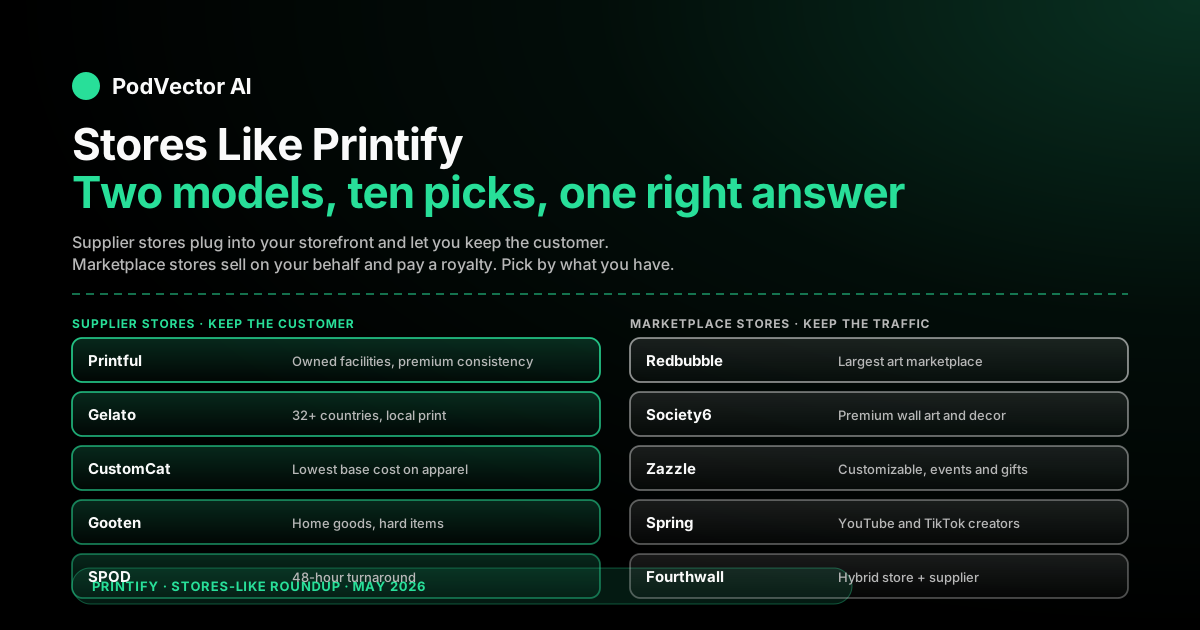
Quick Answer: "Stores like Printify" covers two different models. Supplier stores — Printful, Gelato, CustomCat, Gooten, SPOD — plug into a storefront you own and let you keep the customer. Marketplace stores — Redbubble, Society6, Zazzle, Spring, Fourthwall — sell on your behalf and pay royalties.
The right pick depends on whether you want to own the brand or rent shelf space. Supplier stores win for operators building an asset. Marketplaces win for designers who want traffic without doing the marketing work.
This roundup compares 10 stores by model, take rate, catalog, and the kind of seller each one fits. For the full landscape see the Printify topic hub and the Printify comparison cluster.
Two kinds of stores like Printify
Most "stores like Printify" roundups mash supplier networks and marketplaces into one list. That's a mistake. They are two different businesses, and they suit different sellers.
Printify itself is a supplier. You design products, you pick a storefront — Shopify, Etsy, WooCommerce, Wix, BigCommerce — and Printify prints and ships when an order lands. You keep the customer, the email, and the brand. Printify never sees the traffic.
A marketplace works the opposite way. You upload designs to Redbubble or Society6, they list your products in their catalog, and their visitors do the buying. You get a royalty per sale, typically 10–20%. They keep the customer.
Both models qualify as "stores like Printify" in everyday usage. But the trade-off is sharp. Supplier stores demand marketing effort and pay you the full margin. Marketplaces hand you discovery and pay you a fraction. Pick the wrong model for your operation and you will under-earn for years.
The ten stores below split five-five. We cover the supplier picks first — same model as Printify — then the marketplaces.
Supplier stores (plug into your store)
These five all run the same shape as Printify. You bring the storefront and the traffic. They print and ship. You set retail prices, keep the customer relationship, and own the brand.
What changes between them is base cost, fulfillment ownership, catalog mix, and geographic coverage. The right pick comes down to which product categories you sell and where most of your customers live.
1. Printful
Printful is the closest like-for-like swap to Printify and the comparison nearly every seller runs first. The two have shared a parent company since 2021 but operate as deliberately different brands.
The structural difference is supply ownership. Printful runs its own fulfillment centers in Charlotte, Los Angeles, Toronto, Riga, Birmingham UK, and Tijuana. Printify aggregates a network of third-party print providers. Same shape, opposite supply chain.
Quality is the headline trade-off. Owned facilities deliver tighter consistency across orders. The third-party-network model gives you per-product supplier choice — useful for routing to a faster or cheaper provider, at the cost of more variance.
Catalog is comparable on apparel. Printful is stronger on embroidered hats and branded inserts. Printify wins on niche items like all-over-print apparel through specialist suppliers.
Best for: sellers who want one quality benchmark across every order and are willing to pay a few dollars more per unit to get it. See the head-to-head at Printful's own comparison page for their framing.
2. Gelato
Gelato is the leading global-production alternative and the strongest pick for anyone selling outside the US. Its network spans 130+ production facilities in 32+ countries.
Local production is the whole pitch. An order from a German customer prints in Germany, not in Charlotte. Shipping times drop. Carbon footprint drops. International returns become a smaller line item.
Pricing is competitive with Printify on common SKUs and sometimes wins outright on apparel destined for Europe. The catalog is strong on wall art, mugs, and apparel. Photo books and calendars are a Gelato strength most competitors lack.
Integrations are wide. Shopify, Etsy, WooCommerce, Wix, BigCommerce, Squarespace, Shopline, and a usable API for custom builds.
The trade-off is US quality control. Because production is distributed across facilities, US sellers occasionally see a quality drift between regions. Most solve this by locking specific products to specific facilities.
Best for: sellers with meaningful non-US revenue, or any operator planning to expand internationally in the next 12 months.
3. CustomCat
CustomCat is the budget supplier that competes hardest with Printify on raw base cost. Founded in Michigan, US-based fulfillment, with pricing aimed at high-volume sellers.
The price advantage is real on common apparel. A standard tee that prices at $8–9 on Printify often lands at $6–7 on CustomCat. At volume that gap funds the marketing budget.
The catalog runs around 550 products, weighted toward apparel and including some embroidery options. Turnaround is 2–4 business days for most items.
Two caveats. Quality variance is real on lower-tier blanks — sellers report more sizing inconsistency than with Printful or Printify's premium suppliers. And the $30/month premium plan that drops base costs further only pencils out above a certain volume.
Best for: price-sensitive sellers doing high volume on standard apparel, where every dollar of base cost saved compounds across thousands of units.
4. Gooten
Gooten is the supplier network built for sellers who care about margin more than features. It operates a partner network of 50+ manufacturers across 70+ regions, with most items produced within two business days.
Where Gooten wins is base costs on hard goods. Mugs, tumblers, blankets, pet products, and home decor often price several dollars below Printify on equivalent SKUs. On apparel the gap is smaller.
The catalog skews wider than deeper — 200+ products spanning categories most rivals don't bother with. Phone cases, pet bowls, and shower curtains are real strengths.
The user interface is the weakness most reviews flag. It is functional but dated, and the mockup generator lags Printify's. Operators usually compensate with third-party mockup tools.
Best for: sellers leaning into home goods, kitchen products, or pet accessories — categories where Gooten's pricing advantage compounds across the catalog.
5. SPOD
SPOD is Spreadshirt's print-on-demand arm and the supplier most credibly competing on speed. The published promise is 48-hour fulfillment on most orders, which holds up in practice on standard products.
For sellers running paid traffic where shipping time affects refund rate and review score, that speed compounds. Faster fulfillment means fewer "where is my order" tickets and higher review velocity.
Pricing sits between Printify and CustomCat — not the cheapest, not the most expensive. Catalog is narrower than Printify, around 230 products, heavy on apparel and accessories.
The major limitation is integrations. SPOD is strong on Shopify and serviceable on WooCommerce, but the broader catalog of e-commerce platforms supported is narrower than Printify or Gelato.
Best for: Shopify-first sellers where turnaround speed is the conversion lever — typically paid-ads operators selling time-sensitive designs.
Marketplace stores (sell on your behalf)
The next five are not suppliers. They are marketplaces. You upload designs to them, they list and sell products in their own catalog, and you take a royalty.
The pitch is the opposite of Printify's. You give up the customer and the brand. In exchange you get traffic — sometimes a lot of it — without running ads, building a Shopify store, or paying for SEO. For artists with strong portfolios and weak interest in operations, that trade is sometimes worth taking.
Royalty rates vary from roughly 10% to 70% depending on platform. The platform sets retail prices, handles fulfillment, eats card fees, and owns the customer email.
6. Redbubble
Redbubble is the largest art-driven POD marketplace and the platform most often cited as "the marketplace version of Printify." Around 700,000 artists list designs across 70+ product categories — apparel, stickers, wall art, home decor, accessories.
You set a royalty percentage above Redbubble's base price. Default royalty sits around 20%. There is no upfront cost, no subscription, and no inventory risk. You upload a design and walk away.
What you trade for that simplicity is everything else. Redbubble owns the customer. You get a payout, not an email list. Discount campaigns are platform-wide and not under your control — Redbubble can mark your products 30% off without asking. And competition inside the marketplace is brutal; new artists struggle to surface against established sellers.
For sellers comparing the two formats head-on, see Redbubble vs Printify.
Best for: artists with broad portfolios and no interest in running a storefront. The break-even is when Redbubble's organic traffic exceeds what you would generate yourself.
7. Society6
Society6 is the higher-end art marketplace and the closest aesthetic neighbor to Redbubble. Catalog leans toward wall art, home decor, throw pillows, and apparel — items where design quality is the selling point.
The royalty model is similar to Redbubble's but more design-led in practice. Artists set a markup on wall art, while other categories have a fixed 10% baseline royalty. The platform actively curates and promotes designs in editorial channels.
Society6's audience skews higher-spend than Redbubble's, which matters for premium apparel and gallery-style wall art. The trade-off is a smaller catalog of product categories and tighter editorial filtering on what surfaces.
Like every marketplace, Society6 keeps the customer relationship. You cannot email past buyers or retarget them.
Best for: visual artists selling premium wall art and home decor to a design-conscious audience.
8. Zazzle
Zazzle is the original POD marketplace and the largest by catalog. The platform claims 30+ million users and 1,300+ products across personalized invitations, business cards, apparel, mugs, and home goods.
Royalty rates run higher than Redbubble's — sellers commonly set 15–20% markup, and the platform allows up to a 99% royalty in theory (though products rarely sell at that markup). Volume discount tiers can pull effective margins down on bulk orders.
The customizable-product angle is Zazzle's edge. Buyers can edit text and colors before checkout, which makes the platform a strong fit for invitations, wedding stationery, and event merchandise — categories Printify does not seriously serve.
The downside is that Zazzle's interface and brand skew older and less design-led than Society6. Apparel is a smaller share of total sales than on Redbubble.
Best for: sellers whose designs lend themselves to customization — names, dates, monograms — particularly in the events and gifts category.
9. Spring (formerly Teespring)
Spring is the creator-merch marketplace built around social platform integration. Native connections to YouTube Merch Shelf, TikTok Shop, Twitch, and Instagram let creators drop merch in-feed without a separate storefront.
The catalog is apparel-heavy with some accessories and drinkware. Royalty rates sit in the 20–40% range depending on product and base cost. Spring sets the retail price floor; you mark it up.
Where Spring is uniquely positioned is the creator economy. If your audience lives on YouTube or TikTok and you have not yet built a Shopify store, Spring removes the friction of one. The trade-off is that you are reaching that audience through Spring's checkout, not yours, and the email captures stay with the platform.
For a direct comparison see Printify vs Teespring.
Best for: creators with audiences on YouTube, TikTok, or Twitch who want low-friction merch without operating a separate store. As that audience matures, most graduate to Shopify plus a supplier like Printify or Printful — see Printify vs Shopify for the next step.
10. Fourthwall
Fourthwall is the hybrid — both a storefront builder and a fulfillment network. It sits on the boundary between supplier and marketplace, which is why it appears on both kinds of roundup.
You get a hosted storefront under your own domain, a fulfillment network for the products, and bolt-on features like memberships and digital goods. You keep the customer relationship and the email list, like Printify. But you do not have to set up Shopify separately, like a marketplace.
Take rate is comparable to Printify's effective cost when you factor in Shopify fees, transaction fees, and theme costs. The catalog is apparel-heavy with broad accessories and sourced custom products.
The trade-off is platform lock-in. If you outgrow Fourthwall you cannot easily port your storefront to Shopify — the domain, theme, and customer database stay tied to Fourthwall's stack.
Best for: creators who want one tool to do the storefront and the fulfillment, particularly those running memberships or digital products alongside merch.
Side-by-side comparison
| Store | Model | Take rate | Strongest at | Best for |
|---|---|---|---|---|
| Printful | Supplier | Base cost (you keep retail) | Owned-facility consistency | Premium brand apparel |
| Gelato | Supplier | Base cost | Global production network | International sellers |
| CustomCat | Supplier | Base cost (lowest) | High-volume apparel | Price-sensitive scale |
| Gooten | Supplier | Base cost | Home goods, hard items | Non-apparel margin |
| SPOD | Supplier | Base cost | 48-hour turnaround | Paid-ads operators |
| Redbubble | Marketplace | ~20% royalty | Discovery traffic | Hands-off artists |
| Society6 | Marketplace | 10% baseline, variable on art | Premium home decor | Visual artists |
| Zazzle | Marketplace | 15–20% typical | Customizable products | Events and gifts |
| Spring | Marketplace | 20–40% royalty | Creator-social integration | YouTube / TikTok creators |
| Fourthwall | Hybrid | Comparable to Shopify+supplier stack | Storefront + fulfillment combo | Creators with memberships |
How to pick the right store
Start with one question: do you have traffic, or do you need traffic?
If you already have an audience — a TikTok account, an email list, a YouTube channel, an existing Shopify store — pick a supplier. Printful, Gelato, CustomCat, Gooten, or SPOD plug into the store you already run and let you keep the full margin. The marketplace traffic Redbubble would give you is irrelevant when you already have your own.
If you have designs but no audience, pick a marketplace. Redbubble, Society6, Zazzle, Spring, or Fourthwall do the discovery work in exchange for a royalty. The 80% you give up is mostly money you would never have earned anyway.
Most operators eventually run both. A marketplace for passive royalty income on a wide catalog. A supplier-plus-Shopify combo for the designs they actively market.
The second question is which products you sell. Apparel goes anywhere. Wall art is strongest on Society6 and Gelato. Mugs and home goods favor Gooten. Customizable invitations are a Zazzle category. Pet products and kitchen items are Gooten strengths. Match the catalog to the platform.
The margin question nobody answers
Every roundup tells you what each platform charges. None tell you which platform actually leaves you the most money per SKU you sell. That answer changes per product, per region, and per traffic source.
A Bella+Canvas tee that prices at $8.50 on Printify, $6.95 on CustomCat, and yields a 20% royalty on Redbubble does not have a single correct platform. The answer depends on your retail price, your ad cost, your refund rate, and what your customers actually return for.
That is the question Victor — PodVector's AI employee — was built to answer. Victor sits on a live data warehouse fed by your store and supplier data. Ask it "which supplier would be more profitable for my bestsellers in the next quarter?" and it pulls real numbers across your SKUs and traffic sources. Victor answers and acts — with your approval — routing orders to the highest-margin supplier per SKU automatically.
FAQs
What is the closest store to Printify?
Printful. Same operational shape — your store, your customer, your brand — with the structural difference that Printful owns its fulfillment centers while Printify aggregates third-party suppliers. The two share a parent company and remain the most direct swap.
Is Redbubble like Printify?
No, not really. Redbubble is a marketplace that lists your designs in its own catalog and pays you a royalty per sale. Printify is a supplier that prints products you sell through your own store. Same end product, opposite business model.
Which store like Printify is cheapest?
On base cost, CustomCat is the lowest-priced supplier for high-volume apparel. On total cost of ownership — including platform fees and traffic acquisition — marketplaces like Redbubble are technically cheaper because you pay nothing upfront, but you also keep a fraction of the retail price. See our deeper breakdown at Cheaper Than Printify.
Can I sell on a marketplace and run a Printify store at the same time?
Yes, and many sellers do. The marketplace provides passive royalty income on a broad catalog. The Printify-plus-Shopify combo handles your actively marketed designs at full margin. The two channels do not compete because they reach different buyers.
Do these stores integrate with Etsy?
Suppliers do. Printful, Gelato, CustomCat, Gooten, and SPOD all integrate with Etsy. Marketplaces do not — they are themselves the storefront, not a supplier to one. Fourthwall sits in between and does not integrate with Etsy by design.
Which store keeps the customer email?
Suppliers — Printful, Gelato, CustomCat, Gooten, SPOD — pass the customer email through to your store. Marketplaces — Redbubble, Society6, Zazzle, Spring — keep it. Fourthwall gives you the email because the storefront is yours. This single difference is often the biggest factor in choosing a model.
What is the Printify Premium plan and is it worth it?
Printify Premium is a paid subscription that discounts base costs across the catalog. Whether it pays for itself depends on your monthly order volume — see the 2024 Premium price breakdown and the August 2024 update for the math.
Stop guessing which supplier wins on your SKUs
Every "stores like Printify" roundup compares features. None compare your actual margin per SKU across suppliers. That answer lives in your data — and Victor is the AI employee that pulls it.
Victor sits on a live data warehouse fed by your store, your suppliers, and your ad platforms. Ask it which supplier maximizes your margin per product, per region, per quarter — and get real numbers back, not feature comparisons.
Try Victor free