
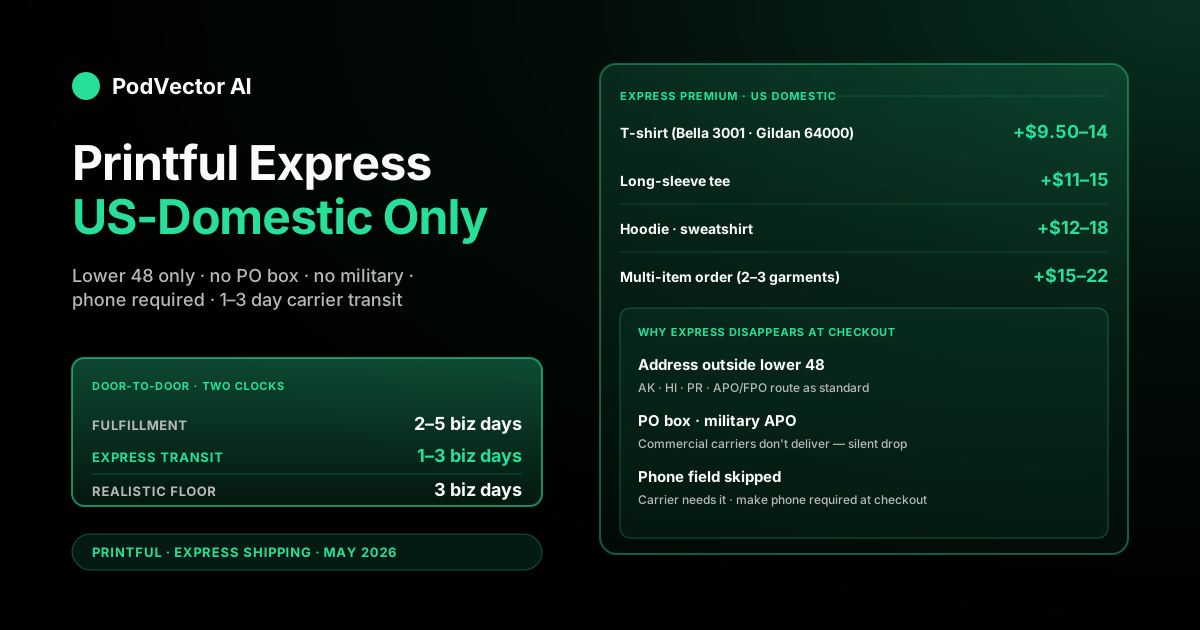
Quick Answer: Printful Express is a US-domestic-only carrier upgrade that delivers in 1–3 business days of transit after fulfillment — not 1–3 days door to door. According to Printful's official help center, fulfillment runs 2–5 business days first, so the realistic floor is about 3 business days end to end. Express premiums over standard run roughly $9.50 to $22 per order, per Printful's shipping cost breakdown. The address must be a US residential or commercial address — no PO boxes, no APO/FPO military, and a phone number is required.
It is the right tool for gifts with a date, replacement orders, and event merch. It is the wrong default for everyday sales — the premium is large enough to flip a healthy unit margin negative if you eat it instead of passing it through.
2026 note: Printful pushed a broader batch of shipping price changes live on June 4, 2026 (published on Printful's shipping price updates page with a downloadable old-vs-new list). Cross-check any rate figures you have saved before that date against the live Printful shipping page.
What Printful Express shipping actually is
Express is the name Printful uses for its premium US domestic shipping tier. According to Printful's official help center, it delivers in 1–3 business days after fulfillment — and carrier selection is automatic, with Printful choosing the best carrier for your shipment based on the selected shipping method and delivery location. You find the carrier in the shipping confirmation email when the order is dispatched.
The product is narrower than most sellers assume. Express is US destinations only. The same upgraded carrier services are not labeled "Express" on Canadian, European, Australian, or worldwide routes — those route faster transit under different names, usually exposed as "expedited" line items in live rates. International Express from US and Canadian facilities does exist as a separate option, but the flat-label "Express" at checkout primarily targets US domestic routes.
If your store is selling internationally and you see "Express" missing for a Canadian buyer at checkout, that is not a bug. According to Printful's help center, if a shipping method isn't available in the customer's area, it simply won't appear at checkout.
The two-clock model: why "1-day Express" takes 4
Every Printful order has two clocks running in series, never in parallel.
Clock one — fulfillment. The time between order placement and the package leaving the print facility. According to Printful's help center, fulfillment typically takes 2–5 business days to create and pack your product. A direct-to-garment t-shirt on a calm week finishes in 2 days. A hoodie in November finishes in 5. Embroidered items and posters sometimes run longer.
Clock two — Express transit. The carrier leg, which only starts when fulfillment ends. According to Printful's official shipping options page, Express delivers in 1–3 business days after fulfillment.
So a "1–3 day Express" order placed Monday with a 3-day fulfillment runs: printed Thursday, picked up Friday, delivered Monday or Tuesday. That is 5–6 business days door to door. Express bought the back half. The front half did not move.
This is the single largest source of support tickets on Express orders. Buyers see "Express: 1–3 business days" at checkout and start counting from purchase. Set the expectation up front — on the product page, in your shipping policy, and in the order confirmation: "Express accelerates the carrier portion of your delivery. Total order time is fulfillment (2–5 business days) plus Express transit (1–3 business days)."
For a deeper read on this two-clock split across every Printful tier, the Printful expedited shipping guide compares standard, economy, and express side by side.
Real Express delivery windows
Express transit, after fulfillment, that you can quote with reasonable confidence on US domestic routes:
- US lower 48, urban: 1–2 business days
- US lower 48, rural: 2–3 business days
- Alaska, Hawaii, US territories: Express not available — these route as standard with extended transit
Total door-to-door times once you stack fulfillment on the front:
- Best case (urban, light fulfillment week): 3 business days, ~4 calendar days
- Typical (any continental US): 4–6 business days, ~5–8 calendar days
- Worst case (heavy fulfillment week, rural): 7–8 business days, ~10 calendar days
A concrete example. A buyer in Austin orders a single Bella+Canvas tee on a Tuesday morning. Fulfillment runs 2 business days (printed by Thursday). Express transit is 2 business days (delivered Monday). Total: 5 business days, 6 calendar days. Standard on the same route would have run 6–9 business days. Express bought roughly 2–4 business days.
If the buyer needs same-day or next-day delivery, Express is not the answer — and no POD service is. The fulfillment floor makes it physically impossible. For those orders you need local pre-printed stock or a non-POD warehouse partner.
What Express costs over standard
Printful prices Express through a live-rates engine — real carrier quotes pulled at checkout, not a static rate card. The number that matters for margin planning is the premium: Express rate minus standard rate.
According to Printful's shipping cost breakdown (verified against the June 4, 2026 rate update), Express premiums on US domestic single-product orders run approximately:
- T-shirt (Bella+Canvas 3001 or Gildan 64000): +$9.50 to +$14
- Long-sleeve tee: +$11 to +$15
- Sweatshirt / hoodie: +$12 to +$18
- All-over-print apparel: +$14 to +$20
- Mug, single: +$10 to +$13
- Poster (rolled, up to 18×24): +$11 to +$16
- Multi-item order (2–3 garments): +$15 to +$22
According to Printful's shipping cost page (as reported by PodVector's shipping breakdown), the standard US flat rate for a t-shirt starts at $3.99 first item. Express on the same item can run well above $20, making the Express tier roughly 4–6× the standard rate on a single-item order — even though the absolute premium may read as "only" $18.
Two things drive the variance. Weight is the obvious one — heavier garments hit a higher Express tier. Destination zone is the quieter driver — coast-to-coast Express prices a few dollars above a same-coast Express because the carriers are bidding rural fuel and time-of-day windows differently.
Always verify rates using Printful's live shipping calculator before publishing product pages. Rate tables published before June 4, 2026 may not reflect the current structure.
2026 rate changes you need to know
Printful has adjusted shipping prices twice in 2026. According to PodVector's complete Printful shipping guide (verified in July 2026), there was a round of increases on select categories in February, then a broader batch of first-item and additional-item price changes that went live on June 4, 2026, published on Printful's shipping price updates page with a downloadable old-vs-new list.
These changes are uneven by category and region. Stores running a flat shipping table at checkout silently absorb the deltas on every affected order — nothing breaks, no alert fires, and margin just gets thinner on the affected SKU/zone combinations. Express rates are included in these batches.
The action item: pull your store's actual Printful Express charges from the last 30 days and compare them to what you are collecting from buyers. If you set your Express upcharge before June 4, 2026, it may now be underwater on certain product/zone combos.
Eligibility rules that trip up new stores
Express has more address-level rules than standard. Most stores discover them by losing a sale.
US destinations only. The Express label only appears in live rates when the shipping address is a US ZIP code in the lower 48. Canadian, EU, AU, NZ, and worldwide carts will not see the US domestic Express option.
No PO boxes. Express ships via commercial carriers that do not deliver to PO boxes. A buyer with a PO box address will see Express disappear from the live-rates list silently — there is no checkout error, the option just is not offered.
No APO, FPO, or DPO military addresses. Military mail moves through USPS only, and the Express label routes through commercial carriers that do not handle military APOs.
Phone number required. According to Printful's help center, Express shipping requires a phone number — make sure you collect it from customers to avoid shipping delays. Stores that have the phone field optional or hidden will see Express drop out at checkout for any buyer who skipped it. The fix is to make the phone field required when Express is in the rate list.
No Alaska, Hawaii, US Virgin Islands, Puerto Rico, or Guam. Express is lower 48 only. The carriers will fly the package, but not under the Express SLA.
Products must be synced. According to Printful's live-rates help article, live rates only apply to synced products — if a product isn't synced in your Printful dashboard, Printful cannot calculate a live rate for it, so Express will not appear.
Product eligibility and exclusions
Most Printful catalog products are Express-eligible when the address rules above are met. The exceptions are worth knowing because they tend to be the higher-margin items operators want to upsell.
- Embroidered apparel: Express eligible but adds 1–2 business days to fulfillment. The fulfillment leg, not the transit leg, is the gotcha here.
- Cut-and-sew all-over-print: Eligible, but fulfillment runs 5–7 business days. Door to door on Express still lands at 7–10 business days.
- Framed posters and canvases: Eligible but priced separately because of dimensional weight — the Express premium can run significantly higher depending on size.
- Beach towels, blankets, large drinkware: Eligible, dimensional weight matters again.
- Mixed orders (apparel + non-apparel): Eligible, but the order ships as one Express package only if a single fulfillment center handles both items. If they split, only the slowest item determines the door-to-door window.
How to enable Express at your checkout
Express only appears as an option when your shipping configuration is set up to expose live rates. There are three common setups:
Shopify with Printful's app and live rates enabled. According to Printful's official guide, to enable live shipping rates on Printful's side, go to Dashboard → Settings → Stores → Shipping. On the Shopify side, your shipping zones need to allow third-party carrier-calculated rates — which requires the Shopify Advanced plan or a Shopify Plus account, or the annual billing add-on on lower plans.
WooCommerce with the Printful plugin. Install the Printful WooCommerce plugin, link your store, and enable "Use Printful shipping rates" in plugin settings. Live rates ship into WooCommerce as a shipping method; you can also let WooCommerce add a flat handling fee on top if you want a margin cushion.
Etsy, Amazon, eBay, or non-integrated storefronts. These platforms run their own shipping logic, not Printful's. Express is not exposed to buyers on these channels directly. Sellers usually pick one of two patterns: charge a single flat shipping rate that averages to standard and absorb the difference if a buyer requests rush, or list a separate "rush shipping" product in the store that the buyer adds to their cart.
One subtle setup detail: the phone field. According to Printful's help center, Express shipping requires a phone number — make phone required at checkout for any store that wants to actually sell Express.
For Shopify-specific automation around store configuration, see the Shopify Admin API store modifications guide.
Live rates, DDP, and the CO₂-offset option
When you enable live rates, buyers see more than just Express vs. Standard. According to Printful's ecommerce shipping pricing guide, with live rates enabled, customers can choose from: Express, Standard, and Standard DDP — the last being international shipping to the UK and Canada with customs duties and taxes included in the shipping price.
Printful also offers a Standard rate with CO₂ offsetting (available on certain routes), which adds a carbon-emissions offset at no significant extra cost. This is separate from Express and is worth surfacing on Standard orders for brand-conscious audiences — it doesn't speed anything up, but it can improve conversion among buyers who weigh sustainability.
According to Printful's DDP help article, DDP is available for international orders going to Canada and the UK if your store uses live shipping rates, and it requires a phone number from the recipient as well. DDP may not always be available depending on order size or fulfillment location.
The practical implication: stores that want to surface Express, DDP, and CO₂-offset options simultaneously must have live rates enabled and must collect phone numbers at checkout — both requirements converge.
When the Express premium is worth charging
Express is a niche product, not a default. The cases where it pays off:
Gifts with a date. Birthdays, anniversaries, Mother's Day, Father's Day, Valentine's, Christmas. Buyers ordering 5–8 business days out from a gift date will pay a meaningful upcharge to get it on time. Surface Express prominently in product pages from late November through December 22.
Replacements and reprints. If you are replacing a misprint or a lost package, eat the Express premium. The customer's clock has already been broken once. A second standard ship will turn a one-star review into a two-star and a refund request. Express turns it into a recovery.
Event merch. Conferences, weddings, fundraisers, sports events. Buyers know fulfillment takes time and accept the upcharge. Build a dedicated event-shipping flow with an extra "in stock by" date so buyers self-select.
Time-anchored marketing drops. Limited-run merch tied to a TV episode, a product launch, an album release. Offering Express signals "this is the date, we hear you."
According to PodVector's complete Printful shipping rates guide, for most POD stores, the right policy is: don't offer express at all on retail orders, and instead use express selectively to recover from a fulfillment delay you caused — the experience of "your order is upgraded to express at no charge" beats the conversion lift of listing express at a premium by a significant margin.
Cases where Express is the wrong call:
- Default upgrade buried in checkout. If buyers select it without understanding the fulfillment floor, you generate support tickets on day 3 when they expected the package.
- Free Express as a promo. The premium is too large to absorb on everyday products.
- International "express equivalents." Customers reading "Express" on your US page who order from Canada or the EU expect the same speed. They get standard international, and your support inbox fills up.
For the checkout-side conversion angle, see ecommerce checkout conversion rate optimization — shipping option presentation is one of the highest-leverage levers covered there.
The margin math your store dashboard hides
Shopify, WooCommerce, and Etsy all report "shipping revenue" and "shipping cost" as two line items. They do not net them per order, and they do not split standard from Express.
So when a buyer pays $9.99 shipping and you pay Printful's Express rate, your dashboard shows +$9.99 revenue and the Express cost as a separate line item in two different reports. The net loss per order is real but invisible unless you reconcile manually.
Three margin leaks operators routinely miss on Express:
Markup math on a bigger base. If your standard markup is "actual cost + $2," a buyer's $5 standard becomes $7 and you pocket $2. The same rule on a high Express rate becomes a buyer-facing price that looks absurd next to a competitor's flat rate. So you discount Express, absorb the difference, and the order quietly turns a unit profit into a loss.
Refund differential. When you refund a buyer on Shopify, Stripe returns the full amount they paid — including the Express premium. But Printful already billed you the Express rate the moment fulfillment shipped. You eat the entire Express premium on every Express refund. For more on how refund math interacts with your P&L, see how to calculate contribution margin.
Customer-promise overhang. Express is the highest-touch tier in the catalog. Buyers email when transit hits day 2 with no movement. They email when fulfillment runs day 4. Each support ticket is a real cost — operator time per ticket adds up fast. Express orders generate disproportionately more ticket volume than standard.
The fix is netting these per order, not per report. Reconcile every Express order weekly: was the shipping the buyer paid greater than what Printful charged? If not, raise the Express upcharge or hide it from product pages where it doesn't pay off.
If you want this reconciled automatically — by SKU, by week, by channel — that is exactly the gap PodVector's Victor closes. Victor reads your Printful, Shopify, Meta Ads, and Google Ads data into a single live warehouse and answers margin questions like "which products lost money on Express last week" without you opening a spreadsheet. You ask in plain English; Victor proposes the action (such as repricing a product to a target margin); you approve and he executes it on Shopify.
For the upstream cost structure that determines whether Express can break even at all, see the Printify t-shirt cost and profit breakdown for a side-by-side cost reference, and the contribution margin guide for the per-order math framework.
Printful Express vs. Printify Express
Sellers running both fulfillment providers sometimes ask which Express is faster or cheaper. The short answer: they are structured similarly but priced differently at the order level.
According to a 2026 Printify shipping guide, Printify Express offers 2–3 day US delivery on eligible products but at a premium shipping rate, and production time of 2–7 business days applies first. Printful's Express delivers in 1–3 business days after fulfillment, per Printful's help center — a slightly wider window but comparable in practice.
The key difference is that Printify's rates vary by print provider — the same product can cost more or less to ship Express depending on which provider fulfills it. Printful's Express uses a carrier-calculated live rate that is consistent per zone/weight, regardless of which Printful facility handles the order.
For a deeper cost comparison between the two providers, see the Printify t-shirt cost breakdown.
FAQs
Is Printful Express the same as overnight shipping?
No. According to Printful's official help center, Express delivers in 1–3 business days of carrier transit on US domestic routes. It is not next-day. The fastest realistic door-to-door window — including fulfillment — is about 3 business days, and only in best-case conditions (urban destination, light fulfillment week, no embroidery).
Does Printful Express skip the fulfillment step?
No. Fulfillment runs first regardless of shipping tier. Printful does not currently offer a paid fulfillment-priority upgrade. Every order goes into the same fulfillment queue and ships when its turn comes up.
Why doesn't Express show up at my buyer's checkout?
Five common reasons. The address is outside the lower 48. The address is a PO box. The address is an APO/FPO military. The phone field is empty. Or the product is not synced in your Printful dashboard (per Printful's help center, live rates only apply to synced products). Fix the most common one — the phone field — first.
Can I offer Express on Etsy or eBay?
Not directly through Printful's live rates. Those platforms run their own shipping logic. The workaround is to list a "rush shipping upgrade" as a separate product or as an order add-on, and route the order manually when a buyer adds it.
What's the difference between "Express" and "expedited" on Printful?
Express is Printful's product name for the premium US-domestic tier. "Expedited" is the same idea applied to international routes — it shows up as a separate line item in live rates with a different SLA per region. For a comparison of every tier across routes, see our Printful expedited shipping guide.
How much should I charge buyers for Express?
Pass through the live Express rate plus a small handling premium. Discounting Express below cost as a promo is the single fastest way to vaporize unit margin. If Express never sells at full pass-through, the answer is to hide it on that product, not to subsidize it. See how to get contribution margin for the per-order framework to set the floor price.
Does Express affect my refund handling?
Yes. The platform refunds the buyer their full payment, including the Express premium. Printful does not refund you the Express cost once the order has shipped. Build that into your reorder threshold. For how refund math flows through your P&L, see the Shopify Capital overview for context on cash-flow timing, and the contribution margin guide for the per-order framing.
Is Express available on every Printful product?
Almost. The exceptions are products with extended fulfillment windows — embroidery adds 1–2 days, cut-and-sew all-over-print adds 3–5 days, framed posters can add 2–4 days. Express is still offered, but the transit savings are dwarfed by the fulfillment add. Surface Express only on fast-fulfilling products to keep the buyer promise honest.
Did the June 2026 rate changes affect Express?
Yes. According to Printful's shipping price updates page, the June 4, 2026 batch covered both first-item and additional-item pricing across categories. Express rates are part of the live-rate calculation, so any category that saw standard rate changes also saw Express rate shifts. If you have not reviewed your Express upcharge since June 4, 2026, do it now.
For more context on how Printful packs and ships specific products, the Bella+Canvas 3001 shipping time breakdown covers the most common Express SKU in the catalog.
If you are sourcing through Printful's broader dropshipping fulfillment model, the Printful drop shipping guide and the Printful dropshipping review walk through how Express fits into the larger fulfillment pipeline.
For the cluster hub with every Printful shipping topic, see the Printful shipping hub. For the full Printful operator playbook, the Printful topic hub ties pricing, products, integrations, and shipping into one map.
External references for this guide: Printful's official shipping speeds and pricing page · Printful help: What shipping options are available? · Printful help: How do live shipping rates work? · Printful shipping price updates (June 4, 2026).
Stop guessing whether Express is profitable
Express premiums silently eat margin when the buyer pays standard and you pay Printful Express — and the June 2026 rate changes made the gap wider on select SKUs. Victor reads your Printful charges, Shopify payouts, and ad spend into one live view, then shows you exactly which products lost money on Express last week and which earned it. When a reprice is needed, Victor proposes it with the margin math — you approve, and he executes the change on Shopify.
No spreadsheets. Ask in plain English.
Try Victor free