
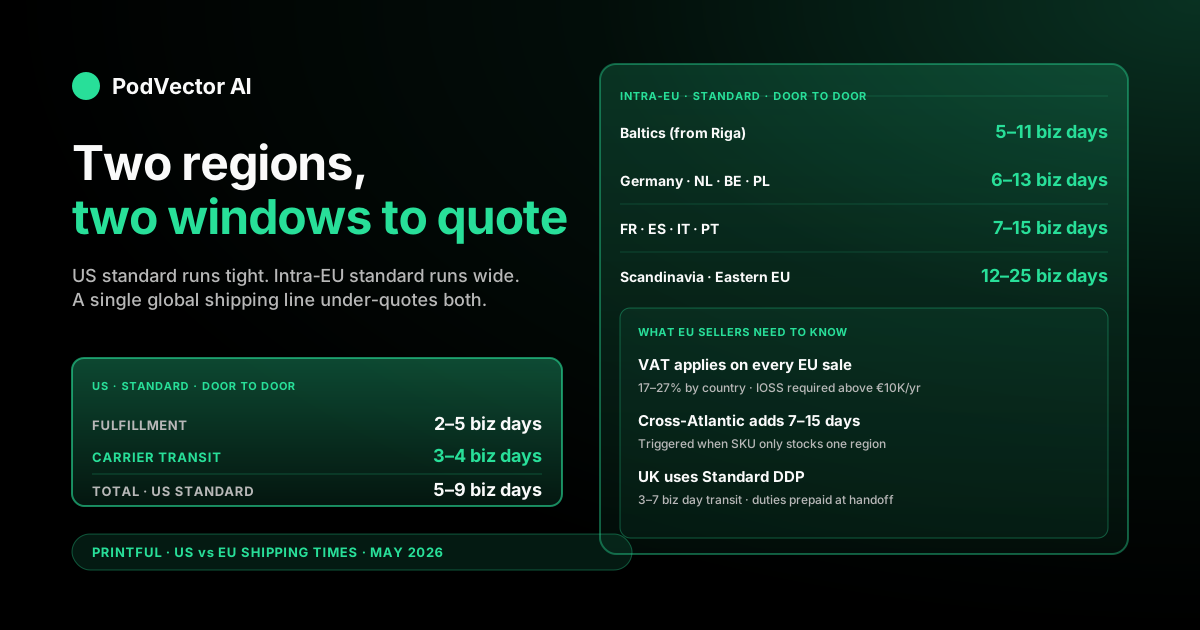
Quick Answer: On Printful, a standard US order lands in roughly 5–15 business days door to door — according to fulfillant.com, Printful's production times of 2–7 business days plus shipping create that total. A standard intra-EU order runs 7–14 business days for most destinations, with outlier routes (Eastern EU, cross-region) stretching to 25 business days. Printful's official help center confirms standard fulfillment is 2–5 business days globally, with domestic carrier transit adding 1–8 business days and international transit adding 1–20 business days on top.
The US window is tighter because Printful has multiple US apparel facilities feeding a domestic carrier network. The EU window is wider because intra-EU transit varies more by destination country and carrier handoff than the US zone system does.
If you sell into both regions, quote each region its own window. A single global "ships in 5–20 business days" copy line tanks US conversion and under-quotes the EU edge cases at the same time.
Rate alert: Printful pushed two shipping rate updates in 2026 — an accessories-only round on February 26 and a broader batch live on June 4, 2026. Always verify current rates against Printful's live shipping calculator before publishing storefront prices; snapshots go stale fast.
The two windows you should quote, side by side
Sellers serving both regions need two numbers, not one. Here's the cleanest version for customer-facing copy, anchored to current Printful data:
- US standard: 5–15 business days door to door (2–7 fulfillment + 3–8 carrier transit) — per fulfillant.com
- US express: 3–8 business days door to door (2–5 fulfillment + 1–3 express transit) — per Printful's shipping page
- EU standard (intra-EU): 7–14 business days door to door for most destinations (2–5 fulfillment + 5–9 transit), with Eastern EU and non-EU European routes reaching 25 business days — per fulfillant.com and Printful's help center
- EU express (intra-EU): 3–8 business days door to door (2–5 fulfillment + 1–3 express transit)
- US to EU cross-shipment: 10–30 business days door to door; customs delays common
- EU to US cross-shipment: 10–30 business days door to door; customs delays common
The biggest gap is intra-EU standard vs US standard. EU standard's tail is wider because intra-EU consumer parcel transit isn't a single uniform network — it's a patchwork of national carriers and customs steps that vary by destination country.
For best results, express is the great equalizer. Express transit windows are roughly comparable in both regions because Printful uses similar courier services (UPS, DHL, FedEx) on the express leg in both markets. Per Printful's own shipping page, express delivers in 1–3 business days after fulfillment in both regions.
Also see: how much Printful charges for shipping — a line-by-line cost breakdown by region and product type — and the Printify vs Printful vs Gelato comparison if you're benchmarking delivery windows across providers.
Fulfillment: where the EU and US clocks differ
According to Printful's official help center, standard fulfillment takes 2–5 business days for all products. That stated window is identical for US and EU facilities. The variance underneath the window is not.
According to getfuelpod.com, Printful handles 97.66% of orders within five business days, with most being completed in just 2–3 business days. That global figure masks a regional split.
US fulfillment runs at multiple apparel facilities — California, North Carolina, and Dallas, Texas — plus specialty operations for embroidery, all-over-print, and warehoused goods. Most standard DTG (direct-to-garment) apparel ships in 2–3 business days from a US facility.
EU fulfillment runs primarily out of Latvia (Riga, near Printful's HQ) and Spain (Barcelona), with smaller operations supporting specific product types. EU apparel fulfillment runs slightly longer on average than US fulfillment — 3–4 business days is more typical than 2–3 — because EU production volume per facility is smaller and SKU coverage per facility is narrower.
The practical effect: an EU customer ordering an EU-fulfilled t-shirt typically sees fulfillment land on day 3 or 4. A US customer ordering a US-fulfilled t-shirt typically sees fulfillment land on day 2 or 3. The window is the same on paper. The realistic median is one day apart.
Printful also notes that fulfillment time calculations account for current order volume and facility capacity — meaning that number shifts during peak weeks and Q4. For the deeper product-by-product timing breakdown, the Printful shipping cost breakdown covers fulfillment estimates by SKU class alongside cost data.
The US transit leg
Once a US order leaves the facility, the carrier window is tight. According to Printful's help center, domestic orders run 1–8 business days on the carrier leg. Standard typically lands in 3–4 business days; express compresses that to 1–3 business days. The continental US is a single zone system from a carrier standpoint, with USPS, UPS, and DHL handling most of the volume.
Per PodVector's own shipping guide (verified against Printful's rate table after the June 4, 2026 update), US domestic apparel ships at roughly $4.75 for the first item. The price is flat across the continental US — a t-shirt to Boston and a t-shirt to Phoenix both cost the same to ship. Transit time changes by zone; the base price does not. Always verify the current figure against Printful's live shipping calculator, since Printful updated rates twice in 2026.
Express US shipping compresses the carrier leg from 3–4 days to 1–3 days. It does not touch fulfillment, which still takes 2–5 business days per Printful's help center.
Remote-zone US destinations (Hawaii, Alaska, Puerto Rico, US Virgin Islands) carry small surcharges and longer transit windows. Hawaii and Alaska typically run 5–7 business days transit. Puerto Rico typically runs 6–9 business days transit.
The EU transit leg
Intra-EU transit is where the window stretches. According to Printful's help center, international orders run 1–20 business days on the carrier leg. The wide range is real — it reflects actual carrier variance by destination country, not a buffer for outliers.
Typical EU transit clusters by destination:
- Latvia, Lithuania, Estonia (Baltics): 3–6 business days transit from Riga
- Germany, Poland, Czech Republic, Netherlands, Belgium: 4–8 business days transit
- France, Spain, Italy, Portugal: 5–10 business days transit (or 3–6 days from the Spain facility for Iberia)
- Scandinavia (Sweden, Denmark, Finland): 5–10 business days transit
- Greece, Bulgaria, Romania, Cyprus: 10–20 business days transit
- UK (now non-EU): 3–7 business days transit via Standard DDP (Delivered Duties Paid), customs handled at handoff
The single biggest source of EU transit variance is the customs leg on borderline cases. An order from the EU facility to a non-EU country (Switzerland, Norway, the UK) involves customs clearance, which can add 2–10 business days even on a fast carrier route. The UK's DDP option absorbs this by paying duties upfront, but other non-EU European destinations don't have an equivalent.
For a full look at how Printful's free-shipping offer interacts with these transit windows, see Printful free shipping: full breakdown for POD sellers.
How Printful decides whether your order ships from the US or the EU
Printful's order-routing system picks the facility automatically based on three factors: customer address, product availability at the closest facility, and current queue depth across facilities. Printful's shipping page confirms that the estimated delivery time is calculated according to historical shipping data for deliveries to the customer's area or selling region.
The default behavior is geographic. A US customer order routes to a US facility. An EU customer order routes to an EU facility. The seller does not pick the routing manually.
Exceptions happen when:
- The SKU isn't stocked at the closer facility. Some specialty SKUs (specific colorways, niche product lines, embroidery options) only fulfill from one or two facilities globally. An EU customer ordering a US-only SKU will see their order route through US fulfillment and cross-shipment, which adds significant business days to the timeline. Printful's shipping page explicitly notes that orders shipped from a facility in a different region than the delivery destination may carry customs fees.
- The closer facility is at capacity. During Q4 peak, the routing system can re-route some orders across regions to balance load, especially on standard DTG apparel that any facility can produce.
- The order contains a mix of SKUs split across facilities. In this case, Printful may split the order into two shipments, fulfilled and delivered separately, each from its own facility.
The practical effect for the seller: most EU customer orders ship from the EU, most US customer orders ship from the US, and a small percentage cross the Atlantic. The cross-shipment percentage is the one to watch — it carries a much wider delivery window and costs more in shipping.
Printful does not let sellers force a region for routing. The closest a seller can get is curating the SKU mix to favor products that stock at both EU and US facilities.
2026 shipping rate changes: what's shifted
This is a section the older version of this article was missing — and it's now material to how you quote shipping to customers.
According to PodVector's shipping guide (verified against Printful's rate table), Printful pushed two rate updates in 2026:
- February 26, 2026: An accessories-only round. Hats shipping to Canada increased; apparel rates to Australia and New Zealand increased; Japan saw increases too.
- June 4, 2026: A broader batch affecting first-item and additional-item rates across multiple product categories and regions. Printful published this update with a downloadable old-vs-new list on their shipping price updates page.
The practical implication: any shipping rate figures you published before June 4, 2026 are potentially stale. Treat Printful's rate card as a living document you reconcile monthly against actual Printful invoices, not a set-and-forget table. Every specific dollar figure in this article should be verified against the live Printful shipping calculator at time of use.
Per PodVector's July 2026 rate verification, US domestic apparel first-item rates sit at roughly $4.75, and intra-EU first-item rates sit at roughly $4.79 — but both of those figures are subject to change. See how much Printful charges for shipping for a current breakdown.
Also relevant if you're watching shipping cost versus profit margin: how to increase print-on-demand profits covers the margin levers that sit on top of the shipping cost floor.
VAT, IOSS, and what changes for EU customers
EU shipping doesn't just take longer. It comes with tax obligations that change the seller's economics.
VAT on EU sales. Every EU consumer order is subject to value-added tax in the destination country, with rates varying by member state. The seller is responsible for charging and remitting VAT for orders shipped within the EU.
The €10,000 threshold. If a non-EU seller's total EU sales exceed €10,000 per year, they must register for IOSS (Import One Stop Shop) or appoint an EU intermediary to handle VAT remittance. Below the threshold, low-value imports (under €150) can ship duty-paid via individual VAT collection at delivery, but the friction is high — many customers refuse the customs handoff and abandon the package.
Printful's role. Printful does not collect or remit VAT on behalf of the seller for most plans. Sellers need to handle VAT in their store platform (Shopify VAT settings, WooCommerce EU plugins) or via a tax automation service. Customers receive a clean total with VAT included at checkout; the seller remits VAT to the relevant authority on a quarterly schedule.
UK specifics. Brexit moved the UK out of the EU VAT system. UK sellers and customers now see customs steps on shipments to and from the EU. Printful's Standard DDP option for UK shipments folds the duties into the shipping price — a much cleaner experience than the default customs clearance, but with a price premium.
VAT and IOSS sit alongside the shipping cost itself in the unit economics. The Printful free shipping breakdown covers the seller-side cost stack that sits underneath both regions, and the provider comparison shows how VAT handling differs across Printful, Printify, and Gelato.
Dual-region storefront playbook
If you sell into both the US and the EU, treat them as two distinct fulfillment economies on the same storefront. The biggest operator wins:
Region-specific shipping copy on product pages. A single "ships in 5–20 business days" line is useless. Show "5–9 business days to US, 7–14 business days to most of EU" with a dropdown for the customer to confirm their region. Shopify and WooCommerce both support IP-based region detection that pre-fills this on page load.
Region-specific pricing. EU customers see VAT-inclusive prices. US customers see pre-tax prices. Running a single global price line and "VAT calculated at checkout" tanks conversion on EU mobile, where the gap between displayed price and checkout price creates abandonment.
Region-specific shipping promos. "Free shipping over $50" works in the US where transit is short and cheap. The same offer in the EU, where shipping costs less per item but transit takes longer, doesn't move the needle as much. Test "Free express shipping over €60" instead — it shaves real days off the EU delivery window. See Printful free shipping: full breakdown for the threshold math.
Region-specific SKU coverage. Some Printful SKUs only stock at one regional facility. If you carry one of those SKUs, customers in the other region see longer windows from cross-shipment. Either drop the SKU, accept the longer window with explicit copy, or sub in a comparable SKU that stocks at both facilities.
Region-specific support replies. Your "where's my order?" reply template for EU customers should differ from your US template. EU customers asking about a day-7 order are within the normal window. US customers asking about a day-7 order are at the edge of the normal window. The reply tone shifts accordingly.
Ad retargeting cadence by region. A Meta or Google ad clicked on day 1 in the US drives a delivery experience around day 7–10. The same click in the EU sees the delivery experience on day 10–14. Your post-purchase email sequence and retargeting windows in Klaviyo should reflect the longer EU clock. For the full retargeting-timing setup, see Klaviyo browse abandonment flow setup.
On the paid-acquisition side, US and EU customers also convert differently by channel. Facebook Ads vs Google Ads for POD covers how the channel mix differs by market.
Peak season — US and EU diverge here
Q4 stretches both windows, but not by the same amount.
US fulfillment in Q4 typically adds days across product types. According to getfuelpod.com, Printful handles 97.66% of orders within five business days globally, but this metric drops during peak weeks. Embroidery and all-over-print SKUs tend to slip further behind the standard window during the worst Q4 weeks than basic DTG apparel does.
EU fulfillment in Q4 adds more days than the US equivalent, with bigger swings on specialty SKUs. EU transit during Q4 sees more carrier variance because European national postal services have their own peak-season capacity issues that compound Printful's own queue.
According to PodVector's dropshipping review (citing checkthat.ai), Printful applied a holiday shipping surcharge from October 15, 2025 through January 17, 2026 — an important data point for budgeting Q4 shipping costs in 2026. Watch for a similar surcharge window this year and build it into your promotion math before running holiday creative.
Printful publishes Christmas cutoff dates for each region, broken out by shipping tier. The US cutoffs are typically several business days before Christmas for standard. The EU cutoffs are typically 10–14 business days before Christmas for standard intra-EU and longer still for non-EU European destinations.
Operator playbook for dual-region Q4:
- Switch EU customers to "order by [EU cutoff]" banners earlier than the US version. EU customers see the holiday-shipping anxiety land sooner because the windows are wider.
- Push express as the default for any EU order placed within 14 business days of the holiday deadline. The premium is worth eating in marketing copy ("Express delivery guaranteed before December 22nd").
- Stop running gift-themed creative before the EU express cutoff and shortly before the US express cutoff. Once express can't make it, the marketing has to shift to "order for the new year."
- For high-volume sellers, the cross-shipment window collapses entirely in Q4 — a US-to-EU order placed in late November is unlikely to deliver before Christmas. Block cross-region SKUs from showing on EU storefronts during peak.
- Account for the holiday surcharge in your shipping cost projections — if Printful runs a similar surcharge to the 2025–2026 period, it will affect the cost of every order shipped during that window.
For broader Q4 campaign strategy across Meta and Google, see the industry-standard Google Ads campaign strategy for POD and Google Ads vs Facebook Ads effectiveness for POD sellers.
What this means for store operations
Three operational implications specific to dual-region sellers.
Refund-window math is different by region. Your US refund window of "30 days from delivery" runs to roughly 40–45 days from order placement on a standard US order. Your EU refund window of "30 days from delivery" runs to 55–65 days from order placement on a standard EU order. The accounting and chargeback dispute windows need to reflect the longer EU clock.
Ad attribution lag differs by region. A Meta or Google ad clicked on day 1 in the US drives an order, and the customer experience that fuels a repeat purchase happens around day 7–10 (delivery). The same click in the EU sees the delivery experience on day 10–14. The retargeting cadence — when to send a "how's it going?" email, when to push a second purchase — should be different in each region.
Inventory hedge math is different. A high-volume US seller can hold a small bestseller inventory in a US warehouse to bypass POD lead times during peak. The same hedge in the EU is harder because EU 3PL networks are more fragmented and shipping across EU borders carries customs steps when the inventory isn't pre-located in the destination country. Most EU sellers eat the longer Q4 window instead.
Tracking these numbers per region — fulfillment time, transit time, late-delivery rate, refund rate by region — is the kind of thing a spreadsheet does poorly. Printful's reports show order-level data but don't compare region against region or week against week without manual export.
That's the gap Victor fills. Victor reads your connected Printful and Shopify accounts into a live data warehouse and answers questions like "what's my US vs EU late-delivery rate this month?" in plain English — no spreadsheet reconciliation. On the Shopify side, Victor can also act: if your shipping margin is slipping because Printful's June 2026 rate update changed your cost floor, Victor can propose and execute a bulk price update across your affected SKUs — with your approval before anything changes. Try Victor free.
FAQs
How long does Printful take to ship to the US vs the EU?
According to fulfillant.com, Printful's production times plus shipping create a total US delivery timeline of 5–15 business days for US orders and 7–14 business days for EU orders (most destinations). According to Printful's official help center, standard fulfillment is 2–5 business days, domestic carrier transit is 1–8 business days, and international transit is 1–20 business days. Express compresses the carrier leg to 1–3 business days in both regions per Printful's shipping page.
Why is EU shipping wider than US shipping on Printful?
The US is a single carrier zone system with multiple Printful apparel facilities feeding it. The EU is a patchwork of national postal networks, customs steps for non-EU destinations (UK, Switzerland, Norway), and two primary Printful facilities (Latvia and Spain) covering a much larger geographic spread. The wider window reflects real variance, not buffer padding.
Did Printful change shipping rates in 2026?
Yes — twice. According to PodVector's shipping guide verified against Printful data, there was an accessories-focused rate update on February 26, 2026 and a broader multi-category update on June 4, 2026. Any rate figures published before June 2026 should be re-verified against Printful's live shipping calculator or their shipping price updates page.
Do I need to register for IOSS to sell into the EU via Printful?
Only if your total EU sales exceed €10,000 per year. Below that threshold, you can rely on individual customs declarations and per-order VAT collection, but the customer-side friction is high. Most sellers approaching €10K register for IOSS proactively to keep checkout clean and avoid customs holdups at delivery.
Can I force Printful to ship a US customer order from the EU facility, or vice versa?
No. Printful's order-routing system picks the facility automatically based on customer address, SKU availability, and queue depth. Sellers cannot override the routing. The only practical lever is curating the SKU mix to favor products that stock at both EU and US facilities, which avoids cross-shipment and the customs fees Printful's shipping page explicitly warns about.
What happens when a Printful order has to cross between the EU and US?
Cross-shipment adds significant business days to the standard window and runs into customs clearance on the receiving side. Per Printful's shipping page, customers may need to pay handling and/or customs fees upon delivery if the order ships from a different region than the destination. Most cross-shipments are unintentional — a customer ordered a SKU that only stocks at the opposite-region facility. Curate SKU coverage to minimize this.
How does the UK fit into Printful's EU shipping system after Brexit?
The UK is now a non-EU destination. Printful offers Standard DDP (Delivered Duties Paid) for UK shipments, which folds VAT and customs duties into the shipping price — typically 3–7 business days transit after fulfillment. The DDP option is much smoother than default customs clearance but carries a price premium versus intra-EU rates.
Does Printful's "97.66% within 5 business days" metric apply to both US and EU?
It's a global system-wide metric — according to getfuelpod.com, Printful handles 97.66% of orders within five business days, with most completed in 2–3 business days. Sub-region performance varies. US apparel hits the metric more consistently than EU apparel because US production volume per facility is higher. The metric is fulfillment performance only, not door-to-door delivery.
What's the cheapest way to ship to the EU on Printful?
Standard intra-EU flat-rate shipping is the lowest-cost tier. Per PodVector's July 2026 rate verification, EU first-item apparel rates sit at roughly $4.79 — but verify this against Printful's live calculator given the 2026 rate updates. Express EU runs meaningfully over standard. For most dual-region sellers, letting Printful's automatic routing keep most orders within their origin region is the best cost-control lever.
How should I quote EU customers shipping time on my product page?
Use the region-specific window: "EU standard shipping: 7–14 business days door to door for most of Western Europe. Eastern EU and Scandinavia may run 12–20 business days." Pair that with a separate line for US customers. A single global "ships in 5–20 days" line under-quotes the EU edge cases and tanks US conversion simultaneously.
Does Printful charge me VAT when I place an order to fulfill a customer order?
For EU sellers and certain non-EU sellers with EU tax registrations, Printful charges VAT on the wholesale order. The seller then collects VAT from the end customer and remits the difference. Sellers without EU tax obligations typically don't see VAT on their Printful invoice but are still responsible for charging end customers VAT in the destination country if they exceed the €10,000 annual threshold.
Region-by-region shipping performance is the single most underused number in dual-region POD operations.
Printful tells you when each order shipped and when it delivered. It doesn't tell you that your EU fulfillment time has crept up over the last six weeks, that your Italian customers are now seeing extended transit on average, or that the cross-shipment orders between regions are driving an outsized share of your refund volume.
Victor connects to your Printful and Shopify accounts, pulls fulfillment timestamps, transit times, and refund events into a live data warehouse, and answers questions like "what's my US vs EU late-delivery rate this month?" or "which EU countries are my worst transit performers?" in plain English. When the answer points to a Shopify-side fix — a price update after Printful's June 2026 rate change, a new shipping threshold — Victor proposes the move and executes it only after you approve. No spreadsheet reconciliation. No end-of-quarter surprise.
Try Victor free