
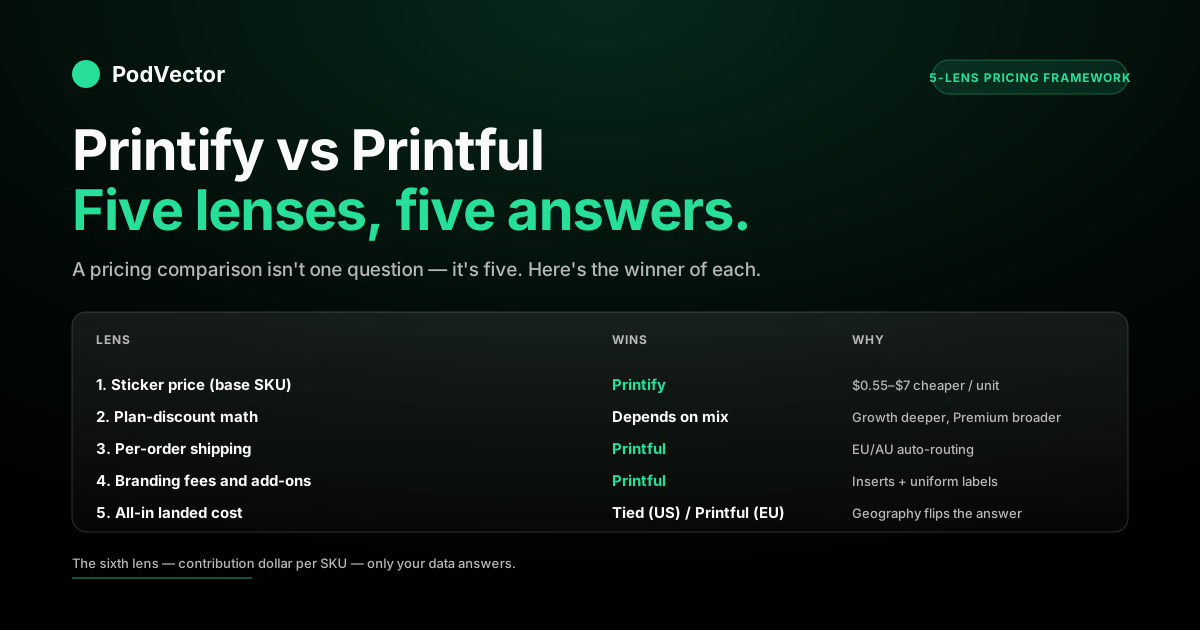
Quick Answer: Printify is cheaper on sticker price for most standard SKUs (a Bella+Canvas tee runs ~$10.95 vs Printful's ~$12.95; an 11oz mug ~$5.49 vs ~$8.95). But "cheaper" has five different right answers depending on the lens. Plan-discount math: Printful's Growth plan ($24.99/mo, up to 30% off, free past $12k/yr) saves more per unit on flagship apparel; Printify Premium ($29/mo, or $24.99 billed yearly, flat 20% off) saves more across a wider catalog.
Total order cost (base + shipping): Printful is often cheaper on hoodies and international shipments. All-in landed cost (base + shipping + branding + defects + plan): the platforms tie within a dollar on most US tee orders. Per-SKU contribution dollar: only your own data can answer that one — and that's the comparison your P&L actually runs on.
Below: each lens with the numbers, the side-by-side master table, and a checklist for running the comparison against your own catalog instead of someone else's averages.
The five pricing comparisons sellers conflate
Most "Printify vs Printful pricing comparison" articles you'll read are actually only one comparison: sticker price on a single tee. That's the easiest one to write and the least useful one to act on.
The pricing question splits into five separate comparisons. Each gives a different winner, and each maps to a different decision you'll make as a seller.
- Sticker price — what does the SKU cost before any plan, before shipping, before branding?
- Plan discount — how much does each platform's paid tier shave off the sticker, and at what monthly volume does it pay for itself?
- Per-order shipping — what does it cost to actually deliver one order to a customer?
- Branding fees — the inserts, label swaps, and pack-ins that make a POD product feel like a brand, not a drop-ship.
- All-in landed cost — every line above stacked, including defect reserve and plan amortization, on a real order.
A complete comparison runs all five. Skipping any one of them produces a confidently wrong answer that doesn't match your unit P&L. We'll walk through each, then stack them.
Comparison 1 — Sticker price on standard SKUs
Sticker price is what every comparison article opens with, and what every seller looks at first. On the public catalog without any plan, Printify is cheaper on most flagship SKUs.
Standard apparel
A Bella+Canvas 3001 unisex tee runs $12.95 on Printful's free tier and $10.95 on Printify's free tier. A Gildan 18500 hoodie runs $28.95 on Printful and $22.49 on Printify. The gap widens with garment weight — pricier products amplify the per-unit difference.
On premium fabrics — tri-blends, ringspun cotton at 4.3 oz or heavier, organic certifications — Printful's catalog is tighter and the gap shrinks. A Bella+Canvas 6004 women's slim tee or a Comfort Colors 1717 garment-dyed tee often comes within $0.50 between the two platforms.
Non-apparel
The mug is where Printify's catalog advantage shows up loudest. An 11oz ceramic mug runs $8.95 on Printful and $5.49 on Printify — a 39% sticker gap before any plan. Phone cases, water bottles, and tote bags follow the same pattern: Printify's marketplace of providers undercuts Printful's in-house catalog by 30–50%.
Embroidered goods reverse the pattern. Printful's embroidery has been in-house since 2019 and runs $4–6 cheaper per unit than Printify's top-tier embroidery providers. If your catalog leans embroidered hats, polos, or jackets, Printful wins this lens outright.
What sticker comparison gets right and wrong
Right: Printify's catalog is cheaper on most standard SKUs, full stop. Wrong: the sticker is one cost line out of four or five. A $2 sticker advantage gets erased — sometimes flipped — by shipping, branding, and defect costs that show up later. For a deeper line-by-line walkthrough on each platform individually, see the complete guide to Printful costs and fees and the complete guide to Printify costs, fees, and discounts.
Comparison 2 — Plan-discount math (Growth vs Premium)
Printify Premium runs $29/month, or $24.99/month billed annually — which matches Printful Growth's monthly fee at parity. What each tier unlocks is different.
Printful Growth
- Up to 30% off product costs on the most-discounted SKUs — heavier on flagship apparel like Bella+Canvas tees and Gildan hoodies, lighter on premium garments and most non-apparel.
- 9% off branding fees (label swaps, inserts).
- 20% off sample orders (up to 3 products/month).
- Free background removal in the design tool.
- Free Growth tier after $12,000 in annual sales — the milestone resets each year.
Printify Premium
- Flat 20% off product costs across the catalog — no per-SKU variation.
- Up to 10 stores on Premium (vs 5 on Free).
- Self-serve product personalization features.
- No annual sales milestone — Premium remains a paid subscription regardless of volume.
- No free trial — unlike Printful's free-after-$12k path, Printify Premium is a flat subscription from day one.
Above Premium, Printify offers a custom-priced Enterprise tier for high-volume sellers (negotiated product discounts, dedicated support, higher store limits). It's quote-based, not published, so it doesn't factor into the break-even math below — but it's the lever to pull once you're past a few thousand orders a month and want rates beyond the flat 20%.
Break-even math
The plan pays for itself when (per-unit savings × units sold) equals the monthly fee. Rearranged: break-even units = $24.99 ÷ per-unit savings.
- Printful Growth, Bella+Canvas 3001 tee: $12.95 → $9.50 = $3.45 saved per unit. Break-even ≈ 8 tees/month.
- Printful Growth, Gildan 18500 hoodie: $28.95 → $21.50 = $7.45 saved per unit. Break-even ≈ 4 hoodies/month.
- Printify Premium, Bella+Canvas 3001 tee: $10.95 → $8.95 = $2.00 saved per unit. Break-even ≈ 13 tees/month.
- Printify Premium, Gildan 18500 hoodie: $22.49 → $17.99 = $4.50 saved per unit. Break-even ≈ 6 hoodies/month.
Printful Growth pays back faster on flagship SKUs because its discount per unit is heavier. Above 50 orders a month, both plans compound — the question is which discount shape (deep on flagship vs flat across catalog) fits your mix. Read the deeper Printful subscription analysis in the complete guide to Printful Premium, Plus, and Pro memberships.
Comparison 3 — Per-order shipping cost
Shipping is the cost line most pricing comparisons under-cover. On a $20 retail tee with $5 shipping, the shipping line is 25% of the customer's payment — and on a free-shipping store, it's a direct hit to your margin.
Domestic US shipping
Printful runs slightly cheaper on the standard tee (~$4.69 vs Printify's ~$5.19) because Printful's owned facilities use volume-negotiated US carrier rates. The gap reverses on phone cases — Printify's accessories-focused providers ship a phone case for $2.59, where Printful charges $4.99 for the same line.
On hoodies, Printful's domestic shipping advantage holds: $8.49 vs Printify's $9.99 on a Gildan 18500. On mugs, it reverses again — Printify mug providers often beat Printful by $1–2 per shipment.
International shipping
This is where the platforms diverge most. Printful auto-routes each order to the nearest of its facilities (US East/West, EU/Riga, EU/Spain, Mexico, Japan, Australia, Canada). For a US-headquartered store with an EU customer, the order ships from Riga or Barcelona — short distance, EU rates, no customs hit.
International shipping on a Bella+Canvas tee from Printful runs $4.49 to the UK, $7.19 to Australia, $8.29 to Canada. The seller does no setup work to access this routing.
Printify's international shipping economics depend on whether you listed the SKU through a regional provider. If your tee is listed only through a US Printify provider and the order ships to Germany, the shipping line goes international from the US — slower and pricier. UK shipping on the same tee runs ~$10. Australia runs ~$12.49.
The fix is to list the same SKU through multiple Printify providers — one US, one EU, one AU — and let Printify route by destination. Done well, this beats Printful's international economics. Done lazily, it's significantly worse. For the routing tables and per-region cost breakdowns, see the complete guide to Printful shipping and the complete guide to Printify shipping.
Comparison 4 — Branding fees and add-ons
Branding fees are small per unit, but they add up — and the architecture between the two platforms is different.
Printful branding fees (uniform across catalog)
- Inside-collar relabel: $2.49/item.
- Outside neck label print: $2.49/item.
- Pack-in marketing insert (postcard, sticker): $0.50/pack-in.
- Custom packing slip with your logo: Free.
- Branded sticker on package: $0.50/order.
Growth subscribers get 9% off these fees. Across a 1,000-order month with relabel + insert on every order, branding adds roughly $3,000 to the cost line.
Printify branding fees (provider-specific)
Printify's branding options are decided per provider. Inside-collar relabeling is available on premium providers like Monster Digital ($2.50/item) but not catalog-wide. Custom packing slips are supported on most major providers. Pack-in inserts are not native to Printify — sellers wanting per-order inserts typically self-fulfill that piece or use a third-party fulfillment add-on.
This isn't a fee disadvantage so much as an architectural one: on Printify, branding consistency is the seller's job, executed per-provider. On Printful, branding is on rails across every order. Whether that's worth the per-unit price gap depends on how much your brand depends on the unboxing.
Sample orders
Both platforms charge full base price plus shipping for samples. Printful Growth subscribers get 20% off sample orders, on up to 3 products a month. Printify offers no equivalent sample discount tier. For a seller testing new SKUs every month, that's a small but real recurring saving on Printful Growth — and it caps at three discounted samples, so high-volume sample testers stop benefiting past that.
Comparison 5 — All-in landed cost
Stack every line above into a real order, and the comparison shifts again. This is the only comparison that maps directly to your unit P&L — and it's the one where the headline "Printify is cheaper" narrative starts to break.
Worked example: Bella+Canvas 3001 tee, US shipment, branded
| Cost line | Printful Growth | Printify Premium |
|---|---|---|
| Base product cost | $9.50 | $8.95 |
| Shipping (US) | $4.69 | $5.19 |
| Inside-collar relabel | $2.27 (with 9% Growth discount) | $2.50 |
| Pack-in insert | $0.50 | — |
| Defect reserve (1% / 3%) | $0.17 | $0.50 |
| Subscription amortization (1k orders/mo) | $0.025 | $0.025 |
| Landed unit cost | $17.16 | $17.17 |
The platforms tie almost exactly on landed cost for this scenario. The $0.55 sticker gap evaporates once the rest of the lines stack. This is why a sticker-only comparison is misleading — it leaves the seller thinking they're saving money they're not actually saving.
Worked example: Gildan 18500 hoodie, EU shipment
| Cost line | Printful Growth | Printify Premium (US-only listing) |
|---|---|---|
| Base product cost | $21.50 | $17.99 |
| Shipping to Germany | $8.29 (Riga facility) | $18.40 (US-to-EU) |
| Defect reserve (1% / 3%) | $0.30 | $1.09 |
| Landed unit cost | $30.09 | $37.48 |
On EU shipments without per-region Printify routing, Printful is $7.39 cheaper per hoodie despite the higher base cost. Listing the same hoodie through a Printify EU provider closes most of that gap. Whether the setup work is worth it depends on volume — under 50 EU hoodies a month, probably not. Above 200, definitely.
Side-by-side: every pricing line at a glance
The full comparison stacked into one table. Numbers reflect 2026 published catalogs in the US for sellers in the US. Always verify against the live catalog before committing your unit economics.
| Cost line | Printful | Printify |
|---|---|---|
| Bella+Canvas 3001 tee, US base | $12.95 (free) / $9.50 (Growth) | $10.95 (free) / $8.95 (Premium) |
| Gildan 18500 hoodie, US base | $28.95 (free) / $21.50 (Growth) | $22.49 (free) / $17.99 (Premium) |
| 11oz ceramic mug | $8.95 (free) / $6.50 (Growth) | $5.49 (free) / $4.39 (Premium) |
| Subscription | Growth: $24.99/mo, up to 30% off | Premium: $29/mo (or $24.99 yearly), 20% off; Enterprise quote-based |
| US shipping, single tee | ~$4.69 | ~$5.19 |
| EU shipping, single tee | $4.49 (Riga facility) | ~$10 (US provider) or $5 (EU provider) |
| Branded inside-collar label | $2.49 / item (uniform) | $2.50 / item (provider-specific) |
| Pack-in marketing insert | $0.50 / pack-in | Not native — provider-specific |
| Sample order discount | 20% off, up to 3/mo (Growth) | None |
| Defect rate | ~1% across facilities | 1% (top-tier) to 4–5% (lower-tier providers) |
| Free Growth/Premium milestone | Free Growth after $12k annual sales | None |
How to run this comparison on your own catalog
Every number above is an average. Your store's pricing question runs on specifics. Here's the four-step version that actually answers it.
Step 1 — Pull your top 10 SKUs by order volume
Sticker comparisons across "tees" don't generalize. Your real catalog mix matters — if 60% of your orders are mugs, the mug pricing line drives your platform decision more than the tee pricing line. Pull your top 10 SKUs from the last 90 days. That's the comparison set.
Step 2 — Price each SKU on both platforms
For each of those 10 SKUs, look up the current base cost on both Printify and Printful. Note the per-unit gap. Multiply by your monthly volume on that SKU. That's your sticker savings, by SKU, in dollars per month.
Step 3 — Add the four other lines per SKU
For each SKU, add: shipping cost (per your typical destination mix), branding fees (per your standard order setup), defect reserve (1% Printful, 3% Printify as a default if you haven't measured your own), and plan amortization. The sum is your landed cost per SKU per platform.
Step 4 — Take the lower-landed-cost platform per SKU
You'll find some SKUs cheaper on Printful, some on Printify. That's the catalog mix decision: route each SKU to whichever platform produces the lower landed cost. Most established POD sellers run both platforms and route per-SKU — the savings compound across the catalog. The case for the multi-supplier approach is in Printful alternatives: the complete comparison.
Five store profiles — which platform wins each
The decision pattern depends on three variables: catalog mix, monthly volume, and customer geography. Here's the shortcut by profile.
Profile 1 — US-only Etsy seller, mostly tees and mugs, under $5k/month
Printify Premium wins. The base-cost gap on standard apparel and the catalog-wide gap on mugs both favor Printify. Volume is too low to justify Printful's deeper SKU-specific discount tiers. Defect-rate risk is manageable at this volume — sample-test top providers before listing.
Profile 2 — US-only Shopify seller, paid-social, hoodie-led, 500–2,000 orders/month
Mixed. Printify Premium's $3–7 hoodie advantage matters at this volume — but so does Printful's lower defect rate on paid social, where every return chips at LTV/CAC. Most sellers in this profile run both: Printful for brand SKUs, Printify for margin SKUs.
Profile 3 — International store, US + EU + AU mix, mid-volume
Printful's auto-routing wins on simplicity. The EU/Riga and AU facilities cut international shipping by 50%+ versus a single-provider Printify setup. Printify can match this — but only after you list every flagship SKU through three regional providers. If you'll do the setup work, Printify wins. If you won't, Printful does.
Profile 4 — Brand-first seller, premium garments and embroidery
Printful wins on both pricing and quality. Printful's embroidery is $4–6 cheaper than Printify's top-tier embroidery providers, and the consistency premium matters when the brand is the product. Pricing comparisons that look only at base apparel miss this entirely. See the Printful vs Printify quality breakdown for the full quality comparison.
Profile 5 — High-volume seller crossing $12k/year
Printful's free Growth milestone changes the calculus from year two onward. Past $12k, the subscription is free — and the up-to-30% discount continues to apply. For a $50k/year apparel seller, that's roughly $300/year of subscription savings plus the SKU-discount compounding. Printify Premium has no equivalent milestone.
The pricing comparison only your data can run
Every comparison so far gives a platform-level answer. Pick A for X profile. Pick B for Y profile. The actual pricing question your P&L runs on is one level deeper.
On your Bella+Canvas 3001 in heather grey, shipping to your top region, with your ad-blended customer acquisition cost and your historical refund rate, which supplier produces a higher contribution dollar per order? The answer changes by garment, region, volume, and season — and none of the public pricing articles can answer it for you.
Closing the gap takes three pieces working together. Every order's supplier-charged cost has to flow into a single source of truth alongside revenue, ad cost, refunds, and processor fees. The math has to run per-SKU and per-supplier so a tee that's profitable on Printify and a hoodie that's profitable on Printful both surface clearly. The answer has to refresh fast enough to act on — switching a single SKU's supplier weekly is high-leverage if the data is fresh, useless if it's a quarter old.
This is the job PodVector AI built Victor to do. Victor is an AI employee for POD sellers: it pulls every order's supplier-charged cost, shipping line, refund, and ad spend from Shopify, Printful, Printify, Meta, and Google, runs the landed-cost math per-SKU and per-supplier, and tells you which supplier wins each SKU — "switch this hoodie to Printful for EU orders," "keep this tee on Printify." The answer isn't always Printful or always Printify. It's per-SKU, it changes by season, and a POD seller without an operator watching it is guessing on the most expensive lever in the business.
For the underlying profitability picture per platform, see is Printify profitable and how to make money with Printful.
FAQs
Is Printify or Printful cheaper overall?
On sticker price, Printify wins on most flagship SKUs. On all-in landed cost (base + shipping + branding + defects + plan), the answer flips by garment, region, and store profile. On EU shipments without per-region Printify routing, Printful is often cheaper. On US-only mug-led catalogs, Printify usually wins.
Is the Printify Premium plan worth it?
For tees and standard apparel, Premium pays for itself at roughly 13 units a month. For hoodies, at 6 units a month. Above those volumes, the 20% catalog-wide discount compounds. Below, the free tier costs less. Most sellers crossing 50+ orders/month are leaving money on the table by not subscribing.
Is Printful Growth worth $24.99/month?
Break-even is roughly 8 tees or 4 hoodies a month. For sellers crossing $12k in annual sales, Growth becomes free for the next year — making the math automatic. If your catalog is apparel-heavy and your monthly volume is 50+, Growth's deeper per-SKU discounts on flagship apparel often beat Printify Premium's flat 20%.
Which platform has cheaper shipping?
Printful runs slightly cheaper on US apparel shipping (~$0.50 less per tee) and significantly cheaper on international shipping when the destination matches one of its facilities. Printify can match or beat Printful's international shipping if you list the same SKU through multiple regional providers — but the setup work is real.
Are branding fees the same on both platforms?
Roughly the same per unit (~$2.50 for inside-collar relabeling on both). The architectural difference matters more than the price: Printful's branding is uniform across every order, Printify's depends on the provider. Pack-in inserts are native to Printful only.
How big a deal is Printify's higher defect rate?
It's provider-specific, not platform-specific. Top-tier Printify providers run ~1% defect rates — equal to Printful's. Lower-tier providers run 4–5%, which adds roughly $0.50/order to your real cost on a $14 landed-cost tee. Provider selection is the variable. Printful's uniform 1% rate is a known constant; Printify's range requires sample-testing per provider.
How does the $12k/year free Growth milestone work?
Once a Printful seller hits $12,000 in annual sales (rolling 12-month window), the next year of Growth is free. The up-to-30% per-SKU discount continues to apply. For sellers who'd otherwise pay $300/year for the subscription, this is a real savings line — and it has no equivalent on Printify Premium.
Can I run both Printful and Printify on the same store?
Yes — and most established POD sellers do. Both apps run in Shopify and Etsy without conflict. Route different SKUs to different suppliers based on margin, geography, or quality. The only added work is per-supplier mockup generation and per-supplier sample ordering. The case for the multi-supplier approach is in Printful alternatives: the complete comparison.
Where can I see the layered all-in landed cost analysis?
The companion deep-dive on landed-cost layers — base, shipping, branding, defects, sub amortization — is at Printful vs Printify pricing. For the full Printful vs Printify breakdown beyond pricing, see the Printful vs Printify comparison. The Printful comparison cluster lives at the Printful comparison hub and the broader Printful topic at the Printful topic hub.
Run the pricing comparison your platform can't run for you.
Every public Printify vs Printful pricing comparison gives you averages. Your unit P&L runs on specifics — which SKU, which region, which season. Victor is the AI employee that watches every order, supplier-charged cost, shipping line, and refund, runs the per-SKU landed-cost math for you, and tells you which supplier to route each product to — no spreadsheets, no dashboards to babysit.
Try Victor freeFor external context on the same axes, the Do Dropshipping 2026 Printful vs Printify pricing breakdown covers the plan and product side. To go broader on Printful, see the complete Printful guide; for Printify, the complete Printify guide.