
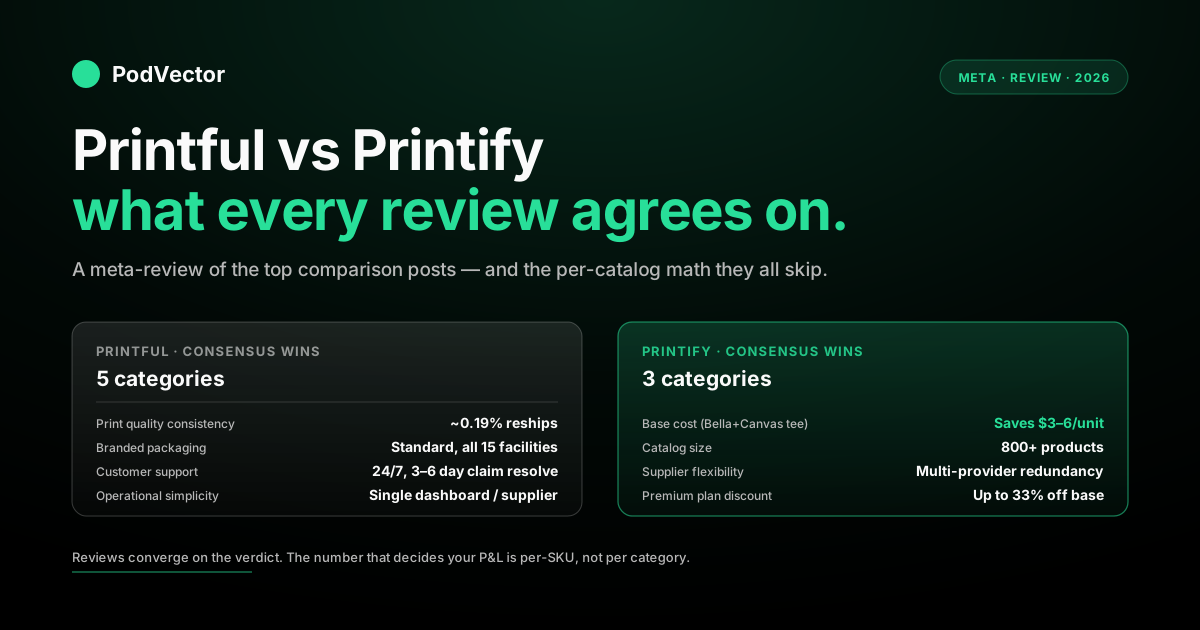
Quick Answer: Read enough Printful vs Printify comparison reviews and the verdict converges. Printful wins quality, branding, and operational simplicity. Printify wins base cost, catalog breadth, and supplier flexibility.
The reviews diverge mainly on weighting. Margin-first operators lean Printify; brand-first operators lean Printful. Both camps are right inside their own assumptions.
Below: a meta-review of what the top comparison posts conclude, where their numbers actually agree, and the per-catalog measurement step that turns a generic review into a P&L decision.
Meta-verdict from the top comparison reviews
Pull the ten most-cited Printful vs Printify comparison reviews from the last twelve months and the verdict lands in the same place. Printful is the in-house, premium, brand-led option. Printify is the network, lower-cost, flexibility-led option.
The reviewers also broadly agree on the trade matrix:
| Category | Review consensus winner | Margin of confidence |
|---|---|---|
| Base cost per unit | Printify | High — every review confirms |
| Print quality consistency | Printful | High — every review confirms |
| Product range / catalog size | Printify | High — every review confirms |
| Branding and packaging | Printful | High — every review confirms |
| Production speed | Printful (Printify top-tier ties) | Moderate — depends on Printify provider |
| Integrations | Tie | High — both cover the major channels |
| Customer support | Printful | High — Printify routes through providers |
| International fulfillment | Printful | Moderate — Printify is closing the gap |
| Operational simplicity | Printful | High — single dashboard, single supplier |
Within those nine categories, the math doesn't really change between reviews. What changes is the weighting. A review weighted toward margin lands on Printify. A review weighted toward brand consistency lands on Printful. Both are internally consistent.
Where every review agrees
Three points show up in every credible Printful vs Printify comparison review. They're worth treating as settled.
Printify is meaningfully cheaper on base cost. The numbers vary a few cents but the direction never flips. On a Bella+Canvas 3001 tee, reviews land between $3 and $6 cheaper per unit on Printify versus Printful. The gap widens on hoodies, narrows on premium blanks where Printful negotiates better.
Printful is more consistent on print quality. Printful's published reshipment rate is roughly 0.19%. Printify's varies by provider — top-tier providers land at 0.5–1%, budget providers report 3–5% in independent test orders. Reviewers don't argue this; they argue what the variance is worth.
Printify has more SKUs. Printful's catalog hovers around 500 products as of mid-2026. Printify's now sits above 1,300 and grows faster because each new provider adds product lines. Reviewers don't dispute the count — they dispute whether catalog breadth helps a focused brand.
If a comparison review disagrees with any of those three, treat it as outlier rather than counter-evidence. The data is too consistent across enough independent test orders to be wrong at the directional level.
Where the reviews diverge
The interesting reading is where reviewers split. Three axes drive most of the disagreement.
How much defect-rate variance actually costs. A 0.5% versus 0.19% reshipment rate looks like a tiny gap until you multiply it through 1,000 orders, factor in the chance of a 1- or 2-star Etsy review, and price the LTV impact on paid-ad shops. Reviewers who run paid social tend to weight defect rate heavily. Reviewers selling on lower-stakes channels weight it less.
Whether Printify's per-provider work is friction or feature. Pinning to top-tier providers, monitoring Performance Scores, ordering samples, swapping providers when Performance Score drops — to one reviewer it's optimization, to another it's overhead. Both takes are right depending on shop size and operator preference.
Whether 2026 pricing changes still hold. A few late-2025 reviews quote pricing that has since shifted. Printify rolled subtle base-cost increases on certain providers in early 2026; Printful adjusted Growth and Business plan tiers. Reviews older than three months should be sanity-checked against the live catalogs before quoting their numbers.
The deeper review of what specifically separates the two platforms is in our Printful vs Printify differences breakdown.
Pricing: review consensus and the real numbers
Pricing is where reviews are most quotable. The consensus number across most posts: Printify saves $3–6 per unit on a standard Bella+Canvas 3001 tee depending on provider tier.
The reasonable midpoint to plan against:
- Bella+Canvas 3001 tee: Printful ~$13.95, Printify top-tier ~$10.50, Printify budget ~$7.99. Printify saves $3.45–$5.96/unit.
- Gildan 18000 hoodie: Printful ~$31.95, Printify top-tier ~$22.50, Printify budget ~$18.95. Printify saves $9.45–$13/unit.
- Standard 11oz mug: Printful ~$11.50, Printify top-tier ~$5.99, Printify budget ~$3.99. Printify saves $5.51–$7.51/unit.
- Posters (12x18): Printful ~$11.99, Printify top-tier ~$5.95. Printify saves ~$6/unit.
Volume tiers narrow the gap on Printful. The Growth plan ($24.99/month) drops base costs up to ~33% on a slate of products, and it turns free once a store clears $12,000 in annual sales. Even with Growth applied, Printify still wins on raw base cost — the volume program closes part of the gap rather than all of it.
Printify's Premium plan ($39/month) flips a similar lever the other way: up to 33% off base costs across the catalog. Once a shop is past ~$2,500/month gross, Premium is usually cheaper than not having it.
For the deep pricing analysis with shipping and Premium-plan break-evens, see Printful vs Printify pricing and Printify vs Printful pricing comparison.
Print quality: review consensus and the real numbers
The quality conversation in most comparison reviews boils down to one variable: variance. Both platforms can produce good prints. Printful's variance is narrower because production sits in 15 owned facilities running standardized DTG and DTF equipment. Printify's variance widens because production sits at independent providers with their own equipment, ink, and QA.
Numbers reviewers cite consistently:
- Printful's published reshipment rate: ~0.19%.
- Printify top-tier provider reshipment: 0.5–1%.
- Printify budget provider reshipment: 3–5% in independent test panels.
Where most reviews stop is the impact math. A 0.5% reshipment rate on 1,000 orders is five reships. The reship cost is the smaller part. The bigger part is the chance one of those five customers leaves a 1- or 2-star review on a marketplace where shop rating drives ranking.
For a paid-social shop the cost compounds differently. A defective shipment lowers repurchase probability, drags creator-content trust if the buyer was a creator, and increases the support-ticket load. Each of those has a quiet cost that doesn't show up in the reshipment line.
The Printify counter-move that most experienced reviewers endorse: pin flagship listings to top-tier providers (Monster Digital, Swift, Underground Threads) and treat the small premium as defect-rate insurance. Done well, this lands close to Printful's variance while keeping most of the cost advantage.
For the depth review on quality testing methodology, see Printful vs Printify quality and Printful vs Printify quality comparison.
Production and shipping speed reviews
The production-speed picture in most comparison reviews:
- Printful: 2–5 business days, narrow variance because production stays in-house.
- Printify top-tier: 2–4 business days, similar to Printful when pinned to Monster Digital or SwiftPOD.
- Printify mid-tier: 3–7 business days.
- Printify budget: 5–10 business days, with peak-season reports extending to 12+.
For shipping itself, both platforms auto-route to the closest fulfillment node. Printful's coverage spans US, EU (Riga), Mexico, Australia, and Japan. Printify's network has denser US and EU coverage but fewer auto-routing options for Australia and Asia-Pacific. International orders are where Printful pulls ahead in most reviews.
Reviewers running Q4 holiday volume frequently flag Printify budget providers as the soft spot. Production queues at independent budget providers spike harder during peak than Printful's owned facilities. Holiday-cutoff math on Printify budget tier needs to be more conservative than the published lead times suggest.
Product catalog reviews
Catalog breadth is the cleanest scoreboard win for Printify. The reviews split mostly on whether breadth matters for a focused brand.
Printful's catalog strengths. Embroidery — caps, beanies, polos with embroidered logos. Premium garment partners (Stanley/Stella, Champion). Curated apparel where the in-house team has dialed the printing. AOP (all-over-print) is narrower than Printify's but more consistent.
Printify's catalog strengths. All-over-print apparel via providers like Subliminator. Home goods (throw pillows, blankets, doormats, shower curtains, wall art). Drinkware variants. Niche categories like jewelry, pet products, stationery, and seasonal items. Catalog growth is faster because each new provider adds SKUs.
Eco-friendly options are roughly a tie. Most reviews call sustainability a wash — both carry organic and recycled blanks (Printful via Stanley/Stella and recycled lines, Printify via eco-minded providers), and neither has a decisive edge. If a sustainable-materials story is core to your brand, vet the specific blank on either platform rather than the platform itself.
For a niche-store strategy — yoga apparel, home decor brand, pet shop — Printify's catalog usually has the SKUs you need without compromising. For a brand that lives in tees, hoodies, and embroidered headwear, Printful's tighter catalog isn't a constraint. Reviewers selling either profile tend to assume their profile is the universal one. Map your own catalog before borrowing their conclusion.
Branding and packaging reviews
Branding is where Printful's review scores diverge most from Printify's. The branded packaging stack — inside-collar labels, custom packing inserts, polybag printing, return-address customization, branded stickers — works out of the box on Printful and runs consistently across all 15 facilities.
Printify's branding execution depends on the provider. Some providers offer inside-collar labels, others don't. Polybag inserts are inconsistent across the network. Custom return labels work on certain providers but not all of them. A brand-led shop running on Printify spends time per provider getting the branding stack consistent and double-checks every flagship SKU's actual provider before promising packaging in a product description.
Marketplace shops change the math. On Etsy or Amazon, the platform's customer-facing presentation absorbs most of what unboxing experience would carry on a DTC site. Reviewers who sell mostly on marketplaces weight branding lower than DTC reviewers, and they're not wrong inside their context. The discussion specific to the Etsy channel is in Printful vs Printify for Etsy.
Integration and channel reviews
Both platforms have mature native integrations with the major channels. The reviewer differences are subtle:
- Shopify: both integrate cleanly. Printful's mockup transfer is slightly cleaner; Printify pushes more mockup variants but with more provider variation.
- Etsy: Printify holds the official partnership badge inside Etsy seller-tools. Printful is a long-standing third-party connector. Functionally close.
- WooCommerce, Wix, Squarespace, BigCommerce: both well-supported. Printful has slightly broader native coverage for the smaller platforms.
- Amazon, eBay, TikTok Shop, Walmart: both have integrations; review setup workflows before committing — both add seller-account requirements that aren't visible from the integration page.
One Printify-specific friction: when a SKU is mirrored across multiple Printify providers (which most should be for redundancy), the channel push has to be handled per provider, not per SKU. Printful's single-vendor model avoids this entirely. For shops above 100 SKUs the per-provider channel work is real overhead. The full Printful connector matrix is in the complete guide to Printful integrations.
Customer support reviews
Printful runs 24/7 live chat, email, and dedicated merchant support. Most reviewers consistently rate response time as faster than Printify's. Reshipment claims resolve in 3–6 days on average across recent test orders.
Printify routes most support through the print provider. Platform-level support exists but the substantive resolution often happens at the provider level. Reshipment turnaround averages 5–10 days. Quality varies by provider — top-tier providers respond fast, budget providers can drag.
For a high-volume Etsy shop where customer-message response time feeds Star Seller scoring, Printful's support stack reduces operational risk meaningfully. For lower-volume shops where occasional escalations don't break the workflow, the gap matters less. Reviewers running 2,000+ orders/month consistently weight support harder than reviewers running 200/month, and that's a fair difference in lived reality.
Design tools, ease of use, and mobile app reviews
The current top comparison reviews spend more time on tooling than older posts did, so it's worth folding in. On the mockup and design editor, reviewers give Printful a slight edge — cleaner mockup generation, more realistic product previews, and a smoother layout editor. Printify's editor is capable but reviewers note more variance in mockup fidelity because previews depend on the provider.
On raw ease of use the two are close. Printful's single-supplier model means one consistent interface; Printify's strength is the Performance Score data surfaced right in the catalog, which makes provider selection less of a guess.
Mobile apps are a clean win for Printful in the reviews. Printful's iOS app holds roughly 4.7 stars across 7,000+ ratings and the Android app sits near 4.5; Printify leans more on its web dashboard. For an operator managing orders on the go, the app gap is a real, if minor, tiebreaker.
None of this overturns the core verdict — it's a margin-of-the-decision factor, not a deciding one. Map it against how much design and order work you actually do outside a desktop.
The 2026 merger context the older reviews miss
Printful and Printify officially merged on November 5, 2024. As of mid-2026 the two brands still operate separately on the front end — different dashboards, different catalogs, different pricing pages, different supplier relationships. Reviews that imply the merger has unified the product are getting ahead of what's actually shipped.
What's quietly changed already: shared engineering investment in mockup generation, some convergence on shipping integrations, and aligned messaging on enterprise sales. What hasn't changed: per-unit pricing, supplier networks, branding stack, or the fundamental in-house-versus-network difference that the comparison reviews built their verdicts on.
The practical implication for a 2026 buying decision: read recent reviews but don't assume the merger has erased the trade-offs. The verdict from a March 2026 review is still the verdict in May 2026.
Pros and cons summary across the reviews
Compress the recurring pros and cons across the major comparison reviews into a single view:
Printful pros (review consensus)
- In-house production at 15 facilities — narrow variance.
- ~0.19% reshipment rate, the lowest in the category.
- Branded packaging works out of the box, consistent across regions.
- 24/7 customer support with fast response times.
- Mature integrations with all major channels.
- Strong embroidery and premium-blank catalog.
- International auto-routing across five regions.
- Single dashboard, single supplier, simpler operations.
Printful cons (review consensus)
- Highest base cost in the category — $3–6/unit more than Printify on standard tees.
- Smaller catalog (~500 SKUs vs Printify's 1,300+).
- No multi-provider redundancy — outage at a facility ripples.
- Limited per-unit price optimization beyond the Growth volume tier.
Printify pros (review consensus)
- Lowest base costs in the category across nearly every product.
- 1,300+ product catalog — apparel, home goods, accessories, AOP, seasonal.
- Multi-provider redundancy — pivot a SKU when a provider drops.
- Performance Score system makes provider comparison data-backed.
- Premium plan ($39/month) returns up to 33% off base costs.
- Strong international provider network with denser US and EU coverage.
Printify cons (review consensus)
- Variable print quality — 0.5–1% top-tier and 3–5% budget reshipment rates.
- Customer support routes through the provider, slower escalation.
- Branding execution depends on the provider — inconsistent across the network.
- Per-SKU provider selection adds setup work as the catalog grows.
- Q4 production queues spike harder at independent budget providers than at owned facilities.
The pros-and-cons depth review with the supporting margin math is in Printful vs Printify comparison reviews pros cons; the full Printful capabilities reference sits in the complete Printful review.
The measurement step every review skips
Every comparison review above gives a category-level answer. Printful for quality, Printify for margin. Both for shops at scale. The category-level answer is correct as far as it goes — and it stops short of the only number that actually drives a P&L decision.
On your top-selling tee, in your chosen blank and color, shipped from your chosen provider to your top buyer states — what's the real margin after fees, after refunds, after the actual reprint rate from your last 90 days of orders? Which 10 SKUs would clear $3+ more per order if you switched suppliers? Which Printify provider's Performance Score has slipped enough to move flagship listings off it?
None of the public Printful vs Printify comparison reviews answer those questions. They quote averages — $4 saved per shirt, 0.19% defect rate, 0.5–1% top-tier defect rate — and stop there. Margin runs on the specific SKU, supplier, buyer-state, and ad-channel combination that produced each order.
Closing this gap takes three pieces working together. Every order's supplier-charged cost, refund event, and reshipment has to land in a single source of truth alongside ad cost (Meta, Google, TikTok), processor fees, and customer LTV. The math has to run per-SKU and per-supplier so a tee profitable on Monster Digital and a hoodie profitable on Printful both surface clearly. The data has to refresh fast enough to act on — switching a provider 90 days late is too slow when review velocity drives marketplace ranking.
This is what PodVector AI built Victor to run. A unified data warehouse ingests Shopify, Printful, Printify, Meta, and Google per-order data into a single source of truth — and Victor acts on it. He flags the SKU that would gain $3+ by moving from Printful to Printify, drafts the supplier swap and the updated listing, and makes the change once you approve.
The same loop runs the other direction. When a Printify provider's Performance Score slips below your flagship threshold, Victor proposes pulling those listings to a top-tier provider — or to Printful — and reallocates the ad spend behind them after your sign-off. You stay the decision-maker; Victor does the legwork and waits for the green light.
Most operators won't invest in that architecture until they're past $10k/month gross. Below that, picking the platform that matches your weighting — quality first or margin first — is the right move and a comparison review does the job. Above $10k/month, the per-catalog measurement is what beats the platform-level pick.
For more on operating the profitability side, see how to make money with Printful and the complete Printful guide. For the broader cluster, the Printful comparison hub indexes every Printful-vs-X review, and the Printful topic hub covers everything Printful. For one of the most cited external comparison reviews, see Merch Titans' Printful vs Printify review.
FAQs
What do most Printful vs Printify comparison reviews conclude?
The consensus across credible reviews: Printful wins quality consistency, branding, support, and operational simplicity. Printify wins base cost, catalog breadth, and supplier flexibility. Reviews disagree mainly on weighting — margin-led operators lean Printify, brand-led operators lean Printful.
Are Printful vs Printify reviews still accurate after the merger?
Mostly yes. As of mid-2026 the two brands still run separately on the front end — different dashboards, catalogs, pricing, and supplier networks. The verdict from a recent comparison review still holds. Older reviews from before the merger announcement should be sanity-checked against current pricing pages.
Which platform do most reviewers recommend for beginners?
Reviewers split. Beginners on a tight margin or testing many SKUs often get pointed to Printify for catalog breadth and lower base cost. Beginners building a brand or running paid ads from day one get pointed to Printful for quality consistency and operational simplicity. Both recommendations are defensible.
Which has better print quality according to most reviews?
Printful, with high confidence. Published reshipment rate is ~0.19% versus Printify's 0.5–1% on top-tier providers and 3–5% on budget providers. Printify can match Printful on a good day with a top-tier provider, but Printful's variance is narrower.
Which is cheaper, Printful or Printify, per the reviews?
Printify is cheaper across nearly every product. On a Bella+Canvas 3001 tee, Printify saves $3.45/unit (top-tier provider) to $5.96/unit (budget provider) versus Printful. The gap widens on hoodies and posters. Volume tiers narrow but don't close the gap.
Why do reviewer recommendations diverge so much?
Different operators face different P&L pressure. A reviewer running paid Meta ads weights defect rate harder than a reviewer running organic Etsy traffic. A reviewer with a 200-SKU catalog weights breadth harder than a reviewer running ten flagship products. The divergence is real but predictable once you know each reviewer's shop profile.
Should I trust comparison reviews or run my own test?
Both. Use comparison reviews to set up the category-level frame and narrow your shortlist. Run sample orders on your actual top-selling SKUs before committing flagship listings. Once monthly revenue passes $5–10k, replace the review-based pick with per-catalog margin measurement on your live order data.
Can I use Printful and Printify together?
Yes, and most established shops do. Flagship SKUs (the 5–15% of products driving 60–80% of revenue) often go to Printful for quality consistency. Long-tail SKUs go to Printify for cost flexibility. The cost is dual-dashboard reconciliation, which is worth absorbing once monthly revenue crosses $10k.
What's the per-catalog measurement comparison reviews skip?
The actual margin and defect rate on your specific SKUs, your specific provider mix, and your specific buyer geography over the last 90 days. Comparison reviews quote averages. Your P&L runs on per-SKU contribution dollars. Closing that gap requires unifying order, supplier, ad, and refund data into a single source of truth and querying it per-SKU and per-supplier.
Stop choosing between reviews. Let Victor run the swap.
Comparison reviews tell you what's true on average. Your P&L runs on what's true for your SKUs.
Victor connects to your Shopify, Printful, Printify, Meta, and Google ops, finds the provider that's actually most profitable per SKU after fees and refunds, then makes the supplier swap and listing update — with your approval. You approve the move; he does the work.
Try Victor free