
Quick Answer: Most pros-and-cons lists for Printful vs Printify read the same — Printful wins on quality and branding, Printify wins on price and catalog. That's true. It's also incomplete, because the items on each list don't carry equal weight for your store.
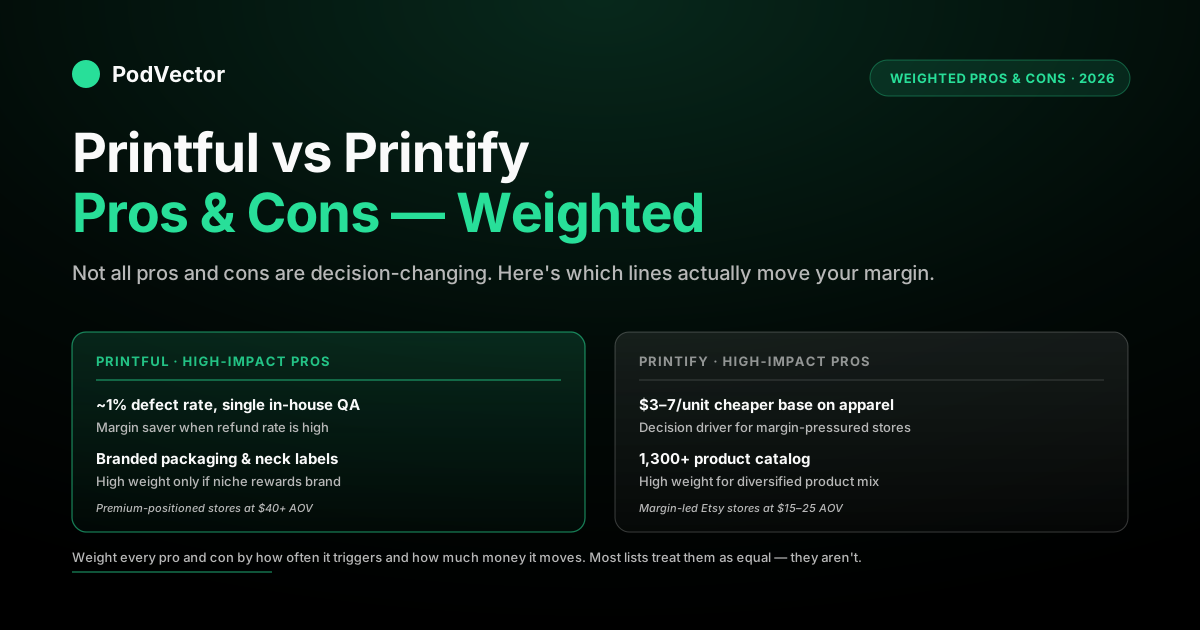
The decision-changing items are: Printful's ~1% defect rate (a margin saver if your refund rate is high), Printify's $3–7/unit price advantage on apparel (a margin saver if your refund rate is low), and Printful's branded packaging (a brand equity lever only some niches reward).
Below: the full pros-and-cons list for both platforms, with each item tagged for how much it actually matters to a POD operator's unit economics — not just whether it sounds nice on a feature page.
How to actually use a pros-and-cons list for POD
Pros-and-cons lists are scannable because every item gets equal visual weight. That makes them useful for orientation and misleading for decisions. A "Printful con: higher base cost" and a "Printful con: no SVG upload" sit on the same line, but only one of them moves your monthly profit by $400.
The right way to read any Printful vs Printify pros-and-cons list is to weight each item by two things: how often it triggers, and how much money it moves when it does.
The lists below tag each item with a weight — high (changes the decision for most POD stores), medium (matters at scale or in specific niches), or low (real but rarely decision-changing).
Printful pros — what works, weighted
Defect rate around 1% across in-house facilities [high]
Printful runs everything through its own facilities with a single QA team. The reshipment rate is consistently quoted around 1%, with some operator reports as low as 0.19% on premium SKUs.
At $25 AOV with 5% margin compression per percentage point of defects, a 1% defect rate vs a 3% defect rate is worth roughly $0.50 per order. Real money for any store above 500 orders/month.
Branded packaging, custom labels, pack-ins [high for brand stores, low otherwise]
Printful's white-label branding — neck labels, custom packaging, branded inserts — is meaningfully better than Printify's. The catch is that this only matters if your niche rewards brand equity. Custom merch for cause-based audiences? High weight. Generic dog meme tees on Etsy? Near zero.
If you're not sure which side of that line your store sits on, look at your repeat purchase rate. Above 15% suggests brand equity is doing work and branded packaging matters. Below 8% says you're a one-and-done store and Printful's premium for branding is mostly waste.
Consistent shipping policy across SKUs [high]
Because Printful owns the fulfillment, shipping copy is consistent across products. "5–7 business days domestic" actually means 5–7 business days. Printify ship times depend on which provider gets routed the order, which changes by SKU and sometimes by load.
Customer service operators rate this as one of Printful's biggest hidden pros. A consistent shipping copy means fewer "where's my order" tickets, which means lower support cost and lower refund rate.
In-house EU, MX, CA fulfillment [medium]
Printful runs print facilities in Latvia, Mexico, Canada, and the US — all owned. For international sellers, that means real local fulfillment without supplier roulette. Printify has international providers but they're partners with variable quality.
Better integrated design tools and mockup library [low]
Printful's design tool has ~25,000 graphics, full-featured mockup library, and mobile app support. Printify's library is smaller (~250 graphics) with a less polished tool.
This is a "nice to have" pro that rarely changes the platform decision. Most POD operators import designs from Canva or external sources anyway — the built-in library is a beginner convenience.
Warehousing for non-POD merch [medium for hybrid stores]
Printful's Warehousing lets you ship non-POD inventory through the same fulfillment infrastructure. Useful for stores that blend POD apparel with pre-bought merch (stickers, branded mugs, etc.). Printify doesn't have an equivalent.
One support team, one SLA [medium]
Printful support resolves issues through a single internal team. Printify routes issues to the underlying provider for fulfillment problems, which can add days. For high-volume operators dealing with defective batches, the difference matters more than the marketing pages suggest.
Printful cons — what hurts, weighted
Base cost $3–7/unit higher on apparel [high]
This is the most-cited Printful con, and it deserves its weight. On a Bella+Canvas 3001 tee, Printful runs about $13–14 base vs Printify's top-tier providers at $9–10. On heavier garments (hoodies, sweatshirts), the gap can hit $7.
For a store doing 500 orders/month with a $4 unit cost gap, that's $24,000/year in margin. That's not a "nice to consider" number — that's the decision driver.
Narrower product catalog (~370 products) [medium]
Printful's curated catalog is around 370 products. Printify carries 1,300+. For apparel-only stores, this gap is irrelevant — both cover the major shirt, hoodie, and hat variants. For stores that sell into wider product types (tech accessories, drinkware, home decor), Printify's catalog depth wins by default.
Higher international shipping rates on some routes [medium]
Printful's owned international facilities reduce cross-border shipping, but their shipping rate cards can run higher than Printify's cheapest international providers for some routes. Operators shipping heavy SKUs internationally should benchmark per-route, not platform-wide.
Less provider flexibility when a facility has issues [low to medium]
If a Printful facility runs into delays or quality issues on a specific SKU, you can't re-route — they own all the fulfillment. Printify lets you swap providers mid-catalog. This bites Printful stores during peak season more than off-peak.
Pro membership math doesn't always pay back [low]
Printful's paid tier (the Growth plan, $24.99/mo, up to 33% off products and free once you clear $12K in annual sales) reaches its discount tiers at a higher volume than Printify's $29/mo Premium (up to 20% off). For a low-volume store the subscription math pays back later on Printful. See Printful Premium Membership Pricing — full breakdown for POD sellers for the math.
Printify pros — what works, weighted
Lowest base costs across most apparel [high]
Printify is the price leader on standard apparel SKUs, and it's not particularly close. Top-tier providers like Monster Digital, SwiftPOD, and Dimona Tee run $9–10 base on a Bella+Canvas 3001 vs Printful's $13–14. That's a structural advantage for margin-pressured stores.
1,300+ product catalog [high for diversified stores]
If your store sells across product types — apparel plus drinkware plus tech plus home decor — Printify's catalog depth is decisive. Printful caps you at ~370 products. Printify gives you 3x+ the surface area.
Provider flexibility and routing control [medium]
Printify's marketplace model lets you pick the provider per SKU based on price, quality reviews, and location. You can route the same product through different providers in different regions to optimize ship times. This is real upside for operators willing to manage the complexity.
$29/mo Premium plan with up to 20% off products [high above ~30 orders/month]
Printify Premium pays for itself fast. At ~30 orders/month on a $3 average discount per unit, the $29 subscription clears. Above that volume, it's the highest-leverage subscription in POD.
Custom Order Routing for resilience [medium]
Printify's Custom Order Routing lets you set fallback providers if your primary goes down. For stores running through one provider, this is the operational insurance that prevents a single provider outage from breaking your fulfillment.
Larger international fulfillment footprint [medium]
Printify's partner network spans more countries than Printful's owned facilities. For stores selling heavily into specific international markets (UK, AU, DE), Printify's local-provider options often win on ship time.
More generous free plan and SVG upload [low]
Printify's free plan runs up to 5 stores with unlimited product designs, and it accepts SVG vector uploads directly. Printful's free tier is tighter and takes raster files. This rarely decides the platform, but for a bootstrapped operator testing multiple stores before committing spend, it lowers the cost of the trial.
Printify cons — what hurts, weighted
Variable defect rates by provider (1–5%) [high]
Printify's provider model creates quality variance. Top-tier providers run ~1% defect rates similar to Printful. Mid-tier providers run 2–4%. Bottom-tier providers (the cheapest) can hit 5%+.
The implication: Printify's price advantage only fully holds if you lock to top-tier providers, which narrows the price gap. Most experienced operators do exactly this.
Inconsistent shipping times across SKUs [high for support-sensitive stores]
Different providers ship at different speeds. One product might ship in 3 days, another in 12. Customer service ticket volume rises with shipping variance — operators who quote "5–10 business days" generically eat the support cost when the slower deliveries land.
Minimal branding options [medium for brand stores]
Printify offers limited custom branding — no neck labels on most products, less polished packaging. For brand-equity-driven stores, this is a hard ceiling that Printful clears.
Provider vetting required [medium]
Picking the right provider per SKU is real work. Printify gives you the data — provider ratings, reshipment rates, fulfillment time — but it's on you to read it. Operators who don't vet end up with bad-provider exposure.
Customer support routes through providers [medium]
When something goes wrong with fulfillment, Printify support escalates to the underlying provider. That adds latency. Printful's single-team support resolves the same issues faster on average.
No first-party warehousing for non-POD merch [low]
If you run a hybrid POD + branded merch store, Printify doesn't offer Warehousing. You need a separate 3PL.
The pros-and-cons trade by store profile
The same pros-and-cons list flips weight depending on the store profile reading it. Three common profiles, with which items actually decide for them.
Margin-pressured Etsy store at $15 AOV
The decision-changers are: Printify's base cost (high pro), Printful's higher base cost (high con). Branding pros are near-zero weight because Etsy buyers don't see your packaging — they see Etsy's. Defect rate matters, but only if you're below ~2% with Printify (achievable by locking to top-tier providers).
Pick: Printify with top-tier provider lock. The price advantage is the entire game at this profile.
Branded Shopify store at $40 AOV with subscription / repeat behavior
The decision-changers are: Printful's defect rate, Printful's branded packaging, Printful's shipping consistency (all high pros). Printify's price advantage is smaller in relative terms — $4/unit on a $40 AOV is 10% margin, not 25%.
Pick: Printful. The brand equity from packaging and the lower refund rate pays for the premium at scale.
Diversified store with 200+ SKUs across multiple product types
The decision-changers are: Printify's catalog depth (high pro), provider flexibility (medium pro), and the cost of running both platforms (operational con). If your catalog needs Printify's product range, Printful isn't fully substitutable.
Pick: Run both. Premium SKUs through Printful, broad catalog through Printify. Track per-SKU margin monthly and route accordingly. See Printful vs Printify vs Gelato — which is best for POD sellers for the three-platform version of this analysis.
The pros and cons most lists skip
The conventional pros-and-cons format misses three items that operators learn the hard way.
Pro (Printful): COGS sync to Shopify reports is cleaner
Printful's Shopify integration writes base costs back to your Shopify product COGS field. Printify's integration is shallower on this point. For margin reporting inside Shopify, Printful's sync saves manual reconciliation. If you're building a margin dashboard, this is non-trivial.
Con (both): Neither writes ad-attribution-ready order data
Neither platform exposes order-level data with the marketing channel attached. To know "did this order come from a Meta ad or organic search," you stitch Shopify order data with ad platform data yourself. Both platforms are equally bad at this — it's not a Printful vs Printify trade, it's a category problem POD operators inherit. See Printful vs Printify vs Shopify — which is best for POD sellers for how the data layer slots in.
Pro (Printify): Provider routing lets you arbitrage refund risk
Sophisticated Printify operators route high-AOV, low-margin SKUs to top-tier providers and low-AOV, high-margin SKUs to mid-tier providers. The same store can have a 1% defect rate on the products where defects hurt most and a 3% defect rate on products where they don't. Printful doesn't offer this lever.
Con (Printful): Catalog gaps force multi-platform if you expand product types
A store that starts Printful-only often needs to add Printify when it expands into product types Printful doesn't carry (specific drinkware, certain tech accessories, niche home goods). That's two supplier accounts to manage. See Printful vs Printify vs Teespring — which is best for POD sellers for the broader multi-platform comparison.
Pro (Printful, conditional): T-shirt base cost on premium SKUs
For premium SKUs specifically (high-end tees, embroidered hats), Printful's premium-line base costs can be competitive with Printify's mid-tier providers — because the premium-line price is paying for QA Printify charges separately for. See Printful Premium T-Shirt Base Cost — full breakdown for POD sellers.
FAQs
Is Printful actually higher quality than Printify, or is that marketing?
Mostly real. Printful's defect rate hovers near 1% on in-house production, while Printify's varies 1–5% depending on provider. If you lock Printify to top-tier providers (Monster Digital, SwiftPOD, Dimona Tee for apparel), the gap narrows to ~1–2%. The "Printful is always higher quality" framing is true only when comparing to Printify's average, not Printify's top providers.
Does Printify's lower price actually translate to higher profit?
Yes, if your refund rate stays below ~3%. The $3–7/unit savings on apparel clears Printify's higher defect risk for most stores. The breakeven flips on premium-positioned stores where refunds destroy LTV faster than the unit cost gap saves it.
Can I use both Printful and Printify on the same store?
Yes — many mid-size stores do. The pattern: premium SKUs (branded merch, high-AOV apparel) through Printful, broader catalog and low-AOV SKUs through Printify. The operational cost is two supplier accounts and reconciliation; the upside is per-SKU margin optimization.
Which has better Shopify integration?
Both are solid. Printful's is slightly deeper on COGS sync to Shopify reports. Printify's is slightly more flexible on per-product provider routing. For a simple Shopify-only store, either works.
Which is better for Etsy?
Usually Printify, because Etsy is price-sensitive and Etsy buyers don't see your packaging. The exception is a high-AOV Etsy store where defect rate has bigger LTV impact than unit cost.
Are the pros and cons different in 2026 vs prior years?
The structural trade — Printful for quality and branding, Printify for price and catalog — is unchanged. What's shifted is Printify's top-tier providers closing the quality gap, Printful moving to the Growth plan (up to 33% off, free above $12K annual sales), and both platforms widening their integration lists (Printful now covers 20+ channels including TikTok Shop and Walmart). The decision is mechanically the same; the per-line math has moved.
What's the worst pro-or-con to over-weight?
The "design tool quality" pro for Printful. Most operators import designs from Canva or external sources, so the built-in tool's polish barely matters. Don't pick a platform based on its design tool — pick on base cost, defect rate, and branding fit.
Where can I read more on Printful vs alternatives?
The cluster hub for Printful comparisons is Printful Comparison Articles, and the topic hub is Printful with everything else (pricing, costs, integrations, reviews). For another well-balanced operator review, Bootstrapping Ecommerce's hands-on test covers the same ground from a different angle.
Stop weighting pros and cons. Ask the data.
Every Printful vs Printify pros-and-cons list ends with "depends on your store." That's not unhelpful — it's just incomplete. The actual answer is the per-SKU margin math on your orders, your refund rate, your ad spend, your AOV.
Victor — PodVector AI's AI employee for POD sellers — is the agent that runs that math for you. Connect your Shopify store, Printful/Printify supplier costs, and Meta/Google ad accounts. Ask "should I move my Bella+Canvas tees from Printful to Printify?" in plain English. Get a real number back, not a feature comparison.
Victor answers the question. Victor acts on the answer with your approval — routing SKUs to the supplier with the better unit economics for your specific store.
Try Victor free