
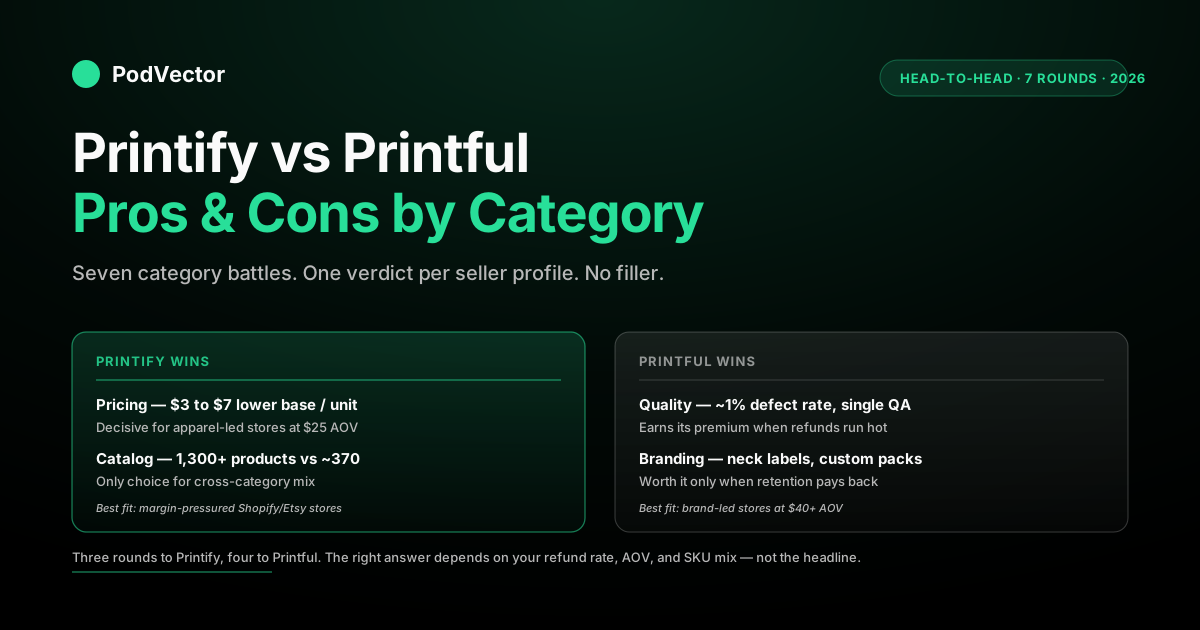
Quick Answer: Printify wins on base cost, catalog depth, and supplier flexibility. Printful wins on quality consistency, branding, and a single support SLA. Most other pros and cons are roughly a wash.
The honest answer for most POD sellers in 2026: pick Printify if your unit economics rely on a low COGS (cost of goods sold) and you're willing to vet print providers. Pick Printful if your refund rate is high enough that a 1% defect rate beats a $4 lower base cost.
Below: every pro and con of both platforms, organized as head-to-head category battles, with a verdict by seller profile at the bottom. The 2024 merger between the two — and what it actually changed — is covered too.
TL;DR — Printify vs Printful at a glance
Printify is a marketplace. You design once, then pick from dozens of independent print providers who compete on price, location, and product type. The product list runs past 1,300 SKUs.
Printful is in-house. They own the facilities, the QA team, and the shipping policy. Catalog is tighter (~340–380 products), prices are higher, but consistency is the trade.
For most apparel-focused POD stores, Printify's lower base cost is the bigger decision driver. For brand-led stores with retention and packaging budgets, Printful's consistency earns its premium.
Round 1: Pricing model and base cost
Printify pros
Lower base cost on nearly every comparable SKU. A Gildan tee runs about $6.21 on Printify's top providers vs $12.95 on Printful. On a $25 retail tee, that's the difference between a $13 contribution margin and a $7 one — almost 2x.
The Premium plan ($39/mo, roughly $29/mo billed annually) layers another ~20% off provider catalog prices. Most stores doing more than ~70 orders/month earn back the subscription.
No subscription is required to start. The free plan unlocks the full provider network — you only lose the bulk discount tier.
Printify cons
Prices vary by provider for the same SKU. You can find a tee at $6.21 from one provider and $9.10 for an essentially identical garment from another. Without a side-by-side check, you can leave $3/unit on the table.
The cheapest providers are often the busiest, which can mean longer queues during peak.
Printful pros
One price, one supplier. No provider-switching games. The Growth plan ($24.99/mo, and free once you pass ~$12K in annual sales) gives up to 33% off the standard catalog — competitive if you're shipping high volume on the products Printful's plan covers.
Printful also cut base prices roughly 6–9% across parts of the catalog in the last year. The gap with Printify narrowed, but on apparel it didn't close.
Printful cons
Base costs run $3–7 higher per unit on apparel. On heavier garments (hoodies, sweatshirts), the gap can hit the top of that range.
For a store moving 500 orders/month at a $4 unit-cost gap, that's $24,000/year in foregone margin. That's not "nice to consider" money — that's the decision driver for any high-volume apparel store.
Round winner: Printify
Decisively, for apparel-led stores. The base-cost gap is wide enough that the convenience premium Printful charges only makes sense once defect costs, refund costs, or branding revenue cover the gap.
Round 2: Product catalog
Printify pros
1,300+ products across the network. Catalog covers apparel, drinkware, tech accessories, home decor, pet supplies, art prints, wall canvases, jewelry, and dozens of niche categories.
If a product category exists in POD, Printify probably has it. Stores that sell into broad merch (not just shirts) get materially more coverage.
Printify cons
Quality and availability per SKU depend on the underlying provider. A product showing in the catalog isn't always in stock at the cheapest provider. Cross-checking inventory at the provider level is a recurring task.
Printful pros
Tighter, more curated catalog — about 340–380 products. Every product is in-house, with a single QA standard. If it's on Printful, it ships on Printful, no inventory roulette.
Printful cons
Missing entire categories that Printify covers. If you need pet beds, niche drinkware, custom puzzles, or specialty home decor, Printful's catalog often doesn't have them.
Round winner: Printify
For breadth. Printful's curation is a virtue if you're a focused apparel store — but it's a hard ceiling if your store sells across categories.
Round 3: Print quality and defect rate
Printful pros
Defect rate consistently quoted around 1% across in-house facilities, with some premium SKUs reported under 0.5%. Printful publishes a return rate near 0.19% — a rare hard number in a category that mostly hand-waves at quality. A single QA team enforces a single standard across products and regions.
Color reproduction is consistent across orders. A run of 100 navy hoodies in March looks like a run of 100 navy hoodies in November.
Printful cons
The premium for quality is built into the base cost. If your customers are price-sensitive and your refund rate is already under 2%, you're paying for quality your store doesn't capture.
Printify pros
Some providers in the Printify network produce work indistinguishable from Printful's. Monster Digital, SwiftPOD, and a handful of others get high marks in operator forums. When you find a good provider for your specific SKU, you can win on both price and quality.
Printify cons
Quality varies by provider. The same shirt SKU run through two different providers can come back looking like two different products. New sellers underestimate how much research goes into finding the right provider for each SKU.
Reshipment rates and defect rates aren't published per provider — you find out from order data after the fact. That's a learning curve nobody warns you about.
Round winner: Printful
For consistency without homework. Printify can match Printful on quality once you've found the right provider for your SKU, but the discovery cost is real.
Round 4: Shipping speed and fulfillment
Printful pros
Owned facilities in the US, Mexico, Canada, Latvia, Spain, and Japan. Domestic US fulfillment runs 2–7 business days. International routing to the nearest facility is automatic.
Shipping policy is consistent across products because the same network handles every order. "5–7 business days domestic" actually means 5–7 days, not "5–7 days unless the routed provider is backed up."
Printful cons
Less route flexibility. If a facility is having issues, you can't re-route to a different provider mid-catalog. You wait it out or eat the delay.
Printify pros
Providers cover more locations than Printful's owned facilities — including providers based in the UK, Australia, Germany, and elsewhere. For sellers with niche international markets, this matters.
Domestic US fulfillment can be as fast as 2–5 days with the right provider.
Printify cons
Fulfillment time depends on the provider. The same product can ship in 3 days from one provider and 8 days from another. Buyer expectations get messy when shipping copy on your store has to cover a wide range.
Some operators end up writing per-SKU shipping copy by hand to manage this. That's overhead.
Round winner: Printful
For policy consistency. Printify can be faster for the right provider/route, but the variance is the cost.
Round 5: Branding and white-label options
Printful pros
Neck labels, custom packaging, branded inserts, pack-ins, and woven labels are all in-house. The white-label experience is genuinely competitive with private-label suppliers, not just "POD with a sticker."
Brand stores that retain customers — repeat purchase rate above 15% — capture real revenue from this. Cause-based merch, fan merch, and creator merchandise all benefit.
Printful cons
Branded options add per-order fees on top of base cost. A neck label adds $2.50/order, custom packaging $4+, pack-ins $0.50 each. If your AOV is under $30, the branding stack can compress margins below break-even.
Printify pros
Some providers in the Printify network now offer branded packaging and neck labels — Monster Digital and Drive Fulfillment in particular. The option exists.
Printify cons
Coverage is uneven across providers. If you want consistent branded packaging across your full catalog, you'll end up forced into a narrow provider subset. Effectively, you trade Printify's main advantage (provider flexibility) for parity with Printful.
Round winner: Printful
For brand-led stores. If you don't retain customers, this round doesn't matter — but if you do, Printful's branding stack is materially better.
Round 6: Integrations and ease of use
Printify pros
Direct integrations with Shopify, Etsy, eBay, WooCommerce, Wix, Squarespace, BigCommerce, TikTok Shop, and others. The Shopify and Etsy integrations are mature and stable.
The dashboard is clean and beginner-friendly. Most new POD sellers can publish their first product within an hour of signup.
Printify's Pop-Up Store gives you a free standalone storefront that sells worldwide — handy for testing designs before you commit to a full store. Printful's equivalent Quick Store is US-only.
Printify cons
No native Amazon or Walmart integration. For sellers who want to scale through those marketplaces, this is a hard wall — you'd need a third-party connector or manual fulfillment.
Printful pros
Same major integrations as Printify, plus Amazon, Walmart, and Wayfair. That's a meaningful edge for sellers planning to scale through marketplaces beyond Etsy and Shopify.
Design tools include ~25,000 graphics, full mockup library, and mobile app support.
Printful cons
Slightly more onboarding friction. The catalog is smaller, but the design flow has more options, which beginner sellers can find overwhelming on day one.
Round winner: Printful
For sellers planning multi-marketplace distribution. Tie for Shopify/Etsy-only sellers.
Round 7: Customer support
Printful pros
One support team handles everything. 24/7 chat, US-based phone support on the Growth plan, average first-response under 2 hours by most operator reports.
Defective batch? One ticket, one resolution. No routing your issue to the underlying provider.
Printful cons
Higher-tier responsiveness (US phone, dedicated reps) is locked behind paid plans.
Printify pros
Free email support for all users. Premium plan adds priority response.
Printify Connect now handles more customer-facing support in-house, so buyers aren't always bounced straight to the print provider. It softens — but doesn't erase — the multi-provider routing problem.
Printify cons
Deeper provider-related issues (defects, shipping delays, lost orders) still get routed back to the underlying print provider. That adds days to resolution and means support quality varies by provider, not just by Printify.
No phone support. No 24/7 chat on the free tier.
Round winner: Printful
For operators who deal with support tickets regularly. The single-SLA model saves real time once volume scales past a few hundred orders per month.
The 2024 merger — what changed, what didn't
Printful and Printify announced a merger in 2024. The corporate entities combined, but the platforms themselves stayed separate — and as of 2026, that hasn't changed.
What's the same: two distinct platforms, two distinct catalogs, two distinct dashboards, two distinct pricing structures. The merger didn't unify them into one product.
What might change: shared backend infrastructure (fulfillment routing, payment processing, integrations) could converge over time. Some operators speculate Printful's facilities will eventually appear as "providers" inside the Printify marketplace, but there's no announced timeline.
The practical takeaway: pick the platform on its merits today, not on what the merger might do later. If consolidation happens, both sets of customers will get migrated — neither platform is a dead end.
Verdict by seller profile
Use Printify if:
You sell apparel-led products at $25–35 AOV with margins that depend on a low COGS. The $3–7/unit base-cost advantage is the bigger lever than quality consistency at that price point.
Your catalog spans multiple product categories. Printify's 1,300+ products is the only reasonable choice for breadth.
Your refund rate is already under 2% and you don't need branded packaging. You're capturing the cost advantage without paying for consistency you don't need.
You sell primarily through Shopify, Etsy, or eBay, and have no plans to scale through Amazon or Walmart.
Use Printful if:
You're a brand-led store with repeat purchase rates above 15% and a retention strategy that depends on packaging quality. The branded experience is worth the premium for you.
Your refund rate is above 3% on a comparable POD platform. The 1% defect rate buys back its cost difference fast.
You're scaling through Amazon, Walmart, or Wayfair. Printify can't connect there natively.
You ship internationally to the US, EU, MX, CA, JP, or AU markets that Printful's owned facilities cover, and shipping copy consistency matters for your customer experience.
Use both if:
Many high-volume sellers run both. Printful for branded core products that drive retention, Printify for catalog breadth and price-sensitive add-ons. The dual-platform approach adds operational complexity but lets you optimize per-SKU.
The question worth asking either way
"Which supplier is actually more profitable for my catalog?" is the question most pros-and-cons lists can't answer for your specific store. The answer depends on your refund rate, AOV, repeat purchase rate, and SKU mix — and changes as you scale.
PodVector's Victor agent works from your live Shopify orders, Printify and Printful per-order costs, and shipping receipts — then proposes the moves: reprice this SKU, switch that one to the cheaper platform, update the Shopify listing. You approve; Victor executes.
Less "which platform is better in general," more "which platform is more profitable for *your* catalog this month." See our full Printful coverage and other comparison guides for context.
FAQs
Which platform is cheaper, Printify or Printful?
Printify, on base product cost — typically $3–7/unit lower on apparel, even after Printful's recent 6–9% price cuts. Discount tiers run in the same ballpark (Printful Growth $24.99/mo, Printify Premium $39/mo). For most apparel-led stores, Printify's all-in cost is materially lower.
Which has better print quality?
Printful, on consistency. Quality is reproducible across orders because the same in-house network handles everything. Printify can match Printful on quality with the right provider, but the right provider for your SKU isn't always obvious upfront.
Can I use both Printify and Printful at once?
Yes. Both platforms integrate with the same Shopify or Etsy store. Many sellers route different products through different platforms — Printful for branded merch, Printify for catalog breadth. The downside is operational complexity (two dashboards, two reconciliations).
Did the 2024 merger change anything?
Not for the user experience. Both platforms still operate as separate products with separate pricing, catalogs, and dashboards. The corporate entities combined; the platforms didn't.
Which is better for Etsy sellers?
Either works. Printify edges out for sellers focused on price-competitive listings; Printful for branded merch and consistent shipping copy. See Printify vs Printful for Etsy for the full breakdown.
Which is better for beginners?
Printify has a slightly easier onboarding and lower upfront cost. Printful's design and mockup tools are more polished but the catalog and price take a beginner longer to map. Either is fine for a first POD store; the choice matters more once you're past 100 orders/month.
How do I decide without testing both?
Start with your AOV and refund rate. AOV under $30 with refund rate under 2%? Printify is almost certainly cheaper. AOV above $40 with refund rate above 3%? Printful's quality premium tends to earn back. Anywhere in between, the answer depends on your SKU mix — and that's where store-specific analysis beats general advice.
What's the difference between this comparison and the broader Printify vs Printful breakdown?
This article weights pros and cons head-to-head by category. For the broader platform comparison, see Printify vs Printful: the difference and Printify vs Printful: the differences. For cost-only deep dives, see the complete guide to Printful costs and fees and Printful Pro Membership pricing. For external benchmarks, Merch Titans' head-to-head review covers similar ground with hands-on testing data.
Want a real answer, not a generic one?
Generic pros-and-cons lists can't tell you which platform is more profitable for your catalog. Victor can. Connect your Shopify and your Printify or Printful account, and ask: "Which of my SKUs would make more margin moving to the other platform?"
Victor reads your live order data, supplier costs, and refund history, then proposes the switches that actually move your monthly profit — with one-click approval to apply discount or pricing changes on Shopify if needed.
Try Victor free