
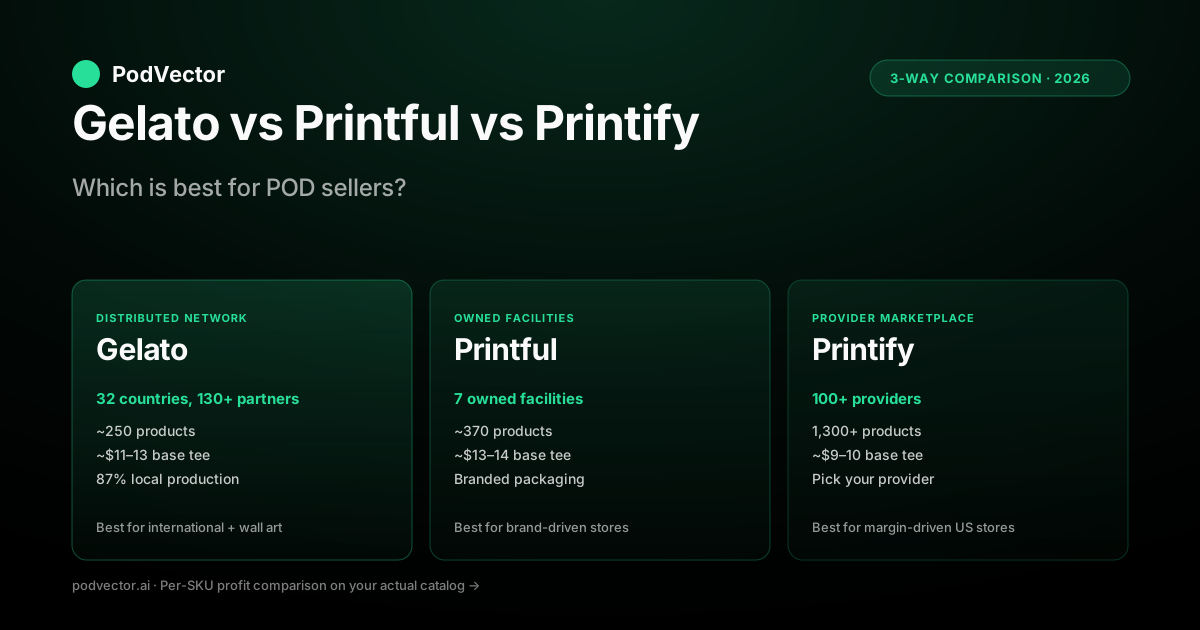
Quick Answer: All three are fulfillment partners you plug into Shopify, Etsy, or your own store. The difference is the production network sitting behind them — Printful runs owned facilities, Printify is a marketplace of 100+ third-party providers, and Gelato is a software-orchestrated network of 140+ local print partners in 32 countries.
Pick Printful if you want owned-facility consistency and branded packaging on a US-Europe brand. Pick Printify if you want the lowest US base costs and the broadest catalog. Pick Gelato if you sell internationally — especially in Europe, the UK, and APAC — and want local production cutting your shipping cost and delivery time.
The trap is choosing on monthly fee or sticker product price. The real cost is base + shipping + refund rate after geography, and each supplier wins in a different zone of that map.
The 3-way decision in 60 seconds
All three run the same business model in the abstract — you design a product, they print and ship when you sell. The difference is who actually prints the order and where the press sits relative to your buyer.
Printful prints in its own facilities in the US, Canada, Mexico, Latvia, Spain, the UK, and Australia. Printify routes your order to one of 100+ third-party providers you pre-select per product. Gelato sends the file to whichever local production partner is closest to the buyer's address inside its 140+ partner network across 32 countries.
That architectural difference cascades into base cost, shipping speed, quality consistency, and where each supplier is profitable. The rest of this article unpacks the trade-offs the marketing pages skip.
Side-by-side snapshot table
Use this as the orientation, not the decision. Each row hides nuance unpacked further below.
| Dimension | Gelato | Printful | Printify |
|---|---|---|---|
| Production model | Distributed network (140+ partners, 32 countries) | Owned facilities (7 countries) | Marketplace of 100+ providers |
| Monthly fee | Free; Gelato+ $29.99/mo ($19.99/mo billed annually); Gelato+ Gold $119/mo | Free; Growth $24.99/mo | Free; Premium $39/mo; Enterprise custom |
| Base unit cost (Bella+Canvas 3001 tee, US) | ~$11–13 | ~$13–14 | ~$9–10 (top providers) |
| Catalog size | ~250 products | ~370 products | 1,300+ products |
| Local production rate | ~90% of orders ship from a partner inside the destination region; ~90% delivered within 5 days | Limited — orders from countries without a facility ship internationally | Varies by provider — many are US-only |
| Strongest geography | EU, UK, APAC, multi-region brands | US, EU (Latvia/Spain hubs) | US (top providers) |
| Branded packaging | Available on Gelato+ and above | Yes (inserts, neck labels, custom packaging) | Limited — provider-dependent |
| Ecommerce integrations | Shopify, Etsy, WooCommerce, Wix, Squarespace, BigCommerce, Shopline | 20+ (Shopify, Etsy, WooCommerce, Wix, BigCommerce, Squarespace, Amazon, eBay…) | 10+ (Shopify, Etsy, WooCommerce, Wix, BigCommerce, eBay…) |
| Best for | International sellers, wall art, low-shipping geographies | Brand-driven US/EU stores | Margin-driven US stores |
Production model: owned, marketplace, distributed
This is the section that should drive your decision. Everything else is a detail under it.
Printful — owned facilities
Printful operates its own print facilities. Files go to a Printful press, get printed by Printful employees, get QA'd by Printful staff, and ship from a Printful warehouse. Quality is consistent because one team controls the process end to end.
The trade-off is geography. Printful has facilities in seven countries, so if your buyer lives somewhere without one — most of Asia, all of South America, most of Africa — the order ships internationally with longer lead times and higher cost.
Printify — marketplace of third-party providers
Printify is a software layer sitting on top of 100+ independent print shops. When you add a product to Printify, you pick which provider prints it. Different providers have different base costs, blank brands, print methods, locations, and quality standards.
This is where Printify's catalog and pricing edge comes from — you can shop for the lowest base cost on every SKU. It's also where the quality inconsistency comes from: a $9 t-shirt from a provider you've never used can land beautifully or land badly, and you only find out from your first orders.
Gelato — distributed network with smart routing
Gelato is neither owned nor a marketplace. It runs a software-orchestrated network of vetted local print partners across 32 countries and routes each order to whichever partner is closest to the buyer's address.
If a customer in Germany orders a poster, the file goes to a German printer who produces and ships domestically — typically arriving in 2–4 days at domestic shipping rates. The seller never picks the partner; Gelato's routing engine does, optimizing for proximity, capacity, and product fit.
The benefit is the cleanest international shipping model in POD. Gelato says ~90% of orders are produced locally and ~90% are delivered within 5 days, which means most international sales never cross a border in transit. The downside is less control — you can't say "always print my orders at Provider X" the way you can with Printify.
Pricing, base costs, and subscription tiers
Three different pricing models. Compare them on what they actually cost you per order, not on the surface line items.
Gelato pricing
Free tier with no monthly fee. Paid tiers unlock discounts and features:
- Gelato+: $29.99/month, or $19.99/month billed annually — up to 50% off shipping, 10% off products on select items, branded packaging, premium mockups, expert support.
- Gelato+ Gold: $119/month — deeper discounts (up to 25% off products on select categories), priority support, more advanced features.
- Platinum: Custom pricing — dedicated account manager, implementation support, enterprise SLAs.
Base costs vary by product and region. A Bella+Canvas 3001 tee printed in the US runs $11–13 before shipping. Posters and wall art — Gelato's strongest category — are typically 10–20% cheaper than competitors when produced locally.
Printful pricing
Free tier with no monthly fee. The optional paid tier is the Growth plan at $24.99/month, which unlocks 20% off shipping on most orders, 7% off products, and additional branding tools.
Base costs are the highest of the three on US apparel — $13–14 for a Bella+Canvas 3001 — but include Printful's QA. Premium products like all-over print apparel and embroidered hats are competitive once you factor in the quality consistency.
Printify pricing
Free tier with no monthly fee. Premium is $39/month (roughly $25/month equivalent when billed annually) and unlocks 20% off products from select providers. Enterprise is custom, typically for sellers doing 10,000+ orders per month.
Base costs are the lowest of the three on US apparel — $9–10 for a Bella+Canvas 3001 from top providers like SwiftPOD or Monster Digital. That advantage shrinks or disappears on premium products (embroidered apparel, all-over-print, etc.) where Printful's owned facilities are price-competitive.
Which subscription pays back fastest?
Printify Premium pays for itself at around $195/month in product spend (20% of $195 = the $39 fee). Printful Growth at $25/month pays for itself at around $125/month in product spend, but its 20% discount is on shipping, not products. Gelato+ at $29.99/month ($19.99 billed annually) also pays back fastest on shipping-heavy products like posters and large-format prints.
The right answer depends on what you sell. For a t-shirt brand running 50+ orders per month, Printify Premium is usually the highest ROI. For a poster brand selling internationally, Gelato+ wins because the shipping discount alone clears the fee. For brand-driven shops where branded packaging is part of the unboxing, Printful Growth's combination of discount and branding tools is hard to beat. The full per-tier breakeven analysis sits in the step-by-step Printful profit guide for the per-order math.
Product catalog and quality
Catalog size and product quality are the two dimensions most operators check first. They're also the two where the surface numbers mislead the most.
Catalog breadth
Printify wins on raw count — 1,300+ products across the marketplace. Printful comes second with ~370 products, all stocked in its owned facilities. Gelato has the smallest catalog at ~250 products, but its catalog skews toward globally-printable items (posters, framed prints, mugs, apparel) that route well across its distributed network.
More products isn't automatically better. A 1,300-product catalog with inconsistent quality across providers can be harder to operate than a 250-product catalog where every SKU is print-tested. The right question is "how many products in MY niche does this catalog cover well," not "how many products total."
Print quality
Printful's owned-facility model produces the most consistent print quality across SKUs and orders. If you order the same t-shirt 100 times across a year, you get 100 nearly identical prints. That consistency is what brand-driven shops pay the higher base cost for.
Printify's quality varies by provider. Top-tier providers (SwiftPOD, Monster Digital, Duplium for apparel; Sensaria, Prodigi for prints) match Printful on quality. Lower-tier providers produce more variance. The seller's job on Printify is to pick the right provider per SKU and order samples before going live.
Gelato's quality is consistent within a region but can vary across regions. A poster printed in Germany may have slightly different paper feel than the same poster printed in the US — both are professional quality, but the cross-border consistency Printful's owned facilities offer isn't there. For products where this matters (gallery prints, framed art for collectors), Gelato will sample-ship across regions to verify.
Which catalog wins for what
- Apparel breadth: Printify — more brands, more cuts, more fits.
- Apparel consistency: Printful — single QA team, single source of blanks per facility.
- Wall art and home decor: Gelato — strongest category, best paper stock options, local production.
- Embroidered apparel and headwear: Printful — best in-house embroidery operation.
- All-over-print: Printify on top-tier AOP providers; Printful on its in-house AOP.
- Mugs and drinkware: Comparable across all three — pick on shipping geography.
Shipping speed and geography
This is where the production model decision pays back or punishes you. The same buyer ordering the same t-shirt gets very different experiences across the three.
US shipping
All three perform similarly inside the US. Printful, top Printify providers, and Gelato's US partners all ship in 2–5 production days plus 2–5 shipping days. There's no clear US winner — pick on base cost (Printify), brand consistency (Printful), or international footprint (Gelato).
EU and UK shipping
Gelato is the strongest performer in Europe. Local production in Germany, France, Spain, the Netherlands, the UK, Italy, Poland, and Scandinavia means most EU orders never cross a border. Production typically completes in 2 days and ships in 2–3 more — comparable to Amazon Prime in many EU markets.
Printful is competitive in the EU thanks to its Latvia and Spain facilities, but orders to Scandinavia, the Balkans, and Eastern Europe still cross borders. Lead times typically run 5–9 days end to end.
Printify's EU coverage depends entirely on which provider you picked. Some EU-based providers ship fast and clean; many of the cheapest providers are US-only, meaning EU orders ship internationally with longer lead times and customs friction.
APAC and rest of world
Gelato has Australia, Japan, Singapore, and rotating partners in other APAC markets, so domestic-rate shipping is achievable in those countries. Printful has an Australia facility but no APAC presence beyond that — orders to Japan, Korea, Southeast Asia ship from outside the region.
Printify's APAC coverage is thin. Most providers are US or EU based. For an APAC-heavy buyer base, Gelato is usually the only viable option of the three.
Customs, VAT, and DDP
International shipping isn't just about speed — it's about whether your customer gets a surprise customs bill on delivery. Gelato's local production model avoids customs entirely for most orders, because the product never crosses a border. Printful handles DDP (delivered duty paid) on most routes from its EU facilities, so the customer pays no surprise fee. Printify's customs handling varies by provider — some include DDP, some don't.
For sellers expanding into the EU after VAT and IOSS changes, this matters. A $20 t-shirt with a $5 surprise customs fee on delivery is a refund and chargeback waiting to happen.
Integrations and store setup
All three integrate with the major ecommerce platforms, but the depth and quality of each integration differs.
Shopify
Printful's Shopify app is the most mature — auto-product creation, mockup generation, order routing, refund/reprint flows, and analytics all live inside Shopify. Printify's Shopify app is comparable in feature surface but historically had more sync hiccups, mostly resolved in 2024 updates. Gelato's Shopify app is solid for catalog sync and order routing but newer than the other two; advanced flows (split orders, partial refunds) are still maturing.
Etsy
All three have Etsy integrations. Printful's is the deepest with auto-mockup generation matching Etsy's listing requirements. Printify's covers the core flow well and is popular with high-volume Etsy sellers. Gelato's Etsy integration is functional but newer; large Etsy stores tend to prefer Printful or Printify here. For the full Etsy seller view across suppliers, see the complete guide to Printful integrations.
Other platforms
Printful has the broadest integration footprint — Shopify, Etsy, WooCommerce, Wix, BigCommerce, Squarespace, Webflow, Amazon (handmade), eBay, Storenvy, Wish, TikTok Shop, and direct API. Printify covers Shopify, Etsy, WooCommerce, Wix, Squarespace, BigCommerce, eBay, and an API. Gelato covers Shopify, Etsy, WooCommerce, Wix, Squarespace, BigCommerce, Shopline, and an API.
For most operators, the integration surface isn't the deciding factor — all three cover Shopify and Etsy well. It matters when you run niche platforms (Webflow, Squarespace, TikTok Shop) or when you need direct API access for a custom storefront.
Design tools and mockups
All three have a built-in design tool and a built-in mockup generator. They differ in polish and template variety.
Printify's design studio has the largest template library and the strongest community-shared design assets. Printful's design maker is the most polished UI and the best for embroidery setup. Gelato's design tool is clean and modern with premium mockups locked behind Gelato+.
For sellers running real design files in Photoshop, Illustrator, Figma, or Procreate, the built-in tool is mostly a preview surface. All three accept high-res PNG uploads and produce mockups suitable for product listings. The visual difference your customer sees on the storefront is the mockup quality — Gelato's premium mockups and Printful's lifestyle photography are the strongest there.
Branding and white-label options
Branded packaging matters when your unboxing is part of the product experience.
Printful has the most mature branding suite — custom packing slips, neck labels, inside labels, custom packaging (boxes, tissue, stickers), and branded inserts. Most of these are included on the Growth plan or available a la carte.
Gelato offers branded packaging on Gelato+ and above — packing slips, branded labels, and select packaging options. Coverage varies by region; some local partners support more branding options than others.
Printify's branded packaging is the weakest of the three. Some providers support custom inserts and neck labels, but the marketplace nature means coverage is inconsistent. For sellers prioritizing unboxing as a brand moment, Printful is the default; Gelato is the alternative if you're internationally focused.
Customer support and operator experience
Quality of support is where small differences compound over years of operating. None of the three are perfect, but they have distinct profiles.
Printful's support is the most consistent — 24/7 chat and email, response times typically under 4 hours, and the support team can resolve most production and shipping issues without escalation. Printful Growth members get priority routing.
Gelato's support is solid in business hours and weaker on weekends. Gelato+ unlocks priority support; Gold and Platinum tiers unlock dedicated account managers. The support quality depends on the regional partner — issues with a German partner go through a different routing than US issues.
Printify's support is the most varied. Marketplace providers handle their own production issues, so a Printify support ticket sometimes needs to route to the underlying provider, which adds time. Premium and Enterprise tiers get priority support that smooths this out.
Who wins where: US, EU, UK, APAC
If you can only pick one, geography of your customer base is the cleanest decision rule.
Mostly US customers
Printify wins on base cost. Printful wins on consistency. Gelato is neutral here — its US network is good but not differentiated. The decision between Printful and Printify on US-only catalogs is the cleanest one to make on per-SKU profitability. The detailed cost-vs-features tradeoff between Printful and Printify sits in the Printify vs Printful pricing, quality, and features comparison.
Mostly EU or UK customers
Gelato is the default. Local production in the destination country means faster shipping, lower shipping cost, no customs surprises, and easier returns. Printful is the second-best EU option thanks to Latvia and Spain. Printify's EU performance depends on whether you picked an EU-based provider.
Multi-region brand
Gelato. Its routing engine handles the international complexity automatically. The alternative — running Printful for some regions and Printify for others — is operable but adds complexity to inventory, mockups, and customer support workflows. For sellers running multi-region brands at any scale, the simpler operating model usually beats the marginal base-cost advantage of a multi-supplier stack. Once you're at multi-region scale and looking at how each supplier shapes total profit, the analysis in the Printful profit playbook applies to all three.
APAC-heavy customers
Gelato. None of the other two have meaningful APAC local production. If a significant share of your sales lands in Japan, Australia, Korea, or Southeast Asia, Gelato's network is the difference between "viable POD business" and "shipping costs eat the margin."
Pick X if Y
Compressing everything above into a decision tree:
- Pick Gelato if: 30%+ of your sales are outside the US, you sell wall art or posters, or you're building a brand that wants to scale internationally without rebuilding fulfillment per region.
- Pick Printful if: Your customers are mostly US or EU, you run a brand-driven store where branded packaging is part of the experience, you sell premium apparel or embroidered products, and you want one consistent quality bar across SKUs.
- Pick Printify if: Your customers are mostly US, you compete on price, you want the broadest catalog to test new products fast, and you're willing to operate provider selection per SKU.
None of these are wrong defaults — they're trade-offs aligned with where your buyers live and what your brand stands for.
Running two suppliers at the same time
Many operators eventually run two of the three in parallel. The common patterns:
- Printful + Gelato: Printful for US/EU brand-consistent SKUs, Gelato for international fulfillment and wall art. The split is by geography or by product category.
- Printify + Gelato: Printify for US margin-leading SKUs, Gelato for international orders to avoid customs friction.
- Printful + Printify: Printful for hero products where quality consistency matters, Printify for the long-tail catalog where lower base cost matters more than perfect consistency.
Running two suppliers doubles the operational overhead. You have two inventory systems, two mockup pipelines, two refund flows, and two customer support trees. The payoff has to be measurable — usually a clear margin or shipping-time advantage on a specific segment of your catalog.
The mistake most operators make is splitting the catalog by intuition without measuring whether the split actually improved unit economics. The right way is to compare per-SKU profit after fees, refunds, and ad spend across both suppliers for the same product, then move SKUs to whichever supplier wins.
The comparison most sellers actually need
The comparisons above are the right starting point. They're not the right ending point.
The decision-grade question isn't "which supplier is cheapest" or "which is fastest." It's "which supplier nets the most margin on my actual catalog, sold to my actual buyer geography, given my actual refund and reship rates." That answer is per-SKU and per-segment.
A canvas print bestseller selling 60% to EU customers nets very different margin on Gelato vs Printful vs Printify. A unisex tee selling 90% to US customers tells a different story. A holiday mug spike that lands in November/December has different shipping pressure than a steady-state SKU.
The per-SKU economics are where the operator's edge lives. The supplier-level "which is better" articles get you 80% of the way; the last 20% is in your own data.
FAQs
Is Gelato cheaper than Printful or Printify?
On base product cost, no — Printify's top providers are typically $1–3 cheaper than Gelato on US apparel, and Printful's premium products are competitive once you factor in QA. Gelato wins on total landed cost for international orders, where its local production avoids the international shipping fees the other two charge.
Which has the fastest shipping?
Inside the US, all three perform similarly (2–5 production days + 2–5 shipping days). For international shipping — especially EU, UK, and APAC — Gelato is meaningfully faster because most orders ship domestically inside the buyer's country.
Which has the best print quality?
Printful for cross-SKU consistency from a single QA team. Printify top providers (SwiftPOD, Monster Digital, Sensaria) match Printful on quality. Gelato's quality is professional everywhere but can vary slightly across regions due to local production. For collectors and gallery-grade prints, sample across regions before scaling.
Which has the widest product catalog?
Printify by a wide margin — 1,300+ products. Printful has ~370 and Gelato has ~250. For breadth and rapid product testing, Printify wins. For curated catalogs of well-tested products, Printful and Gelato's smaller lists are easier to operate.
Can I use more than one of these at the same time?
Yes. All three integrate with Shopify and Etsy, and you can route different products to different suppliers. The most common multi-supplier patterns are Printful + Gelato (brand SKUs + international fulfillment) and Printify + Gelato (cheap US SKUs + international fulfillment).
Which is best for Etsy sellers?
Depends on customer geography. US-heavy Etsy stores typically run Printify for margin or Printful for brand consistency. International Etsy stores — especially EU sellers shipping to EU buyers — gain real margin by switching to Gelato to avoid international shipping on every order.
Which is best for wall art and posters?
Gelato. Local production matters disproportionately for posters and framed prints because shipping cost and damage rate are higher on large flat goods. Gelato's regional partners handle posters as a core competency.
Which is best for embroidered products?
Printful. In-house embroidery operations produce the most consistent results across orders. Printify's embroidery quality depends on which provider you picked. Gelato's embroidery offering is smaller and newer than the other two.
Which subscription tier is worth paying for?
Printify Premium ($39/mo) pays back fastest for high-volume US apparel stores. Gelato+ ($29.99/mo, or $19.99 billed annually) pays back fastest for international or wall-art-heavy stores via shipping discounts. Printful Growth ($24.99/mo) pays back when branded packaging and shipping discounts compound across a brand-driven catalog. The full breakeven analysis between Printful and Printify tiers lives in the Printify vs Printful pricing comparison.
How does refund rate compare across the three?
Refund rates correlate with shipping speed and damage rate more than with print quality. Gelato's local production tends to have lower in-transit damage on fragile items (posters, frames, mugs) for international orders. Printful's owned QA produces fewer print-defect refunds. Printify's refund rate varies by provider — sampling and provider selection drive the outcome.
Where can I read other operator comparisons?
For a broader supplier landscape view, Print on Demand Business runs a detailed 3-way comparison weighted toward EU sellers. For category-by-category Printful comparisons across other suppliers (Spreadshirt, Redbubble, Teespring, Gooten), see the Printful comparison cluster. The full Printful topic hub covers integrations, pricing, profit playbooks, and category alternatives.
Stop guessing which supplier nets you the most margin
Gelato wins on EU shipping. Printify wins on US base cost. Printful wins on brand consistency. None of them tell you which one actually nets the most margin on your SKUs, sold to your buyer geography, after fees, refunds, and ad spend. Victor is an AI employee that watches your Shopify orders and supplier costs per-SKU, catches the SKUs bleeding margin to the wrong supplier or geography, and proposes the specific moves — supplier swaps, price changes, regional promo timing — that you approve in one click. It does the operating work, not just the reporting.
Try Victor free