
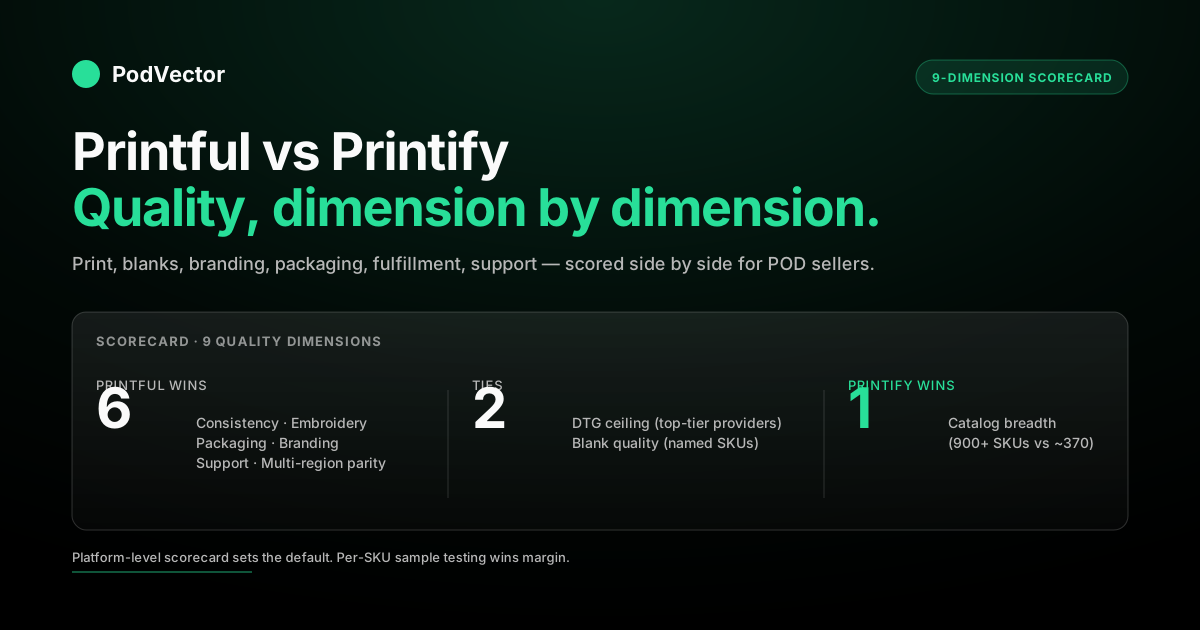
Quick Answer: Across nine quality dimensions, Printful wins six (consistency, embroidery, packaging, branding, customer support, multi-region print parity), Printify wins two (catalog breadth, top-tier provider ceiling), and one is a tie (blank quality, since both source the same Bella+Canvas / Gildan / Stanley & Stella SKUs from the same wholesalers).
So on average Printful is the higher-quality choice. On peak, Printify's top providers — Monster Digital, SwiftPOD, Dimona Tee — match Printful, and on a few SKUs beat it. The right pick is per-SKU, not platform-wide.
Below: the dimension-by-dimension scorecard, what each quality category actually costs you when it slips, the sample-testing protocol that makes the decision, and the data layer most POD sellers don't have but need.
The 9-dimension quality scorecard
Most "Printful vs Printify quality" comparisons collapse the question into one line: which has the better print? That misses 80% of what quality means in POD.
Quality is what your customer experiences from the moment they open the box. That includes the print, but also the blank, the labels, the packaging, the on-time delivery, and what happens when something goes wrong. Each dimension has its own winner.
| Quality dimension | Printful | Printify | Winner |
|---|---|---|---|
| DTG print quality (average) | High, standardized (Kornit Atlas / Avalanche) | Variable by provider (top-tier matches Printful) | Printful |
| DTG print quality (ceiling) | High but capped at in-house spec | Monster Digital, SwiftPOD can match or beat | Tie |
| Embroidery quality | Tajima multi-head, consistent | Few providers do it well; variance wide | Printful |
| Blank garment quality | Same wholesalers (Bella+Canvas, Gildan, etc.) | Same wholesalers; budget tier carries off-brand too | Tie (top-tier) |
| Production consistency | ~0.19% reshipment rate | 0.5–5% depending on provider tier | Printful |
| Packaging consistency | Standardized polybag across all facilities | Varies by provider (polybag, kraft, custom) | Printful |
| Branding (inside-collar, neck tags) | Single-vendor, uniform spec across catalog | Per-provider, requires alignment work | Printful |
| Catalog breadth (more SKUs = more upside) | ~500 products | 1,300+ products across the network | Printify |
| Customer support quality | 24/7, single team, fast resolution | Routes through Printify, then to provider | Printful |
Six dimensions to Printful, two ties, one to Printify. That looks like a blowout. It isn't — because the two columns Printify wins (catalog breadth and provider ceiling) are exactly the columns where a savvy seller can build a higher-margin, equally-high-quality store. The platform-level scorecard tells you the default. Your per-SKU choices override it.
The rest of this article unpacks each dimension. For the broader feature comparison beyond just quality, see the full Printful vs Printify comparison.
Print quality: DTG, embroidery, UV, sublimation
"Print quality" is four different conversations depending on the technique. Each platform handles them differently.
DTG (direct-to-garment)
Printful runs Kornit Atlas and Avalanche industrial DTG printers across all its facilities. Same machines, same calibration, same color profiles. A heather-grey tee printed in Charlotte looks the same as one printed in Riga.
The result is predictable. Reviewers who order the same design side by side — one Printful shirt against three Printify providers — consistently flag Printful's print as the most uniform of the batch.
Printify's DTG quality depends on which provider you pick. Monster Digital, SwiftPOD, and Dimona Tee run comparable equipment and produce prints indistinguishable from Printful's at the seam-and-color level. Mid-tier and budget providers can run older machines, water-based ink mixed differently, or skip the pre-treatment step that helps prints stick on dark garments. The variance is real.
Verdict: Printful wins on DTG average. Printify ties or wins at the ceiling — but only if you pick the right provider and confirm with samples.
Embroidery
Embroidery is where the gap is widest. Printful runs Tajima multi-head machines (the industry standard for premium custom apparel) at every facility that does embroidery. Stitch count, thread tension, color matching — all standardized. Embroidered hats and polos come out clean and consistent.
Printify's embroidery offering is narrower. Fewer providers in the network do embroidery, and those that do operate at varying levels. Some are excellent; some produce loose stitches, off-color thread, or placement issues. If embroidery is core to your brand — corporate gifts, sports apparel, branded workwear — Printful is the safer default.
UV printing (mugs, phone cases, accessories)
Printful runs Mimaki and Inkcups Helix UV printers in-house. Sharp color reproduction on hard surfaces, no peel after use. Printify's UV providers vary: top providers match Printful, but variance on adhesion and color saturation is wider on the budget tier.
All-over-print (AOP) and sublimation
This is a Printify advantage on selection. AOP hoodies, leggings, all-over tees — Printify's network includes specialist sublimation providers (Dimona Tee, Subliminator) that print bright, full-coverage designs that Printful's catalog doesn't include in equivalent variety. The quality of these prints from top Printify providers is excellent. If your store is built on AOP, Printify is the answer not because Printful's AOP is bad — it's because Printful's AOP catalog is thin.
For the broader Printful vs Printify trade-off across all axes, see the full print-on-demand comparison.
Blank garment quality
This is the most-misunderstood part of the comparison. Both platforms source the same blanks from the same wholesalers.
A Bella+Canvas 3001 from Printful is physically the same shirt as a Bella+Canvas 3001 from a top-tier Printify provider. Same factory, same fabric, same fit. Gildan 5000s are Gildan 5000s. Rabbit Skins baby blanks are the same blank either way. The fabric quality difference between the two platforms on identical SKUs is essentially zero.
Eco apparel is a clean tie for the same reason. Both platforms carry Stanley & Stella organic-cotton blanks, and the named SKU is identical on each — so if sustainable garments are your category, pick on cost and provider, not on a quality gap that doesn't exist.
Where blank quality diverges: Printify's budget tier sometimes carries off-brand or no-name garments alongside the named ones. The same product page might list the brand-name Bella+Canvas at one price and a similar-spec generic at a lower price. The generic isn't always bad, but it isn't the same — fit, fabric weight, and seam quality drift.
How to avoid this: when you set up a Printify product, read the blank SKU on the listing page (not just the product name). If it says "Bella+Canvas 3001," you're getting the named blank. If it says something generic, sample it before listing. Printful side-steps this entirely by carrying only named blanks.
Production consistency and variance
Consistency is where Printful's in-house model pays off most clearly. The same machine, the same QC checklist, the same trained staff — applied to every order.
Printful's published reshipment rate is ~0.19%, and the figure most reviewers quote in 2026 is a 0.24% return rate on quality issues. Printify still hasn't published an equivalent network-wide number — which is the point: there isn't one, because every provider runs its own line. That ~0.2% band puts Printful alongside direct-to-consumer apparel brands that print in their own facility.
Printify's defect rate is a range, not a number, because every provider operates independently. Top-tier providers (Monster Digital, SwiftPOD) sit at 0.5–1%. Mid-tier providers run 1–3%. Budget-tier providers can run 3–5% based on seller reports. The platform-wide average is misleading; what matters is the provider you actually use.
| Provider model | Defect rate | Reprint cost / 1,000 orders ($14 base) |
|---|---|---|
| Printful (in-house) | ~0.19% | ~$30 |
| Printify top-tier | ~0.5–1% | ~$70–$140 |
| Printify mid-tier | ~1–3% | ~$140–$420 |
| Printify budget | ~3–5% | ~$420–$700 |
The reprint cost is just the visible part. Refunds, lost LTV, paid-social pixel degradation, customer support time, chargeback fees — all compound. For the deeper economics, see the defect-rate-and-quality-cost breakdown.
Branding quality: labels, packaging, inserts
Branding is the part of quality your customer feels first — before they see the print, before they wash the garment.
Inside-collar labels and neck tags
Printful supports custom inside-collar branding at $2.50/item across most apparel SKUs. Single vendor, single spec, single execution. Across a 20-SKU catalog you set it up once and it works.
Printify supports branded labels too — but only through specific providers, and the spec varies. Some providers do tear-away labels. Some do printed inside-neck tags. Some do screen-printed. If you want a consistent label across a 20-SKU Printify catalog, you have to align every provider's label spec separately. For one or two flagship SKUs it's fine. At scale it's real work.
Packaging
Printful ships every order in a standardized polybag. Same look, same size, same labeling. Predictable unboxing across orders — important if you're a brand whose customers post unboxing content or care about a coherent first impression.
Printify packaging varies by provider. Polybag, kraft mailer, plain box, even custom branded packaging where the provider supports it. Some providers slip in marketing inserts (their own, not yours). If you don't care about packaging, this is fine. If your brand depends on the unboxing, Printful is more reliable.
Marketing inserts and packing slips
Both platforms support white-label packing slips with your store name. Printful supports custom inserts (postcards, thank-you notes) at extra cost and consistent execution. Printify's insert support depends on the provider, and some providers add their own promotional inserts you can't disable.
For the deeper cost picture on branding, see the complete guide to Printful costs and fees.
Fulfillment and shipping quality
Quality includes whether the order arrives on time and intact. Both platforms ship via the same major carriers (USPS, UPS, FedEx, DPD, Royal Mail, etc.) — the carrier quality is identical. The platforms diverge on production-time variance and damage rates.
Production time
Printful publishes 2–5 business day production for most apparel and hits that band consistently. The in-house production model means orders don't wait for a third-party provider's queue; they go onto the next available Printful machine. Holiday-season variance is real but bounded.
Printify production time depends on the provider. Top-tier providers match or beat Printful's 2–5 day band. Mid-tier providers can stretch to 5–7. Budget providers occasionally run 7–10. The provider's published Performance Score on the Printify dashboard tracks this — read it.
Damage in transit
Both platforms see the same damage-in-transit rates (carrier-driven). Where they differ is the resolution — Printful covers reships on damaged orders without much friction; Printify routes through the provider, which adds 1–3 days but lands in the same place.
Multi-region print parity
Printful runs facilities in the US, EU (Riga, Latvia), AU, Mexico, and Japan. The same product printed in any region looks identical because the equipment and color profiles match. A buyer in Berlin gets the same hoodie as a buyer in Austin.
Printify achieves multi-region fulfillment through regional providers — Print Logistic and Drukarnia in EU, T-Pop in AU. Quality at top regional providers is excellent, but matching the print spec to Printful's standard across regions takes setup work.
Customer support quality
When something goes wrong, support quality is the difference between a 1-star review and a saved customer.
Printful runs 24/7 customer support — chat, email, phone. Single team handles all issues end-to-end. Resolution time on print-defect tickets typically lands within 24 hours, with reships approved on the first message most of the time.
Printify also runs 24/7 support, but the structure is two-layer: Printify's support team triages, then routes to the provider's team for production-side issues. This adds latency. For top-tier providers it's a non-issue — they respond fast. For budget providers, resolution time can stretch to 3–5 days, and reship approval sometimes requires you to chase.
For sellers running paid ads where every refund delay risks a chargeback, Printful's single-vendor support speed matters financially.
The sample-testing protocol that decides for you
Every quality verdict above describes averages. Your store doesn't sell averages. It sells specific SKUs, specific colors, specific designs, to specific customers. The honest quality test is ordering a sample of the exact thing you'll list — and running a real protocol on it.
Here's the protocol that actually works:
Step 1 — order from both
For each flagship SKU, order one sample from Printful and one each from 2–3 Printify providers (top-tier, mid-tier, budget — to see the spread). Total spend: $80–150 per SKU. Use the Printful sample discount where available.
Step 2 — score on six things, in order of how often they fail
- Print color accuracy — does the printed color match the digital mockup, or is it 10% off?
- Print placement — centered, sized correctly, placed where the mockup showed?
- Print durability — wash 5–10 times. Does it fade, crack, or peel?
- Fabric weight and feel — match the spec sheet?
- Stitching and finish — collar, hem, seam quality.
- Packaging and unboxing — what your buyer sees first.
Step 3 — pick per-SKU, not platform-wide
One SKU might score best on Monster Digital. The next on Printful. The next on Dimona Tee. The seller who picks platform-wide ("I use Printful for everything" or "I use Printify for everything") leaves money on the table. Provider-aware setup wins.
Step 4 — re-test annually
Print quality drifts. Providers change equipment. The "best provider for my hoodies" today isn't necessarily the best provider in 12 months. A $300 annual sample budget keeps your supplier choices honest.
Quality verdict by use case
The right answer depends on what kind of POD store you're running.
Brand-first store running paid ads
Defect rate compounds in paid social. Refunds tank pixel signal. LTV drops. A 0.19% Printful defect rate vs 4% on a budget Printify provider can be the difference between a paid-social store that scales and one that stalls. Pick Printful unless you've sample-tested specific Printify top-tier providers and confirmed parity.
Catalog-breadth store (sublimation, AOP, niche garments)
Printify wins by default. The 1,300+ catalog includes premium garments — Stanley/Stella eco apparel, Lane Seven heavyweight tees, all-over-print sublimation pieces — that Printful doesn't carry in equivalent variety. The gap shows up per-category: on tees Printify lists roughly 150 options to Printful's ~45, and on mugs it's ~50 to ~8. Pair Printify with provider-aware setup and the quality is excellent.
Embroidery-focused store
Printful, by a clear margin. Tajima multi-head consistency across all facilities. Skip the per-provider variance work entirely.
Multi-region brand
Printful's facility network produces identical output across US, EU, AU, and Japan. Achieving that on Printify requires aligning multiple regional providers' specs — possible but expensive in setup time. Default to Printful unless you've already done the regional alignment work.
Hybrid (most successful POD stores)
Use both. Printful for embroidery, branding-heavy SKUs, and flagship apparel. Printify for AOP, sublimation, niche garments, and SKUs where a top-tier provider beats Printful on cost-quality combined. Most $50k+/month POD stores run hybrid by year two — the platform fight is a beginner question.
For the broader case for hybrid setup, see Printful alternatives: the complete comparison.
The per-SKU quality question only your data answers
Every dimension above gives a platform-level answer. Pick A here. Pick B there. The actual quality question your P&L runs on is per-SKU and per-provider — and most POD sellers don't have the data to answer it.
On your Bella+Canvas 3001 in heather grey, printed via your chosen provider, shipping to your top customer region — what's your defect rate this month? Your reprint cost as a percentage of revenue? Which SKU's margin would improve if you switched providers? None of the public quality articles answer these. They quote averages and stop there.
Closing the gap takes three pieces. Every order's supplier-charged cost, refund event, and reshipment has to land in a single source of truth alongside revenue, ad cost, and processor fees. The math has to run per-SKU and per-supplier so a tee that's profitable on Monster Digital and a hoodie that's profitable on Printful both surface clearly. The answer has to refresh fast enough to act on — switching a poorly-performing provider after a quarter of bad data is too slow.
This is the architecture PodVector AI built Victor on. A unified data warehouse ingests Shopify, Printful, Printify, Meta, and Google per-order data — but Victor doesn't stop at surfacing the number.
When a provider's defect rate on your top tee creeps past its margin cushion, Victor flags it, proposes the switch to the provider that tests better on that exact SKU, and — once you approve — re-points the Shopify listing and reprices it. He runs the same loop across your Meta and Google spend, pulling budget off SKUs that bleed on reprints. The data layer is the substrate; the operator is what acts on it.
The answer isn't always Printful or always Printify. It's per-SKU, per-provider — and a POD seller without an operator working that lever is leaving margin on the table every batch.
For more on the underlying profitability comparison, see how to make money with Printful and Printful vs Printify pricing. For the cluster overview, see the Printful comparison hub, and for the topic landing, the Printful topic page. External reference: see Shopify's Printful vs Printify guide.
FAQs
Is Printful's quality really better than Printify's?
On average, yes. Printful's standardized in-house production runs a tighter quality band than Printify's 85+ provider network. The published reshipment rate is ~0.19%. But "average Printify" is the wrong comparison — Printify's top-tier providers (Monster Digital, SwiftPOD, Dimona Tee) match Printful on print quality. The verdict depends on which Printify provider you pick.
Which Printify providers match Printful on quality?
Monster Digital is widely considered the strongest DTG quality in the network. SwiftPOD is strong on bright colors. Dimona Tee runs heavy garments cleanly. District Photo and MyLocker round out the top tier. Printify's Performance Scores in the 9.5+ range are a reliable filter.
Are Printful and Printify blanks the same quality?
For named blanks (Bella+Canvas 3001, Gildan 5000, Stanley & Stella) the answer is yes — both platforms source from the same wholesalers. The divergence is on Printify's budget tier, where some providers carry off-brand garments alongside the named ones. Read the blank SKU on the Printify product page, not just the price.
Does Printful or Printify have better embroidery?
Printful, by a clear margin. Tajima multi-head machines across every embroidery facility. Fewer Printify providers do embroidery well, and per-provider variance on stitch count and thread color is wider. If embroidery is core to your brand, Printful is the safer pick.
What about all-over-print and sublimation quality?
Printify wins on selection here. Specialist sublimation providers (Dimona Tee, Subliminator) print AOP hoodies, leggings, and full-coverage designs in greater variety than Printful's catalog. Quality from top providers is excellent. If AOP is your category, default to Printify.
How does packaging quality compare?
Printful uses standardized polybag packaging across all facilities — predictable unboxing. Printify packaging varies by provider (polybag, kraft mailer, sometimes custom). If your brand depends on unboxing consistency, Printful is more reliable.
Does Printful or Printify ship faster?
Printful publishes 2–5 business day production and hits that band consistently. Printify production time depends on the provider — top-tier providers match Printful, budget providers can stretch to 7–10 days. Read the Performance Score before picking.
How much should I spend on samples to compare quality?
Budget $80–150 per flagship SKU. Order one Printful sample and 2–3 Printify samples (top-tier, mid-tier, budget). Wash all samples 5–10 times. Score on print, fabric, finish, packaging. The per-SKU verdict beats every published comparison, including this one.
Should I use Printful or Printify if I'm just starting?
Start with Printful. The default-quality consistency means you don't have to learn provider-selection on top of learning POD. Once you're past $5k/month and want to experiment with margin, add Printify for specific SKUs where a top-tier provider gives you better cost-quality combined.
Can I use both Printful and Printify in the same store?
Yes — and most $50k+/month POD stores do. Printful for embroidery, branding-heavy items, and flagship apparel. Printify for AOP, sublimation, and SKUs where the top-tier provider beats Printful's cost-quality combined. The platform fight is a beginner question.
Does quality variance really hit my P&L that hard?
Yes. A 4% defect rate on a $14 base costs ~$560 per 1,000 orders in reprints alone — and that's before refunds, lost LTV, and pixel-signal degradation on paid social. On a $5k/month ad spend, defect-driven refunds can knock 10–20% off ROAS over a four-week pixel learning window. Quality is a P&L line, not a brand-vibes question.
Let Victor switch the providers that are costing you margin
Platform scorecards get you to the right default. They don't move a single order. Victor does.
He watches per-SKU defect and reprint rates across Printful and Printify, proposes the provider switch when one starts bleeding margin, and — on your approval — re-points the Shopify listing, reprices, and reallocates the ad spend behind it. And hand the busywork to an employee who acts before the next batch ships.
Try Victor free