
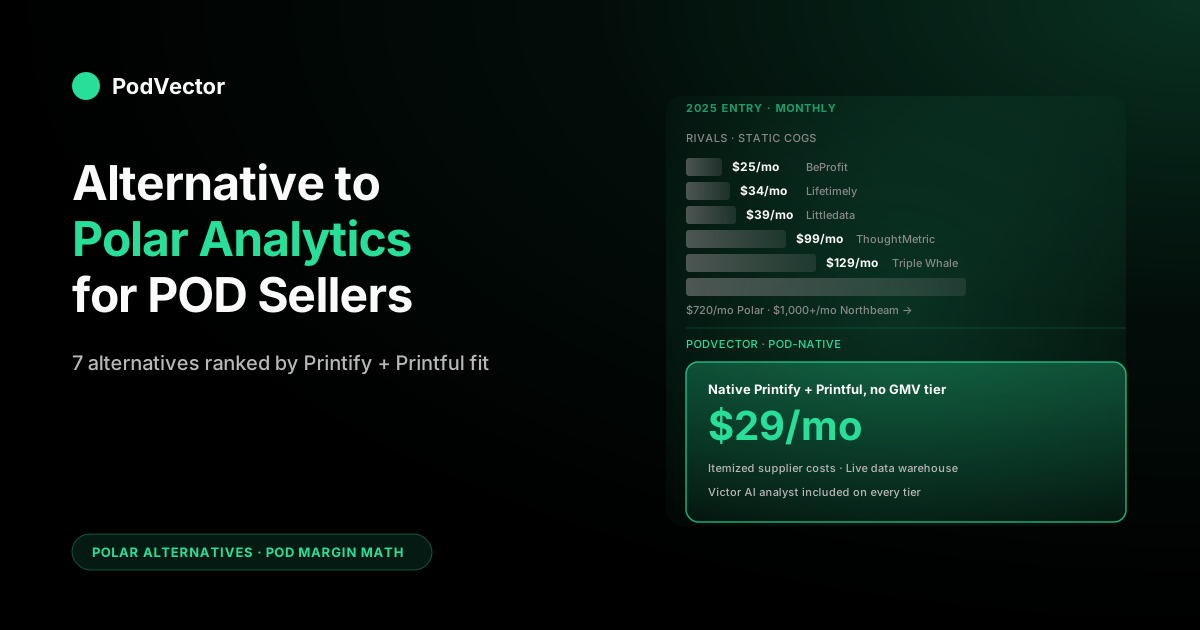
Quick Answer: The right Polar Analytics alternative for a Print-on-Demand store is the one that itemizes Printify or Printful supplier costs at the SKU level — something Polar Analytics doesn't ship by default.
For most POD operators that means PodVector AI at $29/month flat, with Victor (an AI employee) included on every tier and supplier costs joined to Shopify orders automatically. Triple Whale, Northbeam, Lifetimely, BeProfit, ThoughtMetric, and Littledata are also viable alternatives — each suited to a different store profile.
This roundup compares all seven across pricing, POD fit, attribution depth, and what each one actually replaces. The decision matrix at the bottom is the fastest path to a pick.
Why POD sellers look for a Polar alternative
Polar Analytics is a strong product for $5M+ Shopify DTC brands. It's not always the right fit for Print-on-Demand. Three structural mismatches drive most POD operators to look elsewhere.
Price floor. Polar's entry tier is $720/month at ≤$5M GMV. For a POD store doing $250K–$1M in annual revenue, that's 1–3% of GMV consumed by analytics — typically more than the operating margin can absorb. The full 2025 ladder is broken down in the Polar Analytics pricing breakdown for POD sellers.
Supplier-cost modeling. POD sells products you don't own. Printify or Printful charges you a per-item base cost that changes every month, plus shipping, plus platform fees. Polar's data warehouse expects a CSV upload to model these costs — and that file goes stale fast. For deeper detail on how this breaks under POD's cost structure, see Polar Analytics features for POD sellers.
Feature depth you don't need yet. Polar's strength is cross-channel attribution at $20K+/month ad spend. Below that, most of what you pay for sits idle. The Polar Analytics attribution capabilities review lays out where attribution starts paying back.
The seven alternatives below cover every realistic exit path: cheaper, simpler, more POD-specific, or more attribution-heavy. The right pick depends on which of those three problems matters most for your store today.
1. PodVector AI — POD-native, Victor on every tier
PodVector AI is built for one thing: making Print-on-Demand profit visible at the SKU level. It's the alternative most directly aimed at the POD-specific gap Polar leaves open.
Pricing. $29/month flat at the entry tier, no GMV ladder. Higher tiers add seats, additional ad accounts, and longer history retention. The price is roughly 4% of Polar's $720 entry price.
POD fit. Native Printify and Printful integrations ingest supplier invoices line by line, join them to Shopify orders at the SKU level, and surface per-design profit automatically. Sample tier discounts, supplier price changes, and shipping inclusions all map correctly without manual CSV maintenance.
Attribution. Cross-channel ad attribution from Meta, Google, and TikTok joins Shopify orders in a unified live data warehouse you can query directly. Less depth than Polar's full attribution module, but enough for the cross-channel decisions a sub-$5M POD store actually makes.
Victor. An AI employee included on every tier. Ask "what was my Printify hoodie margin last week" or "which Meta ad set is bleeding margin" and Victor queries the warehouse in plain English. Victor answers your questions and acts on those answers — with your approval — pause underperforming campaigns, flag SKUs where supplier pricing erodes margin, and so on.
Where it falls short. No Email Marketer agent, no Klaviyo Audiences activation, fewer pre-built cross-channel attribution models than Polar. If those are core to your stack, Polar still wins on capability.
Best for. Any POD store where supplier-cost accuracy is the bottleneck, regardless of GMV.
2. Triple Whale — Shopify DTC attribution at scale
Triple Whale is the most-cited Polar alternative for Shopify DTC. It's a pixel-driven analytics platform with creative analytics, server-side attribution, and a "Sonar" pixel that recovers post-iOS signal.
Pricing. Plans typically start around $129/month for sub-$1M GMV stores and scale up to several thousand per month at higher GMV — so cheaper than Polar at the bottom, comparable at the top.
POD fit. Strong on Shopify and ad platform integrations, weak on Printify or Printful supplier costs. You'll model COGS as a flat per-SKU rate or upload a CSV. That works for traditional DTC where COGS is stable; it doesn't work as well for POD where supplier prices shift.
Attribution. Comparable to Polar in depth — first-party pixel, server-side tracking, multi-touch attribution, and creative-level reporting are core features. The Creative Cockpit is what Triple Whale users praise most.
Best for. POD stores spending $20K+/month on paid social where creative analytics is a real workflow, and where COGS variability is low enough that flat-rate cost modeling doesn't lie.
3. Northbeam — first-party data and ML attribution
Northbeam is positioned as the analytics platform for serious DTC operators. It uses machine learning on first-party data to deliver attribution that doesn't depend on platform-reported numbers.
Pricing. Custom — typically $1,000–$3,000+/month depending on volume and ad spend. Enterprise-tier from the start; not aimed at sub-$2M stores.
POD fit. Like Polar, Northbeam doesn't natively integrate Printify or Printful supplier costs. You'll layer those in manually or accept that profit numbers are revenue-minus-ads, not true contribution margin.
Attribution. Where Northbeam stands out. The ML attribution engine corrects for platform self-reporting bias and is widely considered more accurate than what Polar or Triple Whale ship by default. Multi-touch, view-through, and modeled conversions are first-class.
Best for. POD brands at $5M+ GMV where attribution accuracy is the highest-value decision, and supplier-cost modeling is already solved by an external accounting workflow.
4. Lifetimely by AMP — LTV and profit dashboards
Lifetimely is a Shopify app focused on customer lifetime value, profit dashboards, and LTV/CAC ratios. AMP acquired it and integrated it into a broader retention suite.
Pricing. Plans start around $34/month at sub-$1M GMV, scaling up. At entry tier, comparable to PodVector AI. The Lifetimely pricing breakdown for POD sellers covers the full ladder.
POD fit. Lifetimely will track Shopify revenue and apply a flat per-product COGS that you set manually. For a POD store with stable supplier pricing and a small SKU count, that's workable. For a store running 50+ Printify designs, the manual maintenance becomes its own job.
Attribution. Limited — Lifetimely is an LTV and profit tool, not a cross-channel attribution platform. You'd pair it with another tool if attribution is the gap.
Best for. POD stores prioritizing LTV/CAC analysis over cross-channel attribution, with stable supplier pricing. The deeper feature comparison is in Lifetimely Shopify app for POD sellers.
5. BeProfit — entry-level profit calculator
BeProfit is the simplest of the alternatives — a profit calculator that pulls Shopify orders, ad spend, and a manual COGS table into a single profit dashboard.
Pricing. Free tier exists; paid plans start around $25/month and scale to $250+/month at higher GMV. Entry-level by design. BeProfit pricing for POD sellers covers the tiers in detail.
POD fit. Manual COGS entry is the model. You list SKUs, set their supplier costs, and BeProfit calculates margin. For a POD store with fewer than 20 active designs and stable supplier pricing, that's enough. For larger or more dynamic catalogs, the upkeep beats the value.
Attribution. Basic — channel-level revenue and ad spend, no multi-touch attribution. If cross-channel is the gap, BeProfit isn't the answer.
Best for. Side-hustle POD stores under $500K GMV running one or two ad channels, where simple is more valuable than sophisticated.
6. ThoughtMetric — multi-touch attribution at lower cost
ThoughtMetric is the closest Polar competitor in terms of feature surface but at lower price points. Multi-touch attribution, ad platform integrations, and Shopify/WooCommerce/BigCommerce support are all in scope.
Pricing. Public pricing starts around $99/month and scales by ad spend rather than GMV. Significantly cheaper than Polar at most tiers.
POD fit. Like the other DTC-first tools, ThoughtMetric expects COGS as a static per-SKU value. No native Printify or Printful integration. The non-Shopify support (BigCommerce, WooCommerce) is useful for stores running outside Shopify, but doesn't change the supplier-cost gap.
Attribution. Multi-touch attribution with first-party data collection. Comparable in spirit to Polar's pixel-based attribution, less depth than Northbeam's ML model.
Best for. POD stores wanting Polar-grade attribution at a fraction of the price, with COGS handled separately.
7. Littledata — Shopify-native data accuracy
Littledata is a Shopify-focused data layer that improves the quality of analytics flowing into Google Analytics, Klaviyo, and other downstream tools. It's positioned as a less expensive alternative to Polar for Shopify Plus brands.
Pricing. Starts around $39/month at low order volume and scales with orders. Significantly cheaper than Polar — Littledata's own marketing cites $149/month at 500 orders versus Polar's $720/month.
POD fit. Littledata doesn't model COGS at all. It's a data accuracy layer, not a profit dashboard. You'd pair it with another tool (PodVector AI or Lifetimely) if margin visibility is the goal.
Attribution. Indirect — by improving data flowing into your existing tools (Google Analytics, Klaviyo), it makes their attribution more accurate. Doesn't ship its own attribution model.
Best for. Shopify Plus POD brands where the gap is data quality (server-side tracking, Conversion APIs) rather than profit visibility or cross-channel attribution.
Side-by-side comparison
The table below is the fastest read. Prices are 2025 entry tiers — most platforms have GMV or order-volume ladders above this.
| Tool | Entry price | POD COGS | Cross-channel attribution | AI employee | Best for |
|---|---|---|---|---|---|
| PodVector AI | $29/mo flat | Native Printify + Printful | Yes (Meta, Google, TikTok) | Victor (every tier) | POD operators |
| Polar Analytics | $720/mo (GMV-tiered) | CSV upload only | Deep, multi-channel | Ask Polar (paid tiers) | $5M+ Shopify DTC |
| Triple Whale | ~$129/mo | Static per-SKU COGS | Sonar pixel attribution | Moby (paid) | Creative-heavy DTC |
| Northbeam | $1,000+/mo | Manual COGS | ML attribution (best in class) | No | $5M+ DTC, attribution-first |
| Lifetimely by AMP | ~$34/mo | Static per-SKU COGS | Limited (channel-level) | No | LTV/CAC analysis |
| BeProfit | ~$25/mo | Manual COGS table | Channel-level only | No | Side-hustle POD stores |
| ThoughtMetric | ~$99/mo | Static per-SKU COGS | Multi-touch attribution | Limited | Polar-grade at lower price |
| Littledata | $39/mo | None | None (data layer only) | No | Shopify Plus data quality |
Two things stand out. First, only PodVector AI ships native Printify and Printful supplier integration — every other alternative expects you to maintain COGS yourself. Second, the price gap between $29 (PodVector AI entry) and $720 (Polar entry) is wide enough that "which is right for my POD store" rarely lands in the middle.
Which alternative fits your POD store
Three questions narrow it to one.
| Your situation | Best alternative | Why |
|---|---|---|
| POD store, supplier-cost accuracy is the gap | PodVector AI | Only platform with native Printify + Printful invoice integration at SKU level |
| POD store, $20K+/month ad spend, attribution is the gap | Triple Whale or ThoughtMetric | Pixel-based attribution at fraction of Polar's price; pair with COGS tool |
| POD brand at $5M+ GMV, attribution accuracy is the priority | Northbeam | ML attribution outperforms Polar's standard models at scale |
| POD store focused on LTV and customer cohorts | Lifetimely by AMP | Purpose-built for LTV/CAC analysis, cheaper than Polar |
| Side-hustle POD store under $500K GMV | BeProfit (or PodVector AI) | Simple profit calculator at low price; PodVector AI if Printify catalog is large |
| Shopify Plus POD brand, data quality is the gap | Littledata | Server-side tracking and Conversion API support without Polar's price |
The shortest decision: if your bottleneck is "I can't trust my Printify or Printful margin numbers," PodVector AI is the alternative aimed straight at that. If your bottleneck is "I'm scaling ad spend across channels and Polar's attribution feels too thin," Northbeam or ThoughtMetric is the right move. If both are gaps, run PodVector AI for COGS and one of the attribution tools alongside.
For more context on how POD profit math actually works once you have visibility, the complete analysis of Printify profitability walks through the unit economics. The Printful costs and fees guide covers the supplier-side numbers.
Browsing the rest of the comparison cluster: the PodVector AI comparison hub indexes every Polar, Lifetimely, and BeProfit head-to-head. The PodVector AI topic hub covers the broader product context.
FAQs
What's the cheapest alternative to Polar Analytics?
BeProfit's free tier is the cheapest entry point at $0. For an actual paid alternative, BeProfit at ~$25/month and PodVector AI at $29/month are roughly tied — but PodVector AI is the only one with native Printify and Printful integration, so for POD operators the value gap is wider than the $4 price difference suggests.
Which Polar Analytics alternative is best for Shopify Print-on-Demand specifically?
PodVector AI. It's the only platform on this list with native Printify and Printful supplier-invoice integration that joins to Shopify orders at the SKU level. Every other alternative expects you to maintain COGS as a static per-SKU table, which breaks under POD's variable supplier pricing.
Can I use Polar Analytics and a Polar alternative together?
Yes. The most common stack is Polar (or another attribution tool) for cross-channel ad reporting, plus PodVector AI for itemized POD supplier costs. They draw on the same Shopify data and don't conflict. Some operators find that running PodVector AI alone covers enough of the attribution surface that Polar isn't needed.
Does Triple Whale work for Print-on-Demand?
Triple Whale works for any Shopify store, but it doesn't have native Printify or Printful integration. You'd model supplier costs as a static per-SKU value and update the table when suppliers raise prices. For a POD store with few active designs that's manageable; for a large catalog with frequent supplier changes, it's a maintenance burden.
Is there a free alternative to Polar Analytics?
Native Shopify Analytics (included free with any Shopify plan) covers acquisition, conversion, and per-SKU sales reporting. It doesn't model supplier costs or do cross-channel attribution, but for a sub-$500K POD store on one or two ad channels, it's often enough. The Polar Analytics 2025 pricing vs Shopify Analytics breakdown covers the trade-off in detail.
How does PodVector AI compare to Polar Analytics across all features?
PodVector AI wins on POD-specific cost integration and price; Polar wins on cross-channel attribution depth, the Email Marketer agent, and Klaviyo Audiences activation. The full feature-by-feature comparison is in PodVector AI vs competitors: the complete POD profit tracker comparison.
Why isn't Google Analytics on this list?
Google Analytics 4 is a web analytics tool, not a profit or attribution platform. It can answer "how much traffic from this campaign converted" but not "what was the per-SKU profit on the conversions Printify shipped." Most Polar alternatives — including PodVector AI — already pull from GA4 as one input among many.
The POD-native Polar Analytics alternative
Polar Analytics is built for $5M+ Shopify DTC. The other alternatives expect you to maintain a static COGS table that goes stale every time Printify or Printful changes pricing.
PodVector AI is built for Print-on-Demand. Native Printify and Printful supplier integration. Live data warehouse. Victor — the AI employee — included on every plan. $29/month flat, no GMV ladder.
Try Victor free