
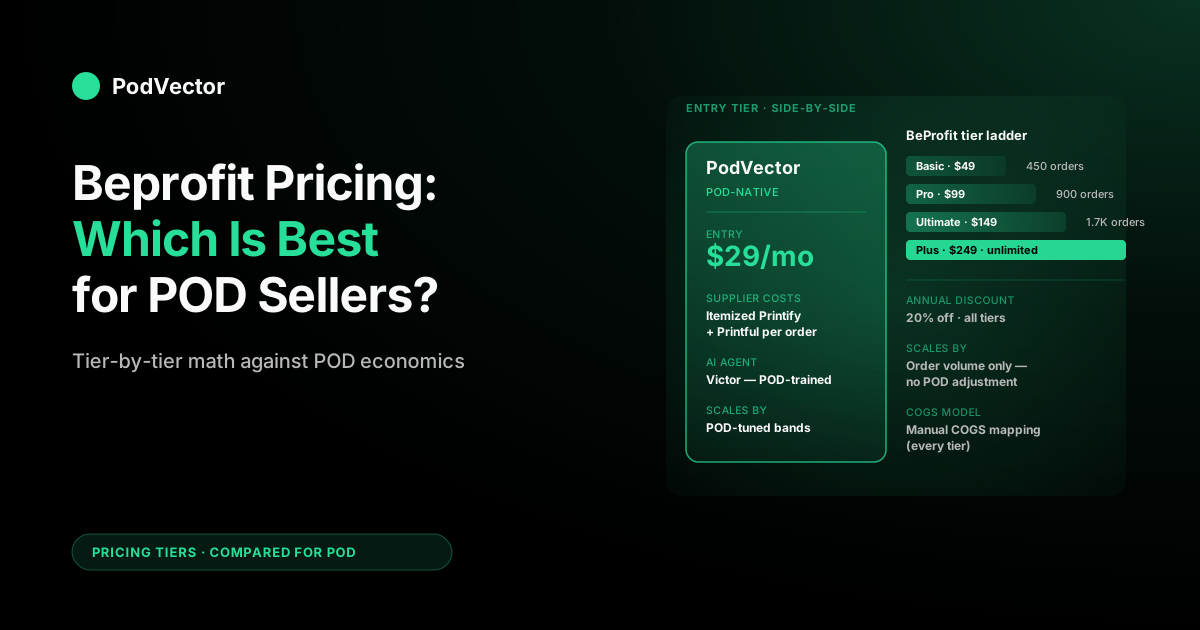
Quick Answer: BeProfit's pricing ladders by monthly Shopify orders — Basic at $49/mo (up to 450 orders), Pro at $99/mo (900), Ultimate at $149/mo (1,700), and Plus at $249/mo (unlimited). Annual billing saves 20% across every tier, and there's a 14-day free trial on every paid plan.
For a typical Shopify DTC brand, those tiers are reasonable. For print-on-demand, the math reads differently. POD's high-SKU, low-AOV pattern pushes you up the order ladder fast, and the COGS field BeProfit pulls from can't represent how Printify and Printful actually charge per order. As the TrueProfit alternatives roundup notes, BeProfit "often requires manual COGS setup, ad budget syncing, or CSV imports" — a real maintenance burden for POD catalogs.
If you're sizing the tiers against POD economics, PodVector AI is the closest POD-native option — itemized supplier costs from order one, an AI employee (Victor) trained on POD reasoning, and a $29 entry tier that doesn't punish high SKU counts. Below: every BeProfit tier broken down for POD, where the math works, where it doesn't, and how to pick.
BeProfit pricing tiers at a glance
BeProfit lists four tiers on the Shopify App Store, all priced as monthly recurring charges through Shopify billing. The gates between tiers are monthly order volume and shop count — feature differences exist but they're secondary to the order ladder.
| Tier | Monthly | Annual (20% off) | Order cap | Shops |
|---|---|---|---|---|
| Basic | $49/mo | $468/yr ($39/mo) | 450 orders/mo | 1 |
| Pro | $99/mo | $948/yr ($79/mo) | 900 orders/mo | 1 |
| Ultimate | $149/mo | $1,428/yr ($119/mo) | 1,700 orders/mo | 1 |
| Plus | $249/mo | $2,390/yr ($199/mo) | Unlimited | Unlimited |
All paid tiers ship with a 14-day free trial. Cancel during the trial window and you're not billed. Older third-party listings still show $25 entry pricing — that's outdated. The current entry is $49/mo, set by the Shopify App Store listing.
The general overview of the product itself lives in our BeProfit for POD sellers comparison. This article is the pricing-specific cut: which tier fits which kind of POD operation, where the order-volume math breaks, and what the alternative looks like.
How order-volume pricing actually works
BeProfit sizes you by monthly Shopify orders, counted across all sales channels BeProfit sees. The threshold is the cap on the tier you're on. Cross it consistently and you're prompted to upgrade or risk paid-overage behavior on the underlying app billing.
This is standard SaaS pricing for analytics tools. The reasoning makes sense for a general Shopify DTC brand. More orders means more data to ingest, more compute to run reports on, and (per the BeProfit pitch) more value to the customer.
The mismatch shows up when you stack the assumption against a print-on-demand profile. POD operations tend to look like this: thousands of active SKUs across multiple Printify and Printful catalogs, modest average order values, and order volume that swings sharply between a quiet week and a viral one.
The order-count axis was tuned for a different shape — fewer SKUs, higher AOV, smoother volume. Three places that matters when you compare BeProfit tiers.
The 450-order Basic tier fills up faster than it looks
POD operators expecting Basic to last through their first year are usually wrong. A single weekend ad winner can push you over 450 orders in a few days. Crossing the cap nudges you to Pro at $99/mo, doubling your tooling spend in one step.
SKU count doesn't lower the bill
A POD store running thousands of SKUs and a DTC store running a handful of SKUs pay the same BeProfit tier at the same order count. But the POD store is asking BeProfit to do far more variant accounting work inside the dashboard — and the accuracy of those reports, given how variable POD per-order costs are, is what suffers.
Volume spikes push you up a tier prematurely
POD stores routinely see sharp order spikes from a single viral post or seasonal hit. If a one-off month pushes you from Pro into Ultimate, you're paying the higher tier for capacity you didn't need long-term. That's not BeProfit's fault — it's the structure of order-count pricing meeting POD's real volatility.
BeProfit pricing vs alternatives for POD
| Tool | Entry tier | Mid tier | POD supplier accuracy | AI agent |
|---|---|---|---|---|
| BeProfit | $49/mo (450 orders) | $99–$149/mo | Manual COGS mapping | No |
| PodVector AI | $29/mo | $59–$129 | Itemized Printify + Printful | Yes — Victor (POD-trained) |
| TrueProfit | $35/mo | $100–$200 | Itemized (Printify + Printful) | Limited |
| Lifetimely | Free / $149 | $299–$499 | Shopify cost_per_item only |
Ask Amp AI (general DTC) |
| Triple Whale | $129/mo | $299+ | Itemized but DTC-modeled | Yes (Moby) |
| Polar Analytics | ~$400/mo | $800+ | Flat or category COGS by default | Yes (Polar AI) |
For the broader category-wide scoring across every major Shopify profit tracker, see our complete POD profit tracker comparison. The cut above is the pricing slice that matters when you're comparing tiers head-to-head. For how TrueProfit specifically stacks up against BeProfit on features, TrueProfit's own comparison page notes their "extra order fees are also a whopping 34% to 50% lower than BeProfit's" — relevant context when sizing cost at scale.
Tier-by-tier breakdown for POD sellers
Each BeProfit tier solves for a different operator size. Here's how each one reads if your store is POD on Shopify with Printify or Printful as your fulfillment layer.
Basic — $49/mo, 450 orders/month
The Basic tier is BeProfit's entry. You get the profit and expense dashboard, unlimited ad-platform integrations (Meta, Google, TikTok, Amazon), order and product profit views, and real-time data refresh. One shop only.
For a POD operator just past launch — first 90 to 180 days, validating products — Basic is fine on the surface. You see your Shopify revenue, your Meta and Google ad spend, your Shopify fees, and a top-line "true profit" number.
Two things to check before you commit. First, the 450-order cap is tighter than it sounds for POD — a winning product can blow past it in a weekend. Second, the COGS field still pulls from Shopify cost_per_item, with manual mapping for variance. POD operators with Printify Premium or Printful's tiered pricing have a hard time keeping that one number accurate across their catalog.
Pro — $99/mo, 900 orders/month
The Pro tier is where most operators evaluating BeProfit actually land. It doubles the order cap to 900 and adds custom reports, a customizable dashboard, a P&L report, and advanced filters.
Translated: you can build views BeProfit didn't ship out of the box. That's genuinely useful — POD has its own slicing needs (by Printify provider, by garment color, by ship-to country) that no off-the-shelf dashboard nails.
What you don't get that POD specifically needs: any way to make BeProfit read your actual Printify or Printful supplier costs per order. The COGS still maps from Shopify, manually maintained, regardless of how many supplier-side dimensions actually move that cost. As our own Shopify–Printify setup guide covers, Printify's per-order cost varies by print provider, color, and destination — a single per-variant number in Shopify can't capture that.
Ultimate — $149/mo, 1,700 orders/month
Ultimate is where BeProfit's pricing starts to overlap with the next category of tools. The order cap nearly doubles again (1,700/mo), and the feature set picks up profit insights, UTM attribution, LTV cohort analysis, and pricing simulators.
The LTV cohort layer is the headline upgrade. If you've got real repeat-purchase dynamics — a club, a niche audience, subscription-printed merch — the cohort math matters. For most POD stores the repeat-purchase rate sits meaningfully below branded DTC, which makes the cohort math directionally useful but rarely decision-driving.
The UTM attribution model is also worth flagging. BeProfit attributes ad spend it can match through UTM parameters. With Meta CAPI and Google enhanced conversions feeding mostly server-side, UTM-based attribution misses a meaningful slice of the actual ad-driven revenue. For context on where Meta and Google ad tracking sits relative to POD margin decisions, see our Google Ads vs Facebook Ads guide for POD sellers.
Plus — $249/mo, unlimited orders, unlimited shops
Plus is BeProfit's enterprise tier. No order cap, no shop cap, and the full feature set plus custom metrics, API access, and unlimited team seats.
API access is the meaningful difference for operators who want to push BeProfit's data into a warehouse or BI tool of their own. If you're already running, or planning to run, a custom data warehouse setup, Plus's API at $249/mo is competitive against the alternatives.
For POD operators at significant scale (multi-store, large catalog), the question shifts from "what does BeProfit cost?" to "what does the right data architecture cost?" — and BeProfit-as-the-source-of-truth has the same supplier-cost limitations as the lower tiers. Most POD brands at this scale either build their data layer on a real warehouse and use BeProfit as a read-only dashboard, or skip BeProfit and go to a POD-native tracker plus a warehouse.
The hidden cost: COGS accuracy
The pricing conversation around BeProfit usually stops at sticker price and order cap. For POD, there's a layer beneath that. The biggest cost of BeProfit isn't the monthly fee — it's how much margin error gets baked into the dashboard you're paying for.
How BeProfit reads costs today
BeProfit pulls each variant's cost from Shopify product fields, with a manual override layer for cases where the Shopify field isn't right. You can map a flat COGS per variant, set a per-product cost, or upload a cost CSV.
For brand DTC with stable unit economics, that's enough. The cost of a standard product is set once; BeProfit's margin math is right.
POD doesn't fit that pattern. We've covered the underlying math in our Shopify–Printify setup guide — short version: a single Printify hoodie can carry a different supplier-side cost depending on print provider, garment color, print size, ship-to country, and Printify Premium discount status. Two orders for the same Shopify variant on the same day can have meaningfully different base costs. Printful's embroidery pricing adds another dimension — see our Printful embroidery review for how that plays into per-order cost variance.
What that does to your dashboard
If you set a flat number per variant, BeProfit's gross-margin readings drift from reality on any given day. The drift compounds over a month — your dashboard says one margin while your supplier ledger says another. That's not a small operational error: a meaningful margin gap can represent real profit you thought you had and didn't. The tier you're paying for ($49, $99, $149, $249) doesn't change that math — the gap is in the data model, not the seat count.
The manual-mapping option doesn't fix it
BeProfit offers manual cost mapping, which is the recommended path for POD on most help-doc threads. As the PodVector competitors guide notes, for a pure-play POD store "the generic COGS model means you'll either manually enter supplier costs or accept meaningfully wrong numbers." The catch is the maintenance cost: if you've got thousands of SKUs and Printify or Printful charges you a different cost per ship-to country and print provider combination, "manual mapping" means maintaining a cost table that has to be updated every time pricing changes. In practice, operators stop maintaining it within a couple of months. The dashboard still shows numbers — they're just wrong.
Why this matters for the pricing decision
The honest comparison isn't "$49 BeProfit Basic vs $29 PodVector AI." It's "$49 BeProfit with a dashboard you have to mentally discount" vs "$29 PodVector AI with a dashboard you can act on." If you're going to pay any money for a profit tracker, the price you should be most sensitive to is the price of being wrong.
Annual vs monthly: when the 20% saves real money
BeProfit's annual billing knocks 20% off the monthly sticker. That's a real discount — the question is whether locking in twelve months at any tier makes sense for a POD operation.
The math on each tier
Basic monthly is $49 × 12 = $588/yr; annual is $468/yr — you save $120. Pro is $99 × 12 = $1,188/yr vs $948 annual — $240 saved. Ultimate is $149 × 12 = $1,788/yr vs $1,428 annual — $360 saved. Plus is $249 × 12 = $2,988/yr vs $2,390 annual — $598 saved.
The dollar savings scale with tier, which is normal for percentage-off pricing. The percentage doesn't change.
When annual is the right call
Annual makes sense if your monthly order volume is steady-state above a tier threshold and you're confident you'll keep using BeProfit for at least 12 months. The 20% is real money — $360 on Ultimate is a respectable line item.
Two scenarios where annual is the wrong call. First, if you're actively evaluating alternatives — locking in a year on a tool you're shopping against PodVector AI, TrueProfit, or Lifetimely is a bad trade. Second, if your order volume is volatile — POD-typical sharp spikes — you may end up paying for a higher tier than your steady-state needs because you crossed the threshold once.
The discount you actually want
The 20% annual discount is fine. The bigger discount is paying the right amount in the first place — picking a tool whose pricing model fits your business shape rather than penalizing it. POD pricing that scales with SKU count and supplier variance saves operators more than the annual discount over a year, in our experience.
Free trial mechanics and what to test
Every paid tier ships with a 14-day free trial. You install the app on Shopify, choose a tier, and aren't billed until day 15. Cancel before then and you owe nothing. Standard Shopify-app trial mechanics — TrueProfit's comparison page confirms BeProfit's trial works the same way as the broader category standard.
What's worth testing in the 14 days, specifically as a POD operator:
- Day 1: Install BeProfit, connect Shopify, connect Meta and Google ad accounts. The connect flow is the easy part — usually under 30 minutes.
- Day 2–3: Import or set your COGS. Try the manual cost mapping for at least 50 of your top SKUs. This is where you'll feel the maintenance cost — if mapping 50 SKUs takes you two hours, projecting that across a large catalog is revealing.
- Day 4–7: Compare BeProfit's reported margins against an actual Printify or Printful supplier invoice for the same week. If the gap is meaningful, the tier you choose won't fix that.
- Day 8–14: Run the custom reports (Pro and Ultimate) on the slices you actually care about — by print provider, by ship-to country, by ad campaign. If you can't slice it the way you need to, no tier upgrade fixes that either.
The 14-day window is long enough to evaluate the dashboard's day-to-day fit. It's short enough that you'll miss any seasonal pattern — Q4 vs summer, Mother's Day vs Father's Day — that shows up only across months.
PodVector AI pricing: POD-native alternative
PodVector AI's pricing is built for POD's actual shape — high SKU count, modest AOV, supplier-side cost variance. The architecture is also a direct response to the gaps BeProfit's general-DTC model can't close.
How the tiers ladder
PodVector AI starts at $29/month and ladders to $59 and $129 across the operating range most POD stores actually live in. The tiers move on order volume the way BeProfit's do, but the bands are tuned to POD economics — which means the percentage-of-revenue math reads more reasonably for thin-margin operators.
SKU count doesn't push you up a tier. Number of variants doesn't push you up a tier. Only order count moves you, and the entry tier covers most POD operators in their growth stage.
What you get at $29
Itemized Printify and Printful supplier costs flowing into a real-time P&L. Operating profit (ads + payment processing + app subscriptions netted out, not just gross). Ad-platform integrations for Meta and Google. The Victor AI employee running on a live data warehouse, answering POD-specific questions from day one.
That's the same surface — accurate margins, an answerable AI, integrated ad data — that BeProfit's Basic tier costs $49 to get a Shopify-side approximation of, and that BeProfit's Ultimate tier costs $149 to add LTV cohort math on top of.
The Victor angle
Victor is the AI employee built into PodVector AI. You ask Victor questions in plain English and he pulls answers from your live data warehouse — including the per-order Printify and Printful supplier line items that Shopify's cost field can't represent. Victor also executes approved Shopify-side actions: bulk repricing, creating buy-one-get-one discounts (see our guide to Shopify Buy X Get Y discounts for POD), setting up free-shipping discounts, raising your free-shipping threshold, organizing collections, and updating shipping settings. He reads Meta Ads, Google Ads, Printify, and Printful data and proposes moves — but write actions execute only on Shopify, with your approval on each step.
BeProfit doesn't have an AI agent at any tier. The closest thing is the dashboard's filter and report builder, which is a query UI, not a conversation.
Victor's Weekly Health Report surfaces the most important POD margin signals from the prior week — margin by SKU, ad spend vs contribution margin, supplier cost shifts — so you start each week with context rather than chasing it. Our Google Ads vs Facebook Ads guide for POD covers how Victor reads ad-platform data to help size channel decisions.
How to decide: stage-based recommendation
The right tier — at any vendor — depends on what your bottleneck actually is. Three honest scenarios.
Early stage: PodVector AI $29 or BeProfit Basic
At launch through validation stage, you need cheap, fast, and right-enough. BeProfit Basic ($49/mo, 450 orders) gives you a clean Shopify-side P&L if you're willing to maintain manual COGS mapping. PodVector AI's $29 tier gives you POD-accurate supplier costs from order one with no manual mapping.
If your catalog is narrow (under 50 SKUs) and your costs are stable, BeProfit Basic is fine. If your catalog spans Printify and Printful with variant-level cost variance, PodVector AI's entry tier is the cleaner read — and saves you $20/month. Our Printify vs Printful pricing and quality comparison covers which supplier's cost model is more predictable, which affects how hard the COGS mapping problem actually is.
Growth stage, Shopify POD: PodVector AI ($29–$129)
The sweet spot for POD-native tools. BeProfit Pro and Ultimate ($99–$149) are the natural comparisons — they give you custom reports and LTV cohort math, but the COGS model is structurally wrong for POD.
PodVector AI's $59–$129 tiers cover the work that actually shifts your scaling decisions: accurate supplier costs, operating profit, ad integration, and an AI employee that understands POD. Same monthly spend or less, on a data model that fits the business. For a comparable pricing breakdown on another tool in this bracket, our Polar Analytics pricing for POD piece walks through the equivalent math at the high end of the category.
Retention-driven POD with repeat-purchase focus: consider both
If you've built a POD brand with genuine repeat-purchase dynamics — loyalty programs, club merch, subscriber-printed items — BeProfit Ultimate's LTV cohort layer at $149/mo earns its keep.
The supplier-cost gap doesn't go away. The honest answer for many brands at this stage is running PodVector AI for the POD margin truth, alongside BeProfit Ultimate for the LTV cohort layer. Two specialized tools is often cheaper and more accurate than one platform doing both jobs poorly. For context on managing the refund side of the P&L at this stage, see our Shopify–QuickBooks refund workflow guide.
Enterprise scale: warehouse-native + POD layer
At significant scale, you'll likely want a managed warehouse you can extend with custom models — Polar Analytics or a custom warehouse setup. Full breakdown in our Polar Analytics pricing for POD piece.
BeProfit Plus ($249/mo, unlimited orders, API access) competes in this band but doesn't cleanly win it — you're paying for capacity and an API endpoint, not for a different category of capability. Many POD-focused brands keep PodVector AI running alongside the warehouse specifically for the daily POD margin view.
FAQs
How much does BeProfit cost in 2026?
$49/mo Basic (450 orders), $99/mo Pro (900 orders), $149/mo Ultimate (1,700 orders), and $249/mo Plus (unlimited orders, unlimited shops). Annual billing saves 20% across every tier. There's a 14-day free trial on every paid plan.
Why do some sites still show $25 BeProfit pricing?
Older third-party listings on review aggregators (Capterra, GetApp, Software Advice) cached an earlier BeProfit pricing tier. The current pricing on the Shopify App Store is $49 entry. Those aggregator pages haven't all updated.
What's the difference between Basic, Pro, Ultimate, and Plus?
Order capacity is the main gate (450 / 900 / 1,700 / unlimited). Pro adds custom reports and dashboards. Ultimate adds profit insights, UTM attribution, and LTV cohort analysis. Plus adds API access, unlimited shops, unlimited team seats, and custom metrics.
Is annual billing worth it for POD operators?
The 20% discount is real — $120 on Basic, $360 on Ultimate, $598 on Plus. It's the right call if your order volume is steady and you're committed to BeProfit for 12 months. It's the wrong call if you're actively evaluating alternatives or if your order volume is volatile (POD-typical viral spikes can push you past a tier you didn't need long-term).
Can BeProfit read Printify or Printful supplier costs directly?
Not directly. BeProfit's COGS comes from Shopify product fields, with manual mapping as the override path. POD supplier costs vary by print provider, garment, color, ship-to country, and Premium subscription status — that variance can't be captured in a single per-variant cost field, regardless of which BeProfit tier you're on.
What's the cheapest BeProfit alternative for POD sellers?
For Shopify POD running Printify or Printful, PodVector AI starts at $29/month with itemized supplier costs and Victor's POD-trained AI employee included. TrueProfit at $35/month is the closest direct alternative on price; Lifetimely's Free tier is cheaper but capped at a low order count.
Does BeProfit work outside Shopify?
BeProfit's primary install path is Shopify, with Amazon and WooCommerce supported on higher tiers via separate connectors. The Shopify App Store listing is where current pricing is published; non-Shopify pricing is sometimes quoted directly.
Does BeProfit have an AI agent?
No. BeProfit does not ship a conversational AI employee at any tier. The closest functionality is the dashboard's filter and custom-report builder, which is a query interface, not an agent that answers questions or proposes and executes actions. PodVector AI's Victor is the only operator in this category that both answers POD-specific questions and executes approved Shopify-side actions — repricing, discounts, shipping settings, and collection organization.
How does TrueProfit compare to BeProfit for POD?
Both tools serve general Shopify sellers rather than POD specifically. According to TrueProfit's own comparison page, TrueProfit's extra order fees are "34% to 50% lower than BeProfit's" at comparable tiers, and TrueProfit handles COGS setup more automatically than BeProfit's manual-mapping approach. For POD sellers, though, both tools share the same core limitation: neither natively ingests per-order Printify or Printful supplier costs the way PodVector AI does. If POD margin accuracy is the priority, the TrueProfit vs BeProfit choice is secondary to whether either tool actually fits POD economics.
POD margin truth — at a price tuned for POD
BeProfit's tiers are fair pricing for general Shopify DTC. They're a poor fit for POD's high-SKU, low-AOV, variable-supplier-cost shape. PodVector AI starts at $29/month with itemized Printify and Printful supplier line items, operating profit, and an AI employee (Victor) trained on POD economics — who can also execute approved Shopify-side actions like bulk repricing and discount setup.
Try Victor free