
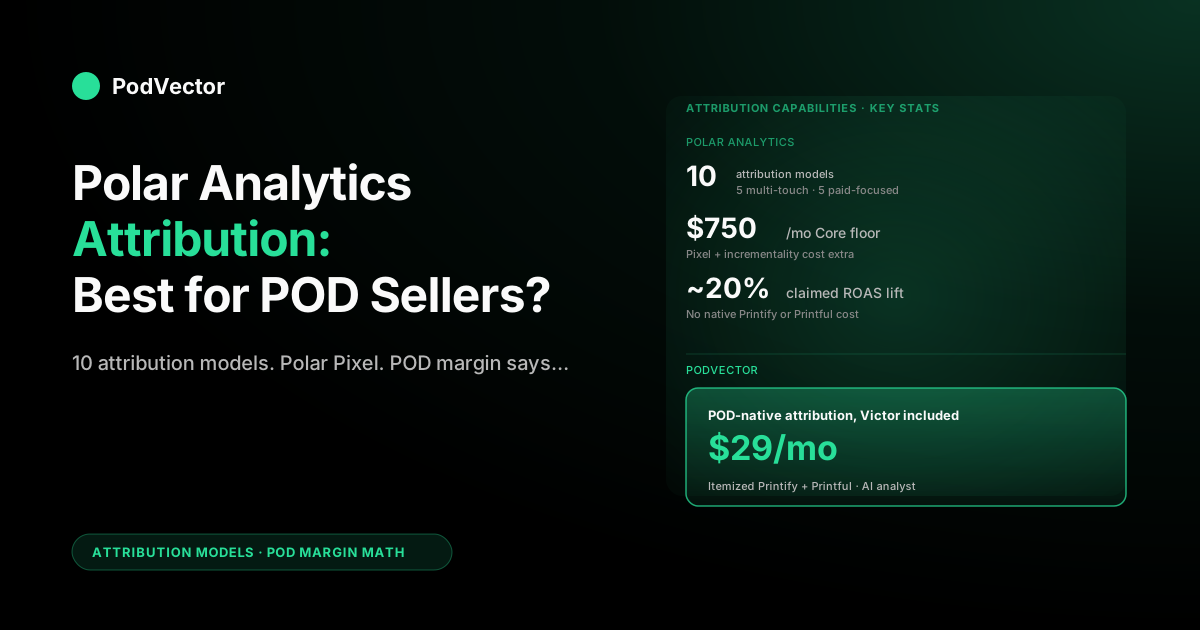
Quick Answer: Polar Analytics' attribution capabilities cover eight models — five standard multi-touch (First Click, Last Click, Linear, U-Shaped, Time Decay) and three paid-focused (Full Paid Overlap, Full Paid Overlap + Facebook Views, Full Impact) — plus an Is Paid Only toggle that makes any model paid-channel-only and a Causal Lift geo-holdout module for incrementality. All of it runs on deterministic, order-level data from the server-side Polar Pixel, with drill-down to see why each conversion was credited to a channel.
For Shopify DTC brands at $3M+ GMV running multi-channel paid, the stack is best-in-class. For Print-on-Demand sellers the math gets harder: Polar's pricing starts at $750/month, attribution-grade modules cost more on top, and the supplier-cost layer that decides whether a campaign was actually profitable isn't part of any attribution model.
If you want POD-aware attribution that knows what each Printify or Printful order cost you, PodVector AI starts at $29/month with itemized supplier costs and Victor — your AI employee — included on every tier. Below is the full Polar attribution capability walkthrough, which models matter when, and a POD-specific decision matrix.
What "attribution capabilities" means in Polar Analytics
Attribution is the math that decides which channel gets credit for a sale. Polar Analytics ships a server-side tracking layer plus a model engine that runs that math eight different ways, side by side — and an Is Paid Only toggle that turns any of them into a paid-channels-only view.
The point of having eight models isn't that one is right. It's that ad-platform reporting (Meta says one number, Google says another, Shopify says a third) double-counts most conversions. Different models give you different ways to subtract that double-count and see what each channel actually drove.
For Shopify operators, the practical question is: how much of last week's revenue was Meta's, how much was Google's, how much was email, and how much was returning customers who would have bought anyway? Polar's attribution capabilities are the answer surface for that question.
If you want the broader Polar evaluation before getting into the model math, the Polar Analytics overview for POD sellers covers the full platform; this article zooms into attribution specifically.
The 8 attribution models in Polar
Polar groups its models into two buckets: standard multi-touch and paid-focused. Here's what each one does and when it's the right pick. Every model runs on deterministic, order-level data — not modeled estimates — so you can drill into any attributed conversion down to the customer and order that earned a channel its credit. (Older write-ups counted a separate "Paid Linear" model; Polar has since folded paid-only variants into the Is Paid Only toggle covered below, so the canonical list is eight.)
Standard multi-touch models (5)
First Click
Gives 100% of the credit to the first marketing touch — typically a paid ad someone saw, an email, or a search click that introduced them to your brand.
Use when you want to see which channels are doing the discovery work. Top-of-funnel-heavy brands and POD operators with long buying cycles will see Meta and TikTok over-credited here.
Last Click
Gives 100% of the credit to the final touch before the order. This is the default in most ad platforms' native dashboards.
Use when you want a simple, conservative read on what closed the sale. Tends to over-credit branded search and email — the channels that catch the customer at the end.
Linear
Splits credit equally across every touch in the journey. Three touchpoints get one-third each. Ten touchpoints get one-tenth each.
Use when you want a fairness baseline that doesn't reward either the discovery channel or the closer. Useful as a sanity check against First Click and Last Click.
U-Shaped (Position-Based)
Front-loads and back-loads credit. The first touch and the last touch each get 40%. The middle touches split the remaining 20%.
Use when discovery and closing both clearly matter, and the middle of the journey is just nurturing. Common pick for considered-purchase ecommerce.
Time Decay
Weights credit by recency. The closer a touch is to the conversion, the more credit it gets.
Use for short consideration cycles where the recent touches are doing most of the work. Apparel, accessories, and impulse-purchase POD products tend to fit this model.
Paid-focused models (3)
These three are paid-channel-specific by design. (To get a "paid only" version of a standard model — e.g. Linear across paid channels only, what older docs called "Paid Linear" — you flip the Is Paid Only toggle covered below rather than picking a separate model.)
Full Paid Overlap
Every paid channel that touched the journey gets full credit — meaning the same conversion is "credited" to Meta and Google and TikTok at the same time.
The total credit adds up to more than 100%. That's deliberate: it shows you each channel's claimed contribution the way the ad platforms see it, which is how you'd reconcile against Meta Ads Manager and Google Ads UI side by side.
Full Paid Overlap + Facebook Views
Same as Full Paid Overlap, plus credit for Facebook view-through conversions — people who saw a Meta ad without clicking but converted later.
This is Polar's signature model. Meta's view-through data normally lives only inside Meta's reporting; Polar pulls it in and lets you see it next to click-through attribution from other channels. For Meta-heavy stores it tends to surface 10–20% more revenue Meta deserves credit for.
Full Impact
Polar's data-driven model. Looks at every customer journey across all channels (paid and organic), runs a Shapley-value computation, and assigns each channel its real contribution as a percentage of total revenue (totalling 100%).
This is the closest thing to a single "true" answer — but it's an algorithmic read, not a deterministic count. Use it as the cross-check on the deterministic models, not as the only number. (Note: Polar has consolidated its paid-channel views over time — what some older write-ups called separate "Paid Linear" or "Full Impact Paid" models is now handled by toggling the Is Paid Only setting on top of the models above, covered below.)
For ad-platform-specific context on how these models reconcile against Meta's own reporting, the complete guide to Meta Ads ROAS and attribution for POD walks through where each model agrees and disagrees with Meta Ads Manager.
The Polar Pixel and the data layer behind attribution
Models don't matter if the underlying data is wrong. Polar's attribution capabilities depend on a server-side tracking pixel that runs alongside ad-platform pixels and Shopify's native event stream.
How the Polar Pixel works
The Polar Pixel installs into your Shopify theme and checkout via Shopify's pixel framework. It captures events server-side rather than relying purely on browser pixels — which means iOS 14+ tracking restrictions and ad-blockers don't blow holes in the data the way they do with Meta's client-side pixel.
Each visitor gets a "Lifetime ID" that persists across devices and sessions. So if a customer clicks a Meta ad on Monday from their phone, comes back via Google Search on Friday from a laptop, and converts, the pixel stitches those touchpoints into a single journey.
The data is deterministic and order-level — actual recorded touchpoints tied to actual orders, not platform-modeled estimates. That's what makes Polar's signature drill-down possible: for any attributed conversion you can open the underlying journey and see why the model gave a channel credit, down to the specific customer and order. By default the Polar Pixel's Key Indicators are calculated on the First Click model, then you re-run any view under whichever model you select.
What the pixel feeds into
The Polar Pixel data lands in your Polar workspace alongside the ad-platform data Polar pulls via OAuth (Meta, Google Ads, TikTok, Pinterest, Microsoft, Snapchat). The attribution models run on the unified view.
You can also push the enhanced server-side conversion data back to ad platforms via Conversion API enhancement. Polar's claim is roughly a 20% ROAS lift on average for stores running this — a function of platforms getting cleaner conversion signals back, not a Polar trick.
Where the pixel fits in the broader stack
The pixel is one layer; the live data warehouse Polar provisions is the other. Attribution models run as queries against the warehouse. SQL access is available, which is unusual for a Shopify-app-class tool — meaning you can write a custom attribution model if the eight built-ins don't fit your business.
For a deeper look at the data infrastructure underneath this, the Polar Analytics marketing data insights breakdown covers how the warehouse and the dashboard layer fit together.
Attribution features beyond the models
Picking a model is one capability. The features around the models are where Polar's attribution capability set actually lives.
Side-by-side model comparison
Polar lets you see the same time period under multiple attribution models in one view. Meta might be credited with $80K under Last Click and $140K under Full Paid Overlap + Facebook Views. The gap tells you how much Meta's view-through and assisted conversions are worth.
This is genuinely useful for budget-allocation arguments. The single number always lies; the spread between models tells you how much you're guessing.
Attribution settings: window, paid-only, and accounting basis
Three controls sit on top of every model. Lookback window sets how far back before a conversion a touchpoint can still earn credit — defaults match ad-platform conventions (typically a 7-day click, 1-day view), but you can set a fixed number of days or an unlimited window for long consideration cycles. Is Paid Only strips organic, direct, and email out so you're comparing paid platforms head to head — it's the toggle that turns any model into its paid-channel-only view. Cash vs. Accrual sets the date a conversion is credited against — Cash dates it to the order/conversion date, Accrual dates the credit to the touchpoint dates instead — so attribution reconciles against how you actually keep books.
POD operators with long consideration cycles (custom apparel, made-to-order) benefit from longer or unlimited windows. Impulse-purchase categories can usually leave defaults alone.
Causal Lift incrementality testing (geo holdouts)
Higher Polar tiers add geo-based incrementality testing, which Polar now ships as Causal Lift. You split your markets into treatment (ads on) and control (ads off) groups, run for a defined window, and measure the actual incremental sales the ads drove — the dashboard reports incremental conversion value, true CAC, and true ROAS, with confidence intervals so you can tell a real result from random noise.
Causal Lift runs as a four-stage workflow: define the hypothesis and success metric, design the experiment off historical sales data (which regions, how long), deploy campaigns to the treatment regions, then read the insights dashboard. It's channel-agnostic — the same methodology applies to Meta, Google, TikTok, or any channel — and privacy-compliant, using first-party data only with no PII required.
This is the gold standard for proving ad effectiveness — it answers "did the ads cause the sale, or would it have happened anyway?" and sidesteps every attribution-model flaw because it doesn't model attribution at all. It just compares what happened with ads to what happened without. Worth doing once per quarter on your biggest channel.
Channel performance and journeys views
Channel Performance ties each channel to its attributed revenue, ROAS, and contribution percentage under the model you pick. Journeys Tab visualizes the actual paths customers took — the sequence of touchpoints — so you can see whether your "Last Click email" wins were really driven by a Meta ad two weeks earlier.
For most operators these views are the day-to-day reason to open Polar. The model-comparison view is the strategic layer; Channel Performance and Journeys are the tactical layer.
Conversion API enhancement for ad platforms
The pixel's data flows back to Meta and Google as enhanced conversion signals via their Conversion APIs. Cleaner signals mean ad platforms' bidding algorithms train on better data. That's why Polar reports a measurable ROAS lift on the platforms even without changing the campaigns.
AI insights on attribution data
Polar's AI assistant can answer plain-English questions about attribution — "which channel had the biggest swing under Full Paid Overlap last week" — and generate dashboards on demand. This is bolt-on rather than the spine of the product, but useful for operators who don't want to learn the eight-model vocabulary.
Which pricing tier unlocks which attribution features
Not every attribution capability ships in the base plan. Here's the breakdown by tier.
| Capability | Core ($750/mo floor) | Customize (Core + modules) |
|---|---|---|
| 8 attribution models + Is Paid Only toggle | Included | Included |
| Polar Pixel (server-side tracking) | Optional module | Bundled if added |
| Conversion API enhancement | Optional module | Bundled if added |
| Causal Lift incrementality (geo holdouts) | Not included | Module add-on |
| Attribution settings (window, paid-only, basis) | Included | Included |
| SQL access on the warehouse | Included | Included |
| AI insights on attribution data | Included | Included |
The $750/month floor scales with Shopify GMV. Adding the Polar Pixel module, Advertising Signals (the Conversion API piece), and Causal Lift incrementality typically pushes the bill into the $1,200–$2,500/month range for stores in the $3–10M GMV band.
For the full pricing math by GMV tier, the Polar Analytics pricing walkthrough covers what each band actually costs. The Polar Analytics Shopify pricing breakdown goes deeper on the recurring-vs-external charge structure inside the Shopify billing system.
Where Polar's attribution misfits POD economics
The nine models and the Polar Pixel are well-engineered. The mismatch with Print-on-Demand isn't about the attribution stack itself — it's about what attribution math is silent on.
Attribution doesn't see supplier costs
Every Polar attribution model answers the same question: which channel drove this $X of revenue? None of them answers the question that decides POD profitability: what did this $X of revenue actually net after Printify or Printful supplier costs?
For a $200 AOV cosmetics brand at 65% gross margin, the gap between revenue and net is small enough that attribution accuracy is the dominant variable. For a $35 AOV t-shirt store at 45% gross margin, the supplier-cost layer is bigger than any attribution-model swing — and Polar doesn't pull Printify or Printful supplier data natively.
Attribution doesn't see per-order variance
Two Printify orders with the same SKU can have different costs. Production routing, shipping zone, mockup variant, and provider availability all shift the per-order base price.
POD operators trying to evaluate an ad campaign need order-level cost data, not category-level averages. Polar's attribution models take revenue at face value — there's no layer in the stack that ingests per-order Printify cost detail unless you build it yourself in SQL on the warehouse.
Attribution gains scale with margin headroom
Polar Pixel + Conversion API enhancement claim a roughly 20% ROAS lift. Real, measurable, and often achievable. But that lift compounds with margin headroom: a 20% ROAS lift on 65%-margin product is a much bigger absolute dollar gain than the same lift on 45%-margin POD product.
It's not a knock on Polar's tech — it's an honest read on which problem dominates POD economics. For a Printify-heavy operator, "what did this campaign actually net?" beats "which model assigned the conversion?" by a wide margin. Both matter; one matters more.
Pricing keys off GMV, not gross profit
Polar's $750/month floor scales with Shopify GMV. POD GMV at 45% margin generates roughly two-thirds the gross profit of general DTC GMV at 65%. The same Polar bill consumes a proportionally larger share of POD operating profit.
For a $5M GMV Shopify DTC brand, Polar's full attribution stack at $1,500/month is reasonable. For a $5M GMV POD store, the same bill against thinner margins is a meaningfully bigger ask.
POD-aware attribution alternatives
Three options that approach attribution differently for POD-shaped data.
PodVector AI — POD-native attribution at $29/month
PodVector AI is built for Print-on-Demand sellers running Shopify. The attribution layer is built on top of order-level Printify and Printful supplier costs, not on top of revenue alone.
That changes the question Victor — the included AI employee — can answer. Instead of "which channel drove this revenue under model X," you ask "which campaign actually netted the most after Printify costs last week," and the answer comes from your unified live data warehouse. Victor answers your questions and acts on those answers — gated through your approval — pause underperforming campaigns, surface margin-eroding products — without leaving the chat.
Pricing is flat-rate ($29 / $79 / $129 monthly tiers), not GMV-tiered, and supplier-cost ingestion is on by default rather than a custom-SQL project. For more on the comparison framing, see the complete PodVector vs. competitors comparison.
Triple Whale — multi-touch attribution at $129+/month
Triple Whale's Shopify App Store entry tier starts around $129/month and scales with order volume. Attribution-wise it's closer to Polar than Lifetimely — server-side pixel, multi-touch models, AI dashboards — at a step lower price point.
For POD specifically, Triple Whale handles supplier costs more flexibly than Polar but less precisely than PodVector AI. Worth evaluating at the $300K+/month band where multi-platform attribution starts paying back.
Lifetimely (by AMP) — LTV-first at $34/month
Lifetimely's attribution is simpler than Polar's — closer to Last Click with retention weighting — but the LTV reporting and profit tracking are solid. POD supplier costs need to be uploaded as a flat rate per product, which is workable for stable rates.
Picks of the Lifetimely-class tools work when attribution model sophistication isn't the bottleneck. For a deeper Lifetimely walkthrough, the Lifetimely overview for POD sellers covers the trade-offs.
How to decide for your POD store
Five buckets, ordered by Shopify GMV and channel complexity.
Under $50K/month Shopify GMV: PodVector AI, attribution layer secondary
At this stage attribution-model sophistication is not the constraint — supplier-cost accuracy is. The Polar Analytics floor of $750/month plus pixel module is meaningfully more than your operating profit. PodVector AI at $29/month gets you accurate Printify and Printful costs plus Victor for plain-English campaign questions. Pick PodVector AI.
$50K–$300K/month Shopify GMV, Meta-only or Meta-heavy: PodVector AI or Triple Whale
You're running paid, but probably mostly Meta with some Google. The eight-model attribution stack from Polar is overkill for a one-platform-dominant business. PodVector AI Growth or Scale tier handles the data side; Triple Whale at $129+/month handles the attribution side if you need more model variety than PodVector AI ships.
$300K–$1M/month Shopify GMV, true multi-channel: evaluate both
At this scale Meta + Google + TikTok + email + SMS all matter, and Polar's full attribution stack starts paying back the bill. But Printify and Printful supplier-cost complexity hasn't gone away.
Honest call: PodVector AI for the supplier-cost layer plus Polar (or Triple Whale) for cross-channel attribution. Or pick one and accept the gap. Worth modeling what each path actually unlocks against your operating margin headroom.
$1M+/month Shopify GMV, multi-channel DTC: Polar fits
At $12M+ annual Shopify GMV, Polar's attribution capabilities genuinely become the right tool for the cross-channel decision layer. The pricing is reasonable against revenue, the Polar Pixel + Conversion API enhancement pays back, and Causal Lift's geo-holdout incrementality testing is worth the add-on bill once a quarter.
Bolt on a POD-aware supplier cost layer for any Printify or Printful volume. PodVector AI Scale tier complements Polar at this stage rather than replacing it.
If you're agency-managed or multi-store: weight unlimited users
Polar's "unlimited users" pricing genuinely matters when you're adding agency partners, contractors, or a five-person ops team to the workspace. PodVector AI ships unlimited users on every tier as well. Either way, don't pick a per-seat tool here.
For wider context on how AI-native analytics — not just attribution — is reshaping this category, the complete guide to AI analytics for Print-on-Demand covers the broader picture beyond a single vendor's attribution stack. For more on attribution capabilities across the Polar stack, the Polar Analytics reporting capabilities walkthrough covers the dashboard layer that sits on top of these models, and the broader PodVector AI comparison cluster covers head-to-head reads on every major analytics tool POD operators evaluate.
FAQs
What attribution models does Polar Analytics support?
Eight models in two groups. Standard multi-touch: First Click, Last Click, Linear, U-Shaped (position-based), Time Decay. Paid-focused: Full Paid Overlap, Full Paid Overlap + Facebook Views, Full Impact. You can compare any of them side by side in the same view, and an Is Paid Only toggle restricts any model to paid channels — which is how you get a "paid only" version of a standard model (what older write-ups labelled separate "Paid Linear" or "Full Impact Paid" models).
What's the difference between Full Paid Overlap and Full Impact in Polar?
Full Paid Overlap credits every paid channel that touched the journey — total credit adds up to more than 100% on purpose, mirroring how each ad platform sees its own contribution. Full Impact runs a statistical model across all touchpoints (paid and organic) and assigns each a percentage of total revenue, totalling 100%. Use Overlap to reconcile against Meta and Google native reporting; use Full Impact for the data-driven cross-check.
Does Polar Analytics handle iOS 14+ tracking restrictions?
Yes — that's the point of the Polar Pixel. The pixel runs server-side via Shopify's pixel framework and the Conversion API enhancement, so iOS 14+ App Tracking Transparency restrictions and ad-blockers don't blow the same holes in the data they do with Meta's client-side pixel alone.
Is the Polar Pixel included in the base Polar Analytics plan?
The Polar Pixel is an optional module, not part of the Core $750/month floor by default. It's bundled into the Customize tier when you add the relevant module. Stores prioritizing attribution capability typically include it; stores running Polar mostly for BI dashboards may skip it.
How much do Polar Analytics' attribution capabilities cost in total?
Core plan starts at $750/month and scales with Shopify GMV. Adding the Polar Pixel module, Advertising Signals (Conversion API enhancement), and Causal Lift incrementality typically pushes the total into the $1,200–$2,500/month range for stores in the $3–10M GMV band. Annual contracts run roughly 20% off the monthly rate.
Does Polar Analytics' attribution work with Printify or Printful?
The attribution math runs on Shopify order data, which includes line items fulfilled by Printify or Printful — but the supplier-side cost data isn't pulled via a native connector. You can load it manually via SQL or a custom upload, but it's not 1-click. For POD operators, that's the gap that determines whether attribution capability translates into accurate margin math.
What's the cheapest way to get multi-touch attribution for a POD store?
PodVector AI at $29/month is the lowest entry point for a POD-specific tool with attribution and supplier-cost modeling included. Lifetimely (by AMP) at $34/month is the closest POD-adjacent generalist option. Triple Whale at $129+/month sits between Lifetimely and Polar on attribution model variety.
Does Polar Analytics offer incrementality testing?
Yes, on higher tiers via Causal Lift, Polar's geo-based incrementality module. Split your markets into treatment (ads on) and control (ads off) groups, run for a defined window, and the dashboard reports incremental conversion value, true CAC, and true ROAS with confidence intervals. It's channel-agnostic and uses first-party data only. It's the gold standard for proving ad effectiveness because it doesn't model attribution — it just compares with-ads vs. without-ads outcomes to show whether the ads actually caused the sales.
Can I customize attribution windows in Polar Analytics?
Yes. The lookback window sets how far back a touchpoint can sit and still earn credit. Defaults match ad-platform conventions (typically 7-day click + 1-day view), and you can set either a fixed number of days or an unlimited window. POD operators with long consideration cycles benefit from longer or unlimited windows; impulse-purchase categories can leave defaults alone. Two related settings — Is Paid Only and Cash vs. Accrual dating — apply across every model.
Want POD-aware attribution that knows what each Printify order actually cost?
Polar's nine attribution models are built for general DTC. PodVector AI is built for POD: Printify and Printful supplier costs feed into the same live data warehouse as your Shopify and ad-platform data, so Victor — your AI employee — can tell you what a campaign actually netted, not just what it grossed. Plain English in, real margin numbers out.
Try Victor free