
Quick Answer: The Lifetimely app on the Shopify App Store — now listed as "Lifetimely Profit Agent & LTV" — is one of the highest-rated profit-and-LTV apps in the Shopify ecosystem, at 4.8 stars across 490+ reviews. It's a one-click install, runs against your Shopify orders, and bundles ad-spend, P&L, and lifetime-value reports into a single dashboard. As of 2026 it also ships an AI "Profit Agent" that monitors your P&L and pushes alerts to Slack.
For a general Shopify DTC store, that's a strong package. For a print-on-demand store, the Shopify-app-only data model breaks down — Lifetimely reads cost_per_item from Shopify products, which doesn't capture the per-order, per-variant pricing that Printify and Printful actually charge.
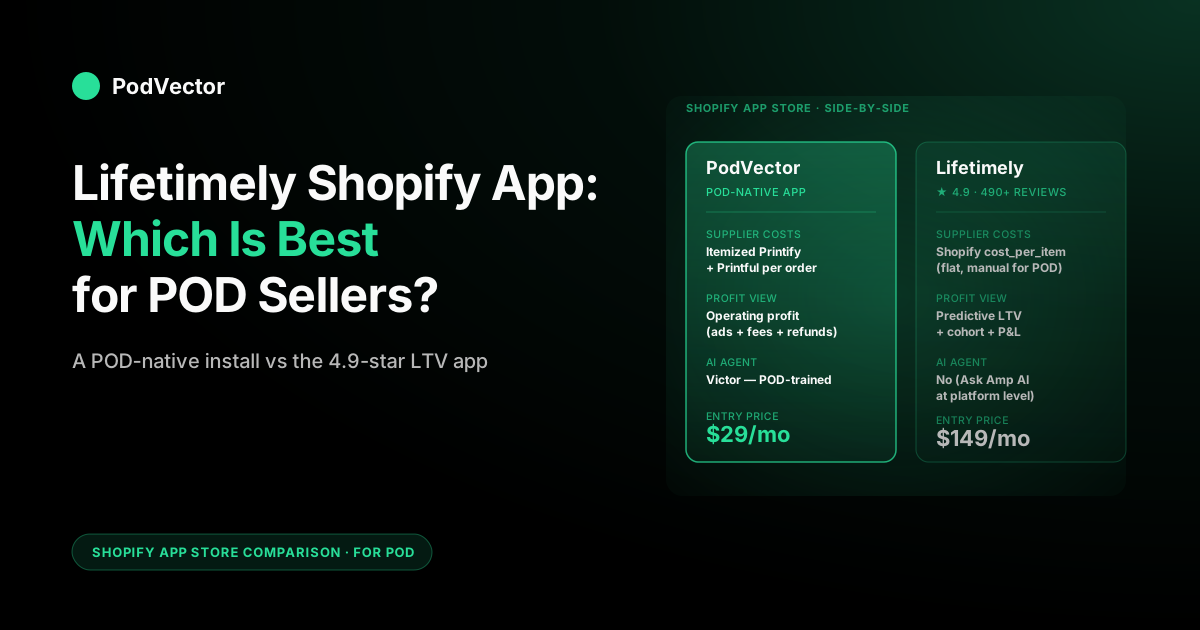
If you're evaluating the Lifetimely Shopify App against alternatives, PodVector AI is the closest POD-native option — itemized supplier line items, an AI employee (Victor) trained on POD economics, $29/mo entry. Lifetimely's new Profit Agent and Victor are both AI employees, but they're built on different data: Lifetimely's reasons over Shopify-only numbers, Victor over your actual Printify and Printful line items. Below: how the App Store install really works, where it wins, where it loses for POD, and how to choose.
What the Lifetimely Shopify App actually is
Lifetimely — now listed as "Lifetimely Profit Agent & LTV" — is a Shopify-native app distributed through the Shopify App Store. It's not a separate SaaS that bolts onto Shopify with embed codes — it's installed inside Shopify, runs against Shopify's order and product data, and is uninstalled like any other Shopify app.
The app sits in two App Store categories: Operations (rank ~36 of 490) and Analytics (rank ~34 of 1,019). The pitch on the listing is "true profit visibility — not just revenue." That's the framing that drives the rating: Shopify operators who have outgrown spreadsheets and want a unified P&L view without paying for enterprise BI.
Lifetimely was acquired by AMP in 2023. The App Store listing has since been rebranded to "Lifetimely Profit Agent & LTV" to foreground its new AI Profit Agent, and the parent company also distributes Back in Stock, Slide Cart, and Bundles under the same umbrella. Read more about the parent platform in our Lifetimely by AMP for POD sellers writeup.
The core surface gives you a real-time P&L, predictive customer lifetime value (LTV) modeling, cohort analysis, and customer-acquisition-cost (CAC) reporting. The newer Profit Agent layers an AI assistant on top that monitors net profit, P&L, and margins around the clock and pushes alerts and forecasts to Slack. Revenue comes from Shopify, ad spend from Meta, Google, and TikTok, and unit costs from each Shopify product variant.
The App Store install flow
The Lifetimely Shopify App install is the standard Shopify App Store flow. Three things happen when you click Add app on the listing.
1. Permissions and historical backfill
Lifetimely requests read access to your Shopify orders, products, customers, and a handful of related resources. After approval, it backfills your full order history.
Most stores under 50K lifetime orders complete the backfill in under an hour. Larger stores can take a day or two. You can keep using the app while the backfill runs — just don't trust the cohort or LTV reports until it finishes.
2. Cost field setup
This is the step that quietly defines whether your margin numbers are right or wrong. Lifetimely reads the cost_per_item field on each Shopify product variant.
If that field is empty (and on most stores it is), every order shows 100% gross margin until you fill it in. For a brand with stable SKU costs, this is a one-time spreadsheet upload and you're done.
For a Printify or Printful catalog, this is where the Shopify App architecture starts to fight you. Supplier cost varies per order in ways a single Shopify field can't capture — we'll come back to this in the gaps section.
3. Ad-platform connections
You connect Meta, Google, TikTok, and (on paid tiers) Amazon as ad-spend sources. Lifetimely pulls daily spend by campaign and overlays it on your P&L.
Klaviyo and QuickBooks integrations are available too if you want email and accounting context in the same dashboard. Total install time is usually 15–30 minutes including ad auth — that's the main reason the App Store reviews are as good as they are.
Lifetimely Shopify App vs alternatives for POD
| Shopify App | POD supplier accuracy | Best for | Entry price | AI agent |
|---|---|---|---|---|
| Lifetimely (by AMP) | Reads Shopify cost_per_item; no native Printify or Printful supplier-cost ingestion |
Sub-$1M Shopify DTC focused on LTV and cohorts | Free / $79+ tiered | Yes — Profit Agent (general-DTC, Shopify-only data) |
| PodVector AI | Itemized Printify + Printful supplier line items per order | Shopify POD sellers (Printify / Printful) | $29/mo | Yes — Victor (POD-trained agent) |
| Triple Whale | Itemized but DTC-modeled; POD line items via custom mapping | $2M+ Shopify DTC, creative-heavy ad operators | $129/mo | Yes (Moby) |
| Polar Analytics | Flat or category COGS by default; itemized requires custom modeling | $3M+ Shopify brands, agencies, multi-channel | ~$400/mo | Yes (Polar AI Assistant) |
| BeProfit | Manual COGS mapping; no native POD integrations | General Shopify P&L beginners | $25/mo | No |
| TrueProfit | Itemized (Printify + Printful supported since 2024) | Multi-channel Shopify DTC with some POD | $35/mo | Limited |
For the full apples-to-apples scoring across every major Shopify profit app, see our PodVector AI vs competitors complete POD profit comparison. The summary above is the slice that matters when you're specifically weighing the Lifetimely Shopify App as your install.
Where the Lifetimely Shopify App wins
The reasons for the 4.8-star App Store rating are real. Four things the Lifetimely Shopify App does well, worth knowing before you pick anything else.
One-click install on Shopify Checkout
The Lifetimely Shopify App is verified Shopify Checkout-compatible. That means it works on Shopify Checkout Extensibility (the new architecture replacing checkout.liquid) without breaking, and the order data it reads matches what Shopify Plus stores see in their reporting.
For Plus stores, that consistency matters. Time-to-first-useful-P&L is usually same-day, and most operators have a working dashboard within an hour of install.
Predictive LTV directly off Shopify orders
Lifetimely's flagship feature is its predictive lifetime-value model. It reads your Shopify customer and order history, fits a cohort curve, and projects 30-day, 60-day, 90-day, and 12-month LTV for any segment.
That matters when you're deciding how aggressively to spend on customer acquisition. If your projected 90-day LTV on Meta-acquired customers is $48 and your blended CAC is $32, you have $16 of acquisition headroom on that channel.
For Shopify brands with strong repeat-purchase economics — supplements, skincare, food and bev — this view is differentiated. It's the single feature most Shopify App Store reviews mention by name.
Real-time P&L without leaving Shopify admin
Lifetimely's P&L combines Shopify revenue, ad-platform spend, Shopify product costs, fees, refunds, and shipping into a daily, weekly, or monthly net profit view. For a Shopify operator who has been living in spreadsheets, this is a meaningful upgrade.
It's the same architectural pattern most modern Shopify profit apps use — clean, fast, and good enough for a non-POD store with stable SKU costs. The dashboard renders inside Shopify admin, so you don't context-switch to a separate tool.
Cohort analysis without CSV exports
The cohort builder lets you slice by acquisition channel, first product purchased, discount used, geography, and other Shopify-order attributes. You can watch cohorts age in a clean grid view without exporting CSVs into a spreadsheet.
For Shopify operators trying to answer "do customers acquired through Meta repurchase at the same rate as Google customers?", this is the daily working surface. Our CAC vs LTV model for Shopify Facebook Ads piece walks through how POD operators should read these numbers.
Where the Lifetimely Shopify App falls short for POD
Lifetimely is a strong Shopify App for general DTC. POD-on-Shopify has structural quirks that the Shopify-app-only architecture wasn't built around. Four gaps matter most.
1. Shopify cost_per_item doesn't match POD reality
Lifetimely's COGS comes from one Shopify field per variant: cost_per_item. That works when your unit cost is stable — your hoodie costs $14, you mark it up, you sell.
POD doesn't work that way. A Printify hoodie has a different base cost depending on the print provider, garment color, print size, ship-to country, and whether you have Printify Premium discounts active. Two orders for the same Shopify variant on the same day can have base costs that differ by $4–$8.
If you set cost_per_item to a flat number, Lifetimely's margin readings drift 8–22% from reality on any given day. The gap is invisible until you reconcile against a Printify invoice — at which point you've already made bad ad-spend decisions on the basis of fictional margin. We dig deeper in the complete guide to Printify costs, fees, and discounts.
2. Bundled supplier shipping isn't modeled
Standard Shopify-plus-3PL setups treat shipping as a separate line: customer pays you, you pay your 3PL. Lifetimely models it that way — correct for general DTC.
POD is different. Printify, Printful, Gelato, and Gooten charge shipping bundled with the per-order fulfillment line. Garment cost and shipping come from the same supplier API call and need to be tracked together to get accurate per-order margin.
The Lifetimely Shopify App's separation makes its POD gross-margin numbers consistently optimistic until you reverse the math by hand. Most operators either eat the inaccuracy or build a side spreadsheet to correct it.
3. The Shopify-only data ceiling
Lifetimely's architecture treats Shopify as the single source of truth. That's a feature for general DTC and a limitation for POD.
The data you actually need to manage POD margin lives in two places: Shopify (orders, customers) and the supplier (Printify/Printful order fulfillments, line-item cost, supplier shipping, premium-tier discounts). A Shopify-only app can only see half of that picture.
You can paper over the gap with manual exports, but it doesn't scale past a few hundred orders a month. By the time you're at 1,000+ Printify orders, you're either tolerating wrong P&L or running a parallel spreadsheet to fix it.
4. The Profit Agent isn't trained on POD economics
Lifetimely now ships an AI Profit Agent — it monitors net profit, P&L, and margins 24/7, surfaces opportunities and risks, and pushes alerts to Slack for your approval. That's a real upgrade for general DTC. The catch for POD is the data underneath it: the Profit Agent reasons over the same Shopify-only numbers as the rest of the app, so it inherits the same supplier-cost blind spot described above.
Ask it "is my Printify Premium subscription paying for itself on the SKUs I shipped this month?" and it doesn't have the context — it never sees the Printify line items, supplier shipping, or premium-tier discounts that the answer depends on. An AI agent's quality is a function of the data it sees and the metrics it's been taught, and an agent fed flat cost_per_item margins will confidently reason from numbers that are 8–22% off for POD. Our AI agents for ecommerce analytics overview covers what's shipped versus roadmap across every major player.
Lifetimely Shopify App pricing tiers
The Lifetimely Shopify App lists order-volume-tiered pricing on the App Store. Current structure as of June 2026:
- Free. Up to 50 orders/month. Daily P&L, customer analytics, custom reports, and predictive LTV modeling. Useful as a trial or for very small stores.
- S — $79/month. Up to 500 orders. The newest tier — full P&L and ad-spend integrations at a lower entry point than the old $149 floor.
- M — $149/month. Up to 3,000 orders. Full P&L, ad-spend integrations (Meta, Google, TikTok), LTV reports, live chat support.
- L — $299/month. Up to 7,000 orders. Adds dedicated Slack channel, custom 1:1 onboarding, monthly profit reporting.
- XL — $499/month. Up to 15,000 orders. Adds dedicated account manager. Marked "Most Popular" on the App Store listing.
- XXL — $749/month. Up to 25,000 orders.
- Unlimited — $999/month. No order cap.
- Amazon add-on. +$75/month for Shopify stores selling on Amazon too.
- 14-day free trial on all paid plans.
The economics are blunt: at 600 orders/month you're paying $149, and at 2,900 orders/month you're still paying $149. The new $79 S tier helps the very small stores, but order-tier pricing still rewards stores that scale within a band and punishes stores that creep just over a threshold.
For a POD-specific tier-by-tier breakdown, the math lives in our Lifetimely pricing breakdown for POD sellers.
PodVector AI: the POD-native Shopify App alternative
PodVector AI is a Shopify app built for one thing: Shopify POD sellers running Printify and Printful. The architecture choices reflect that focus, and most of them are responses to the gaps Lifetimely's general-DTC model can't close.
Itemized supplier costs as a first-class concept
Every Printify and Printful order line item flows into PodVector AI with the actual supplier-charged base cost, supplier shipping, and any premium-tier discounts applied. No flat cost_per_item mapping, no spreadsheet reconciliation, no quarterly "why is my margin wrong?" investigation.
That's the difference between a Shopify P&L that says "42% gross margin" and one that says "42% gross margin — calculated from your actual 1,247 Printify line items this month, with $312 in Printify Premium savings already netted out."
Operating profit, not just gross profit
Most Shopify profit apps stop at gross. PodVector AI includes ad spend (Meta and Google), Shopify payment processing, app subscriptions, refunds, and chargebacks in the operating P&L by default.
That matters in POD because contribution margin is thin. A 25% gross margin shrinks to a 6% operating margin once you net out ads and fees — and 6% is the number you actually need to see when deciding whether to scale a campaign. The full mechanics live in the complete guide to profit tracking for Shopify POD stores.
Victor: agentic AI employee for POD inside the Shopify app
Victor is the AI employee built into PodVector AI. Today, you ask Victor questions in plain English — "which Printify SKUs lost money on Meta last week?" — and get a real answer pulled from your live data warehouse.
Victor is an AI employee: he answers your business questions and acts on them with your approval. Catching a Printify supplier price change at 3 a.m., cross-checking against your average Meta CPA on that SKU, and surfacing which three listings to pause before the morning. The architecture is built for that from day one.
Lifetimely's Profit Agent does the same shape of work — monitor, alert, recommend — but on Shopify-only data. The difference isn't whether there's an agent; it's what the agent can see. Victor reasons over your actual itemized Printify and Printful line items, so a Printify base-cost change or a premium-discount shift shows up in his reasoning. A Shopify-only agent never sees that layer, so its margin alerts inherit the same drift as the flat cost_per_item it reads from.
POD-priced
PodVector AI starts at $29/month. That undercuts the Lifetimely Shopify App's first paid tier ($149/mo) by a wide margin, and the gap holds at higher order volumes — Lifetimely's $299 tier corresponds to PodVector AI's $59 tier in our pricing structure.
The live data layer that powers Victor uses the same architectural pattern as the major DTC analytics platforms — just sized and priced for POD economics rather than enterprise DTC.
Other Shopify Apps in this category
If neither Lifetimely nor PodVector AI fits your store, the Shopify App Store has a few other reasonable picks. Each solves a slightly different problem.
Triple Whale
Triple Whale is the multi-channel attribution Shopify App for ad-heavy DTC operators. Its creative reporting and Moby AI assistant are useful if you're running high-volume Meta tests.
For POD, it has the same itemized-supplier-cost limitation as Polar — you can map costs by category, but Printify and Printful per-variant accuracy needs custom work. Pricing starts at $129/month and climbs.
Polar Analytics
Polar is the warehouse-native BI option for $3M+ Shopify brands. The architecture is excellent and the AI assistant is well-built. But the entry price ($400+/mo) is structurally above what most POD operators can justify, and the supplier-cost gap is the same as Lifetimely's. Full breakdown in our Polar Analytics for Shopify POD comparison.
BeProfit
BeProfit is the budget Shopify P&L app — cheaper than Lifetimely, lighter on features, and missing native POD integrations entirely. It works as a starter tool if you're under $5K/month in revenue and just need rough margin visibility. Trade-offs in our BeProfit for POD sellers comparison.
TrueProfit
TrueProfit added native Printify and Printful support in 2024, putting it in the small group of Shopify apps that actually ingest POD supplier line items. Pricing is comparable to PodVector AI at the entry tier but climbs faster as you add stores and supplier integrations.
For the broader sibling article without the Shopify App framing, see our Lifetimely Shopify for POD sellers piece. The general Lifetimely overview is in our Lifetimely for POD sellers comparison.
How to decide which Shopify App to install
The right Shopify profit app depends less on your absolute revenue and more on what your bottleneck actually is. A practical framework:
Under $20K/month: Lifetimely Free or PodVector AI $29
At this stage you need cheap, fast, and right-enough. The Lifetimely Shopify App's free tier (up to 50 orders/month) gives you a clean Shopify P&L. PodVector AI's entry tier gives you POD-accurate supplier costs from the first order.
If your variant cost variance is small (single Printify provider, few colors, mostly domestic shipping), Lifetimely Free can carry you through the early months. If your catalog is broader, the supplier-cost gap will start to matter and PodVector AI pays for itself in better scaling decisions.
$20K–$200K/month, single-channel POD on Shopify: PodVector AI
This is the sweet spot for POD-native tools. You need accurate per-order supplier costs, operating profit (not just gross), and ad-spend integration with Meta or Google.
You're past the order ceiling on the Lifetimely free tier, which means the next step is the $79 S tier (or $149 once you clear 500 orders) — and at that price, you're paying for LTV features that POD doesn't lean on. PodVector AI's $29–$129 tiers cover the work that actually shifts your scaling decisions, and Victor handles the "what changed and why" question — reasoning over your real supplier line items rather than Shopify-only numbers.
$200K–$1M/month, retention-driven POD: install both
If you've built a POD brand on Shopify with genuine repeat-purchase dynamics (loyalty programs, club merch, subscriber-printed items), Lifetimely's LTV cohort layer starts to earn its $299/mo tier.
The supplier-cost gap remains. The honest answer for many brands at this stage is "PodVector AI for the POD margin truth, plus Lifetimely L for the LTV cohort layer" — two specialized Shopify apps is often cheaper and more accurate than one platform that does both jobs poorly.
$1M+/month: warehouse-native + Shopify POD layer
At this scale, you'll likely want a managed warehouse you can extend with custom models — Polar Analytics or a custom Snowflake, Redshift, or Databricks setup. The Lifetimely Shopify App caps at $999/month for unlimited orders, which sounds high but is actually below where most $1M+ DTC brands end up on a real BI platform.
Even at this stage, many POD-focused Shopify brands keep PodVector AI running alongside the warehouse specifically for the daily POD margin view. Building and maintaining a POD line-item model on top of a general BI tool isn't trivial. Our PodVector AI resource hub collects the deeper writeups on each of these stages.
FAQs
Is the Lifetimely Shopify App free?
There's a free tier — up to 50 orders/month with daily P&L, customer analytics, custom reports, and predictive LTV. Above that, paid tiers start at $79/month (S, up to 500 orders) and scale by order volume. There's a 14-day free trial on the paid plans.
Does the Lifetimely Shopify App support Printify and Printful?
It can read Printify and Printful order data through Shopify (since both supplier apps sync orders into Shopify), but it doesn't model the supplier line items as a first-class POD cost. Per-variant supplier cost and bundled supplier shipping require manual mapping or a side spreadsheet.
How accurate is the Lifetimely Shopify App P&L for POD stores?
Accuracy is bounded by your Shopify cost_per_item field — usually within 8–22% of real per-order Printify or Printful cost on a typical POD catalog with variant-level cost variance. For a stable-cost DTC catalog, accuracy is much higher.
Is the Lifetimely Shopify App compatible with Shopify Plus?
Yes. It's built for Shopify and Shopify Plus, and it's compatible with Shopify Checkout Extensibility. Plus stores get the same product but typically end up on the higher-volume tiers ($499–$999/mo).
What's the best Lifetimely Shopify App alternative for POD?
For Shopify POD sellers running Printify or Printful, PodVector AI is the most direct alternative — itemized supplier costs, operating-margin visibility, and an AI employee (Victor) trained on POD economics, priced from $29/month. TrueProfit is a reasonable second choice if you want broader DTC coverage with some POD line-item support.
Does the Lifetimely Shopify App have an AI agent built in?
Yes — as of 2026 it ships an AI Profit Agent that monitors net profit, P&L, and margins 24/7 and pushes alerts and recommendations to Slack. It's a general-DTC agent, though: it reasons over Shopify-only data, so it doesn't see Printify or Printful supplier line items and inherits the same POD margin inaccuracy as the rest of the app.
Does the Lifetimely Shopify App work outside Shopify?
No. It's Shopify-only (plus an Amazon add-on for Shopify stores that also sell on Amazon). It doesn't support WooCommerce, BigCommerce, Magento, or other ecommerce platforms.
How long does the Lifetimely Shopify App take to install?
Install and basic setup is 15–30 minutes including ad-platform auth. Full historical data backfill takes anywhere from an hour (small stores) to a day or two (50K+ lifetime orders). Time-to-first-useful-P&L is usually same-day.
POD margin truth — installed as a Shopify App, built for POD
The Lifetimely Shopify App is a strong general-DTC pick. PodVector AI is the POD-native alternative — installed the same way, but built around itemized Printify and Printful line items, operating profit, and an AI employee (Victor) trained on POD economics. Start free.
Try Victor free