
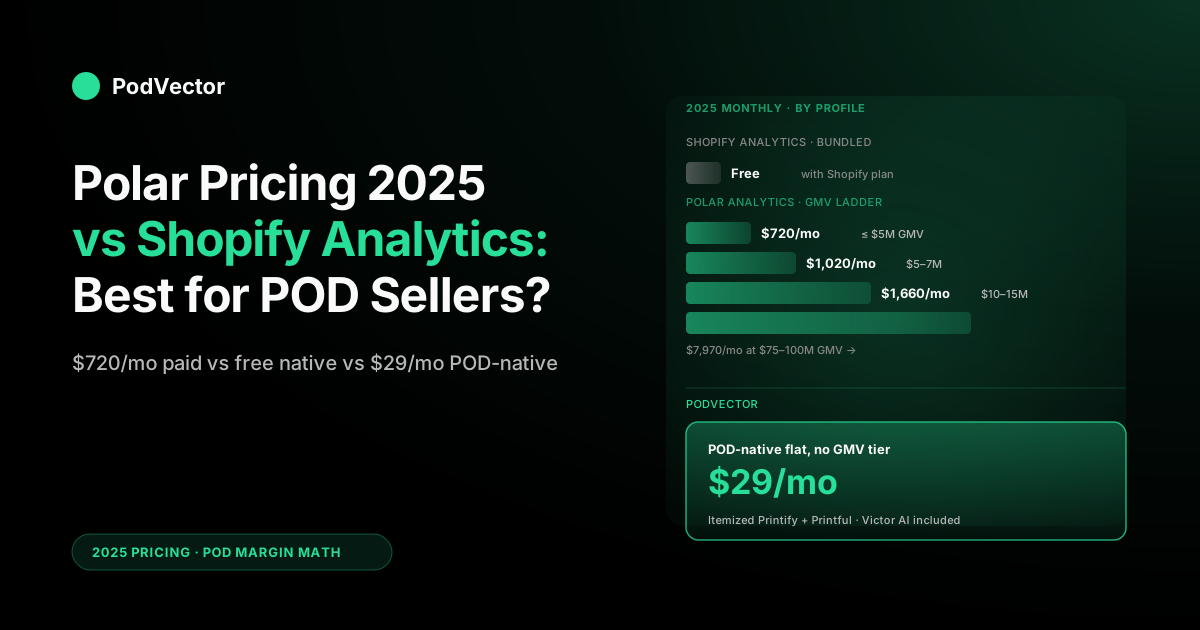
Quick Answer: In 2025, Polar Analytics charges from $720/month at $5M GMV up to $7,970/month at $75–100M GMV. The native Shopify Analytics dashboards inside admin are free on every Shopify plan.
For most Print-on-Demand stores, that price gap is the entire decision. Which is best? Under ~$2M GMV, free Shopify Analytics wins on price. Above $5M GMV with heavy cross-channel ad spend, Polar's attribution earns its four-figure floor.
Polar gives you cross-channel attribution, AI agents, and a customer-accessible data warehouse. Shopify Analytics gives you orders, sessions, and channel reports — and stops well before the question "did this Printify SKU actually net a profit after ad spend?"
Neither tool models Printify or Printful supplier costs at the SKU level. PodVector AI starts at $29/month flat, ships Victor (an AI employee) on every tier, and itemizes every supplier cost. Below is the full 2025 pricing comparison, what each side actually covers, and how to decide for a POD store.
Why "$720/month vs free" is the wrong way to read this
The price gap between Polar and Shopify Analytics is large enough that most POD operators stop reading right there. That's a mistake in both directions.
Free isn't free if it leaves you guessing whether your Facebook ad spend actually made money. And $720/month isn't expensive if it pays back ten times over by killing a campaign that was secretly losing $30 per order.
The right question isn't "which is cheaper." The right question is: at your stage, with your supplier costs, what does each tool actually surface — and what does it hide? That's what this comparison answers.
For the broader Polar evaluation across all features and tiers, the Polar Analytics pricing breakdown for POD sellers covers the whole ladder. This article focuses on the 2025 numbers head-to-head against Shopify's free reports.
Polar Analytics pricing in 2025: the full ladder
Polar's 2025 pricing isn't published as a flat sticker. It's a GMV-tiered ladder where the rate scales with your annual Shopify revenue. The Shopify App Store listing shows a $750/month "Popular" floor (still carrying a 4.8-star rating as of July 2026); the real number you pay depends on which tier your GMV puts you in.
Here's the public 2025 ladder, reconstructed from Polar's own pricing pages and the third-party breakdowns ranking on this query:
| Annual Shopify GMV | Polar Core (monthly) | Implied % of GMV |
|---|---|---|
| ≤ $5M | $720 | ≥ 0.17% |
| $5–7M | $1,020 | ~0.20% |
| $10–15M | $1,660 | ~0.16% |
| $20–25M | $2,770 | ~0.15% |
| $75–100M | $7,970 | ~0.11% |
Three things to notice. First, the entry price is $720/month — there is no smaller Polar plan. Second, the percentage of GMV stays in a narrow band (0.11% to 0.20%), which is how GMV-tiered SaaS is supposed to work but isn't how most POD operators think about cost. Third, annual prepay typically knocks 15–20% off, so the "real" 2025 price for a brand committing to a year is closer to $600–$650 at the entry tier.
Polar's current packaging condenses to two plans on its pricing page: Core ("the essential data stack") and Custom ("a customizable product stack"). Core bundles Business Intelligence dashboards, the Polar AI agents, Data Activations, the Snowflake-backed data warehouse, and the ecommerce semantic layer — with unlimited users, unlimited historical data, and a dedicated Success Manager on every tier. Custom layers in Incrementality Testing and the Polar Headless MCP — the connector that lets an outside AI assistant query your Polar data — on top of Core. Choosing Core nets a stated ~20% discount versus buying the modules individually.
Polar also sells those modules à la carte for brands that only need a slice: Incrementality Testing priced per test (with quarterly testing available), Klaviyo Audiences and Advertising Signals quoted separately, and the Polar Headless MCP priced off your annual Klaviyo revenue rather than GMV. The one constant across every 2025–2026 quote: there is no self-serve free tier on the core analytics product, every price is "book a demo" rather than published sticker, and the base rate is GMV-indexed rather than seat- or feature-indexed. That GMV-tiered shape isn't unique to Polar — Triple Whale and Conjura price the same way, which is why most "Polar alternatives" roundups end up comparing four-figure monthly floors rather than the supplier-cost question a POD store actually needs answered.
For a clean look at how Polar's 2025 pricing reads against the rest of the Shopify analytics market, the Polar Analytics Shopify pricing analysis walks the same ladder against multi-store and connector math.
Shopify Analytics pricing in 2025: free, but with limits
"Shopify Analytics" isn't one product — it's a set of report families baked into the Shopify admin. The pricing model in 2025 is that you get a different tier of these reports depending on your Shopify subscription.
The structure has barely moved in years:
| Shopify plan | 2025 monthly | Analytics access |
|---|---|---|
| Basic | $39 | Overview dashboard, finance summary, Live View, basic reports |
| Shopify (mid) | $105 | Above + full standard reports library |
| Advanced | $399 | Above + custom reports, ShopifyQL Notebooks |
| Plus | $2,300+ | Above + advanced custom reports, multi-store reporting |
"Free" here is shorthand. You're already paying for Shopify itself; the reports are bundled. There is no separate Shopify Analytics SKU you can buy or skip.
The practical 2025 read: a POD store on the Basic plan ($39/month) has dashboards covering sessions, conversion rate, sales by channel, sales by product, returning customer rate, and a finance summary. A store on Shopify ($105/month) gets the full standard report library — including marketing attribution reports, behavior reports, and inventory snapshots.
Custom reports — the kind where you write a query against your store's data instead of clicking pre-built filters — only unlock on Advanced ($399/month) and Plus ($2,300+/month). That's the line where "free" Shopify Analytics stops being meaningfully analytical.
What Shopify Analytics actually covers in 2025
Don't underestimate what's in the box. For a Shopify store running mostly first-party traffic and a couple of ad channels, the native reports get you further than most operators realize.
Acquisition. Sessions by source, sessions by referrer, sessions by location, top landing pages, and a basic UTM breakdown. You can answer "where did my visitors come from" without leaving Shopify admin.
Conversion. Conversion rate by device, by source, by landing page. Cart abandonment metrics. Returning vs first-time customer rates. The Live View dashboard shows real-time visitor activity and orders.
Sales. Sales by product, by variant, by SKU, by collection, by channel, by traffic source. Average order value, units per transaction, refund rate. The reports go down to per-SKU detail at the click level.
Customers. First-time vs returning, by location, by behavior cohort, by acquisition source. Customer count growth over time.
Finances. Gross sales, returns, net sales, taxes, shipping, total sales. Payments by gateway. The finance summary feeds straight into accounting workflows.
Custom reports (Advanced and Plus only). ShopifyQL Notebooks let you write queries against your Shopify data, save them, and chart the results. This is the closest Shopify Analytics gets to a real BI surface.
For POD specifically, the Sales by Product report is the workhorse. It tells you which Printify or Printful designs are moving — but, and this matters, it tells you in revenue, not profit.
What Polar covers that Shopify Analytics doesn't
The honest answer is: a lot, if you're running cross-channel paid traffic. The honest follow-up is: most of what Polar adds is geared at brands spending $20K+/month on ads.
Cross-channel attribution. Polar's Pixel runs server-side and stitches sessions across Facebook, Google, TikTok, and Klaviyo into a unified attribution view. Shopify Analytics will tell you a sale came from "facebook.com / referral" — Polar will tell you it came from a specific Meta ad set, that the customer first touched a TikTok creator post, and that an email three days earlier did the assist.
Custom dashboards across 100+ connectors. Polar pulls from Meta, Google, TikTok, Klaviyo, ShipStation, Recharge, and dozens more — all into one workspace where you build dashboards once. Shopify Analytics shows Shopify data only. One gap worth flagging if you sell on Amazon: as of mid-2026 Polar still has no native Amazon Ads connector, so Amazon spend has to be modeled outside the platform — a limitation the third-party pricing breakdowns ranking on this query call out directly.
AI agents. Polar ships purpose-built agents for data analysis ("Ask Polar"), media buying (campaign optimization suggestions), email marketing, and inventory planning. Shopify's native AI is Sidekick, which mostly answers store-admin questions, not analytical ones.
AI assistant access via MCP. Polar ships the Polar Headless MCP (Model Context Protocol — the standard that lets an outside AI assistant pull a tool's data) so you can ask Claude, ChatGPT, or an n8n automation questions against your Polar dataset. Polar positions it as a "governed data layer your AI agents can trust" — 400+ pre-built ecommerce metrics across 40+ connectors, refreshed roughly every 15 minutes, so an outside model queries one consistent semantic layer instead of raw, unjoined platform exports. Shopify Analytics has no equivalent open hook into its reports.
Incrementality testing. Polar's 2026 packaging adds Incrementality Testing — geo and holdout experiments that measure the true lift of a channel rather than its last-click attribution. Polar's current pricing page bundles a dedicated data scientist to run the lift tests across Meta, Google, TikTok, or TV. It's a Custom-plan/add-on module priced per test, aimed at brands big enough to run controlled spend experiments. Shopify Analytics has nothing comparable.
A customer-accessible data warehouse. Polar provisions every customer a dedicated Snowflake warehouse with SQL access to their unified dataset — useful for analysts who want to write custom queries Polar's UI doesn't expose. Shopify Analytics has ShopifyQL Notebooks but only on Advanced/Plus, and only against Shopify-native data.
Activation features. Polar pushes enriched audiences back to Klaviyo and ad platforms for retargeting. The Polar Pixel also feeds first-party data into Conversion APIs to recover signal lost to iOS privacy changes.
None of these are tricks. They're real features that real DTC brands at $5M+ pay for and use. The question isn't whether they're valuable — it's whether they're valuable at your stage, with your POD margin profile.
POD margin reality: where both tools break
Neither Polar Analytics nor Shopify Analytics models Printify or Printful supplier costs at the SKU level. This is the structural problem nobody in the SERP for this query addresses.
POD margin math runs differently from a typical Shopify DTC brand. A $30 t-shirt sold through Printify might have a $10 base cost from the supplier, $4 in shipping, $1.20 in Shopify transaction fees, and a $0.50 platform fee. That's $14.30 per unit before ad spend. Net contribution is $15.70 per order, or ~52% — and that's before customer acquisition cost.
Now layer ads. If Meta CPA on that hoodie is $18, the order is unprofitable by $2.30. Neither Shopify Analytics nor Polar will tell you this without manual cost modeling.
What Shopify Analytics shows you: the sale happened, AOV is $30, conversion rate is 2.4%. Looks healthy. Nothing about the $14.30 you paid Printify.
What Polar shows you: the sale happened, attribution says it was a TikTok ad, Meta-attributed ROAS is 1.7. Looks healthy. You can manually upload a "cost of goods" CSV per SKU and Polar will use it — but maintaining that file as Printify pricing changes (which it does, monthly) is its own job.
The structural gap is the same in both: neither tool ingests Printify/Printful's actual line-item cost feeds. Both expect you to maintain the cost model.
For POD specifically, that gap is the difference between "this design is a winner" and "this design is a winner net of supplier cost, shipping, and ad spend." The same SKU can be both, depending on how you measure.
Three POD-stage cost scenarios
Numbers make the trade-off concrete. Here are three POD profiles a typical operator might be running in 2025.
Scenario A: Side-hustle store, $250K GMV/year
Shopify Basic plan: $39/month. You get the standard reports — Sales by Product, conversion rate, sessions by source. For a store with one or two ad channels, that's enough to see what's selling.
Polar Analytics at $720/month would consume 3.5% of your GMV — and your operating margin probably runs 12–18% of GMV after Printify costs. Polar would eat 20–30% of your profit. The features don't pay back at this scale.
Verdict: Shopify Analytics is the right tool here. The supplier-cost gap remains, but a $39/month tool can leave that gap; a $720/month tool that leaves the same gap can't justify the price.
Scenario B: Growing store, $2M GMV/year
Shopify on the standard plan: $105/month. You're now running paid social, Google, maybe Klaviyo, possibly TikTok. Shopify Analytics shows the per-channel revenue but not blended attribution; cross-channel ROAS becomes guesswork.
Polar at $720/month is 0.43% of GMV. If your operating margin is 15%, Polar takes ~3% of profit. Defensible if cross-channel attribution actually changes a buying decision — costly if you're not yet making decisions Polar would unlock.
Verdict: The tipping point. If you're spending $15K+/month on ads across three or more channels, Polar's attribution starts paying for itself. If you're not, you're paying for capability you won't use.
Scenario C: Established brand, $8M GMV/year
Shopify Advanced: $399/month. Now ShopifyQL Notebooks and custom reports are available, but you're still inside the Shopify data island.
Polar at $1,020/month is 0.15% of GMV. If you're spending $80K/month on ads, the cross-channel attribution and AI Media Buyer agent absolutely justify the price. This is Polar's design profile.
Verdict: Polar makes sense. The supplier-cost gap still hurts — Printify/Printful invoicing detail still has to be modeled by hand — but the attribution gain dominates.
PodVector AI: the POD-native third option
The reason this comparison usually ends in "neither" for POD is the supplier-cost layer. Polar models marketing data well; Shopify Analytics models Shopify data well. Neither models Printify or Printful's actual line-item costs.
PodVector AI starts at $29/month flat — no GMV ladder. The architecture difference matters: instead of bolting cost data on as an afterthought, PodVector AI ingests Printify and Printful supplier invoices directly, joins them to Shopify orders at the SKU level, and stores the unified record in a live data warehouse you can query.
That means per-SKU profit isn't a CSV upload you have to maintain. It's a column on every order, every day, automatically. You can see "this Printify hoodie design generated $4,200 in revenue, $1,710 in supplier cost, $140 in shipping, $890 in ad-attributed cost — net $1,460" without writing a query.
Layered on top: Victor, the AI employee, included on every tier. Victor speaks SQL against your live warehouse, so when you ask "what was my Printify margin by design last week," the answer is computed from current data, not a stale weekly export. Victor answers questions and acts on those answers — with your approval — pausing underperforming campaigns, flagging SKUs where Printify pricing changes erode margin, and so on.
For POD specifically, PodVector AI also covers what Shopify Analytics covers (sessions, conversion, channel revenue) and the parts of Polar most POD stores actually use (cross-channel ad attribution, simple BI dashboards). The trade-off: PodVector AI doesn't ship Polar's depth in features like the Email Marketer AI agent or Klaviyo Audiences activation. If those are core to your stack, Polar wins on capability.
For the deeper PodVector AI vs Polar comparison across feature sets, see the Polar Analytics features for POD sellers walkthrough or the PodVector AI vs competitors comparison for POD margin.
Decision matrix: which tool fits your POD store
Three questions answer this in under a minute.
| Your situation | Best fit | Why |
|---|---|---|
| POD store under $1M GMV, 1–2 ad channels | Shopify Analytics + a POD profit tool | Polar's $720/month floor is too steep at this stage; Shopify reports cover most of the volume needs |
| POD store $2–5M GMV, cross-channel paid | PodVector AI or Polar (lean toward POD-native if margin is tight) | Cross-channel attribution starts paying back; supplier-cost itemization decides which side |
| POD brand $5M+ GMV, complex stack with Klaviyo/TikTok/Meta | Polar Analytics | The $1,000+/month becomes affordable as % of GMV, and Polar's feature breadth pays back |
| POD store of any size where every dollar of supplier cost matters | PodVector AI | Itemized Printify/Printful integration is the architectural difference; not a feature toggle elsewhere |
The shortest version: if your bottleneck is "I'm spending real money on ads and don't know what's converting," Polar earns its price at the right scale. If your bottleneck is "I sell through Printify/Printful and can't trust my margin numbers," neither Shopify Analytics nor Polar solves it on their own.
FAQs
Is Polar Analytics worth $720/month for a POD store?
Below ~$2M GMV, usually no — the price as a percentage of POD operating profit is too high. Above $5M GMV with serious paid spend across three or more channels, the cross-channel attribution and AI agents typically justify the cost. The decisive variable is ad spend, not GMV.
Can Shopify Analytics replace Polar for a POD store?
For a sub-$1M POD store running one or two ad channels, mostly yes. The native dashboards cover acquisition, conversion, and per-SKU sales. What Shopify Analytics can't replace is cross-channel attribution stitching — once you're spending serious money on Meta + Google + TikTok, you'll feel the gap.
Why doesn't Polar Analytics or Shopify Analytics handle Printify costs natively?
Both tools were designed for general Shopify DTC, not Print-on-Demand specifically. Printify and Printful invoice at the line-item level with prices that change frequently — modeling those costs in a way that's accurate at the SKU level requires direct supplier integration, which neither Polar nor Shopify Analytics ships.
What's the cheapest 2025 path to real POD profit visibility?
Shopify Basic ($39/month) for the dashboards plus a POD-native cost-tracking tool. PodVector AI at $29/month adds itemized Printify/Printful supplier costs and an AI employee on top of what Shopify already shows. Combined cost: under $70/month.
Does Polar Analytics offer a free trial in 2025?
Polar offers a free demo and onboarding consultation but not a self-serve free trial. The minimum commitment is the Core plan; plans are billed monthly through Shopify, with annual prepay discounts of roughly 15–20%.
Can I use Polar Analytics and Shopify Analytics together?
Yes. Polar reads from Shopify as a data source, so the underlying Shopify data is the same in both. Most Polar customers keep Shopify Analytics open for store-admin tasks (refunds, inventory snapshots) and use Polar for the cross-channel reporting Shopify can't do.
Try Victor — the AI employee built for POD margin reality
Polar Analytics is built for $5M+ Shopify DTC brands. Shopify Analytics is built for general Shopify reporting. Neither is built for Printify and Printful supplier-cost reality at the SKU level.
PodVector AI is. Itemized supplier costs, live data warehouse, Victor included on every plan. Starts at $29/month, flat — no GMV ladder.
Try Victor free