
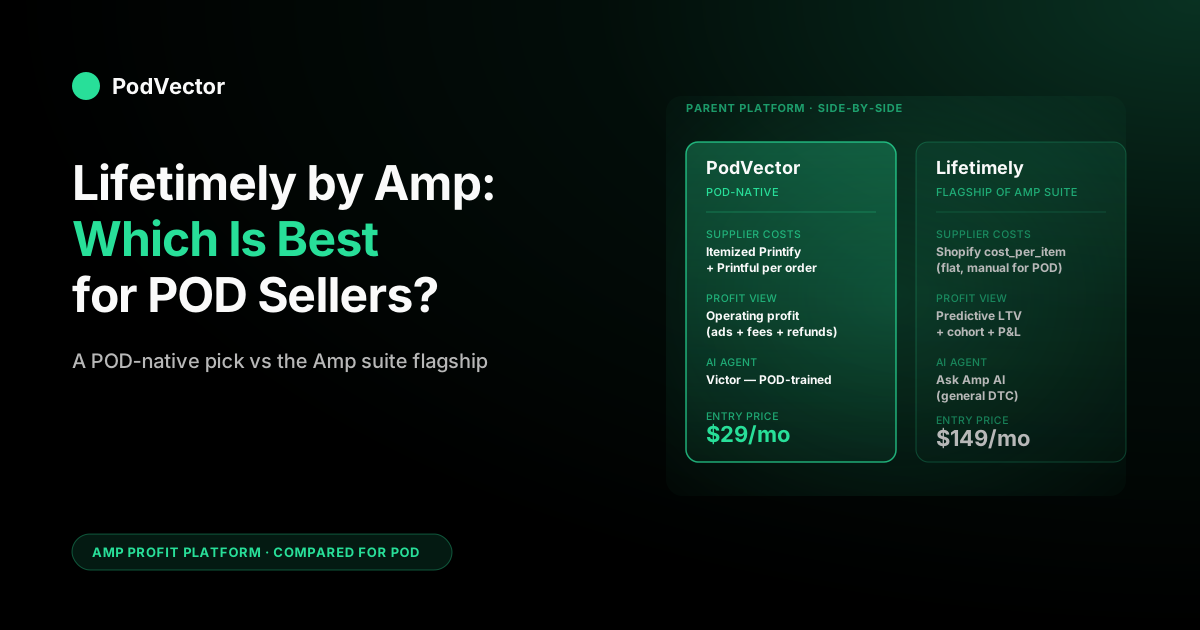
Quick Answer: "Lifetimely by Amp" is the same Lifetimely Shopify analytics app — repositioned under Amp, the parent company that acquired Lifetimely in 2023. The Amp brand bundles Lifetimely with Back in Stock, Slide Cart, Bundles, Post Purchase, and an AI assistant called Ask Amp AI. According to ThePrice Geek's July 2026 review, Lifetimely now positions itself as an "AI Profit Agent" and is used across more than 45,000 stores.
For a general Shopify DTC operator, the Amp suite is a coherent profit-and-conversion stack. For a print-on-demand seller, the bundle adds tools that don't address the core POD problem — Lifetimely still reads cost_per_item from Shopify, which doesn't capture what Printify and Printful actually charge per order.
If you're sizing up Lifetimely by Amp specifically because the parent-platform pitch caught your attention, PodVector AI is the closest POD-native alternative — itemized supplier costs, an AI employee (Victor) trained on POD economics, and a $29 entry tier. Below: what "by Amp" actually means, what's in the suite, and where it fits for POD.
What "by Amp" actually means
Lifetimely launched in 2018 as a standalone Shopify analytics app focused on customer lifetime value. It built a strong reputation in the DTC community for cohort math — predictive LTV projections that helped operators make sharper customer-acquisition decisions.
In 2023, Lifetimely was acquired by Amp, a Shopify-app holding company building what it calls a "Profit Platform." The Lifetimely product itself didn't change much. The branding, marketing site, and roadmap did — and Amp has since repositioned Lifetimely as an "AI Profit Agent" rather than just a passive analytics dashboard.
So "Lifetimely by Amp" is just Lifetimely with the new parent listed in front of the name. The Shopify App Store listing still reads "Lifetimely LTV & Profit by AMP" — same dashboard, same data model, same install path. What changed is the upsell context: Amp now actively sells you the rest of its app suite alongside Lifetimely.
That distinction matters when you're evaluating the tool. The general overview of the product itself lives in our Lifetimely for POD sellers comparison. This article focuses on what the "by Amp" framing adds and whether it's relevant for a POD operator.
The Amp product suite, decoded
Amp's pitch is that you can run a meaningful chunk of your Shopify stack from one vendor. Six products carry the Amp brand today.
Lifetimely (analytics / AI Profit Agent)
The flagship. Lifetimely's P&L dashboard delivers real-time P&L, LTV cohort modeling, CAC tracking, and multi-channel attribution. It pulls revenue from Shopify and ad spend from Meta, Google, TikTok, and Amazon, and reads COGS from Shopify cost_per_item. The "AI Profit Agent" layer now identifies trends, opportunities, and anomalies and surfaces recommended actions — an evolution beyond the static analytics dashboard the product started as.
Back in Stock
Restock notification app. Customers enter their email on a sold-out PDP and get notified when the variant is restocked. Useful for general DTC with inventory-driven scarcity.
Less useful for POD — Printify and Printful catalogs effectively never go out of stock the way a normal DTC SKU does, so the "back in stock" trigger fires rarely. The app exists in the Amp suite but solves a problem most POD stores don't have.
Slide Cart
Shopify cart-drawer optimization. Adds upsells, free-shipping progress bars, and gift-with-purchase to the cart UX. This is genuinely a conversion lever — and it works the same on a POD catalog as on any other Shopify store. Notably, Lifetimely users report the Amp Slide Cart integration works well with the analytics layer, with cross-app data flowing into Lifetimely's profit view.
Bundles
Product-bundling app. Lets you sell "buy this hoodie + this hat together for $X" as a single SKU. POD operators occasionally use bundles for matching merch sets (hoodie + tee + sticker pack), but the supplier-side accounting still goes through Printify or Printful per item — Bundles handles the front-end, not the supplier ledger.
Post Purchase
Thank-you-page upsell app. After a customer checks out, surface a one-click add-on offer before they hit the order-confirmation page. Standard DTC conversion play. Works for POD if your AOV math supports the second order.
Ask Amp AI
The platform-level AI assistant. Answers natural-language questions across the Amp suite — "what was my LTV last month?", "which campaign had the highest CAC?", and similar. We'll cover it separately below; the headline is that it's a general DTC assistant, not POD-trained.
The shape of the suite tells you who Amp is built for: a Shopify DTC store with a stable catalog, a returning-customer model, and an interest in funnel optimization. That's not the core POD profile.
Lifetimely by Amp vs alternatives for POD
| Tool | POD supplier accuracy | Best for | Entry price | AI agent |
|---|---|---|---|---|
| Lifetimely by Amp | Reads Shopify cost_per_item; no native Printify or Printful supplier-cost ingestion |
Shopify DTC focused on LTV, cohorts, and Amp suite cross-sell | Free / $149+ tiered | Ask Amp AI (general DTC, not POD-trained) |
| PodVector AI | Itemized Printify + Printful supplier line items per order | Shopify POD sellers (Printify / Printful) | $29/mo | Yes — Victor (POD-trained AI employee) |
| Triple Whale | Itemized but DTC-modeled; POD line items via custom mapping | Shopify DTC, creative-heavy ad operators | $129/mo | Yes (Moby) |
| Polar Analytics | Flat or category COGS by default; itemized requires custom modeling | Larger Shopify brands, agencies, multi-channel | ~$400/mo | Yes (Polar AI Assistant) |
| BeProfit | Manual COGS mapping; no native POD integrations | General Shopify P&L beginners | $25/mo | No |
| TrueProfit | Itemized (Printify + Printful supported since 2024) | Multi-channel Shopify DTC with some POD | $35/mo | Limited |
For the broader category-wide scoring across every major Shopify profit tracker, see our complete POD profit tracker comparison. The slice above is the part that matters specifically when you're weighing Lifetimely by Amp.
Where Lifetimely by Amp wins
The high App Store rating is earned, and the Amp acquisition didn't break anything. Three things the product still does well — plus one new capability worth noting.
Predictive LTV that operators actually trust
Lifetimely's flagship feature has always been predictive lifetime value. It reads your full Shopify customer and order history, fits a cohort curve, and projects 30/60/90/365-day LTV for any segment. According to ATTN Agency's 2026 review, this gives DTC brands "real-time profit and loss tracking, predictive lifetime value modeling, and cohort analysis that would otherwise require a full-time data analyst and a dozen spreadsheets."
The model behaves consistently across stores — it's not magic, but it's well-tuned, and you can see how it gets to its number. For a Shopify operator deciding "how aggressively can I scale Meta on this audience?", Lifetimely's LTV view is one of the cleanest in the category.
The cohort builder
You can slice cohorts by acquisition channel, first product purchased, discount used, geography, and a handful of other order attributes. The grid view ages cohorts cleanly without forcing you to export CSVs into a spreadsheet.
For Shopify brands trying to answer "do customers from Meta repurchase at the same rate as Google customers?", this is the daily working surface — and it's the feature most App Store reviews mention by name. See also our guide on default attribution models in Google Ads for POD sellers to understand how cohort data interacts with your channel attribution setup.
AI Profit Agent: trend and anomaly detection
Since the previous version of this article, Amp has leaned further into the "AI Profit Agent" positioning. Ask Amp AI now surfaces trends, opportunities, and anomalies proactively alongside the standard Q&A interface. For a general DTC merchant, this means the app flags when something changes rather than waiting for you to check. It's a real upgrade from passive analytics — though its effectiveness is still bounded by what data the agent sees (more on that in the next section).
Cross-app data flow within Amp
If you run multiple Amp apps, data flows between them. Slide Cart's upsell conversion data shows up in Lifetimely's profit view; Bundles' SKU-level revenue shows up in cohort cuts; Post Purchase upsells get tagged correctly. That's a real ecosystem benefit if you're going to run those apps anyway. It's not a reason to adopt apps you wouldn't otherwise install.
Where Lifetimely by Amp falls short for POD
The structural gaps are unchanged from before the Amp acquisition. Adding more Amp apps to the surface around Lifetimely doesn't fix the underlying data model — and the AI Profit Agent upgrade doesn't change this, because the agent is only as good as the data it reads.
1. Shopify cost_per_item doesn't match POD reality
Lifetimely's COGS comes from one Shopify field per variant: cost_per_item. That works when your unit cost is stable.
POD doesn't work that way. A Printify hoodie has a different base cost depending on the print provider, garment color, print size, ship-to country, and whether you have Printify Premium discounts active. Two orders for the same Shopify variant on the same day can have base costs that differ meaningfully. If you set cost_per_item to a flat number, Lifetimely's margin readings drift from reality. We dig into the underlying math in the complete guide to Printify costs, fees, and discounts — and you can see how Canadian fulfillment adds another layer of complexity in our Printify Canada print providers breakdown.
2. Bundled supplier shipping isn't modeled
Standard Shopify-plus-3PL setups treat shipping as a separate line: the customer pays you, you pay your 3PL. Lifetimely models it that way — correct for general DTC.
POD is different. Printify and Printful charge shipping bundled with the per-order fulfillment line. Garment cost and shipping come from the same supplier transaction and need to be tracked together to get accurate per-order margin. For a detailed look at how Printful pricing works, see our Bella+Canvas 3001 Printful cost breakdown.
3. The AI Profit Agent can't answer POD-specific questions
This is the new gap to highlight specifically for 2026. Amp's AI Profit Agent is a meaningful upgrade for general DTC operators — it proactively surfaces anomalies in your Shopify and ad-platform data. But the agent has no access to Printify or Printful supplier data. Ask it "is my Printify Premium subscription paying for itself on the SKUs I shipped this month?" or "which print providers are losing money for me on a per-variant basis?" and it cannot answer — the supplier-side data is simply not in the model.
More Amp apps means more Shopify-side data, not more supplier-side data. The ceiling is structural.
4. The Amp suite doesn't fix the data ceiling
Adding Back in Stock, Slide Cart, Bundles, and Post Purchase to your stack gives you more conversion surface area on the front end. It does not give Lifetimely better visibility into Printify or Printful supplier data. Lifetimely treats Shopify as the single source of truth, and a POD store's truth lives half in Shopify and half in the supplier ledger.
Ask Amp AI vs a POD-trained AI employee
Ask Amp AI is the platform-level AI assistant Amp launched after the Lifetimely acquisition. The pitch is natural-language analytics — type a question, get an answer pulled from your Shopify and ad-platform data. Amp now also positions this agent as proactively surfacing "trends, opportunities and anomalies" so you don't have to check manually.
For general Shopify DTC questions, it works. "What was my net profit last week?" "Which Meta campaign had the highest CAC?" "How did my email cohort perform vs my Google cohort?" These are well-formed DTC questions the assistant has been designed to answer.
POD-specific questions are where it falls flat. Try "is my Printify Premium subscription paying for itself on the SKUs I shipped this month?" or "which print providers are losing money for me on a per-variant basis?" The model doesn't have supplier-side data, doesn't know POD premium-tier economics, and hasn't been taught to reason about per-variant supplier accuracy.
An AI agent is only as good as the data it sees plus the metrics it's been taught. Ask Amp AI sees Shopify-side data and ad-platform spend, and has been taught general DTC vocabulary. Victor — PodVector AI's AI employee — ingests POD supplier line items from Printify and Printful and has been built around POD-specific metrics. The architectural difference is hard to close from a general DTC starting point.
There's also an important distinction in what "agent" means. Ask Amp AI surfaces recommendations and answers questions. Victor is an AI employee: he reads your live data across Shopify, Meta Ads, Google Ads, Printify, and Printful, proposes a typed action with rationale (such as repricing a product to a target margin or creating a free-shipping discount), and executes it on Shopify only after you approve. If you're evaluating ad-attribution setups alongside your analytics choice, our guide on Shopify Google Merchant Center product feed strategy for POD is relevant context for how data flows into both platforms.
Lifetimely by Amp pricing
Pricing is order-volume-tiered. According to ATTN Agency's verified March 2026 review, the current tier structure on the Shopify App Store is:
- Free. Up to 50 orders/month. Basic P&L, 30-day data limit, customer analytics, custom reports, LTV model.
- M — $149/month. Up to 3,000 orders. All features, app onboarding, live chat support, Amp AI recommendations, 24/7 support.
- L — $299/month. Up to 7,000 orders. Everything in M, plus 1:1 onboarding, custom reports built by their team, and a dedicated Slack channel.
- XL — $499/month. Up to 15,000 orders. Everything in L, plus a dedicated account manager and monthly profit reporting sessions.
- Amazon add-on. +$75/month across all plans for Shopify stores also selling on Amazon.
- 14-day free trial on all paid plans.
Note: ThePrice Geek's July 2026 review flags that the free plan's 50-order cap and 30-day data limit mean you outgrow it quickly if you're doing any real volume, and that the jump to $149/mo "is hard to justify for stores below $30,000 in monthly revenue." The XXL and Unlimited tiers that appeared on older listings are not reflected in the most recent verified sources — check the Shopify App Store listing directly for the current top-tier options.
The other Amp apps are priced separately. Slide Cart, Bundles, Back in Stock, and Post Purchase each carry their own monthly fee. There's no bundle discount — the "Profit Platform" branding is a marketing wrapper, not a unified SKU.
For the POD-specific pricing analysis tier-by-tier, see our Lifetimely pricing breakdown for POD sellers. And for a look at how POD-specific discounts affect your cost base before any analytics layer, see our breakdown of Printful free shipping codes for POD sellers.
PodVector AI: the POD-native alternative
PodVector AI is built for one thing: Shopify POD sellers running Printify and Printful. The architecture is a direct response to the gaps Lifetimely's general-DTC model can't close.
Itemized supplier costs as a first-class concept
Every Printify and Printful order line item flows into PodVector AI with the actual supplier-charged base cost, supplier shipping, and any premium-tier discounts applied. No flat cost_per_item mapping, no spreadsheet reconciliation.
That's the difference between a Shopify P&L that says "42% gross margin" and one that says "42% gross margin — calculated from your actual Printify and Printful line items this month, with Printify Premium savings already netted out." Importantly, because PodVector AI reads costs only from completed orders, a seller with no sales history cannot get a margin answer yet — this is a deliberate design choice that keeps the numbers honest rather than estimated. For Printful-specific cost mechanics, see our Printful cost breakdown for the Bella+Canvas 3001.
Operating profit, not just gross profit
Most Shopify profit apps stop at gross. PodVector AI includes ad spend, Shopify payment processing, app subscriptions, refunds, and chargebacks in the operating P&L by default.
That matters in POD because contribution margin is thin. A healthy gross margin can shrink significantly once you net out ads and fees — and the operating number is what you actually need when deciding whether to scale a campaign. The mechanics live in the complete guide to profit tracking for Shopify POD stores.
Victor: AI employee for POD
Victor is the AI employee built into PodVector AI. You ask Victor questions in plain English — "which Printify SKUs lost money on Meta last week?" — and get a real answer pulled from your live data warehouse (Shopify, Meta Ads, Google Ads, Printify, and Printful). But Victor goes beyond answering questions.
Victor is an AI employee: he reads your business data, proposes a specific action with rationale — repricing a product to a target margin, bulk repricing across your store, setting up a buy-one-get-one discount, creating a free-shipping discount, raising your free-shipping threshold, organizing products into a collection, or reverting a price change — and executes the approved action on Shopify. You approve or reject each proposal before anything changes. Ad-platform surfaces (Meta and Google Ads) are read-only for Victor — he surfaces what's happening and proposes moves, but the merchant executes on the ad platform itself. For context on how Shopify-side automation fits into a broader POD workflow, see our guide on Shopify Admin API store modifications for POD automation.
Victor's proactive surface is a Weekly Health Report. Everything else is query-driven — he doesn't monitor around the clock, and each session starts fresh. This is a deliberate honesty constraint: PodVector AI is built to give you accurate, actionable intelligence when you need it, not to oversell autonomous monitoring it hasn't built.
POD-priced
PodVector AI starts at $29/month. Lifetimely by Amp's first paid tier is $149/mo — a gap that holds at higher order volumes too.
How to decide: stage-based recommendation
The right pick depends less on your absolute revenue and more on what your bottleneck actually is.
Under $20K/month: Lifetimely Free or PodVector AI $29
At this stage you need cheap, fast, and right-enough. Lifetimely's free tier (up to 50 orders/month) gives you a clean Shopify P&L. PodVector AI's entry tier gives you POD-accurate supplier costs from the first order.
If your variant cost variance is small, Lifetimely Free can carry you. If your catalog is broader, PodVector AI pays for itself in better scaling decisions. The free plan's 30-day data limitation means you'll outgrow it quickly at any meaningful volume.
$20K–$200K/month, single-channel POD on Shopify: PodVector AI
This is the sweet spot for POD-native tools. You need accurate per-order supplier costs, operating profit, and ad-spend integration with Meta or Google. You're past Lifetimely's free-tier ceiling, which means $149/mo for LTV features that POD doesn't lean on the same way general DTC does. PodVector AI's tiers cover the work that actually shifts your scaling decisions.
For POD sellers working to maximize returns on their ad spend, our guides on Printful Shopify integration for POD and Google Merchant Center product feed strategy for POD are the right companion reads.
$200K–$1M/month, retention-driven POD: consider both
If you've built a POD brand on Shopify with genuine repeat-purchase dynamics — loyalty programs, club merch, subscriber-printed items — Lifetimely's LTV cohort layer earns its $299/mo tier. The supplier-cost gap remains. The honest answer for many brands at this stage is "PodVector AI for the POD margin truth, plus Lifetimely L for the LTV cohort layer." Two specialized tools is often cheaper and more accurate than one platform doing both jobs poorly.
The Amp suite cross-sell (Slide Cart, Bundles, Post Purchase) is independent of this question — adopt those apps if they solve a separate conversion problem, not as a tax for using Lifetimely.
$1M+/month: warehouse-native + POD layer
At this scale, you'll likely want a managed data warehouse you can extend with custom models — Polar Analytics or a fully custom setup. Full breakdown in our Polar Analytics for Shopify POD comparison. Even at this stage, many POD-focused brands keep PodVector AI running alongside the warehouse specifically for the daily POD margin view. Building and maintaining a POD line-item model on top of a general BI tool isn't trivial. The full collection of comparisons lives in our PodVector AI comparison hub.
For POD sellers at scale looking to maximize profitability through Printify's monetization levers, our guide on how to make money with Printify covers the strategies that move the needle.
FAQs
Is "Lifetimely by Amp" different from regular Lifetimely?
No — same product, same dashboard, same pricing. Amp acquired Lifetimely in 2023 and now markets it under the Amp parent brand. The Shopify App Store listing is "Lifetimely LTV & Profit by AMP." The main post-acquisition change is the "AI Profit Agent" positioning and tighter integration with other Amp apps.
What other apps does Amp make?
Amp's suite includes Lifetimely (analytics / AI Profit Agent), Back in Stock (restock notifications), Slide Cart (cart drawer), Bundles (product bundling), Post Purchase (thank-you-page upsell), and Ask Amp AI (platform-level assistant). Each is priced separately.
Does the Amp suite include POD-specific features?
No. The Amp apps are general Shopify DTC tools. None of them ingest Printify or Printful supplier data, and Lifetimely's COGS model still relies on Shopify cost_per_item regardless of which other Amp apps you run.
Is Ask Amp AI good for POD analysis?
Ask Amp AI handles general Shopify DTC questions and surfaces DTC-level anomalies and trends. POD-specific reasoning — Printify Premium ROI, per-variant supplier accuracy, print-provider profitability — is outside its scope because it doesn't have access to supplier-side data.
How much does Lifetimely by Amp cost?
Free up to 50 orders/month (30-day data limit), then $149/mo (M, up to 3K orders), $299/mo (L, up to 7K), $499/mo (XL, up to 15K). Amazon add-on is $75/mo extra. All paid plans include a 14-day free trial. Other Amp apps cost extra. Verify current top-tier options on the Shopify App Store as the tier structure continues to evolve.
What's the best Lifetimely by Amp alternative for POD?
For Shopify POD sellers running Printify or Printful, PodVector AI is the most direct alternative — itemized supplier costs, operating-margin visibility, and an AI employee (Victor) trained on POD economics, starting at $29/month.
Does Lifetimely by Amp work outside Shopify?
No. It's Shopify-only (plus an Amazon add-on for Shopify stores that also sell on Amazon). It doesn't support WooCommerce, BigCommerce, Magento, or other ecommerce platforms.
Can Victor (PodVector AI) pause my Meta campaigns or change Google Ads bids?
No. Victor reads Meta Ads and Google Ads data and proposes moves, but he does not write to ad platforms. The writes Victor executes — repricing, discounts, collections, and similar — are Shopify-side only, and always require your explicit approval before executing.
POD margin truth — without the parent-platform upsell
Lifetimely by Amp is a strong general-DTC pick wrapped in a parent-platform pitch. PodVector AI is the POD-native alternative — itemized Printify and Printful line items, operating profit, and an AI employee (Victor) that proposes and executes approved actions on your Shopify store. Start free.
Try Victor free