
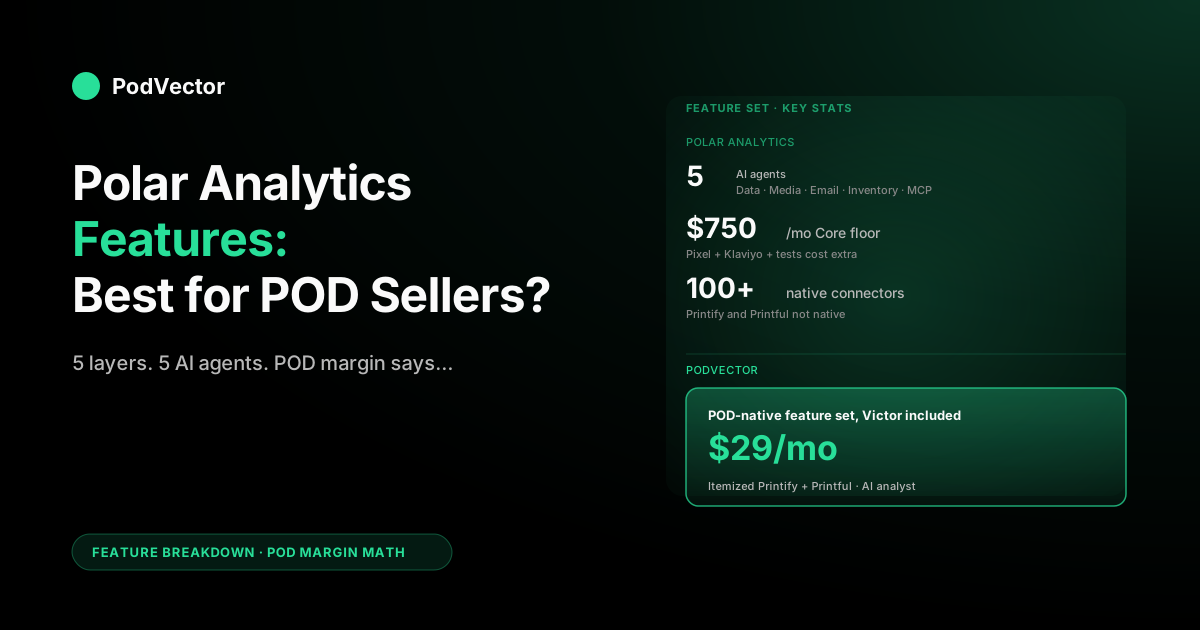
Quick Answer: Polar Analytics' feature set spans five buckets — Business Intelligence dashboards, five purpose-built AI agents (Data Analyst, Media Buyer, Email Marketer, Inventory Planner, MCP), server-side attribution via the Polar Pixel, activation features (Klaviyo Audiences, Conversion API Enhancer), and a customer-accessible data warehouse with SQL.
For Shopify DTC brands at $3M+ GMV running cross-channel paid, the feature breadth is best-in-class. For Print-on-Demand sellers the picture is uneven: pricing starts at $750/month and scales with GMV, several features ship as paid add-on modules, and the supplier-cost layer that decides whether a campaign actually netted profit isn't part of any built-in feature.
If you want a POD-native feature set that itemizes every Printify or Printful supplier cost and ships an AI employee on every tier, PodVector AI starts at $29/month with Victor included. Below is the full Polar feature walkthrough, what each tier unlocks, and a POD-specific decision matrix.
What "features" means in Polar Analytics
Polar Analytics calls itself a "multichannel AI analytics platform." That's a five-layer product, not one. Each layer has its own feature set, and which layers you actually use determines whether the bill makes sense.
The five layers, top to bottom: dashboards and reports (BI), AI agents that answer questions and trigger actions, an attribution engine running on a server-side pixel, activation features that push enriched data back to Klaviyo and ad platforms, and a customer-accessible data warehouse underneath everything.
Most "Polar Analytics features" articles you'll find list the marketing claims. This one walks each layer's actual capabilities, what's gated behind which tier, and where the layers fit — or don't fit — POD economics.
If you want the broader Polar evaluation before getting into the feature math, the Polar Analytics overview for POD sellers covers the full platform; this article zooms into the feature set itself.
Business Intelligence features
The BI layer is what most operators open Polar for day to day. It's the dashboard surface that sits on top of the warehouse.
Pre-built dashboard templates
Polar ships hundreds of pre-built metrics and dashboard templates covering profit and loss, acquisition (blended CAC, MER, ROAS, top-performing ads), retention (LTV, cohorts), and merchandising (product performance, inventory turns). You can deploy a template and have a working dashboard in minutes.
For a multi-channel DTC operator that's a real time saver. For a POD operator the templates land closer to "useful starting point" than "production read" — they don't know what a Printify base price is.
Custom reports and KPIs
Beyond templates, Polar gives you a custom report builder with drag-and-drop dimensions and metrics. You can build any metric from the underlying data — blended ROAS by SKU, LTV by acquisition channel, contribution margin by collection — without writing SQL.
Most operators end up running 70% pre-built templates and 30% custom reports after the first month. The custom side is where the platform earns its keep against simpler tools.
Multi-brand and multi-store views
If you run multiple Shopify stores, Polar aggregates them into unified views and lets you segment by brand, country, or any custom dimension. Agencies and multi-brand holding companies use this heavily.
For a single-store POD operator this feature is dormant. For an operator running a US store and an EU store on separate Shopify accounts, it removes the spreadsheet-stitching tax.
Scheduled reports and exports
Reports can be scheduled to email or Slack on a cadence, and you can export to CSV or Google Sheets. Useful for the weekly leadership update or the monthly investor pack.
Granular access control
Different team members see different dashboards. Useful when you want the media buyer to see ad performance but not the P&L, or when you give an agency partner read access without exposing supplier costs.
AI agent features
Polar's AI layer was rebuilt in 2025 around a five-agent architecture. Each agent has a narrow scope and a different price point.
Data Analyst agent ("Ask Polar")
The Data Analyst answers plain-English questions about your data. "What was Meta's blended ROAS last week?" "Show me top 10 SKUs by margin contribution this month." The agent generates a custom report as the answer rather than just returning a number.
This is the most-used AI feature for non-analyst operators. The trade-off: the answers are only as accurate as the data model underneath, and that data model assumes a generalist DTC structure.
Media Buyer agent
The Media Buyer agent monitors your paid channels and surfaces optimization recommendations — pause this ad set, scale that creative, shift budget here. It's read-only — it tells you what to do; it doesn't push the changes to Meta or Google for you.
Email Marketer agent
Sold as a Customize-tier add-on. The Email Marketer agent generates Klaviyo audience suggestions and segment recommendations based on customer behavior. It pairs naturally with the Klaviyo Audiences activation feature lower in the stack.
Inventory Planner agent
The Inventory Planner agent forecasts stock-outs and surfaces reorder recommendations based on velocity. For Print-on-Demand specifically this agent is mostly idle — POD has no inventory to plan, since orders are produced on demand by Printify or Printful after the customer pays.
MCP agent
Polar exposes its data via Model Context Protocol — meaning external AI tools (ChatGPT desktop, Claude desktop, custom agents) can query your Polar data through a standard interface. This is genuinely forward-looking; most analytics tools don't ship MCP yet.
For an operator who wants to talk to their data through a general-purpose model rather than Polar's own agent surface, MCP is the unlock.
For wider context on how AI-native analytics is reshaping this category, the complete guide to AI analytics for Print-on-Demand covers the broader picture across vendors.
Attribution and tracking features
The attribution layer is one of Polar's strongest selling points. Three features matter most.
10 attribution models
Polar ships five standard multi-touch models (First Click, Last Click, Linear, U-Shaped, Time Decay) and five paid-focused models (Paid Linear, Full Paid Overlap, Full Paid Overlap + Facebook Views, Full Impact, Full Impact Paid). You can compare any of them side by side in the same view.
The deeper walkthrough lives in the Polar Analytics attribution capabilities breakdown; here it's enough to note that ten models is more than any other Shopify-app-class tool ships.
The Polar Pixel
The Polar Pixel is a server-side tracker that installs into your Shopify theme and checkout. It captures events server-side rather than relying on browser pixels — meaning iOS 14+ App Tracking Transparency restrictions and ad-blockers don't blow holes in the data the way they do with Meta's client-side pixel alone.
Each visitor gets a Lifetime ID that persists across devices and sessions. So if a customer clicks a Meta ad on Monday from their phone and converts via Google Search on Friday from a laptop, the pixel stitches both touches into one journey.
Customizable attribution windows
Defaults match ad-platform conventions (typically 7-day click + 1-day view). You can stretch click lookback to 14, 28, 30, or 90 days, and view to 1, 7, or 28 days. POD operators with long consideration cycles benefit; impulse-purchase categories can leave defaults alone.
Incrementality testing (geo holdouts)
A higher-tier module. You split markets into treatment (ads on) and holdout (ads off) groups, run for two to four weeks, and measure the actual incremental sales the ads drove. It's the gold standard for proving ad effectiveness — it sidesteps every attribution-model flaw because it doesn't model anything.
Activation and revenue-recovery features
"Activation" is Polar's term for features that push enriched data back into your stack rather than just displaying it.
Klaviyo Audiences
Polar pushes enriched, real-time customer segments into Klaviyo. Audiences refresh as customer behavior changes — so if someone hits the "high-LTV-likely" threshold mid-day, the Klaviyo flow they get is different from the one they'd have gotten yesterday.
Polar's claim is a 30–50% lift on email performance for stores running Klaviyo Flows Enricher. That's a function of better segments getting better-targeted sends, not a magic trick.
Conversion API (CAPI) Enhancer
The CAPI Enhancer pushes enhanced server-side conversion data back to Meta and Google through their Conversion APIs. Cleaner signals mean ad platforms' bidding algorithms train on better data.
Polar's claim is roughly a 20% ROAS lift on average for stores running CAPI Enhancer. Real and measurable, but it's a function of platforms getting cleaner signals — not a Polar-specific trick.
Smart alerts and anomaly detection
Set thresholds on KPIs (conversion rate drop, CAC spike, ROAS dip) and get notified via email or Slack when they trigger. Saves the "checking the dashboard at 8 AM every day" tax.
Beyond static thresholds, Polar layers automated anomaly detection on top — the system flags metric swings you didn't explicitly set a rule for, surfacing a CAC spike or a sudden conversion-rate dip before it shows up in the weekly review. Useful for catching the problem you weren't already watching. For a POD operator the catch is the same one that runs through every layer here: an anomaly in gross ROAS doesn't tell you whether the underlying order still cleared a profit after Printify or Printful production costs.
Persona features
Customer-segmentation features that sit between BI and activation — letting you build personas from behavior, then feed those personas to Klaviyo and ad-platform audiences. Sold as a Customize-tier add-on.
Data infrastructure features
Underneath everything is the data layer. Polar's customer-accessible warehouse is a real product feature, not just plumbing.
Customer-accessible data warehouse
Polar provisions a managed live data warehouse for each customer and lets the customer query it directly via SQL. Most Shopify-app-class analytics tools don't expose the warehouse at all — Polar's choice to expose it is what lets sophisticated operators build custom models on top.
Bring-your-own Snowflake
Higher-tier customers can run Polar against their own Snowflake instance instead of Polar's managed warehouse. Useful when you already have a Snowflake or equivalent (Redshift, Databricks) data team and want Polar's BI surface on top of your existing infrastructure rather than maintaining a parallel one.
Intraday data refresh
Standard refresh runs on roughly an hourly cadence. Intraday refresh is a paid module that pushes that toward near-real-time — material when you're optimizing during the day rather than reading yesterday's numbers tomorrow.
SQL access
Direct SQL on the warehouse is included on all tiers. Anyone on the team can write a SELECT statement and get back the underlying data — useful for the inevitable custom report Polar's UI doesn't ship out of the box.
For a deeper read on how the warehouse and the dashboard layer fit together, the Polar Analytics marketing data insights breakdown covers the data infrastructure underneath the dashboards.
Integration features
Polar's integration breadth is the structural reason most BI alternatives can't catch up — connectors take engineering time to build and ongoing time to maintain.
1-click native connectors
45+ to 100+ native connectors depending on which marketing material you read. The core set: Shopify, Amazon, Meta Ads, Google Ads, TikTok Ads, Pinterest, Microsoft Ads, Snapchat, Klaviyo, Recharge, Yotpo, Postscript, Attentive, Google Analytics, Looker Studio.
"1-click" is roughly true for OAuth-based connectors. Connectors that need API keys or custom auth are still pretty straightforward, but not literally one click.
Notable POD-relevant gaps
Printify and Printful do not have native Polar connectors. The Polar warehouse can ingest data from them through custom imports or third-party ETL (Fivetran, Airbyte), but it's not a 1-click flow — and you're paying for the ETL on top of the Polar bill.
Etsy's connector is limited compared to Shopify's. Amazon Ads is missing on the standard tier, which a few G2 reviewers explicitly flag as a deal-breaker for Amazon-heavy brands.
Polar Pixel as an integration
The pixel sits in this layer too — it's both an attribution feature and a data-collection integration. It captures events Shopify's native pixel framework alone wouldn't surface to Polar's warehouse.
Which pricing tier unlocks which features
Not every feature ships in the base plan. The breakdown by tier:
| Feature | Core ($750/mo floor) | Customize (Core + modules) |
|---|---|---|
| BI dashboards (templates + custom) | Included | Included |
| 10 attribution models | Included | Included |
| Data Analyst AI agent (Ask Polar) | Included | Included |
| SQL access on the warehouse | Included | Included |
| Smart alerts | Included | Included |
| Polar Pixel + CAPI Enhancer | Optional module | Bundled if added |
| Klaviyo Audiences | Optional module | Bundled if added |
| Incrementality testing (geo holdouts) | Not included | Module add-on |
| Email Marketer + Inventory Planner agents | Not included | Module add-on |
| Persona features | Not included | Module add-on |
| Intraday data refresh | Not included | Module add-on |
| Bring-your-own Snowflake | Not available | Enterprise tier |
The $750/month floor scales with Shopify GMV — published numbers run roughly $720 at sub-$5M GMV up to ~$8,000/month at $75–100M GMV. Adding the high-impact modules (Polar Pixel, Klaviyo Audiences, Incrementality Testing) typically pushes the bill into the $1,200–$2,500/month range for stores in the $3–10M GMV band.
For the full pricing math, the Polar Analytics pricing walkthrough covers what each band actually costs. The Polar Analytics Shopify pricing breakdown goes deeper on the recurring-vs-external charge structure inside Shopify billing.
Where Polar's feature set misfits POD economics
The features themselves are well-engineered. The mismatch with Print-on-Demand isn't about feature quality — it's about which features POD operators actually need most, and which features Polar puts behind which paywall.
No native Printify or Printful connector
Polar pulls Shopify line items, which include the SKUs Printify or Printful fulfilled. What it doesn't pull natively is the supplier-side cost data — what each variant cost you to produce, shipped to which zone, by which provider.
That data is the difference between "the campaign grossed $X" and "the campaign netted $Y." For a 45%-margin POD product, that gap is bigger than any attribution-model swing.
You can load supplier costs into Polar through ETL or custom SQL on the warehouse. It's a few weeks of engineering work or a third-party tool bill on top of Polar's own bill.
Inventory Planner agent is dead weight for POD
POD has no inventory to plan. Orders produce on demand. The Inventory Planner agent is a feature you're effectively paying for at the Customize tier without using it.
Same logic for the inventory-related dashboards in the BI templates — they show stock-on-hand and reorder points, which don't apply.
Activation feature gains compound with margin headroom
Polar Pixel + CAPI Enhancer claim a roughly 20% ROAS lift. Real and measurable. But that lift compounds with margin headroom: a 20% ROAS lift on 65%-margin product is a much bigger absolute dollar gain than the same lift on 45%-margin POD product.
Same for Klaviyo Audiences' 30–50% email lift. Not a knock on Polar's tech — it's an honest read on which problem dominates POD economics. For a Printify-heavy operator, "what did this campaign actually net?" beats "how do I lift Meta's signal quality?" by a wide margin.
Pricing keys off GMV, not gross profit
Polar's $750/month floor scales with Shopify GMV. POD GMV at 45% margin generates roughly two-thirds the gross profit of general DTC GMV at 65%. The same Polar bill consumes a proportionally larger share of POD operating profit.
For a $5M GMV Shopify DTC brand, Polar's full feature stack at $1,500/month is reasonable. For a $5M GMV POD store, the same bill against thinner margins is a meaningfully bigger ask.
POD-aware feature alternatives
Three options that ship a different feature shape for POD operators.
PodVector AI — POD-native feature set at $29/month
PodVector AI is built for Print-on-Demand sellers running Shopify. The feature set is narrower than Polar's by design — no incrementality module, no five-agent split — but the features that ship include itemized Printify and Printful supplier-cost ingestion natively, not as a custom ETL project.
That changes the question Victor — the included AI employee — can answer. Instead of "what was Meta's ROAS under model X," you ask "which campaign actually netted the most after Printify costs last week," and the answer comes from your unified live data warehouse. Victor answers your questions and acts on those answers — with your approval — pause underperforming campaigns, surface margin-eroding products — without leaving the chat.
Pricing is flat-rate ($29 / $79 / $129 monthly tiers), not GMV-tiered. For more on the comparison framing, see the complete POD analytics tool comparison.
Triple Whale — multi-touch attribution at $129+/month
Triple Whale's Shopify App Store entry tier starts around $129/month and scales with order volume. Feature-wise it's closer to Polar than Lifetimely — server-side pixel, multi-touch models, AI agent (Moby) — at a step lower price point.
For POD specifically, Triple Whale handles supplier costs more flexibly than Polar but less precisely than PodVector AI. Worth evaluating at the $300K+/month band where multi-platform attribution starts paying back.
Lifetimely (by AMP) — LTV-first at $34/month
Lifetimely's feature set is simpler than Polar's — closer to Last Click attribution with retention and LTV reporting baked in. POD supplier costs need to be uploaded as a flat rate per product, which is workable for stable rates.
Picks of the Lifetimely-class tools work when feature breadth isn't the bottleneck. For a deeper Lifetimely walkthrough, the Lifetimely overview for POD sellers covers the trade-offs.
How to decide for your POD store
Five buckets, ordered by Shopify GMV and channel complexity.
Under $50K/month Shopify GMV: PodVector AI, feature breadth secondary
At this stage feature-set sophistication isn't the constraint — supplier-cost accuracy is. Polar's $750/month floor plus modules is meaningfully more than your operating profit. PodVector AI at $29/month gets you accurate Printify and Printful costs plus Victor for plain-English campaign questions. Pick PodVector AI.
$50K–$300K/month Shopify GMV, Meta-only or Meta-heavy: PodVector AI or Triple Whale
You're running paid, but probably mostly Meta with some Google. Polar's full five-agent + ten-model feature set is overkill for a one-platform-dominant business. PodVector AI Growth or Scale tier handles the data side; Triple Whale at $129+/month handles the attribution side if you need more model variety.
$300K–$1M/month Shopify GMV, true multi-channel: evaluate both
At this scale Meta + Google + TikTok + email + SMS all matter, and Polar's full feature stack starts paying back the bill. But Printify and Printful supplier-cost complexity hasn't gone away.
Honest call: PodVector AI for the supplier-cost layer plus Polar (or Triple Whale) for cross-channel features. Or pick one and accept the gap. Worth modeling what each path actually unlocks against your operating margin headroom.
$1M+/month Shopify GMV, multi-channel DTC: Polar fits
At $12M+ annual Shopify GMV, Polar's full feature set genuinely becomes the right tool for the cross-channel decision layer. The pricing is reasonable against revenue, the Polar Pixel + CAPI Enhancer pay back, and incrementality testing on the geo-holdout module is worth the add-on bill once a quarter.
Bolt on a POD-aware supplier-cost layer for any Printify or Printful volume. PodVector AI Scale tier complements Polar at this stage rather than replacing it.
If you're agency-managed or multi-store: weight unlimited users
Polar's "unlimited users" pricing genuinely matters when you're adding agency partners, contractors, or a five-person ops team to the workspace. PodVector AI ships unlimited users on every tier as well. Either way, don't pick a per-seat tool here.
For the broader read on where Polar's reporting layer fits this comparison, the Polar Analytics reporting features breakdown walks through the dashboard surface specifically. The full PodVector AI comparison cluster covers head-to-head reads on every major analytics tool POD operators evaluate.
FAQs
What features does Polar Analytics include?
Five layers: BI dashboards (pre-built and custom), five AI agents (Data Analyst, Media Buyer, Email Marketer, Inventory Planner, MCP), attribution and tracking (10 models, the Polar Pixel, customizable windows, incrementality testing), activation (Klaviyo Audiences, CAPI Enhancer, smart alerts, personas), and a customer-accessible data warehouse with SQL.
Which Polar Analytics features are included in the base plan?
The Core $750/month plan includes BI dashboards (templates + custom), the 10 attribution models, the Data Analyst AI agent, SQL access on the warehouse, and smart alerts. The Polar Pixel, CAPI Enhancer, Klaviyo Audiences, incrementality testing, the Email Marketer and Inventory Planner agents, persona features, and intraday refresh are paid modules on the Customize tier.
Does Polar Analytics integrate with Printify or Printful natively?
No. Neither Printify nor Printful has a native Polar connector. You can load supplier-cost data through ETL (Fivetran, Airbyte) or custom SQL on the warehouse, but it's not a 1-click flow — and you're paying for the ETL bill on top of Polar's bill.
What AI agents does Polar Analytics ship?
Five: Data Analyst (Ask Polar — answers questions in plain English), Media Buyer (paid-channel optimization recommendations), Email Marketer (Klaviyo audience suggestions, Customize-tier), Inventory Planner (stock-out forecasts, Customize-tier — mostly idle for POD), and MCP (Polar data exposed to external AI tools via Model Context Protocol).
How much do Polar Analytics' features cost in total?
Core plan starts at $750/month and scales with Shopify GMV. Adding the Polar Pixel + CAPI Enhancer module, Klaviyo Audiences, and Incrementality Testing typically pushes total spend into the $1,200–$2,500/month range for stores in the $3–10M GMV band. Annual contracts run roughly 20% off the monthly rate.
Does Polar Analytics offer SQL access?
Yes — direct SQL on the customer-accessible data warehouse is included on all tiers. That's unusual for a Shopify-app-class tool and lets sophisticated operators build custom models on top when the built-in features don't fit. Higher tiers also support bring-your-own Snowflake.
Is the Polar Pixel server-side?
Yes. The Polar Pixel installs into Shopify's pixel framework and captures events server-side rather than relying on browser pixels alone. iOS 14+ App Tracking Transparency restrictions and ad-blockers don't blow the same holes in the data they do with Meta's client-side pixel. It's an optional module, not bundled into the Core floor.
Does Polar Analytics handle multi-store and multi-brand setups?
Yes. Polar aggregates multiple Shopify stores into unified views and lets you segment by brand, country, or any custom dimension. Unlimited users are included on every tier. Agencies and multi-brand holding companies use this feature heavily.
What's the cheapest way to get a comparable feature set for a POD store?
PodVector AI at $29/month is the lowest entry point for a POD-specific tool with itemized Printify and Printful supplier costs and an AI employee included. Lifetimely (by AMP) at $34/month is the closest POD-adjacent generalist option. Triple Whale at $129+/month sits between Lifetimely and Polar on feature breadth.
Want a POD-native feature set that knows what each Printify order actually cost?
Polar's five-layer feature stack is built for general DTC. PodVector AI is built for POD: Printify and Printful supplier costs feed into the same live data warehouse as your Shopify and ad-platform data, so Victor — your AI employee — can tell you what a campaign actually netted, not just what it grossed. Plain English in, real margin numbers out.
Try Victor free