
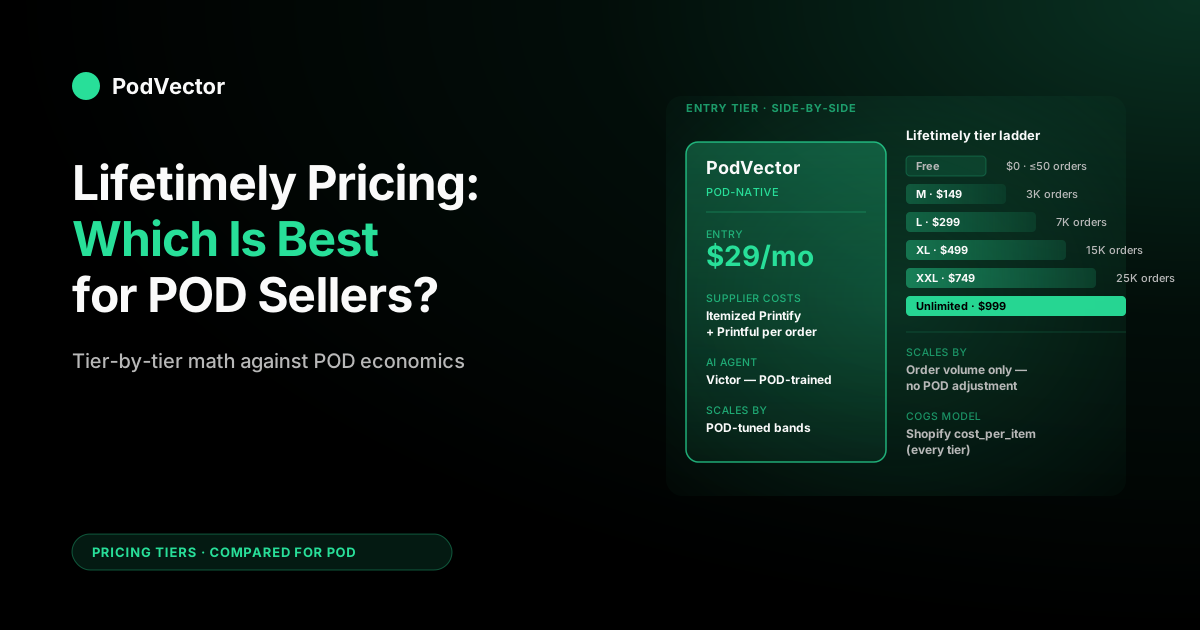
Quick Answer: Lifetimely's pricing ladders by monthly order volume — Free (50 orders), S ($79, 500 orders), M ($149, 3K), L ($299, 7K), XL ($499, 15K), XXL ($749, 25K), and Unlimited ($999, no cap). According to eightx.co (accessed June 2026), every paid tier includes the same feature set; the upgrades are order capacity and support level only. The $75/month Amazon add-on is available on any plan.
For a general Shopify DTC brand, the tier math is fair. For a print-on-demand seller, two things break. Order-volume tiers penalize POD's high-SKU, low-AOV pattern, and upgrading tiers doesn't fix the underlying problem — Lifetimely still reads cost_per_item from Shopify, which can't model what Printify and Printful actually charge per order.
A major product update to know about: according to thepricegeek.com (July 2026), Lifetimely now ships a Profit Agent — an AI layer that monitors your P&L and proposes actions for approval — plus a Claude MCP integration on all paid plans. Neither changes the COGS data model for POD sellers.
If you're sizing the tiers against POD economics, PodVector AI is the closest POD-native alternative — itemized supplier costs, an AI employee (Victor) built on POD reasoning, and a $29 entry tier that doesn't punish high SKU counts. Below: every Lifetimely tier broken down for POD, where the math works, where it doesn't, and how to decide.
Lifetimely pricing tiers at a glance
Lifetimely lists seven tiers on its pricing page, all priced as monthly recurring charges through Shopify billing. Order volume is the only meaningful gate between paid tiers — according to eightx.co (June 2026), the feature set is identical across every plan. You are buying order headroom and a better support tier, not additional features.
| Tier | Price | Order cap | Support level |
|---|---|---|---|
| Free | $0/mo | Up to 50 orders | Help center + ticket |
| S | $79/mo | Up to 500 orders | Standard support |
| M | $149/mo | Up to 3,000 orders | Standard + live chat + 24/7 |
| L | $299/mo | Up to 7,000 orders | Silver support + Slack channel |
| XL | $499/mo | Up to 15,000 orders | Gold support + dedicated account manager |
| XXL | $749/mo | Up to 25,000 orders | Platinum support |
| Unlimited | $999/mo | No cap | Personalized setup + 24/7 |
| Amazon add-on | +$75/mo | — | Imports Amazon sales and ad data |
Note on the S tier: According to eightx.co (June 2026, citing the Shopify App Store listing), the $79 S plan appears on the Shopify App Store transactional listing but not in AMP's published help-doc pricing table. Treat the App Store as authoritative for the S plan's existence. If you're under 500 orders and were previously defaulting to the M tier, the S plan is the right first paid step.
All paid tiers ship with a 14-day free trial. According to bythenumbersapp.com (verified August 2026), the 14-day trial takes a card up front and charges unless you cancel. Annual prepay isn't a published option — billing is month-to-month through Shopify. According to eightx.co (June 2026), there are no overage fees and no annual discount.
The general overview of the product itself lives in our Lifetimely for POD sellers comparison. This article is the pricing-specific cut: which tier fits which kind of POD operation, where the order-volume math breaks, and what the alternative looks like.
How order-volume pricing actually works
According to eightx.co (June 2026), Lifetimely prices on order volume, not revenue — a brand doing high order volume at a low AOV pays the same as one doing the same order count at a high AOV. The threshold is the cap on the tier you're on.
There are no overage fees. According to eightx.co (June 2026), if you blow past your plan's order limit, your bill does not silently balloon — the app watches a rolling pattern and only triggers an upgrade notification after two consecutive months over the limit. A single Black Friday spike does not force a tier jump.
This is standard SaaS pricing for analytics tools. The reasoning makes sense for a general Shopify DTC brand. More orders means more data to ingest, more compute to run cohort math on, and more value to the customer.
The mismatch shows up when you stack the assumption against a print-on-demand profile. POD operations tend to look like this: thousands of active SKUs across multiple Printify and Printful catalogs, modest AOV, and order volume that can swing significantly between a quiet week and a viral one.
The order-count axis was tuned for a different shape — fewer SKUs, higher AOV, smoother volume. Three places that matters when you compare tiers.
SKU count doesn't lower the bill
A POD store running thousands of SKUs and a DTC store running a handful of SKUs pay the same Lifetimely tier at the same order count. But the POD store has vastly more variant accounting work happening inside the dashboard. Cohorts, attribution, and cost modeling all multiply by SKU count. POD operators get more compute work done for the same dollar — which sounds good until the variant-level reports stop being usable because the surface area is too noisy.
Low AOV makes the per-order math harder
According to eightx.co (June 2026), a brand doing orders at a $15 AOV pays the same Lifetimely tier as one doing the same order count at a $150 AOV. That flat pricing structure means the percentage-of-revenue cost is dramatically higher for low-AOV POD stores. For more on POD contribution margin dynamics, see our guide to AI-assisted ecommerce document checks.
Volume spikes push you up a tier prematurely
POD stores routinely see large order spikes from a single viral post or seasonal hit. The two-consecutive-months rule (confirmed by eightx.co, June 2026) is forgiving enough that one viral month doesn't auto-bump you. But several strong months in a row means you're shopping the next tier up, even if your steady-state is much lower. It's worth understanding before you pick a tier.
What's new in 2026: Profit Agent and MCP
Two meaningful product changes have shipped since the last version of this article that affect how you evaluate Lifetimely's tiers.
Lifetimely Profit Agent
According to thepricegeek.com (July 2026), Lifetimely now ships a Profit Agent — an AI layer that monitors your P&L, LTV, and attribution data and proactively flags opportunities and risks with its reasoning attached. According to useamp.com (July 2026), the Profit Agent is included on every paid plan starting at the $79 S tier. The general framing: it monitors, diagnoses, and proposes actions; you approve before anything executes.
For POD sellers evaluating this feature, the key caveat is identical to the rest of the platform: the Profit Agent's analysis is only as accurate as the COGS data it has access to. If your Shopify cost_per_item field doesn't reflect actual Printify or Printful supplier costs, the Agent's margin-based proposals will inherit that error. A proposal to "increase price on low-margin SKUs" is only useful if the margin figure is right. See the COGS accuracy section below for the full picture.
Lifetimely MCP integration
According to thepricegeek.com (July 2026), Lifetimely now supports a Claude MCP integration, letting you connect your profit and LTV data directly to Claude for AI-powered analysis. According to the Shopify App Store listing (accessed September 2026), the Lifetimely MCP is included on all plans. This is a read-only analytical surface — you query your data through Claude; Lifetimely executes nothing. It's a different interaction model from the Profit Agent, which has an action-proposal loop.
For POD sellers, the MCP integration is interesting for ad-hoc analysis but doesn't address supplier-cost accuracy. Querying inaccurate margin data through a more sophisticated interface still returns inaccurate answers. For a deeper look at how AI analytical surfaces work in POD contexts, see our POD seller's guide to AI-automated Shopify stores and our roundup of best AI tools for small ecommerce stores in 2026.
Lifetimely pricing vs alternatives for POD
| Tool | Entry tier | Mid tier | POD supplier accuracy | AI layer |
|---|---|---|---|---|
| Lifetimely | Free / $79 | $149–$299 | Shopify cost_per_item only |
Profit Agent + Ask Amp AI + MCP (all paid plans) |
| PodVector AI | $29/mo | $59–$129 | Itemized Printify + Printful | Victor — POD-trained AI employee |
| TrueProfit | ~$35/mo | ~$60–$200 | Itemized (Printify + Printful) | MCP on Enterprise plan only; no action-proposal agent |
| Triple Whale | $219/mo Foundation (per eightx.co, June 2026) | GMV-based; higher tiers not publicly disclosed | Itemized but DTC-modeled | Yes (Moby) |
| Polar Analytics | ~$400/mo | $800+ | Flat or category COGS by default | Yes (Polar AI) |
| BeProfit | ~$25/mo | ~$60–$150 | Manual COGS mapping | No |
For the broader category-wide scoring across every major Shopify profit tracker, see our complete POD profit tracker comparison. The cut above is the pricing slice that matters when you're comparing tiers head-to-head.
Tier-by-tier breakdown for POD sellers
Each Lifetimely tier solves for a different operator size. Here's how each one reads if your store is POD on Shopify with Printify or Printful as your fulfillment layer.
Free — up to 50 orders/month
The Free plan is a real plan, not a 14-day teaser. According to thepricegeek.com (July 2026), the free plan covers all features — including LTV cohort analysis, predictive LTV, industry benchmarks, and the Profit Agent — for stores processing fewer than 50 orders per month. It is a permanent tier, not a time-limited trial, and according to thepricegeek.com it is the most generous free plan in the analytics category.
For a POD operator just past launch — first 90 days, validating products — Free is genuinely useful. It gives you a clean Shopify P&L with the COGS field you choose to map, plus the cohort and LTV charts running on a small data sample.
The trap is the data window. Once you want to see this month vs the same month last quarter, the Free tier's limited historical data tells you it can't. POD seasonal patterns matter — Q4 vs summer, Mother's Day vs Father's Day — and a short window isn't enough to spot any of them.
S — $79/mo, up to 500 orders
According to eightx.co (June 2026, citing the Shopify App Store listing), the S plan covers up to 500 orders per month at $79/mo and does everything M does — including the Profit Agent and MCP integration. If you're currently under 500 orders and were defaulting to the $149 M plan, the S plan is the right move. Same full feature set, lower bill.
For a POD operator in early growth — validating your first winning SKUs — the S tier gives you the full Lifetimely surface (P&L, LTV, cohorts, ad attribution, Profit Agent) at a price that fits early-stage economics. The COGS limitation still applies: supplier-cost accuracy depends entirely on how carefully you've maintained cost_per_item in Shopify.
M — $149/mo, up to 3,000 orders
The first large-volume paid tier and still the one most scaling POD operators evaluating Lifetimely consider. What you get: full P&L, predictive LTV, cohort builder, ad-platform integrations, the Profit Agent, and MCP. According to storecensus.com (accessed September 2026), the M tier includes all features, app onboarding, and 24/7 support.
According to testfeed.ai (August 2026), Lifetimely in 2026 "no longer positions itself as a dashboard you open" — the Profit Agent monitors numbers and proposes actions continuously. For POD sellers, the value of that shift depends entirely on whether the Agent's underlying cost data is accurate. An agent proposing margin-improvement actions on wrong COGS is worse than no agent at all, because it creates confidence in bad data.
For POD operators watching margin shifts from a Meta campaign mid-day, see our guides to how to improve CPC and how to improve ROAS — both require your analytics layer to surface accurate per-SKU margin.
L — $299/mo, up to 7,000 orders
The L tier doubles the M order cap and adds Silver support — faster ticket response plus a dedicated Slack channel. According to storecensus.com (accessed September 2026), L also includes a custom 1:1 onboarding program. Feature parity with M and S. You're paying the additional $150 for capacity and support, not for new analysis surface.
For a POD operator at this order volume, the question shifts from "is Lifetimely worth $149?" to "is Lifetimely at $299 better than running PodVector AI at $59–$129?" The answer depends entirely on whether you actually use Lifetimely's predictive LTV and Profit Agent at scale. If you do, and your COGS data is maintained, the L tier holds up. If you don't, you're paying for capacity you'd get cheaper elsewhere.
XL — $499/mo, up to 15,000 orders
XL adds a dedicated account manager, monthly product training sessions, and Gold support. According to storecensus.com (accessed September 2026), XL includes everything in L plus Gold support and a dedicated account manager. At this order scale, data needs typically go beyond what any pre-built dashboard can ship. Operators at this stage usually want warehouse-native analytics, POD-specific supplier accuracy down to per-variant per-region, and an AI employee that can answer ad-hoc questions without a data team.
The XL tier does the first poorly (it's still an app, not a warehouse), the second not at all, and the third generically through the Profit Agent trained on general DTC patterns. The $499 is competitive against tools that solve those problems — but those tools aren't Lifetimely.
XXL — $749/mo, up to 25,000 orders
XXL adds Platinum support to the XL feature set. Same dashboard, same data model, more capacity, more support hours. Most POD operators at this scale either run a custom data stack already or are comparing managed warehouses. Lifetimely XXL is rarely the right pick at this price band for a Shopify-app analytics surface — the price overlaps with tools that ship a different category of capability.
Unlimited — $999/mo, no order cap
Unlimited removes the order cap and adds personalized setup and 24/7 support. According to the Shopify App Store listing (accessed September 2026), the Unlimited tier includes the Profit Agent, all features, unlimited users, unlimited integrations, and Lifetimely MCP. This is the enterprise-feel tier without the enterprise contract — month-to-month, Shopify-billed.
Genuinely useful for the niche of operators who want LTV cohort math at high volume without a data team or a managed BI vendor. For POD specifically, the same caveat applies as XL and XXL: the dashboard's structural ceiling on supplier accuracy doesn't change with the tier. You're paying for capacity, not for a different data model.
The hidden cost: COGS accuracy
The pricing conversation around Lifetimely usually stops at sticker price and order cap. For POD, there's a layer beneath that. The biggest cost of Lifetimely isn't the monthly fee — it's how much margin error gets baked into the dashboard you're paying for.
How Lifetimely reads costs today
Lifetimely pulls each variant's cost from one Shopify field: cost_per_item. That field stores a single dollar number per variant. Whatever you put in is what Lifetimely uses for COGS, multiplied by quantity sold. This is true across every tier, including the tiers that now include the Profit Agent — the Agent reads the same field.
For brand DTC with stable unit economics, that field is fine. The cost of a hoodie is fixed; you set it once; Lifetimely's margin math is right. POD doesn't fit that pattern. We've covered the underlying math in our Printify T-shirt cost and profit breakdown — short version: a single Printify item can carry a different supplier-side cost depending on print provider, garment color, print size, ship-to country, and Printify Premium discount status. Two orders for the same Shopify variant on the same day can have meaningfully different base costs.
What that does to your dashboard — and the Profit Agent
If you set cost_per_item to one flat number per variant, Lifetimely's gross-margin readings drift from reality on any given day. The drift compounds over a month — your dashboard may say one gross margin figure while your supplier ledger says another. In 2026, the Profit Agent amplifies this risk: it monitors those numbers and proposes actions. An Agent proposing "these SKUs are your lowest-margin — consider repricing" is giving confident advice on wrong inputs. That's not a small operational error. The tier you're paying for ($79, $149, $299, $499) doesn't change that math — the gap is in the data model, not the seat count.
Why this matters for the pricing decision
The honest comparison isn't "$149 Lifetimely vs $29 PodVector AI." It's "Lifetimely with a dashboard you have to mentally discount" vs "PodVector AI with a dashboard you can act on." If you're going to pay any money for a profit tracker, the price you should be most sensitive to is the price of being wrong. For a broader look at AI tools that do and don't solve this for POD, see our guide to the best AI tools for small ecommerce stores in 2026.
Amp add-ons and what they cost extra
The Lifetimely pricing page lists Lifetimely's tiers in isolation. The full Amp pitch — covered in our Lifetimely by Amp comparison — is a "Profit Platform" of several apps. The others are priced separately, on top of whatever Lifetimely tier you're on.
- Back in Stock — restock notifications. Marginal value for POD (Printify and Printful catalogs rarely "go out of stock" the way inventory-based brands do).
- Slide Cart — cart drawer with upsells, free-shipping bars, and gift-with-purchase. Genuinely useful for any Shopify store, POD included.
- Bundles — product bundling. Useful if you sell combination sets; supplier-side accounting still goes through Printify or Printful per item.
- Post Purchase — thank-you-page upsell. Standard DTC conversion play.
- Ask Amp AI + Profit Agent + MCP — bundled into every paid Lifetimely plan as of 2026. According to useamp.com (July 2026), the Profit Agent is included starting at the $79 S tier — it is not an add-on. According to thepricegeek.com (July 2026), the Claude MCP integration is also included on all plans.
- Amazon data add-on — according to eightx.co (June 2026), the only add-on is Amazon integration at $75/month on any paid plan.
There's no published bundle discount. The "Profit Platform" is a marketing wrapper, not a unified SKU. If you adopt multiple Amp apps on top of Lifetimely M or S, your effective monthly spend can rise quickly — comparable to Lifetimely's higher tiers just for the apps stack.
Worth knowing if the Amp suite framing is what's drawing you to Lifetimely — the parent-platform pitch isn't a discount on Lifetimely itself.
Free plan and trial mechanics
Two distinct things to keep straight:
Free plan (forever)
According to thepricegeek.com (July 2026), the Free plan is a permanent tier — not a time-limited trial — covering all features including the Profit Agent for stores with fewer than 50 orders per month. Once you exceed 50 orders for one month, you're prompted to upgrade.
14-day free trial (paid plans)
According to thepricegeek.com (July 2026), all paid plans include a 14-day free trial. According to bythenumbersapp.com (verified August 2026), Lifetimely's trial takes a card up front and charges unless you cancel — unlike some competitors that never take a card during trial. Cancel before day 15 and you owe nothing.
Two practical notes for POD operators evaluating during the trial:
- Lifetimely's COGS reads from your existing Shopify
cost_per_itemvalues. If you haven't been maintaining those, your trial dashboard will show wrong margins until you backfill — which is a multi-hour exercise for a large POD catalog. The Profit Agent will also inherit those wrong values immediately. - The 14-day window is long enough to evaluate cohort and LTV math, short enough that you'll miss any seasonal pattern.
PodVector AI pricing: POD-native alternative
PodVector AI's pricing is built for POD's actual shape — high SKU count, modest AOV, supplier-side cost variance. The architecture is also a direct response to the gaps Lifetimely's general-DTC model can't close.
How the tiers ladder
PodVector AI starts at $29/month and ladders to $59 and $129 across the operating range most POD stores actually live in. The tiers move on order volume the way Lifetimely's do, but the bands are tuned to POD AOV — which means the percentage-of-revenue math reads more reasonably for thin-margin operators. SKU count doesn't push you up a tier. Number of variants doesn't push you up a tier. Only order count moves you, and the entry tier covers most POD operators under $20K/month in revenue.
What you get at $29
Itemized Printify and Printful supplier costs flowing into a live data warehouse P&L. Operating profit (ads + payment processing + app subscriptions netted out, not just gross). Ad-platform read integrations for Meta and Google. Victor — the AI employee running on the live data warehouse — answering POD-specific questions from day one. That's the same surface — accurate margins, an answerable AI, integrated ad data — that Lifetimely's M tier costs $149 to get a Shopify-side approximation of.
<<<<<<< Updated upstreamThe Victor angle — and the honest differences
Victor is the AI employee built into PodVector AI. He reads your live data warehouse — Shopify, Meta Ads, Google Ads, Printify, and Printful — and proposes actions (on Shopify, with your approval) in plain English. You can ask Victor to reprice worst-margin SKUs to a target margin, bulk-update prices, raise your free-shipping threshold, set up a discount code, or organize collections — and he'll show his reasoning and execute only after you approve. He reads ad data from Meta and Google and proposes moves; the writes he executes are Shopify-side only.
The comparison to Lifetimely's Profit Agent is worth making directly. Both have an approval-gated action loop. The key difference is the data layer: the Profit Agent reads cost_per_item from Shopify; Victor reads itemized Printify and Printful supplier costs from the live data warehouse. For POD sellers, that's the difference between an agent that can correctly identify a low-margin SKU and one that can't.
Honest limits to set expectations on Victor: he does not monitor around the clock. His only proactive surface is a Weekly Health Report every Monday around 8am local; everything else is query-driven. There is no cross-session memory — each conversation starts fresh. Printify and Printful write actions are not built (both connections are read-only), so Victor cannot create mockups or edit supplier listings. No design or image generation. For POD-specific questions — catching a cost shift on a Printify variant, cross-checking against your Meta spend on that SKU, surfacing which listings to reprice before the next campaign — Victor has the per-order supplier data Lifetimely structurally lacks. For more on how AI employees work in a POD context, see our guide to AI-automated Shopify stores for POD sellers.
=======The Victor angle
Victor is the AI employee built into PodVector AI. He reads your live data warehouse — Shopify, Meta Ads, Google Ads, Printify, and Printful — and proposes and executes actions (on Shopify, with your approval) in plain English. You can ask Victor to reprice worst-margin SKUs to a target margin, bulk-update prices, raise your free-shipping threshold, set up a discount code, or organize collections — and he'll show his reasoning and execute only after you approve. He reads ad data from Meta and Google and proposes moves; Shopify is where he writes.
One honest limit to set expectations: Victor does not monitor 24/7. His only proactive surface is a Weekly Health Report; everything else is query-driven. There's also no cross-session memory — each conversation starts fresh. But for POD-specific questions — catching a Printify supplier price change, cross-checking against your Meta CPA on that SKU, surfacing which listings to reprice before the next campaign — Victor has the per-order supplier data Lifetimely structurally lacks. Our guide to Shopify store modification automation covers how write-side actions like Victor's fit into a broader POD ops stack.
>>>>>>> Stashed changesHow to decide: stage-based recommendation
The right tier — at any vendor — depends on what your bottleneck actually is. Four honest scenarios.
Under $20K/month: Lifetimely Free or PodVector AI $29
At launch stage, you need cheap, fast, and right-enough. According to thepricegeek.com (July 2026), the Free plan is a permanent tier covering all features for stores under 50 orders per month. PodVector AI's $29 tier gives you POD-accurate supplier costs from order one, with no data-window cap. If your catalog is narrow and your costs are stable, Lifetimely Free is fine. If your catalog spans Printify and Printful with variant-level cost variance, PodVector AI's entry tier is the cleaner read.
$20K–$50K/month, Shopify POD: Lifetimely S or PodVector AI $29
This is the middle ground the S tier creates. According to eightx.co (June 2026), at under 500 orders the $79 S plan does everything M does — including the Profit Agent. If you're in this band and primarily want LTV and cohort data, Lifetimely S is a reasonable, lower-cost entry to the paid tier. If accurate supplier costs and an AI employee that understands POD economics matter more than LTV cohorts at this stage, PodVector AI's $29 tier is the better fit. For AI-driven personalization thinking alongside your analytics, see our POD seller's guide to AI personalization for ecommerce.
$50K–$200K/month, Shopify POD: PodVector AI ($29–$129)
The sweet spot for POD-native tools. Lifetimely's M tier ($149) is the natural comparison — it gives you the cohort and LTV layer Lifetimely is good at, plus the Profit Agent, but the COGS model is structurally wrong for POD. PodVector AI's $59–$129 tiers cover the work that actually shifts your scaling decisions: accurate supplier costs, operating profit, ad integration, and an AI employee that understands POD. Same monthly spend or less, on a data model that fits the business. For broader AI tooling at this scale, see our roundup of best AI tools for small ecommerce stores in 2026.
$200K–$1M/month, retention-driven POD: consider both
If you've built a POD brand with genuine repeat-purchase dynamics — loyalty programs, club merch, subscriber-printed items — Lifetimely's predictive LTV cohort math earns its $299–$499 tier. According to thepricegeek.com (July 2026), Lifetimely's cohort analysis is consistently cited as the best available on the Shopify App Store. The supplier-cost gap doesn't go away. The honest answer for many brands at this scale is "PodVector AI for the POD margin truth, plus Lifetimely L for the LTV cohort layer." Two specialized tools is often cheaper and more accurate than one platform doing both jobs poorly. For deeper thinking on how AI reads into your email and lifecycle automation, see our guide to Shopify AI shopping assistants.
$1M+/month: warehouse-native + POD layer
At this scale, you'll likely want a managed warehouse you can extend with custom models — Polar Analytics or a custom cloud data warehouse setup. Full breakdown in our Polar Analytics for Shopify POD comparison. Lifetimely's $749 and $999 tiers compete in this band but don't cleanly win it — you're paying for capacity, not for a different category of capability. Many POD-focused brands keep PodVector AI running alongside the warehouse specifically for the daily POD margin view. The full set of competitor breakdowns lives in our PodVector AI comparison hub, with the broader resource set on the PodVector AI topic page.
FAQs
How much does Lifetimely cost?
According to eightx.co (June 2026) and the Shopify App Store listing: Free (up to 50 orders), S ($79, 500 orders), M ($149, 3K orders), L ($299, 7K), XL ($499, 15K), XXL ($749, 25K), and Unlimited ($999, no cap). A 14-day free trial applies to all paid plans. The Amazon data add-on is +$75/month on any plan. According to eightx.co (June 2026), there is no annual discount — billing is month-to-month through Shopify.
Is there a Lifetimely plan between Free and $149?
Yes — the S plan at $79/month for up to 500 orders. According to eightx.co (June 2026), this tier appears on the Shopify App Store listing and includes the full feature set including the Profit Agent. It's the right entry point for stores between 50 and 500 monthly orders that were previously being pushed toward the $149 M plan.
Is the Lifetimely Free plan good enough?
According to thepricegeek.com (July 2026), the Free plan is a permanent tier covering all features — including LTV cohort analysis, predictive LTV, and the Profit Agent — for stores processing fewer than 50 orders per month. Once you cross 50 orders, you'll be prompted to upgrade. The limited historical data window also caps how much seasonal analysis you can do on Free.
What's the difference between S, M, L, XL, XXL, and Unlimited?
According to eightx.co (June 2026), the feature set is identical across all plans — you are buying order headroom and a better support tier, not additional features. The differences are: S (500 orders), M (3K, standard + 24/7), L (7K, Silver + Slack), XL (15K, Gold + dedicated account manager), XXL (25K, Platinum), Unlimited (no cap, personalized setup).
What is the Lifetimely Profit Agent and does it cost extra?
According to thepricegeek.com (July 2026), the Profit Agent is an AI layer that monitors your P&L, LTV, and attribution data and proactively flags opportunities with its reasoning attached. According to useamp.com (July 2026), it is included on every paid plan starting at $79/month — it is not a separate add-on. For POD sellers, its usefulness depends entirely on whether your Shopify cost_per_item data accurately reflects actual supplier costs.
What is Lifetimely MCP?
According to thepricegeek.com (July 2026), Lifetimely's MCP integration lets you connect your profit and LTV data directly to Claude for AI-powered analysis. According to the Shopify App Store listing (accessed September 2026), it is included on all plans. It is a read/query surface — it does not execute actions. For POD sellers, it inherits the same COGS accuracy limitation as the rest of the platform.
Can Lifetimely read Printify or Printful supplier costs?
Not directly. Lifetimely's COGS comes from Shopify's cost_per_item field, which stores one number per variant. POD supplier costs vary by print provider, garment, color, ship-to country, and Premium subscription status — that variance can't be captured in a single Shopify field, regardless of which Lifetimely tier you're on. This limitation also affects the Profit Agent's margin-based proposals. See our Printify cost and profit breakdown for the full picture.
Is there a discount for annual billing?
According to eightx.co (June 2026), Lifetimely has no published annual discount. Billing is month-to-month through Shopify.
What's the cheapest Lifetimely alternative for POD sellers?
For Shopify POD running Printify or Printful, PodVector AI starts at $29/month with itemized supplier costs and Victor — a POD-trained AI employee — included. BeProfit and TrueProfit are similar entry-tier price points but with different data models — see the BeProfit comparison for the breakdown. For a broader look at POD-relevant AI tooling at different price points, see our 2026 AI tools comparison.
Does Lifetimely's pricing include the other Amp apps?
No. Slide Cart, Bundles, Back in Stock, and Post Purchase are each priced separately. The Profit Agent, Ask Amp AI, and Lifetimely MCP are bundled into paid Lifetimely plans. The "Profit Platform" branding is a marketing wrapper, not a unified SKU.
Does Lifetimely work outside Shopify?
According to eightx.co (June 2026), Lifetimely is Shopify-only — if any meaningful share of your revenue runs through WooCommerce, BigCommerce, or a headless front end, the tool can't see it. Amazon data is available via the $75/month add-on for Shopify stores that also sell on Amazon.
How does PodVector's Victor differ from Lifetimely's Profit Agent?
Both use an approval-gated loop where an AI proposes an action and the merchant approves before anything executes. The key differences: Victor reads itemized Printify and Printful supplier costs from a live data warehouse, making his margin analysis accurate for POD. The Profit Agent reads cost_per_item from Shopify, which cannot capture per-order POD cost variance. On the write side, Victor executes approved actions directly on Shopify (repricing, discounts, collections, Klaviyo campaigns). The Profit Agent's action execution scope is per AMP's current documentation — confirm what it writes before relying on it for Shopify-side execution. Victor's limit: no Printify/Printful write access, no design generation, no cross-session memory, and proactive output is a Weekly Health Report only. For more, see our guide to AI-automated Shopify stores.
POD margin truth — at a price tuned for POD
Lifetimely's tiers are fair pricing for general Shopify DTC, and the 2026 Profit Agent and MCP additions make it more powerful for the stores it's designed for. For POD's high-SKU, low-AOV, variable-supplier-cost shape, the COGS data model is still the ceiling — and no tier change fixes it. PodVector AI starts at $29/month with itemized Printify and Printful supplier line items, operating profit, ad-platform integration, and Victor — an AI employee built on POD economics who proposes and executes Shopify actions with your approval.
Try Victor free