
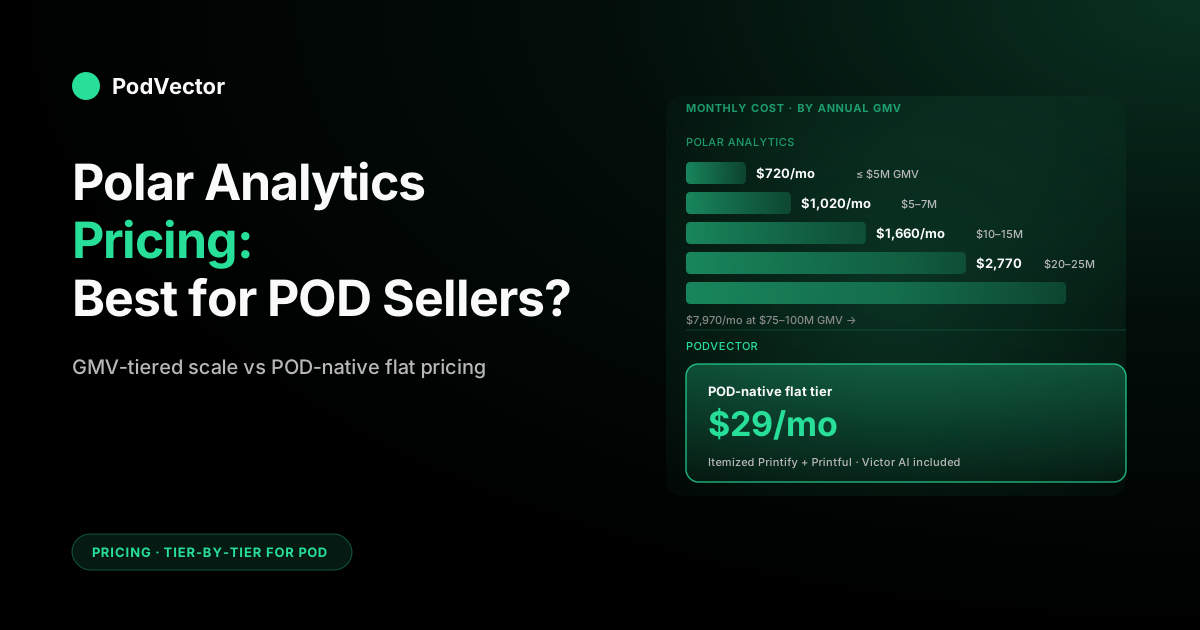
Quick Answer: Polar Analytics uses GMV-tiered pricing with no public price list — you pick your annual GMV and get a quote. The entry Core plan (Business Intelligence + AI Agents + Data Activations) starts around $300–$400/month for the smallest brands, but most operators report being quoted into the $720/month band at ≤$5M GMV, scaling to roughly $1,660/month at $10–15M and $7,970/month at $75–100M. Custom plans kick in above $20M, and paying annually saves about 20%. For POD specifically, Polar is usually not the best fit unless you are already a high-GMV brand with enough contribution profit to absorb a $700+/month analytics bill.
For print-on-demand sellers, the pricing math is awkward in two specific ways. The plan tier is keyed off GMV (gross merchandise value), but POD margin is typically 20–35% of GMV — so a POD store crosses Polar's pricing thresholds long before it has the contribution profit to absorb them. And the entry tier is priced for $3M+ DTC brands, not the sub-seven-figure POD operators where most Printify and Printful businesses live.
If you're weighing Polar specifically on the cost side, PodVector AI is the most direct POD-native alternative, starting at $29/month with itemized Printify and Printful supplier costs built in. Below is the full tier-by-tier breakdown, two real cost scenarios, and how to decide.
Polar Analytics pricing tiers (2026)
Polar doesn't publish a fixed price list. Instead, you select your annual GMV on the pricing page and get a custom quote, with the underlying tier structure showing roughly the same shape across reported numbers from current customers.
Here's the typical monthly cost by GMV band, based on widely reported customer pricing:
| Annual GMV | Approximate monthly cost | Annual cost |
|---|---|---|
| ≤ $5M | $720 | ~$8,640 |
| $5M–$7M | $1,020 | ~$12,240 |
| $10M–$15M | $1,660 | ~$19,920 |
| $20M–$25M | $2,770 | ~$33,240 |
| $75M–$100M | $7,970 | ~$95,640 |
| $100M+ | Custom enterprise | Quote |
Polar now packages this as two plans. The entry Core plan — "the essential data stack" — bundles Business Intelligence, AI Agents, and Data Activations together and is advertised as saving ~20% versus buying those products individually. For the smallest brands it lands around $300–$400/month, getting the dashboard, scheduled reports, alerts, unlimited connectors, and unlimited users.
Once you hit ~$1M in GMV, the practical entry point shifts toward the $720/month band — that's the price most growing DTC operators report paying on Core. Annual contracts are standard, and Polar offers around a 20% discount for paying annually upfront.
Above $20M GMV, you move into the Custom plan, a configurable stack that adds modules like Incrementality Testing, Polar Headless MCP, Klaviyo Audiences activation, and Advertising Signals on top of the base BI product. Pricing here is fully bespoke.
What's included on every Polar plan
Polar's pitch is that all plans get the same architectural foundation, with feature differentiation kicking in at the higher tiers. The base feature set is genuinely strong:
- Dedicated managed data warehouse. Each customer gets their own database (Polar runs on Snowflake under the hood), so you actually own and can query your data.
- Unlimited users. No per-seat add-on cost.
- Unlimited connectors. 100+ integrations across Shopify, Meta, Google, TikTok, Klaviyo, Amazon, and more.
- Unlimited historical data. No retention cliff at 12 or 24 months.
- Pre-built dashboards. Marketing, finance, retention, and product analytics templates wired up out of the box.
- Polar AI Agents. Now bundled into the Core plan — natural-language queries with visualized answers, plus agentic workflows that surface anomalies and draft analyses. (Note the framing: Polar's agents report on your data; they don't run the supplier-cost math POD sellers actually act on.)
- Dedicated success manager. Plus Slack channel and live chat support.
Higher tiers add the first-party Polar Pixel for attribution, intraday data refresh (instead of daily), Conversion API enhancement, sales forecasts, and a 99% uptime SLA. The Custom plan layers on incrementality testing, Polar Headless MCP (for AI agent integrations), and audience activation.
The model is "everything you'd want is on the platform — what you pay for is the data volume and the advanced modules." That's pricing logic that works cleanly for a multi-channel DTC brand and gets messier for POD, which we'll get to in a minute.
Total cost example: a $250K/year POD store
Let's work through real numbers for a typical POD operator. Imagine a Shopify store running Printify, doing $250,000 in annual GMV — solidly in the "growing solo founder" band.
Their P&L looks roughly like this:
- GMV: $250,000
- Printify supplier cost (base + shipping): $135,000 (54% of GMV — typical for apparel POD)
- Gross profit: $115,000 (46% gross margin)
- Ad spend: $75,000 (Meta + Google)
- Shopify + apps + payment processing: $12,000
- Operating profit: ~$28,000 (11% operating margin)
This store falls under the ≤$5M GMV band, so they'd land on the $720/month Polar tier. Annualized: $8,640 for the dashboard alone.
That's 31% of operating profit. Even after a 20% annual discount, you're at $6,912/year — still 25% of operating profit consumed by the analytics tool.
For comparison, this same store on PodVector AI at the $29/month tier would pay $348/year — about 1.2% of operating profit. The functional gap (multi-touch attribution, incrementality testing) matters for $5M+ DTC; for a $250K POD store, the missing features aren't moving any decisions.
Total cost example: a $5M GMV multi-channel brand
Now the case where Polar starts earning its price tag. A Shopify brand doing $5M GMV across Meta, Google, TikTok, and email/SMS, with a mixed Printify-plus-print-partner supplier model.
Their P&L:
- GMV: $5,000,000
- COGS (mixed POD + traditional): $2,250,000 (45% of GMV)
- Gross profit: $2,750,000 (55% gross margin)
- Ad spend: $1,500,000 (30% of revenue)
- Shopify Plus + apps + processing: $180,000
- Operating profit: ~$1,070,000 (21% operating margin)
At $5M GMV, Polar's tier sits at $720/month or $8,640/year — about 0.8% of operating profit. With a 20% annual discount: ~$6,912/year, or 0.65% of operating profit.
That's reasonable. At this scale, the multi-channel attribution layer, Polar Pixel, and incrementality testing genuinely change media-buying decisions. The math works.
The catch for POD operators specifically: Polar's gross margin reporting on the POD portion of this brand's catalog will still be optimistic by 8–22%, because POD supplier costs aren't modeled at the line-item level by default. You either build a custom warehouse transform or accept the inaccuracy. (For the deeper dive on this gap, see our Polar Analytics for POD sellers breakdown.)
Where Polar's pricing model misfits POD economics
Polar's pricing logic assumes the buyer's margin profile looks like a typical DTC brand: 60–70% gross margin, 15–25% operating margin, with the analytics tool consuming a fraction of a percent of contribution profit. That's a clean fit for a $5M skincare brand.
For POD, the same dollar of GMV represents structurally less profit, which makes GMV-tiered pricing misalign with what you can actually afford.
POD margin is half of typical DTC margin
A standard DTC brand with stocked inventory runs 60–70% gross margin. A POD store running Printify or Printful runs 25–45% gross margin — roughly half — because the supplier captures the production and shipping cost on every order.
Polar's tier thresholds were calibrated against the higher-margin profile. A $5M POD store generates ~$1M in operating profit; a $5M traditional DTC store generates ~$1.5–2M. Same Polar bill, very different ability to absorb it.
The first-party pixel premium pays for itself slowly in POD
Polar's biggest pricing premium kicks in when you turn on the Polar Pixel for first-party attribution. That's where the higher tiers earn their cost — better Meta and Google attribution typically lifts ROAS 10–20%.
For a brand spending $1M+/year on ads, a 15% ROAS lift is enormous. For a POD operator spending $50K/year on ads, a 15% lift is $7,500 — which doesn't cover the pixel-tier upgrade. The math just isn't there yet.
Custom warehouse work is on you
Getting accurate POD margin out of Polar requires custom warehouse modeling — joining Printify or Printful supplier line items against Shopify orders at the variant level, then transforming them into Polar's COGS model.
That work is doable. It's also a $5K–$15K agency engagement, or 40+ hours of an in-house analyst's time. Add that to the platform cost and the total annual investment for a POD-accurate Polar setup runs $13K–$25K — a tough number to justify below $5M in GMV.
PodVector AI pricing for comparison
PodVector AI was built for Shopify POD sellers running Printify and Printful, so the pricing model assumes POD margin reality from day one.
- Starter — $29/month. One Shopify store, Printify or Printful integration, itemized supplier costs, gross + operating P&L, daily refresh. Designed for sub-$50K/month operators.
- Growth — $79/month. Multi-store, Meta and Google ad spend integration, Victor (the AI employee), itemized POD margin reports.
- Scale — $129/month. Higher data refresh frequency, advanced cohorts, multi-region cost modeling, priority support.
The architecture is the same pattern Polar uses — a live data warehouse under an AI employee layer. The difference is the price point and the POD-native data model.
On the same $250K POD store from earlier, PodVector AI annualizes to $348/year — 1.2% of operating profit, vs Polar's 31%. The functional gap (no multi-channel incrementality testing, no Conversion API enhancement) doesn't drive decisions at that scale, so you're not paying for capacity you can't use.
Victor is included, not a premium add-on
Victor — PodVector AI's AI employee — ships on the Growth tier and up. Today, you can ask Victor questions in plain English ("which Printify SKUs lost money last week after ad spend?") and get answers pulled from your live data warehouse.
Victor is an AI employee: he answers your business questions and acts on them with your approval. Catching a Printify supplier price change at 3 a.m., cross-checking it against your average Meta CPA on that SKU, and flagging which three listings to pause — that's where the architecture is headed. (For the broader category direction, see our guide to AI agents for ecommerce analytics.)
Other alternatives at different price points
If neither Polar nor PodVector AI fits, the category has a few other reasonable picks at different price points.
Lifetimely (by AMP) — $34/month entry
Lifetimely is the LTV and cohort specialist. Pricing is closer to PodVector AI at the entry tier and scales by Shopify order volume.
For straightforward POD profit tracking, it's overkill on LTV cohorts and underkill on supplier-cost accuracy. Detail in our Lifetimely for POD sellers breakdown.
BeProfit — $25/month entry
BeProfit is the budget Shopify P&L app. It works as a starter tool if you're under $5K/month in revenue and just need rough margin visibility.
No native POD integrations means you're mapping Printify and Printful costs manually — workable at small scale, painful past a few hundred orders. Trade-offs in our BeProfit for POD sellers writeup.
Triple Whale — $129/month entry
Triple Whale sits between PodVector AI and Polar on price, with strong creative reporting and an AI assistant (Moby). It has the same POD supplier-cost limitation as Polar but is more affordable for a $1–3M brand.
For a multi-channel POD store running heavy Meta creative testing, it's a reasonable pick. For supplier-cost accuracy on Printify or Printful specifically, you'll still want a POD-native layer.
Conjura — $499/month entry
Conjura is a direct Polar competitor at the lower-mid market, with GMV-tiered pricing starting at $499/month for sub-$2M brands. It has cleaner UI than Polar and a similar feature footprint.
Same POD limitation, though — supplier costs aren't modeled at the line-item level for Printify or Printful, so you'd accept the same gross-margin inaccuracy.
For the full alternative landscape with apples-to-apples scoring, our complete POD software comparison covers eight tools across the same criteria.
How to decide: a stage-based pricing recommendation
The right price point depends less on absolute GMV and more on your contribution profit and what your bottleneck actually is. A practical framework:
Under $50K/month GMV: $29–$34/month tools only
At this stage, your operating margin (after supplier, ads, and platform fees) is probably $2K–$8K/month. Spending $720/month on Polar would consume 10–35% of that.
PodVector AI ($29) or Lifetimely ($34) cover the profit-visibility need at the right cost. The multi-channel attribution sophistication of Polar isn't moving any decisions yet — your spend is too concentrated and your margin too thin.
$50K–$300K/month GMV, single-channel POD: $29–$129 PodVector AI tier
This is where POD-native tools earn their place. You need accurate per-order Printify or Printful supplier costs, operating profit (not just gross), and ad-spend integration with Meta or Google.
PodVector AI's $79–$129 tiers handle this. Polar's $720/month tier overshoots — you'd be paying for cross-channel incrementality testing you don't run yet.
$300K–$1M/month GMV, multi-channel: evaluate both
Here the math gets interesting. If you're spending across Meta + Google + TikTok + email/SMS and your supplier mix is concentrated (mostly Printify or mostly Printful), Polar starts to earn its $720–$1,020/month price tag on the attribution side.
The honest answer for many brands at this stage is "PodVector AI for POD margin truth, plus a lighter-weight tool for cross-channel attribution" rather than one platform that does both well. Two tools at $200/month total often beats one at $720.
$1M+/month GMV, multi-channel: Polar (with a POD layer)
At this scale, Polar's warehouse-native architecture starts to matter independently. You'll want a managed warehouse you can extend with custom models, and you'll have the engineering or agency budget to fix the POD supplier-cost gap inside that warehouse.
Even at this stage, many POD-focused brands keep PodVector AI running alongside Polar specifically for the daily POD margin view, because building and maintaining the POD line-item model on top of Polar isn't free. See the PodVector AI resource hub for the deeper writeups.
FAQs
How much does Polar Analytics cost?
Polar's entry Core plan starts around $300–$400/month for the smallest brands. Most growing brands land on the $720/month tier (≤$5M GMV), with pricing scaling to $1,020 at $5–7M GMV, $1,660 at $10–15M, and $7,970 at $75–100M. Custom enterprise pricing applies above $20M GMV. Annual contracts get roughly a 20% discount.
Does Polar Analytics offer a free trial?
Polar doesn't publish a self-serve free trial. Onboarding goes through a sales conversation, with a guided implementation handled by your dedicated success manager. Demo videos are available on their site, and some plans include a brief evaluation period negotiated as part of the contract.
Is Polar Analytics worth it for POD sellers?
For POD sellers under $1M in GMV, Polar's pricing is hard to justify against the operating margin it consumes (often 20–30% of monthly operating profit). The platform is built for higher-margin DTC brands, and its COGS model doesn't natively handle Printify or Printful supplier line items without custom warehouse work. POD-native tools like PodVector AI cover the core profit-visibility need at 5–10% of the cost.
What's the cheapest Polar Analytics plan?
The lowest reported price is roughly $300–$400/month for the entry Core plan. In practice, most operators report being quoted into the $720/month band once they share their GMV. There's no self-serve sub-$300 starter tier for very small brands.
Does Polar Analytics charge per user or per seat?
No. All Polar plans include unlimited users and unlimited connectors, which is one of the genuinely operator-friendly parts of the pricing model. Cost scales with annual GMV and module additions, not seat count.
How does Polar Analytics pricing compare to Triple Whale?
Triple Whale's entry tier starts around $129/month and scales with order volume, while Polar's effective entry sits closer to $400–$720/month. Both scale steeply with revenue. Triple Whale tends to come in 30–50% cheaper at comparable scale, with the trade-off being less warehouse-native depth and a different attribution methodology.
What's the cheapest POD-native alternative to Polar Analytics?
PodVector AI starts at $29/month for Shopify POD sellers running Printify or Printful, with itemized supplier costs and operating P&L built in. That's a different product profile than Polar — POD-specific rather than multi-channel BI — but for the supplier-cost accuracy and operating margin use case that drives most POD seller decisions, it's the most direct alternative.
Are Polar Analytics' prices likely to change?
Yes. Polar publishes pricing dynamically through GMV-band quotes, and the tier thresholds and module pricing have shifted multiple times since 2022. The numbers in this article reflect widely reported customer pricing as of mid-2026, but always confirm current pricing directly on Polar's pricing page before making a buying decision.
POD margin truth, without the GMV-tier pricing trap
Polar's pricing scales with the gross dollars flowing through your store. PodVector AI's pricing scales with the size of your warehouse usage — which, for POD sellers, lines up with operating margin instead of GMV. If you sell on Shopify with Printify or Printful and you want itemized supplier costs, operating-profit visibility, and an AI employee (Victor) that knows POD economics, start at $29/month.
Try Victor free