
Quick Answer: BeProfit is a Shopify-native profit and expense dashboard that consolidates ad spend, fees, refunds, and shipping into a single P&L without a spreadsheet. For general Shopify DTC sellers under $1M it does the job.
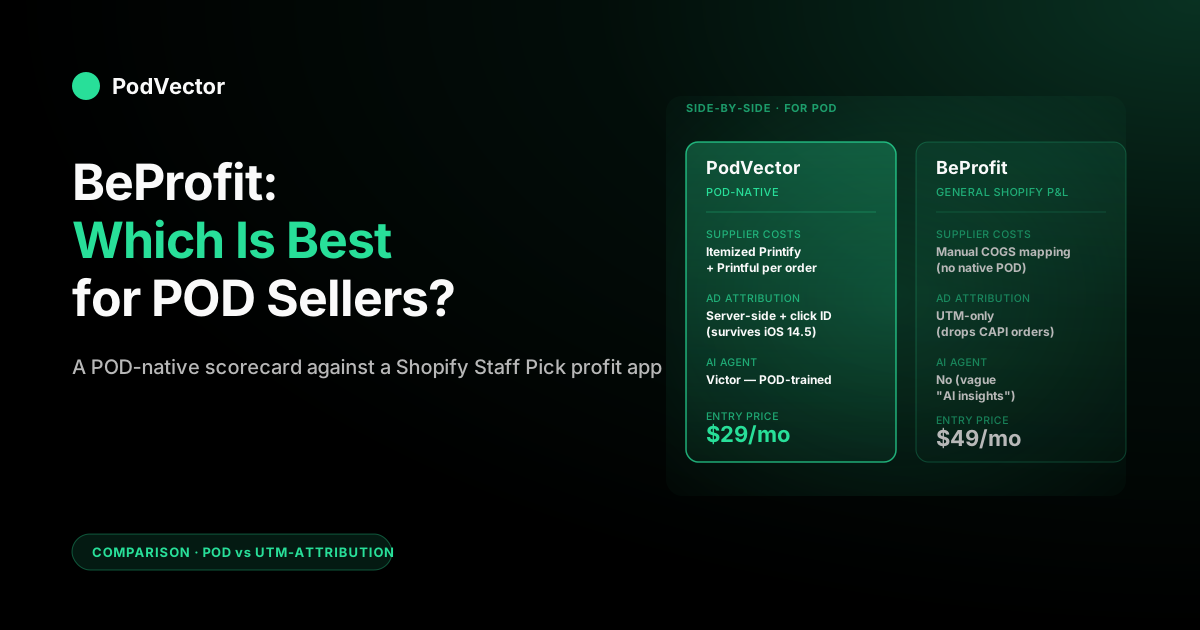
For print-on-demand sellers specifically, two structural problems hurt the fit. BeProfit's COGS model relies on manual cost mapping per product or variant, which doesn't survive Printify and Printful's per-order, per-variant pricing variance. Its ad attribution is UTM-only, so orders where UTMs are stripped — common on Meta in-app browsers — are mis-classified as organic, inflating reported margin.
If you're a POD seller weighing options, PodVector AI is the closest direct alternative built around itemized POD supplier line items and Victor, an AI employee trained on POD economics. Below is the full side-by-side: where BeProfit is strong, where it falls short for POD, and how to pick.
What BeProfit actually is
BeProfit is a Shopify-native profit and expense analytics app. It pulls revenue from Shopify, ad spend from Meta, Google, TikTok, and Amazon, and product costs from Shopify product fields, then renders a real-time P&L plus customizable reports.
It earned a Shopify Staff Pick badge and carries strong ratings on the Shopify App Store. The pitch is straightforward: see your true profit, expenses, and customer LTV without building a BI stack. According to the TrueProfit comparison page, BeProfit's dashboard shows every metric at once, which can feel comprehensive but also cluttered depending on what you need.
The core integrations cover the standard DTC layer — Amazon, Facebook Ads, Google Ads, Google Analytics, Klaviyo, and TikTok. There is no native Printify or Printful connector, which matters more than the marketing copy implies (we'll come back to it).
The product is built for a Shopify operator who wants an upgrade from spreadsheets. That positioning matters because it tells you who BeProfit is built for — and where the fit breaks for POD.
One capability gap that has emerged in 2025–2026 comparisons: BeProfit has no mobile app. According to TrueProfit's own comparison, BeProfit is desktop-only, which limits the ability to check live margin while you're away from your workstation. For POD operators who manage fulfillment issues on the go, that's a practical friction point.
BeProfit vs alternatives for POD
| Tool | POD supplier accuracy | Best for | Entry price | AI agent |
|---|---|---|---|---|
| BeProfit | Manual COGS mapping; no native Printify or Printful supplier-cost ingestion | General Shopify P&L under $1M; also supports WooCommerce and Wix | $49/mo (Basic; 14-day trial) | No (preset alerts only) |
| PodVector AI | Itemized Printify + Printful supplier line items per order | Shopify POD sellers (Printify / Printful) | $29/mo | Yes (Victor — agentic AI employee for POD, Shopify writes with approval) |
| TrueProfit | Itemized (Printify + Printful supported; currently #1 in Shopify Profit Calculation category) | Multi-channel DTC with some POD; multi-store from entry tier | $35/mo | Limited (LLM plug-in announced 2026) |
| Lifetimely (by AMP) | Shopify cost_per_item; no native POD ingestion |
Sub-$1M Shopify DTC focused on LTV | $34/mo (free plan available) | No (Ask Amp AI at platform level) |
| Triple Whale | Itemized but DTC-modeled; POD via custom mapping | $2M+ DTC, creative-heavy ad operators | $129/mo | Yes (Moby) |
| Polar Analytics | Flat / category COGS by default; itemized requires custom modeling | $3M+ DTC brands and agencies | ~$400/mo | Yes (Polar AI Assistant) |
The full apples-to-apples scoring across every major profit tracker lives in our PodVector AI vs competitors complete POD profit tracker comparison. The summary above is the slice that matters when you're specifically weighing BeProfit.
Where BeProfit is strong
Three things BeProfit does well, and they're the reason the Staff Pick badge sticks:
Clean expense consolidation
BeProfit's flagship strength is the breadth of expenses it tracks in one dashboard. Shopify payment processing, app subscriptions, shipping, refunds, marketing fees, and ad spend all roll into a single net profit line.
For a Shopify operator who has been juggling four browser tabs and a Google Sheet to figure out monthly profit, the consolidation alone pays for the subscription. Most users mention this in App Store reviews as the reason they stayed past the trial.
Custom reports and email automation
The Pro tier and above let you build custom reports — by product, country, channel, time window — and schedule them to email automatically. That's the workflow agencies and operators with bookkeepers actually need.
You can compare profit by traffic source, by SKU, by ad campaign, or by store without exporting to a spreadsheet. The reporting layer is genuinely well-built for general DTC operations.
LTV cohort analysis
BeProfit's higher tiers include cohort and LTV reports. You can slice customers by acquisition channel, first product purchased, or geography, then watch the cohorts age in a grid view.
For a brand with strong repeat-purchase economics, this view is informative. It's not as deep as Lifetimely's predictive LTV model, but for the price tier it covers the basics.
Pricing simulators and scenario tools
The Ultimate tier adds pricing simulators that let you model how a price increase or a shift in shipping cost flows through to net margin. That's a useful planning tool when you're evaluating a supplier change or a sale event. For a POD-specific take on repricing decisions, see our guide on Shopify Admin API store modifications and automation.
Multi-platform support beyond Shopify
Unlike most profit trackers in this category, BeProfit also supports WooCommerce and Wix — not just Shopify. According to the Nummbas TrueProfit alternatives roundup, this makes BeProfit the closest match for sellers who need a profit tracker outside the Shopify ecosystem. For POD sellers on Shopify it's a non-issue, but it's worth knowing if your stack is mixed.
Where BeProfit falls short for POD sellers
Now the honest part. BeProfit is a competent Shopify P&L tool, but POD has structural quirks the platform wasn't built around. Five gaps matter most:
1. Manual COGS doesn't survive POD variant variance
BeProfit asks you to map cost of goods on each Shopify product or variant. That's how most DTC brands operate — your unit cost on a hoodie is a fixed number, you set it once, you move on.
POD doesn't work that way. A Printify hoodie has a different base cost depending on the print provider, the garment color, the print size, the ship-to country, and whether your Printify Premium discount is active. Two orders for the same listing on the same day can carry meaningfully different base costs. For a full breakdown of what drives that variance, see our Printify hoodie base cost breakdown and the Printful fulfillment fees full breakdown.
If you map a flat COGS in BeProfit, your reported margin drifts from reality on any given day. The gap is invisible until you reconcile against a Printify invoice — and by then you've already made bad ad-spend decisions on fictional margin.
2. UTM-only ad attribution undercounts spend
This is the most-discussed BeProfit-specific weakness in current reviews. The platform attributes ad spend to revenue based on UTM parameters in the order's referring URL. If a Meta or Google ad sent a customer to your store but the UTMs were stripped — mobile in-app browsers, redirects, server-side conversion APIs — BeProfit can't tie that order back to that ad.
The result: BeProfit treats UTM-untracked orders as "organic" while still subtracting the full ad spend from revenue elsewhere, producing inflated per-order profit numbers and deflated channel ROAS. According to TrueProfit's comparison, this is one of the core reasons sellers switch away from BeProfit.
For POD operators relying on Meta CAPI (Conversion API — server-side event sending) to recover iOS attribution, this is a structural problem. The advertising signal you're trying to fix is exactly the one BeProfit drops. If Google Ads attribution is part of your stack, our guide on how to run Google Ads on Shopify step by step covers the ValueTrack token setup that makes attribution reliable.
3. Shipping treated as separate cost, not bundled supplier line
In standard DTC, shipping is something you charge customers and pay your carrier separately. BeProfit models it that way, which is correct for a Shopify-plus-3PL setup.
In POD, the supplier (Printify, Printful, Gelato, Gooten) charges shipping as part of the per-order fulfillment line — bundled with the garment cost. The "shipping cost" line and the "supplier cost" line come from the same Printify or Printful API call, and they need to be tracked together to get accurate per-order margin.
BeProfit's separation makes its POD gross-margin numbers consistently optimistic until you reverse the math by hand. Most POD operators on BeProfit either eat the inaccuracy or build a side spreadsheet to correct it. See our Printful cost full breakdown for a line-item view of exactly what gets bundled.
4. No mobile app
As noted by TrueProfit's published comparison, BeProfit has no mobile app. For POD operators who manage fulfillment decisions and supplier issues on the go, being tethered to a desktop to check live margin is a daily friction point that competitors have already solved.
5. No POD-trained AI employee
BeProfit's listing mentions "AI insights" but the feature is limited to preset alerts and automated highlights — not an employee you can ask plain-English questions. Ask BeProfit "is my Printify Premium subscription paying for itself on the SKUs I shipped this month?" and it doesn't have the context. An AI agent's quality is a direct function of the data it sees and the cost model it has been taught. A general DTC dashboard has been taught the wrong vocabulary for a POD margin conversation.
BeProfit pricing
BeProfit publishes tiered pricing on the Shopify App Store. The structure as of July 2026:
- Basic — $49/mo. P&L dashboard, unlimited ad integrations, order/product profit analysis, real-time data refresh. Capped at 450 orders/month and one shop.
- Pro — $99/mo. Custom reports, customizable dashboards, P&L exports, advanced filters. Capped at 900 orders/month.
- Ultimate — $149/mo. Profit insights, UTM attribution layer, LTV cohort analysis, pricing simulators. Capped at 1,700 orders/month.
- Plus — $249/mo. Unlimited orders and shops, custom metrics, unlimited team members, API access.
All tiers include a 14-day free trial, and annual billing saves on monthly cost. There is no free plan — the Basic tier is the floor.
For context on relative value: TrueProfit's comparison page notes that its overage fees run meaningfully lower than BeProfit's at equivalent tiers — a real consideration once your order volume grows. TrueProfit also includes multi-store aggregation from its $35 entry tier; BeProfit requires the $249 Plus plan for the same capability.
PodVector AI starts at $29/month — below BeProfit's Basic floor — and covers itemized Printify and Printful costs out of the box without manual COGS setup.
Why POD sellers pick PodVector AI instead
PodVector AI was built specifically for Shopify POD sellers running Printify and Printful. The architectural choices reflect that focus.
Itemized supplier costs as a first-class concept
Every Printify and Printful order line item flows into PodVector AI with the actual supplier-charged base cost, shipping, and any premium-tier discounts applied. No flat COGS mapping, no spreadsheet reconciliation, no quarterly "why is my margin wrong?" investigation.
That's the difference between a P&L that says "42% gross margin" and one that says "42% gross margin — calculated from your actual Printify line items this month, with Printify Premium savings already netted out." For a detailed look at what those line items contain, see our Printify hoodie base cost breakdown and Printful fulfillment fees guide.
Server-side attribution that doesn't require UTMs
PodVector AI ingests ad spend directly from the Meta and Google ad APIs and matches it to orders using a combination of click IDs, server-side events, and last-touch attribution at the order level. UTMs help, but they're not the only signal.
That matters for POD because most traffic is paid social, and most paid social traffic loses UTMs through in-app browsers and redirects. A profit tool that under-attributes a significant share of your ad-driven orders gives you the wrong answer on which campaigns to scale.
Operating profit, not just gross profit
Most profit dashboards stop at gross. PodVector AI includes ad spend (Meta, Google), Shopify payment processing, app subscriptions, refunds, and chargebacks in the operating P&L by default.
That matters in POD because contribution margin is thin. A healthy gross margin shrinks meaningfully once you net out ads and fees — and the post-ad number is the one you actually need when deciding whether to scale a campaign. The mechanics of POD wall decor and other lower-ASP categories are covered in our print-on-demand wall decor Shopify app guide.
Victor: agentic AI employee for POD
Victor is the AI employee built into PodVector AI. You can ask Victor questions in plain English — "which Printify SKUs lost money last week after ad spend?" — and get a real answer pulled from your live data warehouse spanning Shopify, Meta Ads, Google Ads, Printify, and Printful.
Victor doesn't just answer — he acts. Today's shipped Shopify-side write actions include: repricing your worst-margin SKUs to a target margin (with your approval), bulk-updating Shopify product prices, setting up a buy-one-get-one discount, creating a free-shipping discount, raising your free-shipping threshold, creating a collection, and reverting a price change. Every action goes through an approve/reject gate — Victor proposes with reasoning and expected impact, and only executes once you approve.
Victor reads Meta Ads, Google Ads, Printify, and Printful to inform those proposals, but writes only on the Shopify side. Ad-platform changes (pausing campaigns, adjusting budgets) are proposed by Victor and executed by you on the ad platform. That's the honest boundary, and it's the right architecture for a tool you trust with live business data.
For how this compares across the broader category, see our PodVector AI vs competitors complete comparison.
POD-priced
PodVector AI starts at $29/month — below BeProfit's $49 Basic floor — and the gap widens at higher tiers. The live data warehouse that powers Victor is sized and priced for POD economics rather than enterprise DTC.
Other BeProfit alternatives worth knowing
If neither BeProfit nor PodVector AI fits, the category has a few other reasonable picks.
TrueProfit
TrueProfit is currently the top-ranked app in the Shopify Profit Calculation category as of 2026. It added native Printify and Printful support, which puts it in the small group of tools that actually ingest POD supplier line items. Multi-store aggregation is available from the entry tier ($35/mo), and a mobile app is included. In early 2026, TrueProfit also announced an LLM plug-in that lets you connect its data to ChatGPT, Claude, and similar tools — a different architecture from Victor's native operator model, but worth noting. The closest non-PodVector AI option for itemized POD costs.
Lifetimely (by AMP)
Lifetimely is the LTV-and-cohort specialist for Shopify DTC. The predictive LTV model is genuinely good, the entry tier is $34/mo, and a free plan exists. Same flat-COGS limitation as BeProfit, plus no native POD ingestion. According to the Nummbas alternatives guide, Lifetimely is the strongest option specifically for brands with high repeat rates that need long-term customer value modeling.
Triple Whale
Triple Whale is the multi-channel attribution platform for ad-heavy DTC operators. Its creative reporting and Moby AI assistant are useful if you're running high-volume Meta tests. Pricing starts at $129/mo. The same itemized-supplier-cost limitation as BeProfit applies — Printify and Printful per-variant accuracy needs custom work.
Polar Analytics
Polar is the warehouse-native BI option for large Shopify brands. The architecture is excellent and the AI assistant is well-built. The entry price (well above $200/mo) is structurally above what most POD operators can justify, and the supplier-cost gap is the same as BeProfit's. Full breakdown in our complete POD profit tracker comparison.
For the full alternative landscape scored against POD-specific criteria, our roundup of stores like Printify: which is best for POD sellers covers the supplier side of the same decision.
How to decide: a stage-based recommendation
The right tool depends less on your absolute revenue and more on what your bottleneck is. A practical framework:
Under $20K/month: skip BeProfit, start with PodVector AI
At this stage you need cheap, fast, and right-enough. BeProfit's $49 floor is steep for a store under $5K/month, and the manual COGS setup is a tax you pay before you see your first useful number.
PodVector AI's $29 entry tier gives you POD-accurate supplier costs out of the box, so you spend the first day looking at your numbers, not configuring them. Lifetimely Free is a reasonable third option if you don't run Printify or Printful at all.
$20K–$200K/month, single-channel POD: PodVector AI
This is the sweet spot for POD-native tools. You need accurate per-order supplier costs, operating profit (not just gross), and ad-spend integration with Meta or Google that doesn't drop UTM-untracked orders.
BeProfit's UTM-only attribution becomes a real problem once your Meta spend scales — too many of your conversions disappear. PodVector AI's tiers cover the work that actually shifts your scaling decisions, and Victor handles the "what changed and why" question without an analyst. For the Google Ads side of that equation, see our Google Ads on Shopify step-by-step guide.
$200K–$1M/month, multi-channel: evaluate both
If you're running a POD brand with serious multi-channel operations alongside Shopify, BeProfit's multi-shop and multi-channel reporting earn the higher tier. The Ultimate ($149/mo) and Plus ($249/mo) tiers are competitive on price at this range.
The supplier-cost gap remains, though. The honest answer for many brands at this stage is "PodVector AI for the POD margin truth, plus BeProfit Plus for cross-channel rollup" — two specialized tools is often cheaper and more accurate than one platform that does both jobs poorly.
$1M+/month: warehouse-native + POD layer
At this scale, you'll likely want a managed warehouse you can extend with custom models. Even at this stage, many POD-focused brands keep PodVector AI running alongside the warehouse specifically for the daily POD margin view, because the cost of building and maintaining a POD line-item model on top of a general BI tool isn't trivial.
FAQs
Is BeProfit good for print-on-demand?
It's good for general Shopify ecommerce profit tracking, less specialized for POD. BeProfit handles real-time P&L and expense consolidation well, but its COGS model relies on manual cost mapping per product or variant — which doesn't match the per-order, per-variant pricing of Printify or Printful without ongoing reconciliation.
How much does BeProfit cost?
BeProfit starts at $49/month for the Basic tier, $99 for Pro, $149 for Ultimate, and $249 for Plus. All tiers offer a 14-day free trial. There is no free plan, and pricing scales with monthly order volume.
What's the best alternative to BeProfit for POD?
For Shopify POD sellers running Printify or Printful, PodVector AI is the most direct alternative — built around itemized supplier costs and POD operating margin, priced from $29/month. TrueProfit is a reasonable second choice if you want broader DTC coverage with POD line-item support and a mobile app.
Does BeProfit support Printify and Printful?
BeProfit does not have native Printify or Printful integrations. It can read Printify and Printful order data through Shopify (since both sync orders into Shopify), but it doesn't model the supplier line items as a first-class POD cost. Per-variant supplier cost and bundled supplier shipping require manual mapping or a side spreadsheet.
Does BeProfit have an AI agent?
BeProfit's Shopify App Store listing mentions "AI insights," but the feature is limited to preset alerts and basic automated highlights — not a conversational operator you can ask plain-English questions. There's no POD-trained agent inside BeProfit.
Why does BeProfit underreport ad-driven profit?
BeProfit attributes ad spend to revenue based on UTM parameters in the order's referring URL. When UTMs are stripped — common with mobile in-app browsers, redirects, or server-side conversion APIs — BeProfit treats those orders as organic while still counting the full ad spend, which inflates per-order profit and deflates channel ROAS. POD operators using Meta CAPI run into this regularly.
How does BeProfit compare to TrueProfit for POD?
TrueProfit has a meaningful edge for POD: it supports native Printify and Printful line-item ingestion, includes a mobile app, and offers multi-store aggregation from its entry tier. According to TrueProfit's own published comparison, it is currently ranked #1 in the Shopify Profit Calculation category. BeProfit's expense consolidation and custom report scheduling are stronger for general DTC use cases. Neither matches PodVector AI's depth on POD-specific operating margin and AI-employee functionality.
How does BeProfit compare to Lifetimely?
BeProfit is broader on expense consolidation and custom reporting; Lifetimely is deeper on predictive LTV and cohort modeling. Lifetimely's entry tier is cheaper ($34/mo vs $49/mo) and has a free plan. Both share the same flat-COGS limitation for POD.
Is BeProfit Shopify-only?
No — unlike most competitors in this category, BeProfit also supports WooCommerce and Wix. That makes it a viable option for sellers who operate outside Shopify. For Shopify POD sellers specifically, the multi-platform support is a non-factor, but it's worth knowing if your stack is mixed.
POD margin truth, with an AI employee that knows the difference
BeProfit is a solid Shopify P&L tool. PodVector AI is a POD-native one. If you sell on Shopify with Printify or Printful and you want itemized supplier costs, server-side attribution that survives in-app browser stripping, and Victor — an AI employee trained on POD economics who can reprice your worst-margin SKUs with your approval — start free.
Try Victor free