
Quick Answer: Polar Analytics sells itself as the performance marketing platform — one tool that unifies ad spend, Shopify revenue, attribution, and AI insights. For most established Shopify DTC brands, that single-platform pitch holds up.
For Print-on-Demand sellers, it doesn't. Polar's data layer treats supplier costs as a CSV upload, not a live join — which means the platform answers "what's my ROAS" but not "what's my Printify margin after Meta spend." That gap turns a premium performance marketing platform into a ROAS dashboard.
The POD-native answer is PodVector AI at $29/month flat, with Victor (an AI employee) included on every tier and Printify/Printful supplier invoices joined to Shopify orders at the SKU level. This article walks the five capabilities a real performance marketing platform needs, audits Polar against each, and shows where the POD fit breaks.
What "performance marketing platform" means in Polar's pitch
Polar's homepage now frames the product as "Your Shopify Analytics. Effortless. Centralized. Smart." According to Conjura's 2025 review, Polar has expanded from "originally positioned as a reporting layer" into "a flexible, self-serve analytics solution that supports rapid insight generation with the help of AI." Translated out of marketing speak: one tool replacing several — with an AI agent layer sitting on top of unified data.
The pitch is: instead of stitching together Shopify Analytics, Triple Whale for attribution, Lifetimely for LTV, and a manual COGS spreadsheet, you buy Polar and get all four in one dashboard. That's the single-platform promise.
It's an attractive promise. Stack consolidation is the dominant trend in DTC tooling right now — fewer logins, fewer reconciliation bugs, fewer per-seat fees. The question for POD sellers is whether Polar's single-platform implementation actually covers the work, or whether POD-specific gaps force you back into a multi-tool stack anyway.
To answer that, it helps to be specific about what a performance marketing platform must do. The five capabilities below are the minimum spec.
The five capabilities a real PMP needs
A platform that calls itself "performance marketing" — not "ad reporting," not "BI" — has to deliver all five of these. Miss any one and you're back to a stack of tools.
- Unified data layer. A single warehouse where Shopify, ad platforms, supplier invoices, and email data live together. Queryable, joinable, no CSV exports.
- Cross-channel ad ingestion. Native API connectors to Meta, Google, TikTok, and the long-tail channels — refreshed daily without manual intervention.
- Per-order COGS join. Supplier costs joined to each Shopify order at the line-item level so contribution margin (not just gross margin) is correct.
- Attribution that survives iOS. First-party tracking, server-side events, and a model that doesn't collapse when ATT or third-party cookies cut signal.
- AI / agent layer. A natural-language interface or autonomous agent that turns the warehouse into answers without you writing SQL or building dashboards.
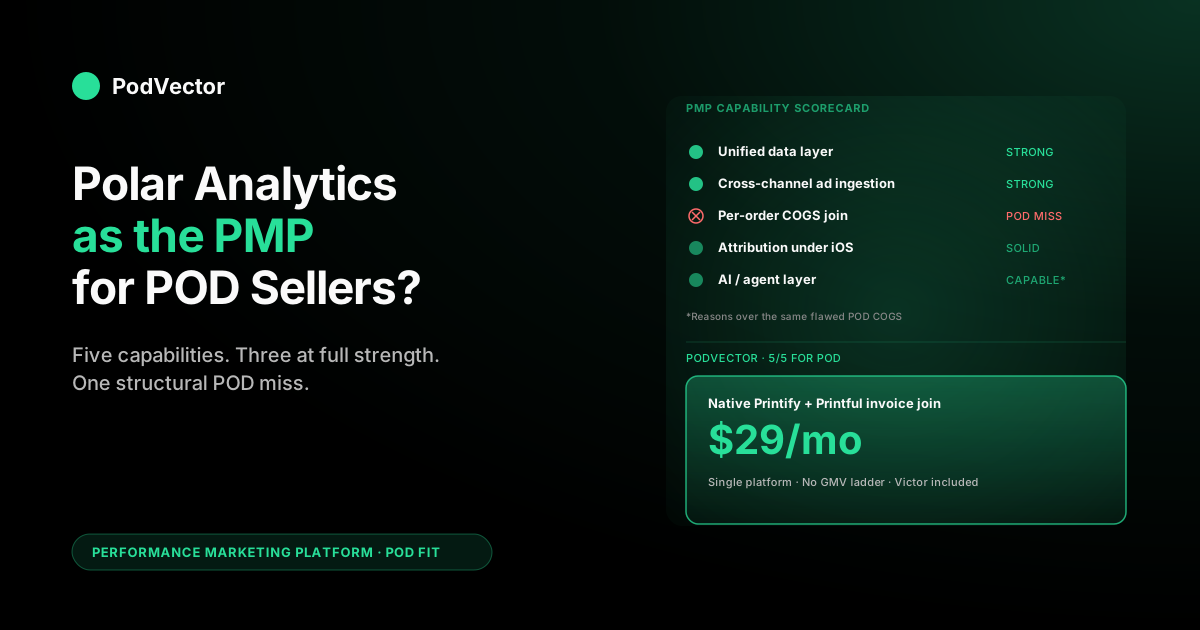
The next five sections audit Polar against each. The TL;DR: Polar nails three of them, partly delivers one, and structurally misses the one POD sellers care about most.
1. Unified data layer
Polar's strongest capability. According to Polar's own comparison page, every Polar customer gets "a dedicated Snowflake database with full SQL access and raw data export" — warehouse-grade infrastructure without hiring a data engineer to stand it up yourself. The semantic layer means "ROAS" is defined once and shows the same number everywhere. Reports stop disagreeing with each other.
For a Shopify DTC brand, this is genuinely best-in-class. You get the warehouse without the setup overhead. The first-party pixel adds lifetime ID and cross-device tracking for Shopify event capture, which keeps the data layer populated even as third-party cookies erode.
POD verdict: The infrastructure works. The problem is what's missing from the warehouse — see capability 3.
2. Cross-channel ad ingestion
According to Polar's vs-attribution page, the platform ships with "45+ native connectors out of the box," covering Meta, Google Ads, TikTok, Pinterest, Snapchat, Klaviyo, Recharge, and the channels a Shopify brand actually uses. One notable gap flagged by Conjura: no native Amazon Ads connector, which matters if you sell on Amazon as well as Shopify.
Refresh frequency is daily by default, with on-demand refresh on paid tiers. API errors are surfaced in-product rather than silently dropped, which matters more than it sounds — most "my dashboard is wrong" tickets in DTC tooling trace back to a broken connector nobody noticed.
Polar has also added a "Data Activations" layer on top of ingestion — Klaviyo Audiences that push customer segments back to email, and the CAPI Enhancer, which pushes enriched server-side conversion data back to Meta and Google. These help the channels you already run, not the ones POD is missing.
POD verdict: No POD-specific issue here. If you advertise on the channels Polar supports — and POD sellers almost always do, with Meta and Google Ads dominating — ingestion works the same as it does for any DTC brand.
For more on how ad-channel signal quality affects POD specifically, see our guides on ad frequency and signal decay and how to avoid ad fatigue.
3. Per-order COGS join
This is where Polar's single-platform pitch breaks for POD.
Polar models COGS through one of three paths: a per-product flat rate you set in the UI, a CSV upload you maintain manually, or an integration with an inventory tool like Cogsy or Inventory Planner. None of those are how Printify or Printful actually charge.
Printify charges a per-item base cost that varies by product, variant, color, size, and provider — and changes when providers adjust pricing. Printful's structure is similar with periodic discount tiers. A "flat rate per SKU" is wrong on day one for a multi-variant catalog and gets more wrong every time costs shift.
The result: Polar's contribution margin number drifts off real margin for a typical POD store with many active designs. That's not a minor calibration error — it's the difference between a campaign that looks profitable and one that's burning money. As Conjura's 2025 review notes, Polar "may fall short" when it comes to "SKU-level profitability" out of the box.
You can hire someone to maintain the CSV. But that adds reconciliation overhead to a tool that's supposed to reduce your operating cost — which is the opposite of the single-platform promise.
For a deeper look at how Printify's cost structure affects margin math, see our Printify t-shirt cost and profit breakdown and Printify sweatshirt cost and profit breakdown. For contribution margin methodology, see how to get contribution margin.
POD verdict: Structural miss. The capability exists in name; the implementation doesn't match how POD supplier billing works.
4. Attribution that survives iOS
Polar ships a first-party pixel, server-side event tracking, and a choice of attribution models. According to Polar's own help documentation, the platform provides "a comprehensive set of models — from traditional First Click and Linear approaches to advanced paid-overlap and full-impact models." The eCommerce Boardroom's April 2026 comparison adds that Polar "uses advanced statistical methods and machine learning algorithms to build attribution models" and "shares their methodology openly and provides confidence intervals with attribution data."
Polar has also added native incrementality testing — geo-based holdout experiments that measure whether ad spend actually drives sales, not just whether it gets credited. That closes part of the gap with Northbeam's ML-based incrementality model, and it's materially better than running on Shopify's native attribution alone, which collapsed for many brands when iOS 14.5 cut Meta's signal.
The catch for POD: incrementality tells you a channel is working, but it still measures lift in revenue, not lift in contribution margin. A campaign can be incrementally positive on revenue and underwater once Printify base costs come out — and Polar's COGS gap (capability 3) means it can't tell the difference.
For high-spend stores, Polar's attribution is genuinely strong. For POD stores at earlier stages, the more pressing question is whether the COGS gap is undermining every answer the attribution layer produces. Our checkout conversion rate optimization guide covers where attribution fits into the broader funnel picture.
POD verdict: Capability works, but the question for POD is whether attribution sophistication pays back when the margin layer underneath it is unreliable.
5. AI / agent layer
Polar has invested heavily here. According to Polar's vs-attribution page, the platform ships five purpose-built AI agents: Data Analyst, Media Buyer, Email Marketer, Inventory Planner, and MCP (a connector that lets an outside AI assistant query your Polar data directly). The AI layer is real and shipping — not vaporware.
The catch is that on the POD side, these agents don't know what Printify or Printful is — they reason against the same flawed COGS table the rest of the platform uses. Ask "which designs are losing money on Meta" and the agent answers using a margin number that's already wrong.
It's also worth being precise about what these agents do. Polar's are analyst-style: they answer questions and suggest. They surface a bid change; you go execute it in Meta. That's a different job from an operator that proposes the action and executes approved writes on your behalf — see the decision section below.
POD verdict: Genuinely capable AI layer reasoning over genuinely flawed POD data. The bottleneck isn't the agent — it's what the agent has to look at.
Polar's scorecard for POD sellers
Five capabilities. Polar delivers three at full strength, one at workable strength, and one with a structural POD gap.
| Capability | Polar's delivery | POD-fit verdict |
|---|---|---|
| Unified data layer | Strong — dedicated Snowflake warehouse, semantic layer, first-party pixel | Works for any DTC use case |
| Cross-channel ad ingestion | Strong — 45+ native connectors, daily refresh, CAPI Enhancer | Works for POD |
| Per-order COGS join | Weak — flat rate, CSV upload, or third-party app | Misses how Printify/Printful actually bill |
| Attribution under iOS | Solid — first-party pixel, multi-model, incrementality testing | Right fit at higher ad-spend volumes |
| AI / agent layer | Strong product — five purpose-built agents, MCP connector | Agents inherit the COGS gap |
Three of five at full strength is enough for most DTC brands. For POD specifically, the COGS gap pulls the AI layer down with it — which means two of the five capabilities don't deliver POD-correct answers regardless of how much you pay.
Single platform vs stacked tools
The whole point of a "performance marketing platform" is that you buy one thing instead of stitching together five. So the test is: does Polar's single-platform delivery actually let you skip the stack?
For an established Shopify DTC brand selling owned-inventory products, yes. The COGS gap doesn't bite because owned inventory has stable per-SKU costs that a CSV reflects accurately. According to Conjura's 2025 review, Polar's costs "can climb steeply" once your brand crosses the higher GMV tiers — particularly for advanced features like pixel attribution or Snowflake access.
For a Shopify POD seller, no. Even with Polar in place, you still need either (a) someone maintaining the COGS CSV monthly, or (b) a separate POD-aware tool joining supplier invoices to orders. Either way, you're back to a stack — except you're paying a premium platform price for the product that was supposed to eliminate the stack.
The alternatives split into two patterns.
Pattern A: POD-native single platform. Use a tool built around POD economics from day one. PodVector AI is the option here — Printify and Printful invoice ingestion, Shopify, Meta Ads, and Google Ads connectors, a live data warehouse, and Victor as the AI employee, all at $29/month flat. The single-platform pitch holds up because the COGS join is native, not bolted on.
Pattern B: Stack with explicit roles. Use Polar (or Triple Whale, or Northbeam) for cross-channel attribution and analytics, and pair it with a POD-specific tool for supplier costs. This works at scale but costs more in subscriptions and reconciliation time.
Which platform fits your POD store
Two questions narrow it down.
Question 1: Is your supplier-cost accuracy a real problem today? If you can name your last three Printify price changes from memory, you have fewer than 20 active designs, and your monthly COGS reconciliation takes under an hour — Polar's CSV approach is workable. If any of those is false, the COGS gap will dominate every other decision.
Question 2: How much are you spending on paid ads per month? Polar's attribution depth pays back at higher spend volumes. Below that threshold, you're funding capability you don't fully use.
| Your POD store | Best platform | Why |
|---|---|---|
| Early stage, lower ad spend | PodVector AI | $29/mo single platform, native POD COGS, Victor included |
| Growing, moderate ad spend | PodVector AI (or PodVector AI + a free attribution layer) | POD COGS dominates the decision; attribution depth is secondary at this scale |
| High GMV, high ad spend, small SKU count | Polar Analytics + manual COGS process | Attribution depth pays back; small SKU count makes CSV maintenance tolerable |
| High GMV, high ad spend, large SKU count | Polar + PodVector AI (stack) | Polar for attribution, PodVector AI for the POD COGS layer Polar misses |
The most common pattern: POD stores at earlier growth stages pick a single POD-native platform and skip Polar entirely. POD stores at significant scale often run both, with explicit roles assigned.
For more context on the financial math behind these decisions, see our Shopify Capital credit check guide and how to get Shopify Capital — both cover the P&L clarity you need before scaling ad spend.
Sibling reading: the six-platform performance marketing roundup covers Triple Whale, Northbeam, Rockerbox, and Lifetimely head-to-head. The PodVector AI comparison hub indexes every Polar comparison; the PodVector AI topic hub covers the broader product context.
FAQs
Is Polar Analytics actually one platform or a bundle of tools?
One platform. The data warehouse, semantic layer, ad connectors, attribution models, and AI agents all run inside the Polar product. You buy a single subscription. The single-platform claim is structurally correct — the question is whether that single platform covers POD's specific COGS join, which it doesn't natively.
What does "performance marketing platform" mean compared to "marketing analytics"?
Performance marketing platforms answer "is this ad spend profitable" — they pull spend, revenue, and margin together. Marketing analytics is broader and often includes brand metrics, web analytics, and SEO data. Polar markets as a performance marketing platform; Google Analytics 4 is closer to marketing analytics.
Can Polar Analytics handle Printify or Printful supplier costs?
Indirectly. You upload a CSV of your Printify or Printful base costs and shipping rates, and Polar applies them as flat per-SKU values. That works for a small, stable catalog. It breaks for any store running many active designs across multiple variants because supplier prices change and the CSV goes stale fast.
What does PodVector AI do that Polar doesn't?
Native Printify and Printful invoice ingestion. PodVector AI pulls supplier invoices line by line, matches them to Shopify orders at the variant level, and surfaces per-design contribution margin without manual CSV maintenance. Polar's flat-rate COGS approach can't reproduce this without third-party tools or an accounting workflow on top. Victor, the AI employee, also executes approved Shopify-side actions — such as repricing a product to a target margin — rather than just surfacing suggestions.
Is Polar Analytics worth the cost for a POD store?
It depends on your stage and SKU count. According to Polar's own pricing page, subscriptions start at around $400/month and climb for advanced features. The attribution and AI capabilities pay back at higher ad-spend volumes, but the COGS gap means you're still maintaining a parallel cost-tracking process. Most POD stores at earlier growth stages get more value from a $29/month POD-native platform plus Shopify's native attribution.
Do POD sellers need a performance marketing platform at all?
If you're spending meaningfully on paid ads each month, yes. Below a few thousand dollars in monthly spend, Shopify's native analytics plus a POD-aware profit tool covers it. Above that, you need attribution that ties ad spend to per-SKU contribution margin — otherwise you're scaling campaigns based on ROAS that ignores supplier cost variance. Polar's overview walks through the use case from the DTC angle.
What's the agentic AI angle?
Polar ships five purpose-built AI agents — Data Analyst, Media Buyer, Email Marketer, Inventory Planner, and MCP — that answer questions and surface suggestions. Victor on PodVector AI ships in the same direction with a different starting point: Victor reads live data across Shopify, Meta Ads, Google Ads, Printify, and Printful, proposes a typed action with rationale, and executes the approved action on Shopify — such as repricing a product or creating a discount — with your explicit sign-off. Polar's agents surface a recommendation; you go execute it. Victor closes the loop on Shopify-side actions with human approval at each step. Both are in the agentic direction; the difference is what data the agent reasons over and whether it can act.
The POD-native performance marketing platform
Polar Analytics is one of the strongest performance marketing platforms in DTC. It's also a premium-priced tool with a CSV-based COGS layer that doesn't match how Printify or Printful actually bill.
PodVector AI is the same category, built for Print-on-Demand. Native Printify and Printful supplier integration. Live data warehouse. Victor — the AI employee — included on every plan. $29/month flat.
Try Victor free