
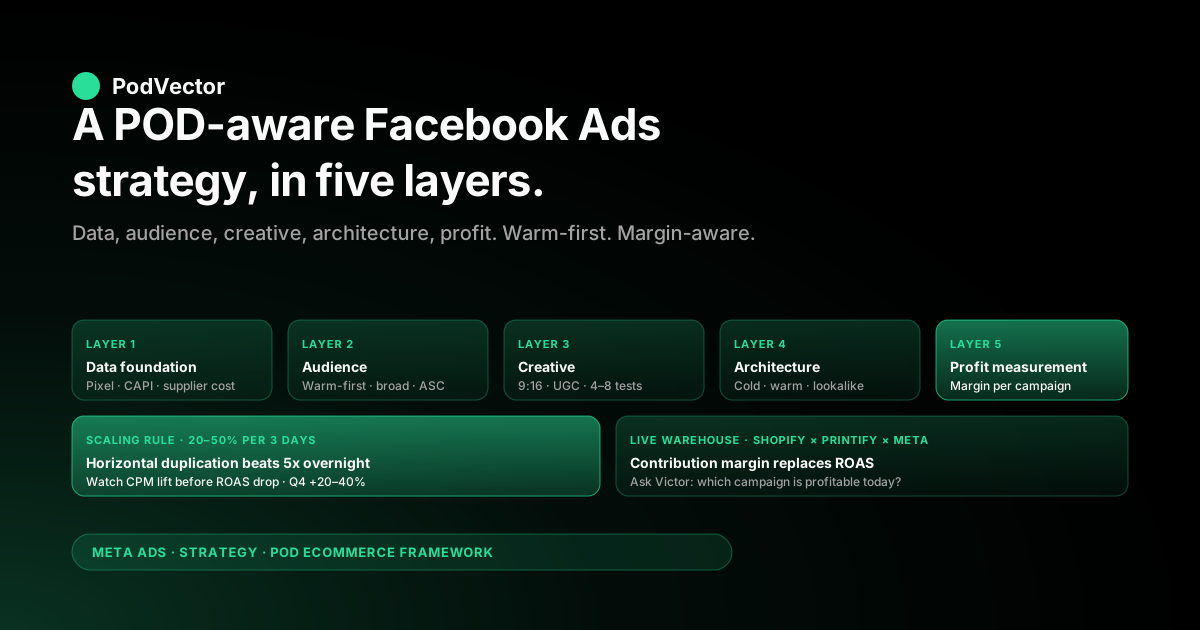
Quick Answer: A Facebook Ads strategy that works for owned-inventory ecommerce will quietly bleed money on print-on-demand because POD unit margins start 20–30 points lower. The strategy has to invert: warm-first audiences over cold prospecting, profit-per-campaign over ROAS, and supplier-cost data flowing back into Meta as the conversion value.
The five-layer framework below — data foundation, audience strategy, creative strategy, campaign architecture, and profit measurement — is the version that holds up when Printify or Printful invoices land three days after the click and reset the math.
This guide walks each layer with the POD-specific numbers, the campaign structure that keeps unit economics intact at scale, and the measurement layer that surfaces real contribution margin instead of dashboard ROAS.
Why generic ecommerce strategies misfire on POD
Most Facebook Ads strategies — including the comprehensive ones from agency blogs like Convertcart's 26 Secrets to Running Successful Facebook Ads — assume owned-inventory unit economics. Buy at wholesale, mark up 3x, run Meta against that gross margin. It works.
Print-on-demand inverts the cost stack. Printify, Printful, Gelato, or SPOD charge a per-unit production fee that already eats 35–55% of retail. Add platform fees, payment processing, and a Meta CPM, and a $25 SKU usually clears $5–$9 of contribution margin before any other costs.
That single difference — a 35–55% supplier cost line that arrives on a 3-day delay — bends every layer of the strategy.
Audience strategy bends. Cold prospecting CPAs of $20–$30 that are healthy for a $60 candle brand are loss-making for a $25 POD shirt. The strategy has to lean warm-first.
Creative strategy bends. "Test 30 variations and let Meta pick" only works if your unit economics can absorb the test cost. POD margins force tighter creative discipline.
Measurement bends hardest. ROAS is computed on pre-COGS revenue. For a brand running 20% gross margin on POD, a 3.0x ROAS campaign is at or below breakeven. The number that matters is contribution margin per campaign, after Printify costs land.
The rest of this strategy framework rebuilds the playbook around those constraints.
The five-layer Facebook Ads strategy framework
The strategy worth running has five layers, each one stacked on the previous. Skip a layer and the system above it breaks.
| Layer | What it does | POD-specific twist |
|---|---|---|
| 1. Data foundation | Captures every conversion signal Meta needs | Adds supplier-cost ingest as a first-class data source |
| 2. Audience strategy | Sends the right intent signals to the algorithm | Warm-first ratios; broad + Advantage+ over interest stacks |
| 3. Creative strategy | Earns attention and conversion in 3 seconds | Tighter test discipline; design + ad combo tracking |
| 4. Campaign architecture | Structures spend across funnel stages | 3-tier funnel with warm-heavy budget split |
| 5. Profit measurement | Decides what gets scaled and what gets killed | Contribution margin per campaign, not ROAS |
Treat the framework as a system, not a checklist. Brands that win on Meta in 2026 run their ad accounts as integrated systems, not collections of one-off campaigns.
Layer 1: Data foundation
If the data going into Meta is broken, every other layer compounds the damage. The data foundation is non-negotiable and has three components for POD.
Component A: Meta Pixel + Conversions API in dual-track mode
The browser-side Pixel still misses 18–35% of conversions in 2026 — iOS privacy enforcement, ad blockers, and consent banners all shave the signal. Conversions API (CAPI — Meta's server-side tracking endpoint) catches what the browser misses by sending purchase events directly from Shopify to Meta.
Run both. Meta deduplicates between them as long as event IDs match. The Pixel and Conversions API setup guide for POD sellers walks the wiring.
Without dual-track conversion tracking, your audience signal degrades, your retargeting pools shrink, and Meta's algorithm misallocates spend toward ad sets that look like winners on the dashboard but aren't.
Component B: Conversion value override (post-discount, not subtotal)
Default Shopify integrations send the pre-discount order subtotal as the conversion value. That's a problem on POD. A 20%-off order looks like more revenue to Meta than it actually is, and the algorithm scales toward orders that don't clear the bank.
The override: send the actual post-discount, post-tax order total to Meta as the conversion value. The cleanest pattern sends contribution margin (revenue minus supplier cost minus fulfillment) as the value parameter — but post-discount total is the floor every POD store should hit.
Component C: Supplier-cost ingest
This is the layer most POD operators don't think of as part of their ad strategy, and it's the one that quietly breaks measurement.
Printify and Printful invoices arrive 1–3 days after the order. They include the actual production cost, which differs from the catalog cost when production-time premiums or surcharges apply. Without that data flowing into your reporting, your "ROAS" numbers are computed against an estimated cost that drifts 3–8% from reality on a normal week and 10–15% during peak.
The complete Meta Ads playbook for POD sellers covers the supplier-cost ingest layer in detail. The short version: pull invoices into a single source of truth nightly, join them to Shopify orders by line-item ID, recompute contribution margin per order, then feed the corrected number back into your campaign decisions.
Layer 2: Audience strategy
The biggest strategic shift in Meta Ads over the last 24 months: the algorithm now rewards broad targeting more than tightly-stacked interests. Brands still building 20-interest audience trees in Ads Manager are running 2018 strategy in 2026 conditions.
Broad targeting + Advantage+ as the default
Lead with broad targeting (no interests, geo + age/gender minimums only) or Advantage+ Shopping Campaigns. Meta's targeting model now uses the conversion signal you feed it (Pixel + CAPI) to find buyers more efficiently than any manual interest stack.
For POD specifically, broad works even better than for owned-inventory ecommerce. Designs already encode niche signal — a "1968 Mustang restoration" shirt advertised broadly will find Mustang restorers because the creative does the targeting. Stacking "1965-1972 Ford fans" interests on top of that just shrinks the auction.
Custom audiences before lookalikes
Custom audiences (90-day buyers, 7-day site visitors, email subscribers) are the warmest, cheapest CPAs in the building. Lookalikes built from those custom audiences are next.
The order matters. A lookalike of a low-quality custom audience is a low-quality cold audience. Build your custom audiences cleanly first — purchasers segmented by AOV, not just "all customers" — then build lookalikes off the high-AOV segment.
Warm-first budget split
The conventional ecommerce split is roughly 70% cold prospecting, 30% warm retargeting. POD inverts that. Recommended starting allocation:
- Warm retargeting (customer list, site visitors, ATC abandoners): 35–45% of budget
- Lookalike audiences (1–3% from customer list): 20–30% of budget
- Cold prospecting (broad targeting, Advantage+): 30–40% of budget
The math: warm CPAs typically run $4–$10, lookalike CPAs $10–$18, cold CPAs $18–$30. On a $25 POD SKU with $7 contribution before ads, only the warm and lookalike layers reliably clear contribution. Cold acquisition is real, but it's a slower, smaller share of the spend than owned-inventory brands run.
The deeper logic of this audience inversion is in the Facebook Ads for Ecommerce Strategy for POD — it covers why the SERP's broad consensus on cold-heavy spend isn't the right starting point for thin-margin catalogs.
Layer 3: Creative strategy
Creative is now the highest-leverage variable in a Meta account. Targeting has been commoditized by Advantage+; creative is where brands differentiate.
Mobile-first vertical formats
Reels-native 9:16 video continues to deliver cheaper CPMs than Feed placement — typically 20–35% cheaper for ecommerce in 2026. Most POD stores still ship square or 1:1 creative because it's easier to produce. Reformatting to 9:16 is the highest-ROI single change you can make this quarter.
The structure that performs: hook in the first 2 seconds, product reveal by 4 seconds, social proof or offer by 8 seconds, CTA close by 12 seconds. Total length 12–20 seconds for cold, 6–12 seconds for warm.
UGC over polished brand video for cold audiences
A counter-intuitive pattern: user-generated content (UGC) outperforms polished brand creative on cold audiences for POD. The mechanism is trust — a buyer who's never seen your brand defaults to skepticism on a glossy ad and engages more with a clip that feels like a real customer.
The cheapest scalable UGC source is your existing customer list. Send a 15% off code to recent buyers in exchange for a 30-second product clip. A handful of those, lightly edited with on-screen captions, will outperform months of brand-shoot output.
Carousel for catalogs, single-product for designs
Carousel ads work best when you're showcasing a related product family or a tiered offer. They underperform for POD when the catalog is a wide range of unrelated designs — a carousel of unrelated SKUs reads as scattered, not as a curated set.
For most POD stores, the strategic creative split is 60% single-product video, 25% carousel for tight collections, 15% static for promo or seasonal hooks.
Creative test discipline
Owned-inventory brands can afford to test 30 creatives in parallel. POD margins force tighter discipline: 4–8 creatives per ad set, with a clear winner identified inside 7 days, then rotated against fresh challengers.
The Facebook Ads Shopify strategy guide covers the creative-rotation cadence in more detail.
Layer 4: Campaign architecture
Three campaigns is the baseline structure that keeps Meta out of perpetual learning phase while giving you enough resolution to decide what's working.
Campaign 1: Cold prospecting (Advantage+ Shopping)
Use Advantage+ Shopping Campaigns (ASC) for cold acquisition. ASC takes broad targeting plus your customer list as a starting input and lets Meta blend new-customer and existing-customer optimization automatically.
Configure ASC with a "new customer percent" cap of 60–80% — this forces Meta to spend most of the budget on actual prospecting rather than reselling to warm buyers (which would inflate ROAS without growing the customer base).
Daily budget: at least $50 to clear the learning phase quickly. Below that, ASC will struggle to find a stable signal.
Campaign 2: Warm retargeting (Conversion / Purchase)
Two ad sets, one for each major warm segment:
- Site visitors and ATC abandoners (7-day to 30-day window, exclude purchasers)
- Customer list (90-day, 365-day, and lifetime — separate ad sets if budget allows)
Creative leans offer-led for the customer list (cross-sell, repeat-purchase, restock) and product-led for site visitors (the product they viewed, with social proof and urgency). The retargeting ads guide covers the audience-window logic.
Campaign 3: Lookalike scaling (Conversion / Purchase)
One campaign with 1–3% lookalikes built off your highest-AOV custom audience. This is the bridge between warm and cold — the closest you can get to warm-audience CPAs while still acquiring new customers.
Pause this campaign if cold ASC is delivering acquisition CPAs in the same range. The lookalike layer is most valuable when ASC is struggling on new-customer signal.
Bid strategy: Highest Volume by default
For most POD stores, Highest Volume (Meta's default) outperforms Cost Cap or Bid Cap. Cost Cap requires a longer learning phase that POD margins can rarely afford to fund. Bid Cap risks under-delivery on the back half of any time-bound window.
Switch to Cost Cap only when you have 50+ purchases per ad set per week and a clean CAC target. Below that volume, the strategy is data-starved.
Budget consolidation
If you're running fewer than 5 conversions per ad set per week, consolidate. Meta needs roughly 50 conversions per ad set per week to leave the learning phase reliably. Three campaigns with $20/day each will perform worse than one campaign with $60/day.
Layer 5: Profit measurement
The measurement layer is where most POD Meta Ads strategies quietly fail. The dashboard says "winning"; the bank account says "losing." Both can be true at the same time.
Why ROAS misleads on POD
ROAS = revenue / ad spend. It's pre-COGS, pre-supplier-cost, pre-payment-fees. For a brand running 65% gross margin on owned inventory, ROAS is a reasonable proxy for profit. For a POD brand running 30–40% gross margin, ROAS overstates profitability by a factor of 2 or more.
A 4.0x ROAS campaign on a 35% gross-margin catalog leaves roughly $1.40 of contribution per dollar spent, before payment fees and shipping absorption. The same 4.0x ROAS on a 65% gross-margin brand leaves $2.60. Same ROAS, very different campaigns. The complete guide to Meta Ads ROAS and attribution for POD walks the math by gross-margin tier.
The number that decides scale: contribution margin per campaign
Contribution margin per campaign = (orders attributed to the campaign × average post-COGS contribution per order) − ad spend on the campaign.
Compute it nightly. The campaigns with positive contribution scale; the ones with negative contribution get killed regardless of ROAS. This single metric replaces the entire ROAS dashboard for spend decisions.
The four data sources you have to join
To compute contribution margin per campaign, four data streams have to come together:
- Shopify orders — line items, discounts applied, payment fees
- Printify or Printful invoices — actual supplier cost per line, including any production-time premiums
- Meta ad spend — by campaign, ad set, ad, with attribution windows
- Attribution model — which campaign gets credit for which order
Most POD operators reconcile these in spreadsheets, weekly at best. By the time the spreadsheet refreshes, the campaign that broke unit economics on Tuesday has burned a week of budget.
The infrastructure: a live data warehouse
The structural fix is a live data warehouse — a unified data layer that joins Shopify, supplier invoices, and Meta ad spend in near-real-time. The warehouse can be Snowflake, Redshift, Databricks, or any cloud-native option you prefer; the critical decision isn't the vendor, it's that the data lives in one place and updates fast enough to drive same-day decisions.
Victor — PodVector AI's AI employee for POD sellers — sits on top of that warehouse. During a high-spend day you can ask "which campaign's actually profitable in the last 6 hours, after Printify costs land?" and get a concrete number with the underlying breakdown, not a Monday-morning recap.
Scaling without breaking unit economics
Scaling Facebook Ads on POD is the part that breaks more accounts than any other phase. The pattern: a campaign hits 4x ROAS on $50/day, the operator scales to $300/day expecting 4x to hold, and CPM rises while CTR fatigues. Two weeks later the account is at 2.1x ROAS and unit margin is negative.
The 20–50% rule
Increase spend on a winning campaign by 20–50% per 3-day window, not 5x overnight. Larger jumps re-trigger learning phase and Meta's algorithm has to rebuild signal — usually at higher CPMs because broader audiences re-enter the auction.
Horizontal scaling over vertical
Once a winning ad set is at $200–$300/day, vertical scaling slows. The next move is horizontal: duplicate the structure with new creative against a fresh lookalike, rather than dumping more budget into the same ad set.
The scaling Facebook Ads strategy guide walks the horizontal duplication playbook in detail.
Watch CPM, not just ROAS
When you scale, CPM tends to rise before ROAS visibly drops. A 20% CPM lift on flat CTR is the early warning that you've outgrown your audience pool. Catch it early and you can redirect spend to a fresh lookalike or a new creative angle before the math goes negative.
Seasonal scaling rules
Q4 changes the math. CPMs lift 20–40% across most ecommerce verticals from late October through December. The campaigns that scaled cleanly at $1.20 effective CPC in September will land at $1.50–$1.70 in November. Plan budget and floor pricing for that lift in advance — the seasonal POD playbook covers the Q4 cadence in full.
Eight strategic mistakes that drain a POD ad budget
- Running 2018 strategy in 2026 conditions. Tightly-stacked interest audiences, dozens of ad sets, and manual audience curation are now beaten by broad targeting + Advantage+ on a clean Pixel signal. Strategy moved on.
- Treating ROAS as profit. ROAS is pre-COGS revenue. On 30–40% gross-margin POD catalogs, a 3.0x ROAS is roughly breakeven before payment fees and shipping absorption. Track contribution margin per campaign instead.
- Ignoring the supplier-cost data layer. Catalog supplier costs drift 3–8% from invoice reality on a normal week. Without invoice ingest, your "profitable" campaigns are running on stale math.
- Front-loading cold prospecting. POD margins don't usually clear cold acquisition CPAs cleanly. Warm-first budget splits convert more profitably; cold becomes the slower expansion layer rather than the front door.
- Sending pre-discount conversion value to Meta. The algorithm optimizes against the value parameter you send. Send post-discount, post-COGS profit when you can. Send post-discount total at minimum.
- Testing 30 creatives in parallel. POD margins force tighter test discipline than owned-inventory ecommerce affords. 4–8 creatives per ad set, decisive cuts at 7 days.
- Scaling 5x overnight. Triggers learning-phase reset, CPM lift, ROAS collapse. The 20–50% rule per 3-day window is the boring discipline that holds.
- Skipping CAPI. Browser-only Pixel underreports purchases by 18–35% in 2026. Without server-side conversion tracking, audience pools shrink and Meta misallocates spend toward worse-performing ad sets.
FAQs
What's the right ROAS target for Facebook Ads on a POD store?
It depends on your gross margin. Most POD stores need 3.5x–5.0x ROAS for a campaign to be unit-profitable after supplier costs, payment fees, and shipping absorption. Calculate your specific number by dividing $1 by your gross margin percentage (e.g., 35% gross margin = ~2.86x ROAS to break even on COGS alone, then add ad spend on top).
Should I use Advantage+ Shopping Campaigns or manual campaigns?
Use Advantage+ Shopping Campaigns (ASC) as your cold prospecting layer. They consistently outperform manual interest-based campaigns in 2026 conditions. Keep manual campaigns for warm retargeting and lookalikes where you want explicit audience control.
How much should I spend per day to start a Facebook Ads strategy on POD?
Minimum $50/day to clear the learning phase on a single campaign. Below that, Meta's algorithm doesn't get enough conversion signal to optimize. If your budget is below $50/day total, run one campaign with all the spend rather than splitting it across three.
How do I know if my Facebook Ads strategy is actually profitable on POD?
Compute contribution margin per campaign: (orders × post-COGS contribution per order) − ad spend on the campaign. ROAS will always overstate profitability for POD because it doesn't account for the 35–55% supplier cost line. Build the contribution margin metric into your reporting and use it as the primary scaling decision.
How long should I let a new Facebook Ads campaign run before judging it?
7 days minimum. Meta's learning phase needs roughly 50 conversions per ad set to stabilize, and the first few days of any new campaign are noisy. Killing campaigns at day 3 because ROAS is below target is the most common avoidable strategy mistake on POD.
What's the difference between a Facebook Ads strategy and a Facebook Ads tactic?
Strategy is the system: data foundation, audience layers, creative discipline, campaign architecture, and measurement. Tactics are individual moves inside that system: which hook to test, which creative format to ship, which audience to retarget. Strategy is what survives a month; tactics are what you change weekly.
Do Facebook Ads still work for ecommerce in 2026?
Yes, decisively. Meta's algorithmic targeting and the AI-driven creative tools have made the platform more effective for ecommerce, not less. The change is that the strategy that wins in 2026 is different from the strategy that won in 2018 — broad targeting + creative + clean conversion data, not interest stacks + manual audiences.
How is a Facebook Ads strategy different for POD versus traditional ecommerce?
The five layers are the same. The numbers in each layer shift. Audience strategy leans warmer because cold CPAs are harder to clear on thin margins. Measurement uses contribution margin instead of ROAS. Supplier-cost ingest becomes a first-class data source. The complete Meta Ads playbook for POD sellers walks every difference.
Can I run Facebook Ads strategy on Shopify without an agency?
Yes — most successful POD operators do. The infrastructure that used to require an agency (Pixel + CAPI setup, audience strategy, attribution) is now self-serve through Shopify's Meta integration plus an AI employee layer for the measurement work. The step-by-step guide to running Facebook Ads on Shopify walks the in-house path.
What's the simplest first version of this strategy I can run this week?
Three things: (1) confirm Pixel + CAPI are both firing, (2) set up one Advantage+ Shopping Campaign at $50/day with broad targeting, (3) build a contribution margin per campaign report (even in a spreadsheet) that joins Shopify orders to Printify or Printful supplier costs. That gets you 80% of the strategic upside before any optimization.
Run a Facebook Ads strategy with profit-per-campaign in the loop
The reason most POD Facebook Ads accounts plateau: the strategy is fine, but the measurement layer is computed against pre-COGS revenue, so the algorithm scales toward the wrong campaigns. ROAS says winning. The bank account says losing. Both are true.
Victor is the AI employee for POD sellers that joins your Shopify orders, Printify and Printful supplier costs, and Meta ad spend into a live profit view — so you can ask "which campaign is actually profitable this week after supplier costs?" and get a numerical answer in seconds, not a Monday-morning recap.
Free to start. Five-minute setup.
Try Victor free