
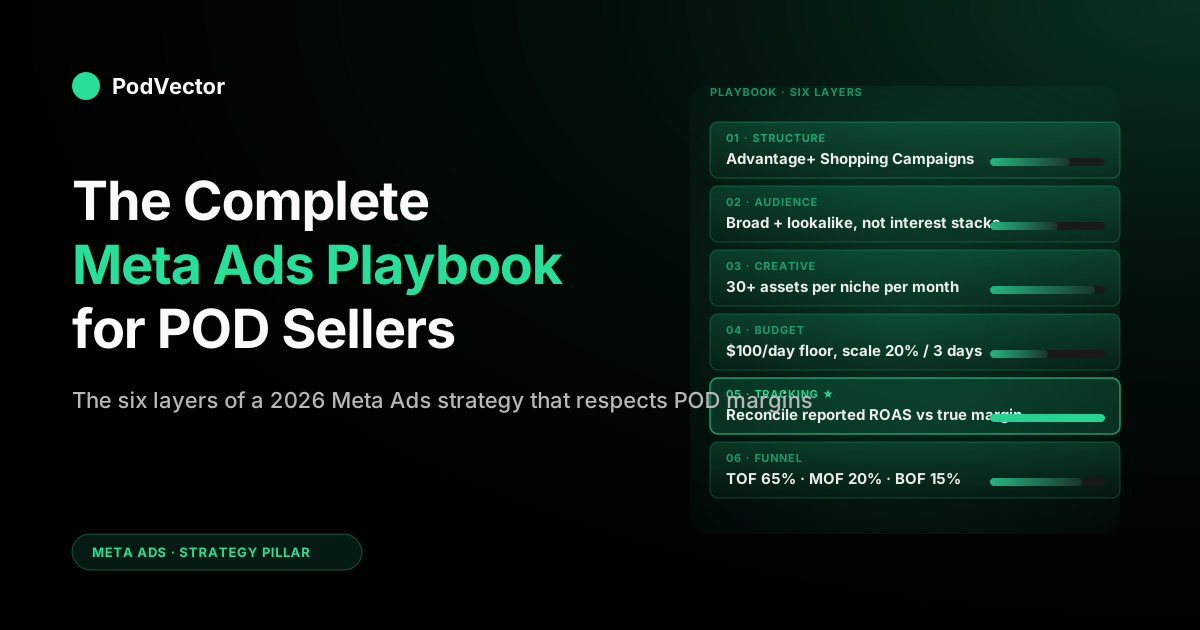
Quick Answer: A working 2026 Meta Ads playbook for print-on-demand has six layers: a clean account structure built around Advantage+ Shopping Campaigns (ASC), an audience strategy that leans on lookalikes plus broad targeting (interest stacks are mostly cosmetic in 2026), a high-volume creative engine producing 30+ assets per niche per month, a budget framework that respects the $100/day-per-ASC learning floor, attribution that reconciles Meta's reported ROAS against itemized Printify/Printful supplier costs, and a funnel structure where TOF prospecting feeds a tightly-segmented retargeting layer. The single biggest leverage point is not any of those mechanics — it's whether your tracking lets you see true margin per ad set, since Meta will happily report 3x ROAS on a campaign that's losing $4 per order. This guide walks all six layers, with the POD-specific calls the generic guides miss.
Why POD breaks generic Meta Ads playbooks
Most "Meta Ads strategy" guides assume one of two business models: a direct-to-consumer brand with fixed COGS shipping from a warehouse, or a lead-gen business measuring cost-per-form-fill. Print-on-demand fits neither.
Your costs are itemized per order — supplier price, blank cost, print fee, shipping, platform fee, product variant — and none of those numbers appear inside Meta Ads Manager. That mismatch is the single biggest reason POD operators pour budget into Meta while their dashboard tells them everything is fine.
Concrete version. Meta reports ROAS as revenue divided by ad spend.
For a DTC brand with $8 COGS on a $30 product, a 3x ROAS leaves roughly $14 of contribution per $10 of spend after COGS. Healthy.
For a POD seller running the same campaign on a Printify hoodie, the supplier cost is $18, shipping is $5.50, and the platform fee on top is another $2 — leaving $4.50 of contribution per $10 of spend. Same dashboard number. One business is profitable; the other is paying Mark Zuckerberg to slowly drain the bank account.
Every recommendation in this playbook is framed around that reality. The right campaign type, audience, and creative pattern for a POD seller is not always the one a generic Meta tutorial would suggest, and the floor for "this ad is working" is materially higher than the Ads Manager dashboard implies.
If you only take one thing from this guide: do not run Meta Ads against a POD store without a tracking layer that can attach itemized supplier cost to each order. Skip ahead to the tracking section if you want the specifics.
The 2026 baseline: what changed and what it means for POD
If your Meta Ads playbook was written before late 2025, it's already wrong on at least four counts. Meta has made more structural changes in the last 12 months than in the prior three years combined, and most of them push the platform further toward "give us your products and budget; we'll handle the rest." That has compounding implications for POD sellers who are used to managing tight, segmented campaigns by hand.
What Meta shipped in late 2025 and early 2026
- The Andromeda retrieval algorithm rolled out across the ads system in March 2026, replacing the prior matching infrastructure. It's roughly 100x faster at matching users to ads and can evaluate 10,000x more creative variants in parallel. Practical implication: creative volume is now a primary lever, not a secondary one.
- Advantage+ Shopping Campaigns (ASC) became the de-facto default for ecommerce sales objectives. Manual sales campaigns still exist but Meta is quietly de-prioritizing them in delivery and in the recommendation surface.
- The 1-ad-per-ad-set ceiling was removed. You can now run up to 50 ads per ad set, and Meta's algorithm allocates budget across all of them based on real-time performance.
- The practical learning-phase floor moved from $50/day to $100/day per campaign for Advantage+. Sub-$100 budgets technically run but exit learning slowly, which on a 30-day testing horizon means you never get clean signal.
- iOS attribution windows continue to compress. The 7-day-click default is intact, but view-through is increasingly noisy. Server-side tracking via the Conversions API (CAPI) is now table stakes, not a nice-to-have.
Why this matters more for POD than for traditional DTC
Three reasons. First, ASC's default behavior is to spread budget across your full catalog and find the buyer-product matches the algorithm thinks will convert.
For a 10-SKU DTC brand, that's fine — there are only 10 things to test. For a POD store with 200 designs, ASC will happily blow through your budget testing combinations you'd never have shipped manually.
Second, the higher learning-phase floor punishes the small-budget testing patterns that older POD ads guides recommend ($1/day testing campaigns are effectively dead for sales objectives). Third, the more Meta optimizes against its own conversion signal, the more critical it becomes that the conversion signal you send Meta reflects profitable orders rather than just orders.
For the deep dive on what changed at the campaign-type and creative-format level, see our complete guide to Meta ad types for POD sellers. For the attribution piece specifically, see the complete guide to Meta Ads ROAS and attribution for POD.
Account structure and campaign types
Account structure in 2026 is simpler than it used to be — partly because Meta has consolidated objectives, and partly because ASC absorbs a lot of the structural complexity that used to live in your campaign tree. The pattern that's working for POD operators in the $5K–$100K/month spend range:
The four-campaign structure for a POD store
- Prospecting ASC (sales objective). Your primary spend bucket — typically 60–70% of budget. Catalog-driven, broad targeting, large creative pool. Goal: find new buyers who don't know your brand.
- Retargeting ASC or manual sales (sales objective). Site visitors, ATC abandoners, video-view audiences. 15–25% of budget. Tighter creative, often featuring social proof, reviews, or limited-time offers. Goal: convert the people who've already seen you.
- New-design test campaign (sales objective, manual). Where new designs and new niches get their first $100–$300 of budget before being promoted into the main prospecting ASC. 10–15% of budget. The one place manual sales campaigns still beat ASC because you need to control the budget and creative per design.
- Engagement campaign (engagement objective, optional). Used to build retargeting pools cheaply when prospecting volume isn't producing enough signal. 5–10% of budget. Skip this until your account is doing $20K+/month.
ASC vs manual sales: when to pick which
Default to ASC. Use manual sales campaigns only when you need control that ASC actively prevents — testing a single new design before promoting it, running a very narrow geo or interest targeting that ASC would override, or troubleshooting attribution issues where you need a clean campaign to compare against.
The 2026 reality is that for most POD spend, you are giving Meta a budget, a catalog, and a creative pool, and ASC decides the rest. Pretending otherwise is fighting the platform.
For a deeper comparison of Meta against the other ad networks POD sellers consider running budget through (TikTok, Pinterest, Google), see Meta Ads vs alternatives: the complete comparison for POD.
Audience strategy in 2026
Here's the part of the playbook that has changed most since 2023 and that most older guides still get wrong. In the pre-iOS-14 era, audience targeting was the central lever — you stacked interests, layered behaviors, and used custom audiences as the primary way to control delivery.
In 2026, audience targeting is mostly cosmetic. The Andromeda matching algorithm decides who sees your ads based on real-time conversion signal; the audiences you set are inputs, not constraints.
The audience hierarchy that works for POD
- Broad / open targeting — for ASC prospecting, this is the default. Set country, language, age range (usually 25–65 for POD), and let Meta find the buyers. Interest layering on prospecting ASC almost always underperforms broad, often dramatically.
- Lookalike audiences — 1–3% lookalikes built from purchaser data (180-day window) are the highest-value seed for Meta's matching algorithm. Build them from at least 1,000 customer records. Below that, the lookalike degrades fast.
- Custom audiences — site visitors (180 days), video viewers (75% completion, 365 days), ATC abandoners (30 days), purchasers (180 days). These are your retargeting and exclusion audiences, not your prospecting audiences.
- Interest stacks — usable on the new-design test campaign where you genuinely need to scope to a niche (e.g., a very specific fandom or hobby with no clear lookalike), not on prospecting ASC.
The two POD-specific audience moves that still beat broad
Broad-plus-ASC wins most of the time for established POD stores, but there are two situations where targeting still has real leverage:
- Niche micro-targeting on launch. When you ship a brand-new design into a tight niche (specific dog breed, specific obscure occupation, specific local sports team), interest targeting on a manual sales campaign with $20–$50/day will outperform throwing the design straight into broad ASC. The algorithm needs at least one conversion to start optimizing; on a niche design it'll never get there from broad targeting fast enough to matter.
- Excluding existing customers from prospecting. If you sell consumable POD (mugs, calendars, seasonal items) and have a meaningful repeat-buyer base, exclude purchasers (180 days) from prospecting and put them in a separate retargeting campaign with new-collection messaging. Meta's defaults will happily double-spend on existing customers if you let it.
Creative strategy for POD catalogs
Creative is now the single largest lever in Meta Ads. With Andromeda evaluating 10,000x more variants in parallel and the per-ad-set ceiling lifted to 50 ads, the brands winning in 2026 are the ones producing creative volume on the order of 20–50 new assets per niche per month. POD sellers have a structural advantage here — your catalog is creative — but most don't exploit it.
The format priority for POD
- Carousel — uniquely good for POD because each card can be a different design in the same niche, a different colorway, or the same design on different products (tee, hoodie, mug). Industry data in 2026 puts carousel as the top-performing format for product-catalog campaigns.
- Single image — still the highest-volume format on Meta and still 24% of top-performing creative according to 2026 benchmarks. For POD, the design is often the entire creative.
- Single video (Reels-first) — 9:16 video for Reels and Stories placements. Lowest CPMs on Meta's network in 2026 are in Reels. Most POD sellers undershoot here.
- Advantage+ Catalog — when you have 20+ SKUs and a clean product feed, Advantage+ Catalog ads (formerly DPA) handle the personalization automatically.
- Collection — full-screen Instant Experience for deep-niche catalogs (100+ designs in a category). Underused by most POD sellers.
Creative volume targets that match the 2026 algorithm
The numbers that matter for an established POD account spending $10K+/month on Meta:
- 30+ new creative assets per niche per month at minimum. Top performers are at 50–100+.
- 3+ aspect ratios per asset (1:1, 4:5, 9:16). Upload all three; Meta serves the right one per placement.
- UGC video for top 10 designs. Cost has dropped to $30–80 per UGC video in 2026 with the rise of creator marketplaces; this is the highest-leverage spend after ad budget itself.
- AI image-to-video for the long tail. Meta's Advantage+ Creative tools and third-party AI video generators get cost-per-video under $5 for catalog-scale output.
The creative iteration loop
Pick a winning design. Vary one element at a time — headline, lifestyle context, mockup background, text overlay, opening hook for video.
Ship 5–10 variants per winning design per week. Let ASC reallocate budget.
Cull anything below 50% of the winner's CPA after 1,000 impressions. The mistake POD operators make is treating creative production as a one-time launch task; in 2026 it's a continuous pipeline, and the operators who treat it that way win.
Budget, bidding, and the learning phase
The 2026 budget reality is harsher for small POD sellers than it was three years ago. The combination of Advantage+ defaults, higher learning-phase floors, and Meta's pricing model (CPMs continue to rise across most surfaces) means the entry point for serious testing is higher than older guides assume.
Budget thresholds by stage
- Below $30/day total spend — you can run Meta Ads, but expect noisy data, slow learning-phase exits, and limited ASC performance. Prioritize one objective, one product, one creative pool. Don't expect to scale meaningfully.
- $30–$100/day total spend — viable for testing 1–2 niches at a time. Use manual sales campaigns; ASC needs more headroom than this gives it.
- $100–$500/day total spend — the practical entry point for an ASC-led playbook. One prospecting ASC at $100+/day, one retargeting campaign, and one new-design test campaign.
- $500+/day total spend — multi-ASC structure becomes possible (separate ASCs by geo, by major product category, or by audience temperature).
Bidding strategy
Default to lowest-cost (no bid cap) for prospecting. Meta's bidding algorithm is dramatically better than it was two years ago, and bid caps mostly serve to throttle delivery and starve the learning phase. The exceptions:
- Cost cap — once you have a stable CPA target and 60+ days of data, cost cap can prevent the runaway scaling that sometimes happens when ASC finds an unusually high-converting audience pocket and rapidly burns budget against it.
- ROAS bid — useful on retargeting where you have tight CPA targets and want to enforce them, less useful on prospecting where it tends to underdeliver.
- Bid cap — almost never the right answer for POD in 2026. Skip.
The 20% scaling rule
When a campaign is profitable and stable, scale by no more than 20% of daily budget every 3–4 days. Aggressive budget jumps (50%+) reset the learning phase and almost always hurt performance for 3–7 days. Patient 20% increments compound — a campaign at $100/day scaled disciplined hits $250/day in roughly a month with no learning-phase whiplash.
Tracking, attribution, and the ROAS reconciliation problem
This is the section that matters most for POD specifically, and the section every other "Meta Ads for POD" guide skips.
The minimum tracking stack for POD in 2026
- Meta Pixel installed correctly on every page of your store, with view-content, add-to-cart, initiate-checkout, and purchase events firing.
- Conversions API (CAPI) set up server-side, deduplicated against the Pixel. iOS-driven attribution loss is real, and CAPI recovers a meaningful fraction of it.
- Server-side purchase events including order value, not just conversion fired. Meta needs the value to optimize for ROAS, and a surprising number of POD stores are sending the conversion event without the value attached, which silently breaks Meta's optimization.
- UTMs on every Meta link with at minimum source, medium, campaign, content. Don't trust Meta's reporting alone.
For the full Pixel + CAPI setup walkthrough specific to Shopify-on-POD stores, see the complete guide to Meta Ads + Shopify integration for POD.
The ROAS reconciliation problem
Meta reports revenue. Your POD supplier (Printify, Printful, Gelato, SPOD) reports cost per order — but those costs only become visible after the order ships, often 3–7 days after Meta records the conversion.
The result: your Meta Ads Manager dashboard shows ROAS based on revenue, but the contribution-margin reality of each order isn't visible inside Meta and isn't visible inside Shopify either. You have to reconcile the two yourself.
The manual version: pull Meta spend by campaign, pull Shopify orders by UTM, pull supplier cost from Printify/Printful's reporting (or scrape it from order detail), join all three on order-ID-or-date, and compute true contribution margin per campaign. Most POD operators do this in a Google Sheet on Sundays. It works, but it's lossy — by the time you see that a campaign is unprofitable, you've spent four more days on it.
The automated version is what Victor (PodVector AI's AI agent) is built around: a live unified warehouse joining Meta spend, Shopify orders, and supplier costs, queryable in natural language. Ask "which Meta campaigns lost money last week after supplier cost" and get the answer in seconds, not on Sunday. The architectural decision behind Victor — putting your data in your own a warehouse rather than another reporting silo — is what makes the employee capability of this question answerable in the first place.
What "good ROAS" actually means for POD
Generic guides quote 2–4x as a "good Meta Ads ROAS." For a POD seller, the reported ROAS that breaks even is usually 3–4x, and the reported ROAS that produces meaningful profit is closer to 5x. The exact number depends on your supplier mix, AOV, and product margin — which is exactly why the reconciliation problem above matters. For a deeper treatment, see the ROAS and attribution guide.
Full-funnel structure: TOF, MOF, BOF
"Funnel" in Meta Ads in 2026 doesn't mean what it meant in 2020. ASC has absorbed most of what used to be middle-funnel logic — the algorithm decides when to show prospecting versus retargeting creative based on real-time conversion probability. But the structural distinction between top-of-funnel, middle-of-funnel, and bottom-of-funnel still matters for how you allocate budget and design creative.
Top of funnel (TOF) — prospecting
- Audience: broad / lookalike on ASC.
- Creative: hero designs, scroll-stopping mockups, problem-solution messaging that doesn't assume brand awareness.
- Budget share: 60–70%.
- KPI: CPA on first purchase, but read it through the contribution-margin lens, not Meta's reported ROAS.
Middle of funnel (MOF) — engaged but not converted
- Audience: site visitors (last 30 days), video viewers (75% complete, last 90 days), engagement audiences.
- Creative: social proof (reviews, customer photos), comparison content, deeper niche-specific designs the algorithm has flagged as performing.
- Budget share: 15–20%.
- KPI: click-through-to-product-page rate, ATC rate.
Bottom of funnel (BOF) — retargeting
- Audience: ATC abandoners (last 7 days), checkout abandoners (last 7 days), product-page viewers (last 14 days). Exclude recent purchasers.
- Creative: the specific product they looked at (Advantage+ Catalog handles this automatically), social proof, urgency (limited stock, expiring discount).
- Budget share: 10–15%.
- KPI: conversion rate on retargeted audience. Should be 3–5x prospecting conversion rate; if it isn't, your retargeting setup is broken.
Why funnel discipline still matters in an ASC world
Even with ASC handling much of the audience routing, funnel discipline is what lets you read your own numbers. If everything is one big ASC campaign, you can't tell whether your retargeting is working, whether your TOF creative is doing the brand-building work, or whether ASC is just harvesting the conversions you already would have gotten from organic traffic. The four-campaign structure described earlier exists specifically to preserve that signal.
Scaling playbook
Most POD scaling failures are creative failures, not budget failures. The path from $5K/month to $50K/month is paved with creative volume, not bid increases.
The scaling sequence that works
- Stabilize unit economics first. If your contribution margin is negative at $5K/month, scaling to $50K/month makes you lose money 10x as fast. Fix margin before you fix volume.
- Build the creative pipeline. Before you increase budget, make sure you have 30+ new creative assets per niche per month coming through. The algorithm is starving for variants in 2026.
- Scale prospecting first, retargeting second. Retargeting scales naturally as prospecting feeds it more audience volume. Trying to scale retargeting independently quickly hits diminishing returns.
- Add ASCs by axis, not by stacking budget. Going from one ASC at $200/day to two ASCs at $200/day each (split by geo, product category, or audience temperature) usually scales better than one ASC at $400/day, because each ASC re-enters learning phase against the same audience pool.
- Add geos. Most POD sellers are US-only by default. Canada, UK, AU, and DE all have viable POD markets with different supplier-fulfillment economics. Geo expansion is often the cleanest path from $20K to $50K/month.
The scaling traps
- Scaling on Meta's reported ROAS instead of true margin. Already covered, but worth repeating — most POD sellers who scale into losses do so because they trusted Meta's number.
- Not increasing creative production proportionally. Doubling spend without doubling creative volume just means the algorithm runs the same fatigued creative against more impressions.
- Burning out a niche. POD niches have ceilings. A specific design or niche that scales smoothly to $200/day may hit a hard wall at $500/day. Diversify niches before pushing single-niche budgets to the ceiling.
- Letting supplier costs creep. Printify and Printful both adjust supplier pricing, sometimes silently per-product. A 5% supplier cost increase on a campaign at break-even ROAS turns it unprofitable overnight, and you won't see it in Meta. Watch supplier-side margin monthly.
Common mistakes POD sellers make
- Treating Meta's reported ROAS as ground truth. Already covered. The single most expensive mistake in POD advertising.
- Running 50 manual sales campaigns instead of 2–3 ASCs. Pre-ASC playbooks segmented heavily by audience and creative; the 2026 algorithm wants budget consolidated. Over-segmentation starves every campaign of learning-phase volume.
- Stopping creative production after a winner emerges. Winners decay. Plan for the next winner before the current one does.
- Ignoring Reels. Lowest CPMs on Meta's network sit in Reels placements. POD sellers who refuse to make 9:16 video are leaving the cheapest impressions on the table.
- Skipping the new-design test campaign. Throwing untested designs straight into a high-budget ASC pollutes the algorithm's signal. The $100–$300 testing budget per design is cheap insurance.
- Setting up CAPI but not deduplicating against the Pixel. Double-counted conversions inflate Meta's reported numbers, and you'll scale into the inflation. The Events Manager will tell you if dedup is working — check it.
- Optimizing for ATC instead of purchase. A relic of the iOS-14 panic era when purchase signal was scarce. In 2026, with CAPI in place, optimize for purchase. ATC optimization scales the wrong audience.
- Hiring an agency without itemized POD margin reporting. Most ad agencies optimize against the metric you ask them to optimize against. If that metric is Meta's reported ROAS, the agency will scale you into losses with a clean conscience. For what to look for in an agency, see Meta Ads agencies and courses for POD: the complete guide.
Where Meta Ads is heading next
Three trends to plan around for the back half of 2026 and into 2027:
- Further consolidation toward Advantage+. Manual campaign types are being deprecated in stages. Expect manual sales campaigns to either disappear or become substantially less performant by mid-2027. Build the muscle for ASC now.
- Native AI creative inside Ads Manager. Meta's Advantage+ Creative tools (image-to-video, background variation, headline generation) are rapidly closing the gap with standalone AI creative tools. The brands that integrate these into their pipeline early will compound a creative-volume advantage.
- Agentic ad management. The same shift happening across the rest of the SaaS landscape — from dashboards-and-tools to agents-that-act — is starting in advertising. Today, Victor and similar AI analytics agents answer questions about your ad performance. In the next 12–18 months, they'll start acting on those answers — pausing underperforming ad sets, reallocating budget across campaigns, drafting creative refreshes. The reason this matters for POD specifically is that the multi-system reconciliation problem (Meta + Shopify + Printify) is exactly the kind of cross-system action that's hard for a human to do continuously and natural for an agent to do continuously.
What to do today to be ready
Three concrete moves:
- Get your Pixel + CAPI setup clean. Everything downstream depends on it.
- You don't have to build this yourself. Victor already brings your orders, ad spend and supplier costs together automatically. That's what lets him act on your real numbers instead of guesses.
- Build the creative pipeline. The 2026 algorithm rewards creative volume; 2027's algorithms will reward it more.
FAQs
What's the minimum monthly budget to run Meta Ads for a POD store?
Practically, $1,500–$3,000/month is the floor for serious testing in 2026. Below that, the combination of higher learning-phase floors and ASC's budget appetite means you'll get noisy data and slow learning. You can run smaller budgets, but expect to spend longer in the testing phase before you know what's working.
Should I use Advantage+ Shopping Campaigns or manual sales campaigns?
Default to ASC. Use manual sales only for new-design testing where you need to control the budget per design, or for narrow-targeting situations where ASC's broad behavior would override your audience intent. Most of your spend should be ASC.
How many designs should I be running ads against?
Quality over quantity. Better to run profitable ads on 5–10 strong designs than to spread thin across 50. The new-design test campaign is where you cycle the long tail; the prospecting ASC should be running your validated winners.
Why is Meta showing 3x ROAS but my bank account isn't growing?
Almost always because Meta's reported ROAS doesn't account for itemized supplier cost, shipping, platform fees, and refunds. For a POD store, the reported ROAS that breaks even is typically 3–4x, and the reported ROAS that produces meaningful profit is closer to 5x. See the tracking section for the reconciliation playbook.
Do I need a Meta Ads agency?
Below $20K/month spend, usually no — the leverage isn't there for an agency to outperform a focused operator. Above $50K/month, an agency can be worth it if they understand POD margin specifically. Anywhere in between is a judgment call. The full breakdown is in Meta Ads agencies and courses for POD.
How does Meta Ads compare to Google Ads, TikTok, and Pinterest for POD?
Each network has a different sweet spot. Meta is strongest for catalog-driven prospecting at mid-scale; Google Ads (especially Performance Max) is strongest for high-intent search; TikTok wins for trend-driven design launches; Pinterest is strongest for evergreen niche designs.
Most established POD stores run Meta + at least one other. See Meta Ads vs alternatives for the full comparison, and the complete Google Ads playbook for POD for the equivalent guide on the other side.
How often should I refresh creative?
For an account spending $5K+/month, plan on 30+ new creative assets per niche per month. Within that, individual ads typically fatigue after 5,000–15,000 impressions for a given audience pool — refresh winners with variants, retire losers fast.
What's the role of AI in a 2026 Meta Ads playbook for POD?
Two roles. First, on the creative side: AI image-to-video and AI variant generation lets a small POD team produce the creative volume that the 2026 algorithm rewards.
Second, on the analytics side: AI agents that join Meta + Shopify + supplier data answer the margin-reconciliation question continuously rather than weekly. For the deeper treatment, see our complete guide to AI analytics for POD.
Where can I read what Meta itself recommends?
Meta's official 2026 ads guidance lives in the Meta for Business ads section. It's authoritative on what the platform supports but, as you'd expect, doesn't cover the POD-specific margin and supplier-cost considerations that this guide is built around. For a contrasting beginner-oriented walkthrough from a POD supplier perspective, Prodigi's 7-tip guide is a reasonable starting point if you want a less algorithmic take.
Stop guessing whether your Meta Ads are profitable
Meta will happily report 3x ROAS on a campaign that's losing $4 per order. Victor joins your Meta spend, Shopify orders, and Printify/Printful supplier costs in your own a warehouse — and answers "which campaigns actually made money last week?" in natural language, not on a Sunday spreadsheet.
Try Victor free