
Quick Answer: Q4 is the best and worst time to run Facebook Ads for a print-on-demand store. Best because almost 40% of annual ecommerce revenue happens between October and December. Worst because Meta CPMs spike 25–40%, Printify and Printful production lead times stretch by 3–7 days, and a generic seasonal playbook will quietly burn through margin you can't get back.
The seasonal Facebook Ads playbook for POD is different in three ways: the start date moves earlier (mid-September prospecting, not late October), the cutoff date moves earlier (production lead time + shipping, working backwards from December 25), and the conversion-value signal must reflect supplier cost, because Q4 CPMs make every wrong-SKU purchase more expensive.
This guide walks the full seasonal calendar — pre-season prep, prospecting ramp, peak conversion, last-mile cutoff, post-holiday retargeting — through a POD lens.
Why generic Q4 ad playbooks miss for print-on-demand
Most published Facebook Ads seasonal playbooks — including Strike Social's Q4 holiday ad trends guide and Power Digital's holiday Facebook ads playbook — assume owned-inventory ecommerce. Apparel stocked in a warehouse, beauty products on pallets, supplements with predictable shipping windows.
That assumption hides three POD-specific seasonal problems.
Problem one: production lead time isn't a constant. Printify and Printful both publish standard production windows of 2–5 business days. In November and early December those windows stretch to 5–9 business days. Adding shipping on top, the practical "guaranteed by Christmas" cutoff for a Printify order in the U.S. lands somewhere between December 10 and December 14 — not December 22.
That moves your peak conversion campaign two weeks earlier than the generic ecommerce calendar suggests.
Problem two: Q4 CPMs compress POD margin faster than owned-inventory margin. Meta CPMs typically rise 25–40% from late October through December. An owned-inventory brand with a 55% gross margin absorbs that CPM lift inside a wider profit cushion. A POD store running 28–35% contribution margin after supplier costs feels every dollar of CPM spike directly.
The strategic implication: the rule "scale winners aggressively in Q4" works for a beauty brand and breaks for a POD store. Scaling a Q4 winner without checking unit profit per SKU is the fastest way to spend $40,000 on ads to lose $4,000 in contribution margin.
Problem three: SKU mix changes the math. A POD catalog usually has 20–80 product variants. Q4 traffic doesn't distribute evenly — gift-friendly SKUs (mugs, hoodies, shirts with named recipients) take 70–80% of the demand, while your standard catalog quiets down.
If your campaign optimizes on order subtotal, Meta's algorithm will still steer toward your highest-revenue SKUs. In Q4 those are often your lowest-margin gift bundles. The fix — covered later — is to override the conversion value with profit, not revenue.
The POD seasonal calendar: five phases, one cutoff
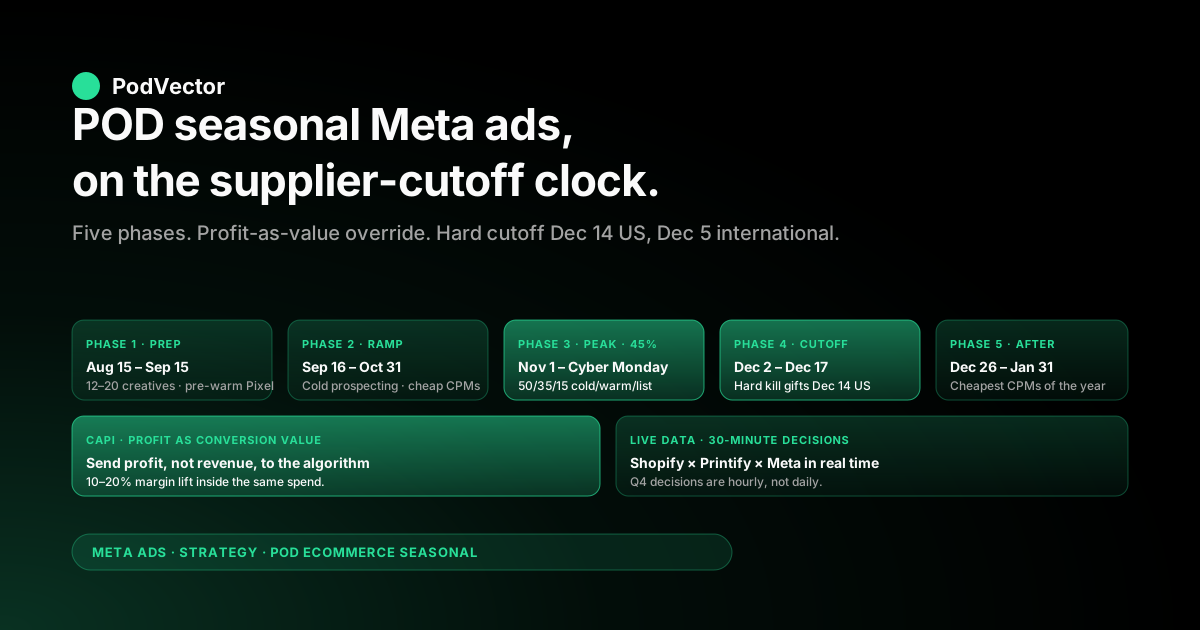
Generic Q4 playbooks split the season into "pre," "peak," and "post." For POD that's too coarse. The five-phase calendar below maps to actual production-cutoff and CPM-curve realities.
| Phase | Window | Primary objective | Budget share |
|---|---|---|---|
| 1. Pre-season prep | Aug 15 – Sep 15 | Build creative library, pre-build audiences, ramp the Pixel | ~5% |
| 2. Prospecting ramp | Sep 16 – Oct 31 | Cold acquisition at lower CPMs while they're still cheap | ~25% |
| 3. Peak conversion | Nov 1 – Dec 1 (BFCM core) | Convert ramp-built audiences and net new buyers | ~45% |
| 4. Last-mile cutoff | Dec 2 – Dec 17 | Ship-by-Christmas urgency on in-stock SKUs only | ~20% |
| 5. Post-holiday retargeting | Dec 26 – Jan 31 | Cleanup retargeting + LTV-focused retention | ~5% |
The exact split shifts with your store's mix. A store leaning heavily on gift mugs and named-recipient apparel weights even harder toward phase 3. A store with self-purchase categories (workout gear, art prints) leaks more spend into phase 4 because the urgency angle works for buyers buying for themselves.
Phase 1: pre-season prep (August–mid-September)
The cheapest time to acquire a Q4 buyer is before Q4 starts. Pre-season prep is where most POD stores under-invest because the work feels invisible — no scaling, no obvious revenue lift.
Build the creative library
Q4 creative fatigue hits harder than evergreen fatigue. By Black Friday week, frequencies above 2.5 are normal and creative degradation runs days, not weeks. Plan to rotate 4–6 creatives per ad set during phase 3, which means you need 12–20 production-ready creatives in the bank before October 1.
Mix formats deliberately:
- Mockup-on-model statics: the workhorse for prospecting.
- 15-second motion ads (Reels-native vertical): the format Meta currently rewards with cheaper CPMs.
- Carousels of related SKUs: for gift-bundle messaging.
- UGC-style "I bought this for [recipient]" testimonials: the highest-CTR format for gift-intent traffic.
Pre-build audiences while CPMs are low
Run a small video-views campaign in August and early September with broad targeting. The goal isn't conversion — it's filling your retargeting pool for phase 3 at $4 CPMs instead of $7 CPMs.
$300–$600 spent here pre-loads a retargeting audience that converts at 3–5x ROAS during peak, while still being a cold buyer for tracking purposes.
Ramp the Pixel and Conversions API
Meta's algorithm relies on event volume to optimize delivery. A Pixel with 50+ purchase events in the last 28 days enters Q4 with a learned profile of your buyer; one with 12 enters Q4 cold and burns the first two weeks of November relearning.
If your event volume is thin, run a small evergreen campaign August through September just to keep the signal warm. The Pixel and Conversions API setup guide covers the dual-tracking layer; if you're missing the server-side half, fix that before October.
Phase 2: prospecting ramp (mid-September–late October)
This phase exists for two reasons. First, CPMs are still 25–40% cheaper than they will be in November. Second, every cold buyer acquired here re-enters phase 3 as a higher-converting warm audience.
Single-campaign, broad-targeted prospecting
One campaign optimizing for Purchase events, broad audience, no detailed targeting, two ad sets max. Meta's algorithm performs better on broad audiences than on stacked interests since iOS 14.5 — a result replicated across thousands of ecommerce accounts.
Daily budget: 70–80% of what you plan to run in November. The goal is to enter phase 3 with the algorithm already converging on a buyer profile.
Creative mix shift toward gift-intent
Through August and early September your creative talks to self-purchase intent. Around September 20, layer in 1–2 gift-angled creatives per ad set ("the perfect gift for [recipient archetype]"). By October 15, gift-angled creative should be 50% of the rotation.
Build the early-bird offer audience
Run a "save 15% pre-Black Friday" lead-magnet flow to capture email addresses in October. Anyone who opts in becomes a high-priority retargeting custom audience for phase 3, completely outside the Pixel-based audience pool.
This is a meaningful POD edge. A POD store doesn't have inventory urgency to drive scarcity — but a closing pre-Black Friday discount window provides the same psychological pressure without the operational risk.
Phase 3: peak conversion (Black Friday through Cyber Monday)
This is where 45% of seasonal budget concentrates. It's also where the gap between an owned-inventory playbook and a POD playbook becomes the largest.
Campaign structure for the peak window
Three campaigns running in parallel:
- Cold prospecting (Conversion / Purchase optimization). Broad targeting, full-funnel creative, 50% of Q4 daily budget. Aggressive but capped — you'll hit a CPM ceiling by November 15 and additional spend will produce diminishing returns.
- Warm retargeting (Conversion / Purchase optimization). 7-day site visitors, video viewers, add-to-cart, IG/FB engagers. 35% of daily budget. Different creative — promo-led, urgency-led.
- Customer list / 90-day buyer (Conversion / Purchase optimization). 15% of daily budget. The cheapest conversions you'll run all year. New-arrivals creative, "second-look" framing.
Bid strategy: don't switch to Cost Cap mid-peak
Switching from Highest Volume to Cost Cap during peak resets the learning phase, and there's no time in November to relearn. If you wanted Cost Cap, set it in phase 2. In phase 3, leave bid strategy alone and let frequency manage itself through creative rotation.
Frequency and creative rotation
Frequency above 3.5 in a 7-day window is the kill signal — CTR has already dropped 40%+ by then. Track frequency daily during BFCM week and rotate creatives the moment any ad set crosses 3.0 frequency.
This is the practical reason for the 12–20 creative library built in phase 1. You can't shoot Q4 creative in Q4.
Profit as conversion value (the override)
This is the single largest optimization most POD stores miss in Q4. By default, Meta sees order subtotal as conversion value. That signal pushes Meta toward your highest-revenue SKUs.
For a POD catalog, your highest-revenue SKUs are often your lowest-margin ones — gift bundles, premium hoodies with $19 supplier cost, multi-item carts where the marginal item is fulfilled at near-cost.
The fix: override the value Meta receives by sending profit (revenue minus supplier cost minus payment processing) as the conversion value via the Conversions API. Meta then optimizes for profit-per-purchase, not revenue-per-purchase. The shift is dramatic — accounts that make this change typically see 10–20% lift in contribution margin without any change in spend, because the algorithm steers toward higher-margin SKU mixes inside the same campaign.
The mechanics live in your data layer: a unified data warehouse that joins Shopify orders to Printify or Printful supplier costs and computes per-order profit, then pushes that figure to Meta's Conversions API as the value parameter. (See the complete Meta Ads playbook for POD sellers for the wiring detail.)
Phase 4: last-mile cutoff (December 2–17)
Phase 4 is what most generic Q4 playbooks completely fumble for POD. They keep prospecting going until December 22, which is structurally broken when your supplier needs 7–9 business days to produce and ship.
The hard cutoff math
Working backwards from December 25 in a typical Printify or Printful December:
- Production: 5–9 business days during peak.
- Shipping: 3–7 business days for U.S. ground (longer for international).
- Buffer for fulfillment errors: 1–2 days.
That makes December 10–14 the realistic last day to take a Christmas-arrival U.S. order on a Printify-fulfilled shirt. International orders cut off around December 5.
Running broad prospecting after December 14 means buying purchases that will arrive late, generate refund requests, and tank your Q1 reviews. The math gets worse: a refunded Q4 order has the worst possible unit economics — you paid the CPM, paid the supplier, paid the return shipping, and gave back the revenue.
Phase 4 campaign mix
Two campaigns only:
- Self-purchase retargeting on adult-purchase categories (workout gear, art prints, anything someone buys for themselves). Cutoff doesn't matter as much because the buyer isn't waiting for Christmas.
- Last-call urgency on warm audiences — but only on SKUs you've validated will arrive in time. Hard kill prospecting on gift-intent SKUs by December 14 in the U.S. and December 5 internationally.
Creative changes too. Phase 3's "perfect gift for them" becomes phase 4's "ships in 24 hours" or "arrives by [confirmed date]." Honest dates beat optimistic dates by every long-term metric.
Add a digital-product fallback
One sustainable phase 4 expansion: a digital gift card or downloadable design that has zero production lead time. Even at 5–10% of phase 4 revenue, it captures buyers who hit your funnel after the physical cutoff and would otherwise convert to zero.
Phase 5: post-holiday retargeting (December 26–January 31)
Q4 isn't over on December 25. The week between Christmas and New Year typically delivers some of the lowest CPMs of the entire year, with two specific buyer segments still active.
- Gift card recipients: people who got a gift card now shopping for themselves, often with extra cash to spend.
- Self-purchase deferred buyers: people who held off in November to wait for January sales.
Phase 5 campaign structure: a single retargeting campaign on the Q4 audience pool with new-year creative ("treat yourself," "new-year-new-look"). Daily budget 30–40% of phase 4 levels.
This is also the right time to run a customer-list re-engagement campaign on first-time November buyers. A 15% second-purchase code sent in week 1 of January typically converts at 4–6x ROAS — a returning POD buyer carries no acquisition cost and inherits your standard 30% margin floor immediately.
Creative formats that hold up under Q4 CPM pressure
Three creative observations from POD accounts that ran clean Q4 campaigns last cycle.
Vertical video at 9:16 outperforms square
Reels placement carries cheaper CPMs in Q4 than Feed placement, sometimes by 30%+. A 15-second vertical motion ad with on-screen captions for sound-off viewing is the format Meta's algorithm currently rewards.
This is partly a placement-arbitrage opportunity: a square ad is forced into Reels with letterboxing and underperforms; a 9:16-native ad gets the cheaper auction. If your library has only square creative, add 9:16 versions before phase 3.
Static carousel beats single-image static
For gift-bundle messaging — "5 gift ideas under $30" — carousels consistently outperform single statics on CTR. The mechanism is engagement: a carousel swipe is its own micro-commitment that signals interest to the algorithm.
UGC-style copy converts colder than polished copy in Q4
"I got this for my mom and she cried" outperforms polished brand copy by 20–40% on cold audiences during gift-intent periods. The psychology is permission — gift buyers who don't trust their own taste lean on social validation.
Capture UGC during phase 1, with explicit license to use it in ads. Two or three UGC clips can carry an entire phase 3 ad set.
Tracking profit when CPMs spike and margins compress
The tracking layer matters more in Q4 than any other quarter, for one reason: the cost of getting it wrong is amplified by the CPM spike.
A misattributed conversion in March costs you a misallocation of $200 in spend. The same misattribution in Black Friday week can cost $2,000.
Three tracking layers, all required
- Pixel + Conversions API in dual-track mode. Server-side via CAPI catches what iOS 14.5 broke. Without it, your phase 3 data underreports purchase volume by 18–35% and Meta's algorithm misallocates downstream.
- Order-level supplier cost ingest. Pull Printify and Printful invoices into a single source of truth daily. By Black Friday week, supplier surcharges (production-time premiums, expedited shipping) shift the unit cost by $0.50–$2.00 per order. If your conversion-value override doesn't reflect this, your "profit-as-value" signal is stale.
- Profit-by-campaign attribution model. The number that actually matters: contribution margin per campaign, not ROAS. A 4x ROAS campaign that converts $30 hoodies with $19 supplier cost and $4 shipping is a 4x ROAS losing money — the math is brutal, the answer is to kill it.
What "live" actually means during Q4
By Cyber Monday afternoon, daily revenue and daily ad spend are both moving every minute. A spreadsheet refresh that lags 24 hours is too slow. The decision window during peak is hourly — pause an ad set at 2 p.m., shift budget to a winner at 3 p.m., adjust creative rotation at 5 p.m.
This is where a live data warehouse setup earns back its cost in a single weekend. A unified data layer that joins Shopify orders, Printify or Printful supplier costs, and Meta ad spend in real time turns the Q4 dashboard from "yesterday's performance" into "the last 30 minutes." For POD operators that can't afford 24-hour decision lag, that's the difference between scaling a winner and missing it.
Victor — PodVector AI's AI employee for POD sellers — sits on top of that warehouse. During Q4 you can ask "which campaign actually made profit yesterday after Printify costs landed?" and get a numerical answer in seconds, not "I'll get back to you Monday."
Six mistakes that drain a POD seasonal budget
- Starting prospecting on November 1. CPMs are already 25%+ above October by then. Your retargeting pool is empty. You're paying peak rates for a cold audience.
- Scaling winners 30% per day in mid-November. Generic ecommerce advice. POD margins don't have the cushion to absorb a learning-phase reset on top of CPM spikes. Scale 15–20% every 3 days at most.
- Optimizing for ROAS instead of profit. A 4x ROAS gift bundle can lose money. ROAS is a vanity number when supplier cost shifts mid-quarter.
- Ignoring the production cutoff. Running prospecting after December 14 on gift SKUs guarantees refunds. Refunds in Q4 are the worst-margin order possible.
- Killing campaigns the morning of December 26. Phase 5 has the cheapest CPMs of the year. Leaving budget on the table here costs you 5–8% of seasonal contribution margin.
- Not pre-loading creative. Trying to ship new creative during BFCM week is operationally impossible and you'll burn your top-performing ads to frequency death by November 22.
FAQs
When should a POD store actually start its Q4 Facebook Ads campaigns?
Mid-September for prospecting, August for creative production. Generic ecommerce advice says "Halloween" — for POD, that's already 4–6 weeks too late given production lead time and CPM curves.
Should I use Advantage+ Shopping Campaigns during Q4?
Yes, but with the conversion-value override (profit instead of revenue) wired through the Conversions API. Without that override, ASC will scale toward your highest-revenue SKUs, which are usually your lowest-margin ones in a POD catalog.
What's the realistic ROAS bar for Q4 POD ads?
Approximately 3.3x to break even at typical POD margins (28–35% contribution after supplier cost). Generic ecommerce ROAS bars of 1.7–2.0x will lose you money.
How do I handle Printify production delays during Q4?
Set the order cutoff for guaranteed Christmas arrival at December 10–14 for U.S. ground, December 5 for international. Honestly state the dates in ad copy. Late-arrival refunds in Q4 are the most expensive order outcome possible because you paid peak CPMs to acquire them.
Should I increase budget for Black Friday or for the full Cyber Week?
Cyber Week. Black Friday alone leaves money on the table in the rest of the funnel. The full window (Thursday–Monday following) usually delivers higher absolute contribution margin than Friday spike spending.
What's the ad spend split between cold and retargeting in Q4 for POD?
50% prospecting, 35% warm retargeting, 15% customer list / 90-day buyer. The retargeting overweight versus the generic ecommerce 70/20/10 split is deliberate — POD margins find more leverage on warm audiences.
Do I need both the Pixel and Conversions API in Q4?
Yes, dual-tracking is non-negotiable in Q4. The Pixel alone underreports purchase volume by 18–35% post-iOS-14.5, and that misreporting compounds with the algorithm's optimization cycle. CAPI is what closes the gap.
What about Instagram Reels — separate budget or part of the same campaigns?
Same campaigns, with placement on automatic. Manually carving Reels out usually loses money because you're constraining the auction. Instead, build 9:16-native creative so your ads compete well in Reels placement when the algorithm sends them there.
Is it worth running ads at all if my margins are tight in Q4?
Yes — if you wire profit-as-conversion-value and run the cutoff discipline above. The cohort of POD stores that lose money in Q4 are the ones running generic ecommerce playbooks at POD margins. The cohort that wins is the one that designs the calendar, the bid, and the conversion signal around POD-specific economics.
How does this seasonal playbook differ from the Google Ads version?
The phases match closely but the levers differ — Google's seasonal play leans heavier on Performance Max product feeds and Shopping campaigns, while Meta leans on creative rotation and audience layering. Most POD stores run both in parallel during Q4, with shared profit-tracking infrastructure underneath. The Google Ads seasonal playbook for POD covers the parallel motion.
See your Q4 ad profit, not just your Q4 ad spend
Q4 is when the gap between revenue and contribution margin becomes the most expensive thing in your business. A 4x ROAS campaign can be a money-loser. A 2.8x ROAS campaign can be your most profitable.
Victor is the AI employee for POD sellers that joins your Shopify orders, Printify and Printful supplier costs, and Meta ad spend into a live profit view — so you can ask "which campaign actually made money yesterday?" and get a numerical answer in seconds.
Free during Q4. Five-minute setup.
Try Victor free