
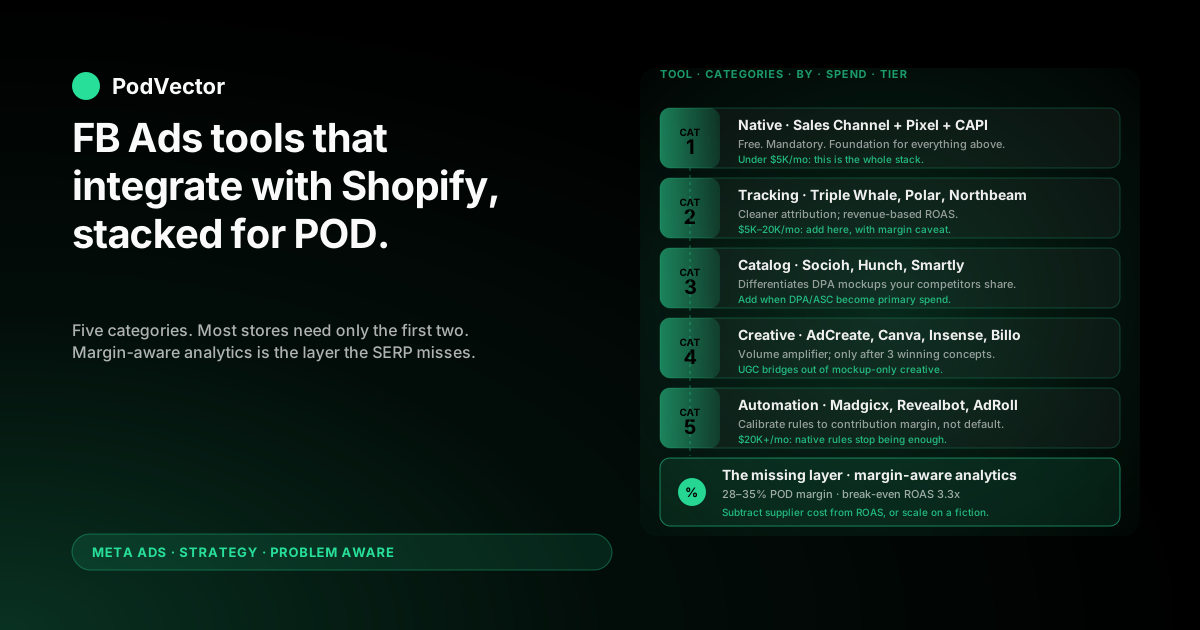
Quick Answer: The right Facebook Ads tools for a Shopify print-on-demand store fall into five buckets: the native Shopify-Meta integration (free, mandatory), tracking and attribution, catalog and feed, creative production, and campaign automation. Most POD sellers only need the first two until they cross $20K/month in ad spend.
The list every other article publishes — Madgicx, Triple Whale, AdCreate, Revealbot, Smartly — is fine for owned-inventory stores at higher gross margins. POD lives at a lower contribution margin after Printify or Printful supplier costs, and most of those tools attribute on Meta-reported revenue, not contribution profit.
This article walks each category, names the tools that work for POD, calls out the ones that quietly mislead at POD margin, and shows the integration stack that survives once spend scales past $50K/month.
Why "tools that integrate with Shopify" is the wrong question for POD
Search "best Facebook Ads tools that integrate with Shopify" and you land on three flavours of result: tool roundups from Madgicx and the long tail of comparison posts; native-setup walkthroughs that just tell you to install the Facebook sales channel and Pixel; and ETL data-sync pages from connectors that pipe Shopify and Meta into a warehouse. They list the same 12–15 tools and rank them on features, pricing, and AI capabilities.
None of them ask the question that matters for print-on-demand: which tools attribute on contribution profit, and which attribute on top-line Meta-reported revenue?
That distinction sounds academic until you check a Printify-fed store's profit numbers next to its Triple Whale dashboard. The dashboard says 4.2x ROAS. The store is losing money.
POD's structural margin gap reframes every tool decision
An owned-inventory Shopify store at a high gross margin breaks even at a relatively low ROAS. A POD store at a lower contribution margin (after the supplier cost on every order) breaks even at a meaningfully higher ROAS. So when a campaign automation tool reports a "profitable" ROAS and recommends scaling, it may be right for the owned-inventory case it was designed against — and wrong for POD, where that same ROAS is barely above break-even.
Tool selection for POD has to start from this reality, not from feature checklists. See the net profit margin benchmark for POD for context on where your numbers should land.
Three categories the generic roundups under-weight for POD
The standard SERP listicles emphasize automation and creative speed. For POD, three other categories carry more weight:
Catalog feed quality matters more, because POD product photos are mockups and your competition is the same mockup library. Margin-aware attribution matters more, because Meta's optimisation signal includes the supplier cost the platform can't see. And contribution-profit reporting matters more, because Shopify's revenue line and Meta's revenue line both overstate what you actually made.
The native stack: Shopify Sales Channel, Pixel, CAPI, catalog
Before any third-party tool, the integration that does the most work is free and ships inside Shopify itself. Most "my Facebook ads aren't tracking properly on Shopify" support threads trace back to one of these four pieces being half-installed.
Meta Sales Channel (the install everything depends on)
Shopify Admin → Sales Channels → Meta. This single install authenticates your Shopify store with a Meta Business Manager, and it's the prerequisite for the Pixel, the Conversions API (CAPI — Meta's server-side conversion channel), and catalog sync.
If you skip this and try to wire the Pixel manually through theme code, the CAPI events won't deduplicate against the browser events. You'll see double-counted purchases all over Ads Manager and a ROAS that looks too good.
Meta Pixel (browser-side events)
The Pixel fires PageView, ViewContent, AddToCart, InitiateCheckout, and Purchase from the browser. iOS 14.5+ App Tracking Transparency cuts off a meaningful share of these events for users who opt out of tracking — that's the gap CAPI was built to close.
Verify the Pixel is firing on every page in Meta Events Manager. If ViewContent is missing on product pages, attribution will skew toward whatever events do fire — usually inflating display-targeting performance.
Conversions API (server-side events, the part that actually scales)
CAPI sends the same events from Shopify's servers directly to Meta's servers, bypassing the browser and iOS opacity. The Shopify Meta Sales Channel installs CAPI automatically when you enable "Maximum" data sharing during setup. As noted by Adwisely (April 2026), the Sales Channel provides native support for the Facebook Conversions API, giving server-side tracking that overcomes iOS privacy gaps.
Two things to verify in Events Manager: server-side Purchase events should land within 10% of browser-side, and the deduplication key should be consistent (Shopify uses the order ID by default).
If server events are double browser events, deduplication is broken and you're scaling on inflated conversion counts. If server events are zero, CAPI isn't actually firing.
Product catalog sync
The Sales Channel pushes your Shopify catalog to Meta Commerce Manager on a schedule. This catalog feeds Dynamic Product Ads (DPAs — ads that pull product images and prices automatically), Advantage+ Shopping Campaigns (ASC — Meta's auto-targeted purchase campaigns), and Instagram Shopping.
For POD, catalog hygiene is the lever no generic roundup mentions: low-margin SKUs leaking into the catalog cause Meta to push spend toward the products you make the least on. See the Printify Premium plan breakdown for a clear view of what supplier costs actually look like before you lock your catalog feed.
Domain verification and Aggregated Event Measurement (the step that breaks attribution silently)
Every current setup guide on the SERP now lists this, and most POD stores still skip it. In Meta Business Manager → Brand Safety → Domains, verify the domain your Shopify store actually serves on (your custom domain, not the .myshopify.com fallback). Then in Events Manager, configure Aggregated Event Measurement (AEM — Meta's post-iOS framework that limits each verified domain to 8 prioritised conversion events) and rank Purchase first.
If the domain isn't verified, you can't set event priority at all, and Meta silently caps your optimisation window. For POD this matters because your one event that has to win is Purchase — not AddToCart, not ViewContent. Put Purchase at the top of the 8, and make sure the verified domain matches the one your checkout runs on, or CAPI and Pixel events get attributed to the wrong place.
Advantage+ Shopping Campaigns (the AI layer baked into the native stack)
The current crop of "Facebook ads for Shopify" guides leads with Meta's own AI before any third-party tool, and they're right to. Advantage+ Shopping Campaigns (ASC) automate audience, placement, and creative selection off the catalog the Sales Channel already syncs — no extra app required. For POD, ASC is the cheapest automation you have, but it optimises on Meta-reported ROAS by default, so the contribution-margin caveat that runs through the rest of this article applies here too: ASC will happily scale a campaign that looks profitable on revenue and isn't on contribution profit after supplier cost.
Tracking and attribution tools
This is the category where POD sellers get burned most often. The tools are excellent — for the customer they were designed against. POD isn't usually that customer.
Triple Whale
The most popular Shopify-native attribution tool. Triple Whale stitches Shopify orders to ad-platform clicks across Meta, Google, TikTok, Klaviyo, and email, then assigns last-click, first-click, or multi-touch credit.
What it does well for POD: shows you blended ROAS across channels, surfaces post-purchase survey attribution (which channel customers say they came from), and gives a cleaner CAC view than Meta alone. Their Pixel is genuinely better at recovering iOS-shrunk events.
Where it gets dangerous for POD: ROAS in Triple Whale is computed on Shopify revenue, which includes the Printify or Printful supplier cost. The tool isn't wrong; it's just not built to subtract per-order supplier cost. You have to do that math separately — which is why pairing it with a checkout completion rate benchmark and a contribution-margin layer matters.
Northbeam
Multi-touch attribution with an emphasis on Marketing Mix Modeling (MMM — statistical attribution that doesn't depend on cookies). Premium price, premium product, primarily used by stores spending heavily on ads.
For POD, Northbeam's strength is the same as its weakness shared with Triple Whale: revenue-based ROAS, not contribution-based. It also requires meaningful spend volume to make MMM statistically valid — most POD stores below $50K/month aren't there yet.
Polar Analytics, Lifetimely, Aimerce
The next tier of Shopify-native analytics, all of which include some attribution layer. Polar is the most analytics-focused, Lifetimely leans LTV, Aimerce focuses on first-party data and CAPI enhancement.
For POD specifically, Lifetimely's LTV-by-product cohorting is useful because POD assortment churns fast — knowing which design themes drive 90-day repeat purchase is harder to derive from raw Shopify exports than from a tool built around it.
The native option: Shopify Marketing Analytics + UTM discipline
Before paying for a tool, audit what Shopify's built-in marketing analytics already shows. With clean UTM tags on every Meta link and Shopify's Source / Medium / Campaign reports, most stores under $20K/month spend can answer the same questions the paid tools answer — they just have to do it manually.
Catalog and feed tools
Native Shopify-Meta catalog sync handles the basics. Once you're running Dynamic Product Ads or Advantage+ Shopping seriously, feed quality becomes the decisive variable. According to Marpipe (January 2026), platforms like Google are increasingly strict about mismatches in price, availability, or formatting — "a feed tool that automatically flags and resolves errors keeps your listings live, and your ROAS intact." The same principle applies on Meta.
Socioh
Catalog enrichment specifically for ad creative. According to Adstellar's 2026 roundup, Socioh provides real-time catalog sync directly from Shopify, keeping ads current with live inventory and pricing data. It adds branded frames, badges (Bestseller, New, Sale), price-drop highlighting, and custom overlays to catalog images so DPAs don't all look like the same Shopify product page.
For POD this is more impactful than it sounds. Your competitors on the same Printify supplier are running mockups from the same library — Socioh's ability to differentiate the image is one of the few visual edges available before you commission custom photography. Per Cometly's 2026 guide, its automated lifestyle image generation transforms plain product photos into branded lifestyle scenes without Photoshop or design skills.
Hunch
Programmatic creative for Meta. According to Segwise's 2026 creative automation review, Hunch generates catalog product videos that transform static product images into dynamic videos, and uses multi-artboard templates to generate dozens of placement-specific variants from a single master design. Note that as of 2026, Hunch has no Google Ads support, per Segwise — a limitation if Google Shopping is part of your mix.
For POD's mockup-heavy assortment, Hunch's creative volume is the main draw — it's creative output the manual way can't match at scale.
Marpipe
A catalog-native creative performance platform newer roundups now surface alongside Socioh and Hunch. According to Marpipe's own documentation (January 2026), it pulls product-level data including titles, images, pricing, variants, and inventory from Shopify, and uses it to generate dynamic creative assets across Meta, Google, and TikTok. The distinguishing feature is a feedback loop: feed performance signals back into creative and campaign decisions, so you learn which products earn ad spend and which don't. Worth evaluating alongside Socioh if you're running heavy DPA volume on a large catalog.
Smartly.io / Madgicx Catalog
Both extend catalog management with multi-platform sync and feed transformation. Per Adstellar's 2026 analysis, Smartly.io is built for brands spending at enterprise scale on Meta advertising and needing advanced automation workflows — overkill below $50K/month for most POD sellers.
DPA creative automation: pulling live product data into Meta creatives
This is the subtopic the 2025–2026 SERP now covers that earlier roundups largely missed. A new generation of tools sits between your Shopify product feed and your Meta DPA campaigns, pulling live price, inventory status, and promotional data directly into creative templates — so when a product goes on sale or goes out of stock, the ad updates automatically without manual intervention.
Confect
According to Segwise's 2026 creative automation review, Confect is "a narrow but sharp creative automation tool built for dynamic product ads on Meta and Google." Its DPA Template Builder populates creatives from product feeds, with auto-updates for pricing, titles, and product details when feed data changes — meaning the creative reflects live catalog state, not a snapshot from last week. Native feed integration covers Shopify, Google Merchant Center, and common ecommerce feeds, with design customisation for fonts, colours, badges, and layouts. Ideal if Meta and Google DPAs are your primary revenue driver and manual DPA updates are eating designer hours.
Adstellar
Per Cometly's 2026 guide, Adstellar is an AI-powered dynamic ad platform that generates and optimizes creatives from your Shopify product catalog with intelligent automation. Its multi-platform publishing capability lets you create once and distribute to Meta, Google, and TikTok without reformatting — useful for POD sellers who run both Meta and Google but don't want to maintain separate creative pipelines. The platform learns from campaign data to suggest which product combinations, layouts, and messaging work best for your audience.
Why live data in creatives matters for POD specifically
POD catalogs change faster than owned-inventory catalogs — designs get retired, Printify pricing shifts, and seasonal products come in and out. A DPA creative tool that pulls live price and availability data means your ads never surface a product that's been pulled from your active catalog or mis-price after a Printify cost change. For a category where supplier cost shifts affect every SKU's margin, this feed accuracy is a margin protection mechanism, not just a creative nicety.
Creative production tools
The category every roundup over-weights — because creative tools are easy to demo and hard to compare. For POD specifically, creative volume is the lever that breaks first.
AdCreate, Pencil, Smartly Creative Studio
AI ad generation. You feed product images and a brief, and the tool outputs static and video variations. AdCreate skews toward Shopify-native flows; Pencil and Smartly are more brand-agency oriented.
For POD, the value is real once you've validated three winning concepts manually. Before that, AI-generated creative tends to amplify the wrong angle — it makes more of what you're testing, not better versions of what works.
Canva and Figma
Still the workhorses for in-house creative teams. Both connect to Shopify through plugins or manual export, and both produce ad-ready assets faster than learning a dedicated ad-creative tool at lower spend tiers.
UGC platforms (Insense, Billo)
For POD sellers trying to get out of mockup-only creative, UGC is the bridge to authentic content. Insense and Billo connect creator briefs to Shopify product feeds and handle creator payments. UGC video typically outperforms mockup video in Meta's feed once you're scaling past the validation phase — it's the fastest way to differentiate from every other store on the same Printify mockup templates.
Campaign automation and bid management tools
Automation tools watch your account, raise budgets on winners, pause losers, and rotate creative on a schedule you set. The category that the SERP listicles love most.
Madgicx
The most marketed Shopify-integrated Meta automation platform. Includes attribution, automation, creative AI, and audience tools in one dashboard. Strong at the unified-workspace pitch.
POD caveat: Madgicx's automation rules optimise on Meta-reported ROAS unless you override. At POD margin levels, a default auto-scale rule will scale losing campaigns. Set custom thresholds at your contribution-profit break-even, not the platform default.
Revealbot
Rule-based automation across Meta, Google, and TikTok. More flexible than Madgicx for custom logic ("scale when 7-day ROAS > 4.0 and frequency < 3.0 and learning phase = active"). Less polished UI, more powerful rule engine.
For POD, Revealbot's flexibility is the advantage — you can build the contribution-profit-aware rules generic tools don't ship by default. Pair it with the guidance in CRO techniques for POD stores to make sure the traffic you're scaling is converting efficiently.
Adwisely
A tool that current 2026 roundups now surface prominently that earlier versions of this article didn't cover. Per Adwisely's own April 2026 comparison, it connects to Shopify in minutes, auto-pulls product data from the catalog, and creates dynamic Facebook and Instagram ads from Shopify product images and descriptions, with real-time inventory sync. It's positioned at Facebook and Instagram as primary channels — if you also run heavy Google Shopping, you'll need a separate tool for that surface. Worth evaluating at the $5K–$20K/month tier before committing to Madgicx or Revealbot.
AdRoll
Cross-channel retargeting and prospecting. Stronger on display and email than on Meta-only optimization, but the Shopify integration is mature and the attribution view is clean.
The native option: Meta's own automated rules
Meta Ads Manager → Automated Rules. Free. Less flexible than Revealbot but adequate for the most common rules: pause ad sets below threshold ROAS, raise budgets on winners by a fixed percentage, send alerts when frequency crosses a ceiling you set.
Most POD stores under $30K/month don't need a paid automation tool. They need 4–6 well-tuned native rules and the discipline to follow them. The deeper sequencing logic connects to increasing average order value — scaling spend without improving AOV is a margin trap for POD.
The margin-aware analytics layer POD needs but the SERP rarely lists
This is the gap. Every tool above optimises for some version of revenue or platform-reported ROAS. None of them, by default, tell you contribution profit per ad set after Printify or Printful supplier cost, after Shopify transaction fees, after refunds and chargebacks.
The three options for closing that gap, in order of complexity:
Manual: spreadsheet on top of Shopify and Meta exports
Pull Shopify orders weekly, join to Meta UTM data, subtract supplier cost per SKU, and compute contribution-margin ROAS. Works fine under $10K/month spend. Breaks down at higher spend because the spreadsheet stops being weekly and starts being daily, and stale data costs you days of bad scaling decisions.
Custom data warehouse
Pipe Shopify, Meta, Printify or Printful, and your finance data into a unified data warehouse using an ETL connector, then build SQL views for contribution-margin reporting. The connectors handle the sync the SERP roundups stop at; the contribution-margin math is still on you. Right answer for stores with engineering resources. Wrong answer for solo sellers because the build cost dwarfs the answer.
An AI employee sitting on top of a unified data warehouse
The same warehouse model, but with an AI employee who doesn't just answer questions — he reads live data across Shopify, Meta Ads, Google Ads, Printify, Printful, and Klaviyo, proposes a move, and executes it on your Shopify store after you approve.
This is what PodVector's Victor does for POD. You ask "which Facebook campaigns are actually profitable after supplier cost this week" and Victor pulls the answer from a live data warehouse that has Shopify, Meta, and supplier cost data in the same place. He then surfaces a next move — say, repricing the worst-margin SKUs or pausing spend toward those products — as an approval card showing old and new values. Nothing changes until you say yes. The ETL connectors and dashboards above stop at reporting; Victor acts on what the numbers say, with your approval before anything executes.
It's the layer the generic SERP roundups don't list because it's POD-specific — most ad tech is built for owned-inventory ecommerce, where the contribution-margin gap doesn't exist the same way. See the PodVector strategy overview for a fuller picture of how the AI employee model works.
The right stack at each spend tier
Under $5K/month spend: native only
Shopify Meta Sales Channel, Pixel, CAPI, catalog. Meta's automated rules. UTM discipline. A weekly spreadsheet that subtracts supplier cost.
You don't need a paid attribution tool, automation tool, or creative tool yet. Spend on tools at this stage usually replaces work you should be doing manually to learn the account.
$5K–$20K/month spend: add tracking + creative
Add Triple Whale or Polar Analytics for cleaner attribution. Add Canva or AdCreate for creative volume. Continue native automation. Evaluate Adwisely if you want an integrated retargeting and prospecting layer without the complexity of Madgicx.
If you're running heavy DPA or ASC, add Socioh for catalog enrichment. Consider Confect if your catalog is large and DPA creative consistency is slipping.
$20K–$50K/month spend: add automation + margin layer
Add Revealbot or Madgicx for rule-based automation, with custom rules calibrated to your contribution margin. Add a margin-aware analytics layer — manual breaks down here, so either an AI employee on a unified data warehouse or a finance-aware reporting tool. Pair with a Klaviyo browse-abandonment flow to convert the traffic you're paying to acquire.
Above $50K/month spend: add catalog automation, UGC, MMM
Add Hunch or Marpipe for programmatic creative on the catalog, with live price and stock data feeding DPA templates automatically. Add Insense or Billo for UGC pipeline. Consider Northbeam for MMM if your channel mix is genuinely cross-platform. At this spend level, keeping your fulfillment model clean and your data reconciliation tight becomes equally important as the ad tooling.
Three tool-selection mistakes that bleed POD margin
Mistake 1: buying automation before fixing attribution
Madgicx, Revealbot, and the rest will faithfully execute the wrong rules if your underlying ROAS number is wrong. CAPI deduplication breaks, supplier costs aren't subtracted, refunds aren't accounted for — and the automation tool scales the resulting illusion.
Fix attribution first. Buy automation second.
Mistake 2: paying for the same data twice
It's common to find a POD store paying for Triple Whale and Polar Analytics and Northbeam simultaneously, getting three different ROAS numbers, and trusting whichever one is highest. Pick one attribution layer, run it for 90 days, and benchmark against Shopify's revenue ground truth before adding another.
Mistake 3: treating tool features as substitutes for account discipline
The best automation tool can't save a POD store that won't audit its catalog quarterly to remove low-margin SKUs. The best attribution tool can't fix a Pixel that isn't deduplicating against CAPI. The best DPA creative tool can't overcome a feed with stale pricing data. Tools amplify the discipline that's already there. They don't manufacture it. Review your net profit margin benchmarks regularly — if margin is slipping, the problem is rarely the tool.
FAQs
What's the single most important Facebook Ads tool to integrate with Shopify?
The Meta Sales Channel app inside Shopify Admin. Free, native, and the prerequisite for the Pixel, CAPI, and catalog sync. Every other tool sits on top of these four pieces. Get this install right before paying for anything else.
Is Triple Whale worth it for a POD store?
Yes for attribution clarity, with one caveat: Triple Whale's ROAS is computed on Shopify revenue, not contribution profit. At POD margins, the ROAS number Triple Whale shows you can look healthy while the store is at or below break-even after supplier cost. Use Triple Whale for channel attribution, but compute contribution-margin ROAS separately before making scaling decisions.
Should POD stores use Advantage+ Shopping Campaigns?
Yes — ASC is free, native, and the cheapest automation in the stack, running off the catalog the Sales Channel already syncs. The catch is the same one that runs through every tool here: Advantage+ optimises on Meta-reported ROAS, so its default "scale this winner" signal fires based on revenue, not contribution profit after supplier cost. Run ASC, but judge it on contribution profit, not on the ROAS Meta shows you.
How does CAPI integration actually improve Facebook ads performance for Shopify?
CAPI recovers conversion events that iOS 14.5+ App Tracking Transparency removes from the browser. With CAPI, Meta sees more of the actual purchases your store generates, which gives the algorithm cleaner signal for purchase optimization. The Shopify Meta Sales Channel installs CAPI automatically when you enable maximum data sharing — making the Sales Channel install the highest-leverage single step in the stack.
What tools pull live price and stock data into Meta DPA creatives automatically?
Confect and Marpipe are the tools current 2026 rankings surface for this use case. Confect auto-updates pricing, titles, and product details in DPA creative templates when feed data changes, per Segwise's 2026 review. Marpipe pulls product-level data including pricing, variants, and inventory from Shopify to generate dynamic creative assets. Socioh handles a similar live-sync for branded catalog ads. All three are worth comparing if your catalog changes frequently — which it will if you're actively managing POD margins by retiring low-performing SKUs.
Do I need a separate creative tool, or is Canva enough?
Canva is enough until you're producing more than 15 new ad concepts a month or running heavy DPA volume. At that point, a dedicated tool (AdCreate, Pencil, Confect for DPA) starts to pay for itself in time savings. Below that threshold, Canva plus a Figma file with brand templates is faster and cheaper.
What's the right automation tool for a $15K/month POD spend?
Meta's native Automated Rules, with 4–6 rules tuned to your contribution margin. At $15K/month you're not at the volume where Madgicx or Revealbot pays for itself, and the native rules cover the most common scaling logic. Evaluate Adwisely if you want more DPA automation without the complexity of a full rule-builder. Revisit the question at $25K–$30K/month.
Can a tool actually subtract Printify or Printful supplier cost from my ROAS?
Most generic ad-tech tools cannot, by default. They optimise on revenue. Closing the gap requires either a manual spreadsheet layer, a custom data warehouse with margin views, or an AI employee built around the POD margin model. PodVector's Victor is the third option — he reads Shopify, Meta Ads, Printify, and Printful into a live data warehouse and answers contribution-profit questions the generic tools can't, then proposes and executes Shopify-side moves with your approval.
How does this fit into the wider Meta Ads strategy for Shopify POD?
Tools amplify a strategy that has to exist first. The strategy stack — account architecture, prospecting, scaling, retargeting — connects across the CRO techniques guide, the AOV scaling guide, and the Klaviyo browse-abandonment flow setup for recapturing the traffic your ads paid to bring in.
What about tools for Facebook Ads that don't touch Shopify at all?
Meta's own ecosystem (Ads Manager, Events Manager, Commerce Manager, Audience Insights) is the deepest Facebook-only toolset, and it's free. The Shopify integration matters because Shopify is your source of truth for orders and inventory — but for ad-side workflows like creative testing or audience research, you can do a lot inside Meta-native tools alone.
Tools optimise toward what they can see
Triple Whale sees Shopify revenue. Madgicx sees Meta-reported ROAS. Confect sees your product feed. Socioh sees your catalog images. None of them see the contribution profit per ad set after Printify or Printful supplier cost — because they were built for ecommerce broadly, not for POD specifically.
PodVector's AI employee Victor does. You ask "which Facebook campaigns are actually profitable after supplier cost this week" and Victor pulls the answer from a live data warehouse that has Shopify, Meta Ads, Printify, and Printful data in the same place. Victor then proposes the next move — repricing a margin-bleeding SKU, adjusting your free-shipping threshold, pausing spend toward a losing product — and executes it on your Shopify store after you approve. He never acts without your sign-off.
Try Victor free