
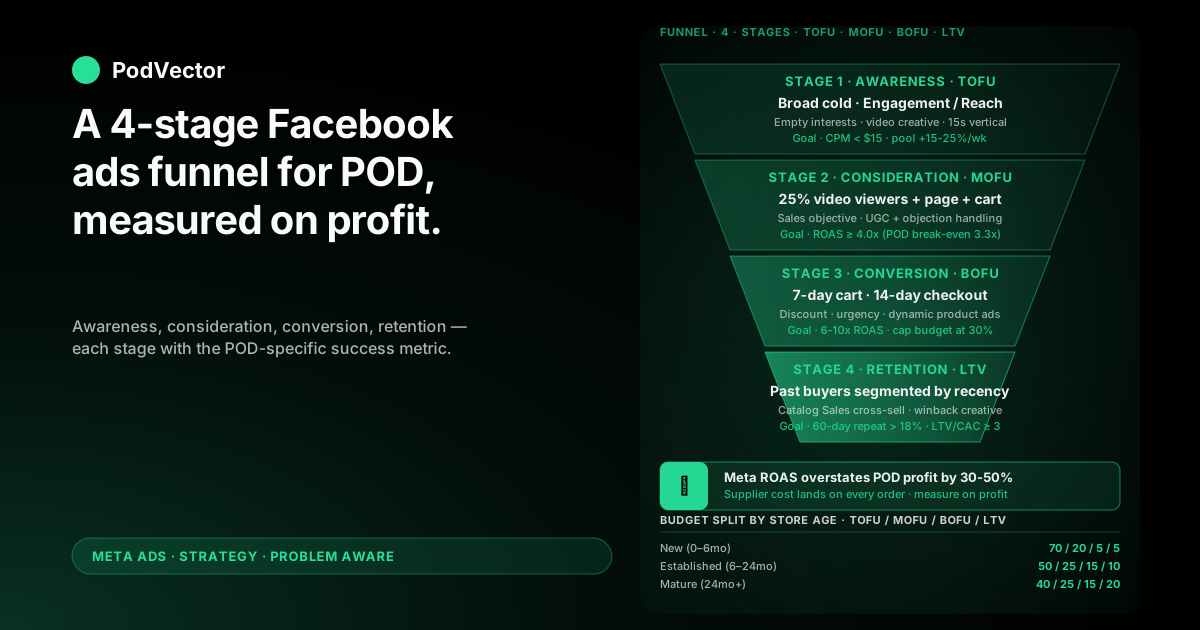
Quick Answer: A Facebook ads funnel for ecommerce is a four-stage system — awareness, consideration, conversion, retention — where each stage runs its own campaign type, audience, creative, and success metric.
For print-on-demand, the structure is the same but the math is different. Generic ecommerce funnels measure stage success on cost-per-click and Shopify ROAS. POD funnels have to measure on contribution profit, because every Shopify order triggers a fresh Printify or Printful supplier invoice that Shopify never sends back to Meta.
This guide walks the four stages with the POD-specific budget split, audience build, creative spec, and profit-based success threshold for each.
Why a funnel beats single-campaign for POD
Most beginner POD operators run one campaign. It targets a cold audience, optimizes for Purchase, and lives or dies on the first 50 conversions Meta can pull through it.
That single-campaign approach hits a wall around $100/day. Cold audiences fatigue. CPMs climb. The break-even ROAS — already 3.3x for print-on-demand at a 30% margin — gets harder to clear because you're paying acquisition prices for traffic that should be cheaper to retarget.
A funnel fixes that by splitting the work into four jobs: introduce the brand, warm the visitor, close the sale, and pull them back to buy again. Each job gets its own audience, creative, and budget — and each job has a different success metric.
The four-stage structure
The four stages map to where the buyer is in their head:
- Awareness (TOFU): they don't know your brand exists yet.
- Consideration (MOFU): they've seen you, clicked through, maybe added to cart.
- Conversion (BOFU): they're ready to buy, just need a reason to do it now.
- Retention: they bought once. The job is to make them buy again.
This structure isn't POD-specific — it's the same one big DTC brands and the standard Facebook ads funnel guides teach. What changes for POD is the budget split, the creative format, and how you read the numbers at the end.
Why POD economics break the standard funnel
Owned-inventory ecommerce stores buy stock at bulk pricing. Cost of goods is locked in months before the first sale. The funnel can optimize on Shopify ROAS and the answer is roughly correct.
Print-on-demand doesn't work that way. Every order Meta sends to your Shopify store triggers a per-unit supplier invoice from Printify or Printful — base product cost plus shipping, settled in real time. Shopify reports the order subtotal back to Meta. The supplier cost shows up on a different invoice, in a different dashboard, on a different cadence.
The result: Meta's reported ROAS is structurally higher than your real margin by 40–60%. A funnel optimized to Meta-reported ROAS will scale stages that look profitable and are actually losing money on every conversion.
Stage 1 — Awareness (TOFU)
The top-of-funnel job is to put your brand in front of people who've never heard of it. Not to sell. Not to retarget. To introduce.
The temptation is to skip TOFU and run pure conversion campaigns to cold audiences. That works at first — Meta's algorithm will find easy buyers. But it caps your scale. Without a steady drip of new awareness, your retargeting pool dries up in 60–90 days.
Audience: broad, no interest stacking
Set the audience to your country, your age range (typically 25–55 for POD), and leave detailed targeting empty. No interests. No behaviors. No lookalikes at the awareness stage.
This goes against the older "find your perfect interest" advice. In 2026, Meta's algorithm reads creative signals — what the ad shows and who engages with it — to find the right audience faster than any interest filter you can hand-pick. Empty targeting + strong creative beats narrow targeting + average creative every time.
Campaign objective: Engagement or Reach, not Sales
This is the stage most beginners get wrong. They run Sales-objective campaigns at TOFU, then wonder why their cost-per-purchase looks brutal.
Run Engagement or Reach instead. The job here is to get cheap impressions in front of new eyeballs and build a retargeting pool. Cost-per-thousand-impressions (CPM) and three-second video views are the metrics that matter — not purchases.
Creative: brand story, video, lifestyle
TOFU creative shows what the brand is about. Think 15-second vertical videos with a strong hook in the first 1.5 seconds, lifestyle photography of someone wearing your t-shirt or holding your mug, founder-story carousels.
The hook tells a problem-aware viewer "this is for you." That might be a niche callout ("for nurses who need scrubs that actually fit"), a design statement ("the only mug that says what you're really thinking on a Monday"), or a lifestyle moment that mirrors the buyer's life.
Success metric: cost per video view + retargeting pool growth
Measure TOFU on two things: CPM under $15 (varies by country and niche, but that's a reasonable ceiling) and weekly growth of your video-view custom audience. If the pool is growing 15–25% week-over-week, the awareness layer is doing its job.
Don't measure TOFU on purchases. They'll happen — the algorithm will pull a few easy buyers through — but they're a side effect, not the goal.
Stage 2 — Consideration (MOFU)
Mid-funnel is for visitors who've engaged but haven't bought. They watched the video. They clicked the ad. They visited the product page. They might have added to cart and walked away.
This stage is where most POD funnels under-invest. Operators jump from "show the brand" to "close the sale" and skip the warming work that makes the close 3–5x cheaper.
Audience: video viewers + page visitors + add-to-cart, last 30–60 days
Build three custom audiences for MOFU:
- Video viewers: 25%+ ThruPlay on any TOFU video, last 60 days
- Page visitors: visited any product page, last 30 days
- Add-to-cart, no purchase: last 14 days (kept tight because intent decays fast)
Combine the first two into one ad set. Run cart-abandoners as a separate ad set with its own creative — they're closer to a buy and need different messaging.
Campaign objective: Conversions or Sales
At MOFU, switch the objective to Sales (or Conversions, depending on your account's terminology). The audience is warm — Meta has enough Pixel and Conversions API signal on these people to optimize for purchase intent.
Optimization event: Purchase. Don't downgrade to Add-to-Cart unless your monthly Purchase volume is below 30 events per ad set per week — at which point you're better off consolidating ad sets, not dumbing down the optimization.
Creative: product detail, social proof, objection handling
MOFU creative answers the questions a warm visitor is still chewing on. The standard objection list for POD:
- Will the print quality be good?
- Will it fit?
- How long does shipping take?
- Can I return it?
- Is this brand legit or some random Shopify store?
Address them in the creative directly. UGC video of a real customer holding the product. Shipping-time callout in the ad copy. Five-star review screenshots in a carousel. Founder talking-head explaining the print process. Whatever closes the gap between "interesting" and "I trust them with my card."
Success metric: ROAS, but read on profit
This is the first stage where ROAS matters. But for POD, "good ROAS" depends on margin. At a 30% contribution margin, break-even is 3.3x. So MOFU ROAS targets should be:
- 3.3x = break-even (kill the ad set)
- 4.0x = thin profit (iterate creative, don't scale)
- 5.0x+ = scale candidate (move to Stage 3 budget logic)
The exact thresholds shift with your margin profile. The framework is the same: read every ad set against your real break-even, not the generic 2x most ecommerce guides quote. Full breakdown of why Meta-reported ROAS overstates POD profit lives in the Meta Ads ROAS and attribution guide for POD.
Stage 3 — Conversion (BOFU)
Bottom-of-funnel is the closer. The audience here is dense with intent — they've added to cart, abandoned at checkout, or visited a product page in the last 7 days. They're ready. The ad's job is to remove the last barrier.
Audience: high-intent retargeting, tight windows
BOFU audiences are small but valuable:
- Cart abandoners, last 7 days: the warmest audience you have
- Initiated checkout, no purchase, last 14 days: the hottest of the warm
- Product page visit + 90+ second site time, last 14 days: high-consideration browsers
Run these as separate ad sets when the audience size supports it (Meta needs 1,000+ in an audience to deliver well). Combine the smaller ones if you're a newer store with thin retargeting pools.
Campaign objective: Sales, optimized for Purchase
Same as MOFU. The difference is in the creative offer and the audience temperature, not the campaign settings.
Creative: discount, urgency, dynamic product ads
BOFU is where discounts, free-shipping thresholds, and "your cart is waiting" dynamic ads belong. A 10% off code for cart abandoners, served in a carousel showing exactly the products they viewed, converts at 3–5x the rate of a static product image.
For dynamic product ads (DPAs), make sure your Shopify catalog feed is clean — POD-specific feed gotchas (variant SKU mismatches, supplier-cost rounding, image-URL drift on Printify catalog refresh) covered in the Facebook retargeting ads for Shopify guide for POD.
Success metric: ROAS + incrementality
BOFU should be your highest-ROAS stage by a wide margin — 6x to 10x is normal because you're targeting people who were already going to buy. That's also the trap.
A chunk of those conversions would have happened anyway. Cart abandoners come back on their own roughly 8–15% of the time without retargeting. So a BOFU campaign showing 8x ROAS might only be 4x incremental once you back out the would-have-bought-anyway baseline.
The fix is conversion lift studies (Meta's built-in tool, available on accounts spending $30k+/month) or holdout tests where you exclude 10% of the retargeting pool and compare conversion rates. For smaller accounts, accept the over-attribution and budget BOFU at no more than 30% of total spend.
Stage 4 — Retention & LTV
The fourth stage is the one most POD funnel guides skip. That's a mistake — repeat-purchase rate is where POD economics actually start working in your favor, because you're not paying for acquisition the second time.
Audience: past purchasers, segmented by recency
Build retention audiences by purchase recency:
- 0–30 days post-purchase: too soon for a hard sell, run review-request ads
- 30–90 days post-purchase: repeat-purchase window, push complementary products
- 90–180 days post-purchase: seasonal re-engagement, push new collection drops
- 180+ days post-purchase: winback, bigger discount, "we miss you" messaging
Each segment gets a different creative and offer. The 0–30 day group should never see a "buy again" ad — it feels pushy and erodes brand goodwill.
Campaign objective: Sales (Catalog Sales for cross-sell)
Use Catalog Sales for cross-sell ads — it'll dynamically show complementary products from your feed. For winback campaigns, run standard Sales with a curated creative push (new collection, bestseller carousel, founder note).
Creative: cross-sell, new drops, loyalty messaging
Retention creative should feel different from acquisition creative. Less "here's why you should buy" and more "you're part of the brand now." Behind-the-scenes content. Early access to new collections. Customer-of-the-week spotlights.
Success metric: 60-day repeat-purchase rate + LTV/CAC ratio
Retention success isn't about per-campaign ROAS — it's about the slope of your repeat-purchase curve. If you can get 60-day repeat-purchase rate above 18% (POD-realistic ceiling for most niches), retention spend pays for itself 4–6x over the customer's first year.
The math is simple: a customer who buys twice at a $35 AOV with $10.50 contribution profit per order delivers $21 lifetime profit. If retention costs $4 per second purchase, that's a 5.25x return — and the second sale didn't require winning a cold-traffic auction.
The POD budget split across stages
Generic ecommerce funnel guides recommend a 60/30/10 split (TOFU/MOFU/BOFU). For POD, the right split depends on your store age and retargeting pool depth.
New POD store (0–6 months, thin retargeting pool)
- TOFU: 70%
- MOFU: 20%
- BOFU: 5%
- Retention: 5%
Heavy on TOFU because you're building the audience pools the lower funnel will draw from. BOFU is small because there's nothing to retarget yet.
Established POD store (6–24 months, healthy pools)
- TOFU: 50%
- MOFU: 25%
- BOFU: 15%
- Retention: 10%
The classic balanced funnel. TOFU still leads because POD has zero recurring-revenue moat — you have to keep refilling the top.
Mature POD store (24+ months, repeat buyer base)
- TOFU: 40%
- MOFU: 25%
- BOFU: 15%
- Retention: 20%
Retention scales as your past-purchaser pool grows. Some mature POD brands push retention to 30%+ once their LTV is well-mapped — at that point, every retention dollar buys 1.5–2x the profit of a TOFU dollar.
Measuring the funnel on profit, not ROAS
Here's the part the standard ecommerce funnel guides won't tell you, because they're written for stores where ROAS and profit are reasonable proxies. For POD, they're not.
To measure each funnel stage on profit, you need three numbers Meta doesn't have:
- Per-order supplier cost from Printify or Printful (varies by SKU, sometimes by variant within the same SKU)
- Shopify Payments fees (2.9% + $0.30 in the US, varies by country and plan)
- Refund and chargeback offsets (POD refund rate runs 6–11%, higher than DTC average)
Subtract those from Shopify-reported revenue, then divide by ad spend. That's your real ROAS. It will be 30–50% lower than what Meta Ads Manager shows, every time.
The dashboard problem
The numbers live in three different systems: Meta Ads Manager (spend), Shopify Analytics (revenue + fees), and Printify or Printful (supplier cost). Reconciling them by hand takes 2–4 hours per week and breaks the moment you add a second sales channel or a third supplier.
Most POD operators give up and just measure on Shopify ROAS. That's the wrong number — but it's the only one that's easy to get.
The fix: a single live data layer
The fix is to pull all three sources into one live data warehouse — Snowflake, BigQuery, Redshift, Databricks, or whatever your stack supports — so the contribution-profit math runs once and stays current. Then every funnel stage gets measured on the same number, automatically, every day.
That's the plumbing layer that turns "I think TOFU is working" into "TOFU drove $4,200 in incremental profit last week, MOFU drove $2,800, retention drove $1,900." Suddenly the budget-split decision isn't a guess.
Five funnel mistakes POD operators make
1. Running TOFU and BOFU in the same campaign
Meta's optimization will spend most of the budget on whichever audience converts cheapest — usually BOFU retargeting — and starve the awareness layer. Always separate stages into different campaigns with different objectives.
2. Optimizing TOFU on Purchase
If you tell Meta to find buyers in a cold audience, it'll find the easy 1–2% who would have bought from anyone. The CPA looks fine for a week, then craters as Meta runs out of easy targets. Use Engagement or Reach at TOFU.
3. Treating MOFU and BOFU as the same audience
A page visitor from 45 days ago and a cart abandoner from 2 days ago are not the same person. Different intent, different ad copy, different offer. Build them as separate audiences with separate creative.
4. Ignoring retention because "it's the email team's job"
Email captures the part of the audience that opted in. Retention ads reach the part that didn't. For POD with 6–11% refund rates and short product lifecycles, retention ads typically deliver 1.5–2x the LTV that email alone does.
5. Measuring every stage on Shopify ROAS
Shopify ROAS reports order subtotal divided by ad spend. It doesn't see Printify supplier cost, doesn't see Shopify Payments fees, doesn't see refunds. For POD, that number is 30–50% higher than your real margin. Funnel decisions made on Shopify ROAS scale losing campaigns.
FAQs
How much should a print-on-demand store budget for a Facebook ads funnel?
Minimum viable funnel budget is around $50/day — split 70/20/10 across TOFU/MOFU/BOFU for a new store. Below that, Meta can't get out of the learning phase on any single stage. Established stores typically spend $200–$1,000+/day with the budget split scaling toward retention as the past-purchaser pool grows.
How long before a Facebook ads funnel starts working for POD?
Plan on 4–6 weeks before the funnel produces stable numbers. Weeks 1–2 are TOFU pool-building. Weeks 3–4 your MOFU audiences are big enough to optimize against. Weeks 5–6 BOFU starts producing real ROAS lift. Pulling the plug at week 2 because "ROAS is bad" is the most common reason POD funnels fail — they're all TOFU at that point.
Should I run a separate Facebook ads funnel per product or per store?
For most POD stores, run one funnel at the store level with broad creative variety — Meta's optimization is better at finding the right product-buyer match than your audience setup is. Run per-product funnels only when you have a hero SKU doing $5k+/month in profit and you want to scale it independently.
What's the difference between a Facebook ads funnel and just running campaigns?
"Just running campaigns" usually means one campaign at a time, optimized for Purchase, against a cold audience. A funnel splits that into stages with different objectives, audiences, and creative — so cold traffic gets warmed before it gets sold to. The result is lower CPA at scale and a retargeting pool that compounds.
Do I still need an awareness stage if I'm already retargeting from organic traffic?
Probably yes. Organic traffic for POD is unstable — TikTok bursts, Pinterest seasonality, Instagram algorithm changes. Paid awareness is the only steady refill source you control. Stores that lean entirely on organic for top-of-funnel hit a wall the first week organic dips.
Can I just use Advantage+ Shopping Campaigns instead of building a manual funnel?
Advantage+ Shopping Campaigns (ASC) is Meta's automated alternative — it handles audience and placement decisions algorithmically. It works well for stores with 50+ monthly Purchase events, especially as a BOFU+MOFU substitute. It's not a TOFU substitute — ASC needs warm audiences to optimize against, so you still need an awareness layer feeding it. Many POD stores end up running ASC for the lower funnel and a manual TOFU campaign on top.
How does this compare to what the top-ranking guides recommend?
The standard ecommerce funnel guides — LeadsBridge's four-stage walkthrough, SevenAtoms' four-step guide, and Instapage's three-part funnel breakdown — all cover the same structural ground: TOFU, MOFU, BOFU, retargeting, with sensible audience and creative recommendations. They're written for owned-inventory ecommerce, where Shopify ROAS approximates real margin within ~10%. The piece they don't cover is what changes when supplier cost lands on every order in real time and Shopify never sends that cost back to Meta — which is the funnel measurement problem this guide is built to solve.
Where do I find more on the strategy side?
The broader Meta Ads strategy work for POD — including funnel design, creative cadence, and attribution — lives in the Meta Ads strategy hub for POD. The campaign-running mechanics (the day-by-day operate-the-account work) sit in how to run Meta ads for a Shopify store, step-by-step. The full topic index is at the Meta Ads topic hub.
Your funnel is set up. Can you tell which stage is making money?
Meta Ads Manager shows ROAS by campaign. Shopify shows revenue by source. Printify shows supplier invoices. Profit by funnel stage sits in the gap between three dashboards — and reconciling it by hand takes hours every week.
Victor is the AI employee that pulls Meta, Shopify, and your suppliers into one live data warehouse and answers the question Ads Manager can't: which funnel stage is making me money on profit, not on receipt size? Ask in plain English, get the number from your real data, decide on the right one.
Try Victor free