
Quick Answer: The best Facebook ads strategy for ecommerce in 2026 is a stacked system: Advantage+ Shopping Campaigns at the top, broad-targeting prospecting underneath, and behaviour-segmented retargeting at the bottom — all optimised for the Purchase event, fed by both the Pixel and the Conversions API.
That's the SERP consensus. It's also the right call for owned-inventory ecommerce that breaks even at roughly 1.8x ROAS.
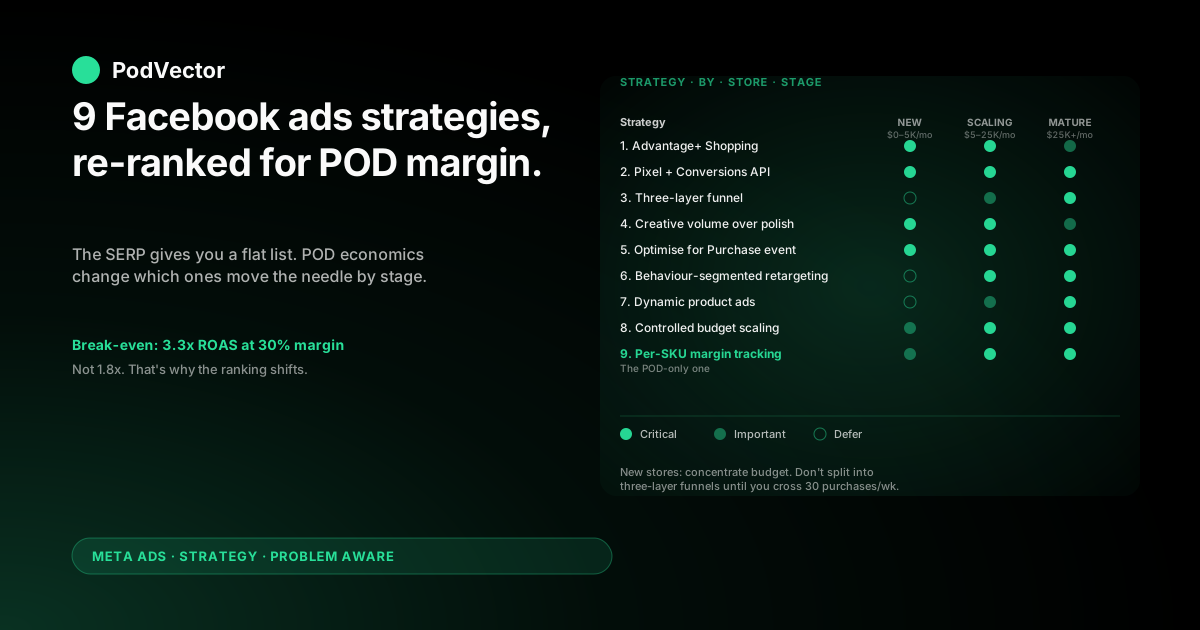
For print-on-demand stores, the same nine strategies still apply — but the rank order changes, because POD breaks even closer to 3.3x ROAS at a 30% contribution margin. Below is the comparison the major guides skip: which strategy moves the needle hardest at which store stage.
How POD economics change the ranking
Every "best Facebook ads strategy" article on the first page of Google is written for ecommerce stores carrying their own inventory. Their break-even ROAS sits between 1.7x and 2.0x. That margin headroom changes which strategies actually move the needle.
Print-on-demand operates on a fundamentally different cost stack. After Printify or Printful supplier costs, payment processing, returns, and shipping subsidies, contribution margin lands at 28–35% on a typical $30 t-shirt. Break-even ROAS is closer to 3.3x.
That single number reorders the list. Strategies that look "advanced" in a generic guide — per-SKU margin tracking, aggressive optimisation-event discipline — become foundational for POD. Strategies that look foundational — broad lookalikes, video volume — still matter, but get you closer to break-even, not further from it.
What "compared" means in this guide
Most listicles rank strategies by how often they show up on other listicles. This one ranks them by what they actually do for a print-on-demand store, at three honest store stages: new ($0–$5K/month ad spend), scaling ($5K–$25K/month), and mature ($25K+/month).
The stage table below is the part the SERP doesn't give you. The strategy details that follow are the part it does — re-tuned for POD economics.
The 9 strategies, compared by store stage
Read this table as "which strategy buys you the most profit-per-hour at this stage." Strategies marked Critical have an outsized return; Important matters but won't make or break you; Defer is real work that pays off later.
| Strategy | New ($0–$5K/mo) | Scaling ($5K–$25K/mo) | Mature ($25K+/mo) |
|---|---|---|---|
| 1. Advantage+ Shopping Campaigns | Critical | Critical | Important |
| 2. Pixel + Conversions API together | Critical | Critical | Critical |
| 3. Three-layer funnel structure | Defer | Important | Critical |
| 4. Creative volume over polish | Critical | Critical | Important |
| 5. Optimise for Purchase event | Critical | Critical | Critical |
| 6. Behaviour-segmented retargeting | Defer | Critical | Critical |
| 7. Dynamic product ads | Defer | Important | Critical |
| 8. Controlled budget scaling | Important | Critical | Critical |
| 9. Per-SKU margin tracking | Important | Critical | Critical |
Two takeaways. New stores should not waste calendar weeks building a three-layer funnel — they don't have the purchase volume to feed it. Scaling stores should not skip per-SKU margin tracking — at $5K+ spend, a $0.20/unit cost difference between hoodies and mugs can be the difference between profit and loss.
1. Advantage+ Shopping Campaigns as the foundation
Advantage+ Shopping Campaigns (ASC) is Meta's automated campaign type. It collapses audience, placement, and creative-rotation decisions into a single bidding system. For accounts under 30 purchases per week, ASC outperforms manual ad sets in the large majority of POD tests.
The reason is data sparsity. Meta's algorithm needs roughly 50 conversions per ad set per week to exit the learning phase. New POD stores rarely accumulate that volume on a manual structure with three or four cold ad sets. ASC pools the signal into one campaign and learns faster.
When to layer manual campaigns alongside
Once ASC clears 30 purchases per week, layer manual ad sets alongside it — never instead of it. Use manual campaigns to test specific creative angles, products, or audiences that ASC can't isolate. Keep ASC running as the workhorse.
The full graduation path is in the scaling Facebook ads playbook for POD.
2. Pixel + Conversions API together (never one alone)
Every guide on the first page of Google says to use both. They're right, but the explanation usually stops at "iOS 14 broke tracking." The real number matters for POD.
Pixel-only setups lose 25–40% of Purchase events to iOS opt-outs and ad-blockers. That under-reporting inflates your real cost-per-purchase by the same amount inside Ads Manager. On a $25 reported cost-per-purchase, you might actually be at $19 — or you might be at $32. You can't tell without server-side data.
The Conversions API (CAPI — Meta's server-to-server event feed) sends Purchase events directly from your store backend. When the Pixel and CAPI both fire and Meta deduplicates them, reporting accuracy lands around 90–95%, versus 60–75% for Pixel-only.
Verification matters more than installation
Both Shopify's official Meta channel and the major Conversions API apps install in minutes. The work is verification. Open Events Manager, find the Purchase event, and check that "Server" and "Browser" both show recent activity with a high deduplication rate.
If only one is firing, your "best strategy" is broken at the foundation regardless of what the rest of this list says.
3. A three-layer funnel structure
The textbook funnel is prospecting (cold), mid-funnel (warm engagement), and retargeting (visited or added-to-cart). Most ecommerce strategy guides recommend running all three from day one.
For new POD stores, that's wrong. A $50/day budget split across three layers is $17/day per layer — well below the threshold for any of them to exit learning. Single-campaign ASC absorbs all three intents and out-performs a three-way split until you hit ~$200/day.
The honest activation sequence
Layer one (prospecting): start here, with ASC. Run it solo until you cross 30 purchases/week.
Layer two (retargeting): activate at $200/day total ad spend. Build a 30-day site-visitor + ATC abandoner audience and run a separate ad set with offer-driven creative.
Layer three (mid-funnel): activate at $500/day. This is the slowest layer to mature and the easiest to skip — most POD stores see better incremental return from doubling down on creative volume than from building a separate engagement-retargeting layer.
4. Creative volume over creative polish
Meta's algorithm rewards variant count more than variant quality. The brands that win on Facebook ads are the ones shipping 5–10 new creative concepts per week, not the ones shipping one polished agency edit per month.
For POD, this is doubly true. Your audience is broad (anyone in the niche the design speaks to), and broad audiences need many hooks to find the one that converts. Eight short variants against the same product page beat one polished hero ad almost every time.
The minimum POD creative set
For each product launch, ship at least:
- Three vertical videos (9:16, 15–30 seconds) — one product close-up, one lifestyle, one UGC-style demo
- Two static images — one clean product shot, one lifestyle scene
- One carousel showing colour or design variants
- One image-overlay ad with the strongest review quote
That's seven assets per product. Cropink's 2026 strategy roundup argues carousels are the highest-ROI single format for ecommerce — for POD specifically, vertical video tends to edge out carousels on cold prospecting because design-led purchases need motion to communicate the product feel.
5. Optimise for Purchase, not clicks or ATC
Inside the ad set, you choose an "optimisation event" — the action Meta's algorithm tries to maximise. The right answer for ecommerce is always Purchase. The trap is that Meta will sometimes nudge you toward Add to Cart or View Content during the cold-start period, on the logic that there's "not enough Purchase data to optimise."
Don't take the nudge. Optimising for ATC trains the algorithm to find people who add to cart and don't buy. That audience is a real population — and it's expensive to retrain Meta off it later.
What to do when you genuinely have no Purchase data
Run ASC. ASC handles the cold-start period without making you choose a worse optimisation event. Within 7–14 days at $50–$80/day, the Pixel will have enough Purchase events to optimise cleanly. Trying to "warm up" the Pixel with a Traffic objective campaign is a tactic from 2019 that Meta no longer rewards.
The deeper mechanics of Meta's attribution windows live in the Meta Ads ROAS and attribution guide for POD.
6. Behaviour-segmented retargeting windows
Generic retargeting (everyone who visited the site in the last 30 days) burns budget on people who already wouldn't have bought. The strategies that compound results segment by intent and recency.
The minimum POD-relevant retargeting structure:
- 1–7 days, ATC abandoners: highest intent. Run offer-driven creative — free shipping, 10% off, dynamic product reminder. This audience converts at 4–8x cold prospecting CPM.
- 8–30 days, ATC abandoners: still warm, lower intent. Run social-proof creative — review quotes, UGC. Lower budget, lower offer aggression.
- 1–30 days, page viewers (no ATC): lowest retargeting intent. Run brand-style creative reinforcing the design's emotional hook. Treat this as low-CPM audience-warming, not direct response.
Why 60- and 90-day windows usually waste money for POD
POD purchase decisions are emotional and impulsive — buyers either convert within 14 days or they're gone. Audiences over 30 days old don't perform well enough to justify the CPM, except during major sale windows (Black Friday, Mother's Day, Father's Day) where you can briefly extend to 90 days to recapture last year's interested-but-didn't-buy buyers.
7. Dynamic product ads on the catalog
Dynamic product ads (DPAs) pull from your Shopify or WooCommerce catalog and auto-generate retargeting ads for the exact products each visitor viewed. They're the highest-ROI retargeting format in ecommerce.
For POD, DPAs solve a specific problem: design-led catalogs are wide. A POD store might list 200 t-shirt designs across 12 niches. Manually building retargeting ads per design is impossible. DPAs do it automatically.
The catalog setup that determines whether DPAs work
Catalog quality is everything. Each product needs a clean lifestyle image (not a flat mockup), a benefit-led title, and accurate pricing synced through Shopify's Meta channel. Sloppy catalogs produce sloppy DPAs that under-perform manual retargeting.
The full integration sequence sits in the Meta Ads + Shopify integration guide for POD.
8. Controlled budget scaling on winners
Once a campaign clears your break-even ROAS for two weeks running, scale it. The mistake operators make is doubling the budget overnight, which kicks the campaign back into learning and tanks performance for 7–10 days.
The discipline: increase budget by 20% every 3–4 days on a winning campaign. Compound over a month, the budget more than doubles, and you stay out of learning.
What "winning" means for POD specifically
Generic ecommerce guides define a winner as "ROAS above 2.0x for two weeks." For POD, replace 2.0x with 3.3x at a 30% contribution margin — or recompute with your actual margin if it's different. A 2.5x ROAS campaign that looks like a winner in the generic playbook is a losing campaign for POD.
This is also the strategy where per-SKU margin tracking (next section) stops being optional. A single ROAS number across a $25 t-shirt and a $45 hoodie is a lie that hides which SKU is actually scalable.
9. Per-SKU margin tracking (the POD-only one)
This strategy doesn't appear on any of the top three SERP results, because owned-inventory stores don't need it. POD stores do.
Printify and Printful base costs vary widely across products. A $25 mug at $4.50 supplier cost is 82% gross margin. A $45 hoodie at $24 supplier cost is 47% gross margin. Both might show 3.0x ROAS in Ads Manager. Only one of them is profitable.
What to track per SKU, every week
- Net contribution margin per unit: sale price minus supplier cost minus fulfilment minus payment processing minus return reserve. This is the dollar amount one sale puts in the bank.
- Allowable customer acquisition cost (CAC): contribution margin divided by your target margin-after-marketing. If a hoodie nets $14 contribution and your target is 8% margin-after-marketing on a $45 sale price, allowable CAC is $14 minus $3.60 = $10.40 per acquisition.
- Actual blended CAC: total Meta spend on that SKU divided by total purchases of that SKU. Pulled from Ads Manager's Sales-by-product breakdown.
- The gap: allowable CAC minus actual CAC. Positive means scale. Negative means kill or rework creative.
Operators who run this weekly catch losing SKUs in week one. Operators who run blended store-wide ROAS catch them six weeks later, after they've eaten the margin from three winning SKUs.
Why this is operationally hard
The numbers live in three places: Shopify (revenue and SKU), Printify or Printful (supplier cost), and Meta (ad spend). Joining them by hand in a spreadsheet takes 2–4 hours every Monday and produces stale data by Friday. Most operators stop after a month.
The honest answer is that this is the spreadsheet AI agents and connected data warehouses were built to retire — but even before you wire that up, doing it manually for your top 10 SKUs once a week will change which campaigns you scale.
Five mistakes that beat any "best strategy"
The strategies above only work if you don't undermine them with the operator-level mistakes below. Most underperforming POD ad accounts have one of these five issues, not a strategy gap.
- Splitting budget across too many ad sets. Three ad sets at $30/day each loses to one ad set at $90/day, every time. Concentration beats diversification at sub-$300/day spend.
- Editing campaigns mid-learning. Every budget change, audience tweak, or creative swap resets the learning phase. Decide what you're testing before launch, then leave it alone for 7–10 days.
- Killing campaigns at day three. POD CPMs swing 20–40% across the first week as Meta finds the audience. A campaign that looks dead on day three often turns positive by day six.
- Running blended ROAS only. A 2.8x blended ROAS hides a 4.5x mug campaign and a 1.8x hoodie campaign. Per-SKU is the only honest unit of analysis for POD.
- Spending an hour a day in Ads Manager. Daily checking trains anxious decisions. Twice-weekly reviews — Monday for creative refresh, Thursday for budget scaling — produce better results with one-third the time.
FAQs
What's the single best Facebook ads strategy for a brand-new POD store?
One Advantage+ Shopping Campaign at $50–$80/day, optimising for Purchase, with the Pixel and Conversions API both verified, fed 5–8 creative variants per product. Skip retargeting, dynamic product ads, and three-layer funnel work until you cross 30 purchases per week. Concentration beats sophistication at this stage.
Is Advantage+ Shopping Campaign actually better than manual ad sets for ecommerce?
Below 30 purchases per week, yes — by a clear margin in most POD tests. Above 30 purchases per week, the right move is "and," not "or": run ASC as the workhorse and layer manual campaigns to test specific audiences or creative angles. Replacing ASC with a manual structure rarely beats running both in parallel.
How much should a new POD store budget for Facebook ads to test a "best strategy"?
Plan for $1,500–$3,000 over the first 30 days to give the strategy a fair shot. Below $50/day, Meta can't accumulate purchase signal fast enough to exit learning. Above $80/day on a brand-new account, you're paying for clicks faster than you're learning what converts. The middle is where the strategy gets tested cleanly.
Does the best strategy change between Shopify, WooCommerce, and BigCommerce?
The Meta-side strategy is identical. The differences are upstream: Shopify's official "Facebook & Instagram by Meta" channel is the smoothest catalog and Conversions API setup, WooCommerce takes more manual configuration, BigCommerce sits between the two. Pick the platform on store-side reasons. The ad strategy doesn't care.
How does the "best strategy" change for POD specifically vs. owned-inventory ecommerce?
Three changes. Break-even ROAS shifts from ~1.8x to ~3.3x because contribution margins are lower. Per-SKU margin tracking moves from "advanced" to "foundational" because supplier costs vary widely across products. Creative volume matters more because POD audiences are broad and design-led, so finding the converting hook takes more variants than a focused branded catalog.
Should the best strategy include influencer or UGC content?
Yes for the creative layer, no as a standalone strategy. UGC-style video is one of the highest-converting creative formats for POD on cold prospecting — but it sits inside Strategy 4 (creative volume), not as a tenth pillar. Treat creator partnerships as a way to feed your ad account, not as an end in themselves.
What does the top 3 in Google's results recommend differently?
The major strategy roundups — Cropink's 15-strategy 2026 list, AdStellar's 8-strategy ecommerce guide, and WordStream's 2026 trends piece — all converge on roughly the same Meta surface area: ASC, Pixel + CAPI, full-funnel structure, creative volume, Purchase optimisation, retargeting, DPAs, and budget scaling. They're written for owned-inventory ecommerce. The strategy they don't cover is the per-SKU margin work that turns the same Meta tactics into actually profitable POD campaigns. The full Meta strategy library lives at the Meta Ads strategy hub, which sits inside the Meta Ads topic hub. For broader format choices, the complete Meta ad types guide for POD covers when to pick video, carousel, or DPA. For platform comparison, Meta Ads vs alternatives shows where Facebook fits against Google, TikTok, and Pinterest for POD.
You picked a strategy. Now find out if it's making money on profit, not on receipt size.
Meta Ads Manager shows you ROAS on subtotal. Printify shows you the supplier invoice. Your store shows you the order revenue. The margin sits in the gap between three dashboards — and most POD operators never close it.
Victor is the AI employee that pulls your store, suppliers, and Meta into one live data warehouse and answers the question Ads Manager can't: which strategy, which SKU, which campaign is actually putting money in the bank? Ask in plain English, get the number from your real data, decide on the right one.
Try Victor free