
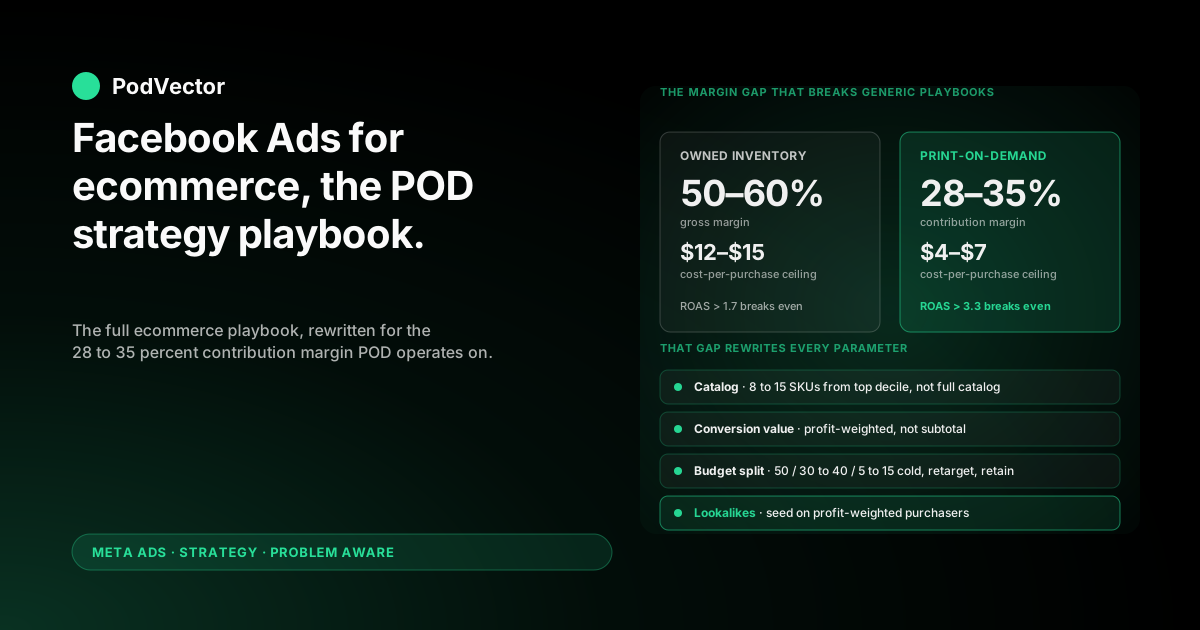
Quick Answer: A Facebook Ads strategy for ecommerce becomes a different problem the moment "ecommerce" means print-on-demand. Generic ecommerce playbooks assume 50–60% gross margins from owned inventory; POD operators run 28–35% contribution margin after Printify or Printful supplier costs.
That gap rewrites every section of the standard playbook — the catalog you sync, the conversion value Meta sees, the campaign structure, the daily budget floor, and the scaling rule. Get the margin math right first and the rest is execution.
This guide walks the full ecommerce Facebook Ads playbook through a POD lens: full-funnel architecture, audience strategy, creative formats, the Pixel and Conversions API layer, budget at POD margins, the profit-as-conversion-value override, and the scaling cadence that doesn't burn cash.
Why ecommerce playbooks miss for print-on-demand
Most published Facebook Ads strategies for ecommerce — including the AdStellar 2026 ecommerce growth playbook and Cropink's 15 strategies that actually work in 2026 — are written for owned-inventory direct-to-consumer brands. Apparel made in bulk, beauty SKUs ordered by the pallet, supplements with 60% gross margin baked in.
That assumption sits underneath every recommendation. Test 12 creatives, scale winners 30% per day, build lookalikes off the top 1% of purchasers — these all work when each order leaves $18–$25 of contribution margin to absorb a $12 cost-per-purchase.
Print-on-demand doesn't have that cushion. A $30 t-shirt fulfilled by Printify or Printful costs $14–$17 in supplier fees before payment processing, shipping subsidy, or returns. The contribution margin per order lands closer to $9 than $20.
The strategic implications cascade from there:
- Cost-per-purchase ceiling: $4–$7 instead of $12–$15 to stay profitable.
- ROAS bar: roughly 3.3x to break even, not the 1.7–2.0x quoted in generic ecommerce playbooks.
- Catalog signal: optimizing on order subtotal pushes Meta toward your highest-revenue SKUs, which for POD are usually your lowest-margin ones.
- Test budget: you can't afford to test 12 creatives at $40/day. Test 3, learn fast, replace.
Every section below is a generic ecommerce playbook section, rewritten with that tighter margin in mind.
Full-funnel architecture: prospecting, retargeting, retention
The full-funnel structure (cold prospecting, warm retargeting, repeat-purchase retention) is the consensus recommendation across every ecommerce Facebook Ads guide. It's also correct for POD — but the budget split changes.
Cold prospecting (50–60% of budget for POD, vs 70% for owned inventory)
One campaign optimizing for Purchase events, broad audience, no detailed targeting. Meta's algorithm finds buyers faster on a broad audience than on a hand-curated interest stack — a result that's been replicated across thousands of ecommerce accounts since iOS 14.5 broke detailed-targeting precision.
Run two ad sets here, no more. One with your strongest mockup-on-model creative, one with a 15-second motion ad. Adding a third ad set on a $60–$90 daily budget thins the learning data so much that nothing escapes the learning phase.
Retargeting (30–40% of budget — the POD overweight)
This is where POD's margin math finds the most leverage. A retargeted buyer is closer to captured intent; cost-per-purchase realistically lands at $4–$6, which the math actually supports at POD economics.
Generic ecommerce playbooks suggest 20% of budget on retargeting because owned-inventory accounts can afford to acquire cold buyers. POD accounts often can't — so retargeting carries more of the conversion load.
Target visitors from the last 14 days who didn't purchase, plus add-to-cart and initiate-checkout abandoners. Different creative from your prospecting ad — usually a discount, urgency, social proof, or "shipping included" angle.
Retention / repeat purchase (5–15% of budget)
Most POD stores skip this entirely. That's a mistake on stores that have crossed ~500 lifetime orders, because a returning POD buyer has a lifetime value 2–3x higher than a one-time purchaser and the acquisition cost is functionally zero.
Build a 90-day post-purchase audience and run a small "what's new" creative campaign to it. Even at $5/day, the math works on returning customers because there's no first-purchase margin tax.
Audience strategy when you don't own the inventory
The standard ecommerce audience playbook leans heavily on lookalikes built from "top 1% of purchasers by lifetime value." That's a strong signal for owned-inventory brands where AOV mostly tracks margin contribution.
For POD it's misleading. Your highest-revenue customers often bought your highest-priced, lowest-margin SKUs (oversized hoodies, full-color all-overs, premium garment lines with thin margins). Building a lookalike off those buyers tells Meta to find more low-margin shoppers.
The audience hierarchy that actually works for POD:
- Lookalike of purchasers, weighted by profit not subtotal. If you're sending profit as the conversion value (covered in section 7), Meta builds the LAL off profit-weighted purchases automatically. This is the single highest-leverage audience for POD.
- Lookalike of repeat purchasers (2+ orders). A returning POD buyer has already cleared the "is this real, will it ship, does it fit" objection. Lookalikes off this seed find buyers who are similarly resilient to first-order friction.
- Broad audience with no interest layering. The default that quietly outperforms hand-curated interest stacks on small POD accounts. Let Meta's algorithm do the targeting work.
- Custom audiences from email and SMS lists. If you have an existing customer email list, upload it as a custom audience for retargeting — and as a seed for lookalikes. Free first-party data Meta can't get anywhere else.
Avoid: lookalikes built off "all website visitors" or "video viewers." These signals are too noisy for small POD accounts to extract a useful pattern from.
Creative formats that work for POD ecommerce
Creative beats targeting on small accounts. Meta has so little signal to work with on a $60–$90 daily POD budget that the creative does most of the audience-finding work.
The format hierarchy that works for POD on Facebook and Instagram:
Lifestyle photography of the design on a real human
Order a sample, photograph the design on a person, post in 4:5 portrait. This single change usually doubles CTR vs. Printify's stock mockups and Printful's flat-lay compositions.
The reason is trust. Mockups on a blank tee scream "POD store" to ecommerce-fatigued shoppers; a real human in the design closes the credibility gap before the price even loads.
15-second vertical video for Reels and Stories placement
Facebook and Instagram have been pushing Reels-native ad inventory hard since 2024, and the placement now consistently delivers the lowest CPM across all Meta surfaces. A 15-second vertical video showing the design in three contexts (worn, close-up detail, packaged) costs almost nothing to make on a phone.
Carousel ads for design variants
Useful when one design has 4–6 SKU options (colors, garment types, sizes). The carousel lets the algorithm test which combination earns the click without you having to build six separate ad sets.
Cropink's playbook calls carousel "the highest ROI format for ecommerce on Facebook." For POD it's specifically strong when you have a single hero design across multiple garment styles.
Dynamic Product Ads (catalog-sourced) for retargeting only
DPAs (Dynamic Product Ads — Meta's catalog-driven format that auto-generates ads from your product feed) need a working catalog and meaningful purchase signal. They're not where to start, but they belong in your retargeting campaign once you have 30+ purchases on the books.
What to avoid
Any ad that opens with "BUY NOW" or "LIMITED TIME OFFER." POD has been associated with low-quality dropship-style creative for so long that hard-sell openers tank the relevance score on impression one.
Also avoid: AI-generated lifestyle imagery that doesn't quite resolve. Real customers can spot it instantly, and the trust cost is brutal.
The tracking layer: Pixel, CAPI, and offline conversions
The tracking infrastructure is where most POD operators lose money invisibly. Meta can only optimize toward conversions it actually sees, and iOS 14.5+ means a browser-only Pixel sees 50–70% of true purchases on a typical ecommerce account.
Three layers, in order of priority:
Layer 1: Meta Pixel + Conversions API (CAPI)
Install the Pixel through your platform's native channel (Shopify, WooCommerce, custom storefront — all support this). Then enable the Conversions API (CAPI — Meta's server-side event channel) so purchase events fire from your server, not just the browser.
Without CAPI, you're optimizing on a degraded signal that gets worse every iOS release. Browser-only Pixel has been the wrong choice since 2021; it's actively damaging in 2026.
Layer 2: Domain verification and aggregated event measurement
Verify your domain in Business Manager and assign your eight-event slot priorities, with Purchase as #1. Without this, iOS 14.5+ users who opt out of tracking generate zero optimization signal — they're invisible to your campaigns.
Layer 3: Offline conversions for refunds and chargebacks
This is the layer almost nobody implements. POD has elevated refund rates (3–6% vs. 1–2% for owned inventory) because of garment fit, design quality variance, and shipping damage on Printify/Printful packages.
Upload refunds back to Meta as offline conversions with negative value. The algorithm then learns to deprioritize buyers who refund — a signal that compounds over months and gets sharper the longer the account runs.
For step-by-step Shopify-specific install detail, see the complete guide to Meta Ads + Shopify integration for POD. The same architecture applies on WooCommerce and custom storefronts; only the install plugin changes.
Budget framework at print-on-demand margins
Generic ecommerce playbooks quote $50–$100 per day as a "minimum meaningful budget" for Facebook Ads. That number assumes 50%+ gross margin and tolerates a $12–$15 cost-per-purchase.
For POD the math runs from contribution margin per order backward. Take a typical $30 t-shirt: Printify Premium supplier cost ~$15.20, payment fees ~$1.05, shipping subsidy ~$4 of margin, 1% return rate. True contribution margin per order: roughly $9.50.
To break even on ads, you need a cost-per-purchase below $9.50. On a typical apparel CPM of $14–$22 and a 1.2% link CTR, break-even sits at a 4–5% landing-page conversion rate — achievable but at the upper end of POD store benchmarks.
The honest budget framework for POD on Facebook:
- Floor: $40/day for 14 days ($560). Below this, Meta's algorithm doesn't accumulate enough purchase events to exit the learning phase. Halving the budget doesn't halve the cost — it eliminates the chance of useful learning.
- Realistic: $60–$90/day for the first 30 days ($1,800–$2,700). Enough headroom for one prospecting and one retargeting campaign to find profitable placements, with margin to absorb the inevitable bad-placement spend in week one.
- Aspirational: $150+/day, only if you've already validated organic demand on the chosen SKUs and have working capital for 30–45 days of negative ROAS while the account trains.
If those numbers feel uncomfortable, the right move is not halving the budget. It's deferring the launch until margin or working capital improves. POD operators who launch on $20/day reliably report worse-than-no-ads outcomes because the spend depletes runway without producing data.
The profit-as-conversion-value override
This is the single highest-leverage change a POD operator can make to a Facebook Ads strategy, and almost nobody does it.
By default, your ecommerce platform sends order subtotal to Meta as the Purchase event value. For owned inventory at 60% gross margin, that's tolerable — Meta optimizing toward higher subtotal still optimizes toward profitable customers.
For POD it's actively damaging. Meta's algorithm will chase your highest-subtotal SKUs, which on a POD store are usually your lowest-margin garments — oversized hoodies, premium all-over prints, the items where Printify or Printful's supplier cost eats almost all of the retail price.
The fix: send profit (subtotal minus per-line-item supplier cost) as the value parameter to both the Pixel and the Conversions API. Meta then optimizes toward profit-weighted purchases natively, and every downstream optimization (lookalikes, automated bidding, Advantage+ placement) inherits the correct signal.
Implementation has three parts:
- Source the per-SKU supplier cost. Pull from Printify or Printful's API, or maintain it as a Shopify metafield. Either way, you need a lookup that takes a SKU and returns the supplier cost.
- Modify the Purchase event payload. In your Pixel and CAPI integration, replace the default value (line item subtotal) with the calculated profit (subtotal minus supplier cost minus payment fee). Most theme integrations don't support this out of the box — it's a custom integration or an app like Elevar or Aimerce.
- Don't include shipping or tax in the profit number. Those don't represent margin contribution and including them inflates the signal back toward the wrong direction.
This is also where Victor — PodVector AI's AI employee — does the work most operators end up doing in spreadsheets at 11pm. Victor pulls Shopify, Printify or Printful, and Meta into one live data warehouse and answers "is this campaign profitable on margin, not just spend?" with a number that already accounts for supplier cost. The point isn't the tool; the point is that the question above is the one that matters and most POD operators don't have a fast way to answer it.
For more on the underlying math, see the pillar on the complete guide to Meta Ads ROAS and attribution for POD and how Meta defines ROAS in its help center.
Scaling rules that don't reset the algorithm
Generic ecommerce scaling guides quote a "20–30% daily budget increase" rule for winning ad sets. That's roughly correct for POD too, but the trigger conditions are stricter.
Don't scale on:
- Day-3 ROAS. Attribution lag means this number is wrong.
- One purchase. Variance dominates at single-digit conversion volumes.
- Meta's reported ROAS alone. Your true cost-per-purchase includes Printify/Printful supplier cost the dashboard doesn't see.
Do scale when:
- An ad set has 10+ purchases over a rolling 14-day window.
- Profit-weighted ROAS (subtotal minus supplier cost ÷ ad spend) is above 1.0.
- Cost-per-purchase has been stable, not improving, for 5+ consecutive days. Stability beats single-day spikes.
The mechanics of the scale itself: increase ad set budget by 20% per day, no more. Larger jumps reset the learning phase and you'll spend the next week re-finding the buyers you'd already found.
If a winning ad set hits diminishing returns (cost-per-purchase rising while spend rises), the move is duplication — copy the ad set into a new campaign with a fresh budget rather than continuing to push the original. This avoids the "I scaled my winner and it died" pattern that plagues POD accounts on small budgets.
Eight mistakes that quietly drain a POD ad budget
- Sending order subtotal as conversion value. Meta optimizes toward your highest-revenue SKUs, which for POD are usually your lowest-margin ones. Fix in week one or accept the misallocation.
- Launching with the full catalog synced. 200 SKUs at $60/day produces no learning. Restrict to 8–15 SKUs from your top decile of organic orders.
- Optimizing on ROAS in week one. Attribution lag means the early number is wrong. Decision-making this early is gambling on noise.
- Skipping the Conversions API. Browser-only Pixel has been functionally degraded since iOS 14.5. CAPI is the floor, not the upgrade.
- Skipping offline conversion uploads. POD has 3–6% refund rates. Without uploading refunds back to Meta, your algorithm keeps optimizing toward buyers who'll refund.
- Building lookalikes off "all purchasers by lifetime value." For POD, your highest-LTV buyers often bought your lowest-margin SKUs. Build off profit-weighted seeds or repeat purchasers instead.
- Running stock Printify or Printful mockups as creative. They underperform real-human lifestyle shots by 1.5–2x on CTR. The sample order pays for itself in week one.
- Treating ad spend as the only cost. Forgetting payment fees, shipping subsidy, and 1–3% returns understates true cost-per-order by $2–$4. That's the entire margin on a $30 t-shirt.
FAQs
What's the best Facebook Ads strategy for an ecommerce store doing print-on-demand?
Start with a 50/30/20 budget split between cold prospecting, retargeting, and brand defense, on a $60–$90 daily budget for the first 30 days. The single highest-leverage change is sending profit (subtotal minus Printify/Printful supplier cost) as the Pixel + CAPI conversion value, instead of the default order subtotal that misallocates Meta's optimization toward your lowest-margin SKUs.
How is Facebook Ads strategy different for POD vs. regular ecommerce?
The structural difference is contribution margin. Owned-inventory ecommerce runs 50–60% gross margin with $18–$25 of contribution per order; POD runs 28–35% with $9–$12 per order. That tighter margin tightens every other parameter: lower cost-per-purchase ceiling, higher ROAS bar (3.3x vs. 1.7x), more retargeting weight, and a profit-weighted conversion signal instead of subtotal.
What's a realistic monthly Facebook Ads budget for a POD ecommerce store?
$1,800–$2,700/month for the first 30 days as the realistic range, mapping to $60–$90/day. Below $1,200/month ($40/day), Meta's algorithm can't accumulate enough purchase events to exit the learning phase and the spend produces no useful data.
Do dynamic product ads work for print-on-demand?
Yes, but only in retargeting campaigns and only after you have 30+ purchases on the books. DPAs need a clean catalog feed and meaningful purchase signal — both take 30–45 days to build on a new POD account. Start with static lifestyle creative and motion ads; layer DPAs once the foundation exists.
Should I run Facebook Ads or Google Ads first for my POD ecommerce store?
Depends on demand state. If your designs target an existing search-intent audience (niche fandoms, professional categories, hobbies people Google), start with Google Search and add Facebook later. If your designs are discovery-driven (visual humor, broad lifestyle, trend-driven), Facebook is where demand exists and Google Search has nothing to match. The Google Ads vs. Facebook Ads for ecommerce comparison for POD covers the decision in detail.
How do I measure true profitability on Facebook Ads for a POD ecommerce store?
Three layers: send profit (not subtotal) as the Pixel + CAPI conversion value so Meta optimizes correctly; reconcile Meta spend, ecommerce platform orders, and Printify/Printful supplier cost in a daily dashboard; upload refunds as offline conversions so the negative signal trains the algorithm. You cannot trust Ads Manager's reported ROAS in isolation for POD because it doesn't see supplier cost.
How long until Facebook Ads become profitable for a POD ecommerce store?
Realistically days 25–45 is when accounts that are going to work start showing positive contribution margin. Earlier than that is usually the learning phase masking the truth; later than that means the strategy needs structural change, not more time. The first 14 days are infrastructure shakeout (Pixel, CAPI, catalog, creative testing), not optimization.
What ROAS should I target for Facebook Ads on a POD ecommerce store?
Roughly ROAS > 3.3 to be marginally profitable at typical POD economics (28–35% contribution margin). The bar is higher than the 1.7–2.0x quoted in generic ecommerce guides because Printify or Printful supplier cost eats most of the gross margin before Meta sees the order.
Stop optimizing on subtotal. Start optimizing on profit.
Generic ecommerce playbooks tell Meta to chase revenue. For POD, that means chasing the SKUs with the thinnest margin.
Victor connects your ecommerce platform, Printify or Printful, and your Meta ad account into one live data warehouse and tells you which campaigns are profitable on margin, not spend. Same playbook above, honest measurement underneath.
Try Victor free