
Quick Answer: Facebook retargeting for a Shopify POD store is the highest-reported-ROAS slot in the Meta stack and the most commonly mis-scaled. The retargeting layer reports 4–8× dashboard ROAS on a healthy POD store, which makes operators want to push more budget into it — but retargeting has a hard audience-size ceiling tied to upstream prospecting volume, and contribution-margin ROAS on POD orders is 3–5× lower than dashboard ROAS once Printify or Printful base costs, Shopify fees, and apparel refund rates net out.
The right setup is a four-tier retargeting funnel — ViewContent 30 days, AddToCart 14 days, InitiateCheckout 7 days, post-purchase cross-sell 14–60 days — each running Advantage+ Catalog Ads against a tightly-defined Custom Audience exclusion chain, with frequency caps tuned to the POD apparel buying cycle, base-cost-tier catalog filters that keep low-margin SKUs out of the retargeting auction, and contribution-margin ROAS measured per tier so the scaling decision lands on real dollars rather than Meta-reported revenue. Below: the audience architecture, the catalog filters, the iOS-14 signal-loss fix that POD stores hit hardest, the frequency and creative cadences that survive past week three, and the contribution-margin math that decides which tier gets more spend.
Why POD retargeting is different from generic Shopify retargeting
Most retargeting playbooks treat a Shopify store as a single P&L with a single AOV and a single margin profile — and the playbook works well enough on a store buying inventory at 30% landed cost. A Shopify POD store sits in a structurally different place.
Base cost from Printify or Printful runs 35–55% of retail, Shopify transaction fees take another 3%, apparel refund and reprint rates run 2–5%, and free-shipping promos compress margin further on cart sizes that are not large enough to absorb the shipping shortfall. By the time a POD order lands in the bank, contribution margin sits at 25–40% of gross revenue — versus 55–70% on a comparable inventoried store.
The downstream consequence for retargeting strategy: the same dashboard ROAS that signals "scale this campaign" on an inventoried store signals "approaching break-even" on a POD store. Generic retargeting guides — including the canonical Shopify retargeting guide, the AdNabu deep dive, and the Cropink funnel walkthrough — assume the inventoried-store math when they say things like "retargeting has the highest ROI in advertising." That assumption breaks for POD operators, and the strategy that follows is built around the breakage.
Where this article sits inside the broader Meta context: the Meta Ads for POD topic hub is the topic entry point, the Meta ad types cluster is where this piece lives, and the upstream stack-wide framing is in the complete guide to Meta ad types for POD sellers.
Meta Pixel + Conversions API: the prerequisite that POD stores fail hardest
Every retargeting tier below depends on website-event Custom Audiences populating from accurate event data. On a Shopify POD store, the four standard events that have to fire correctly are ViewContent, AddToCart, InitiateCheckout, and Purchase — and they need to fire from both the browser-side Meta Pixel and the server-side Conversions API simultaneously. Pixel-only tracking on a 2026 Shopify POD store typically reports 60–70% of true event volume because of iOS 14.5+ ATT opt-outs, ad-blocker prevalence, and Safari ITP cookie expiration; that 30–40% signal loss directly shrinks every retargeting Custom Audience by the same proportion.
The fix is non-negotiable for a POD store running retargeting at any meaningful spend level:
- Enable Conversions API through the native Shopify Facebook & Instagram channel. Shopify's native channel ships Pixel + CAPI as one toggle since 2022. If the channel was installed before 2022 and never re-configured, CAPI is likely off — re-install or toggle it on in the channel settings. The full instrumentation walkthrough is in the complete guide to Meta Ads + Shopify integration for POD.
- Validate event match quality in Meta Events Manager. The dashboard shows a 0–10 score per event. Aim for 7.0+ on Purchase. Below 7, the event match rate is too low for catalog audiences to populate at full size and retargeting tiers underperform on a sample-size problem rather than a strategy problem.
- Deduplicate Pixel and CAPI events. The native channel handles event_id deduplication automatically; third-party tag managers (GTM Server-Side, Stape, Elevar) require explicit event_id parameters or you double-count Purchase events and inflate dashboard ROAS by ~40%.
- Pass user-data parameters (em, ph, fbc, fbp). Match quality scores rise sharply when hashed email and phone are passed alongside the click identifiers. Shopify's checkout gives you both at the Purchase event; passing them through CAPI is the single biggest match-quality lever.
The four-tier retargeting audience architecture
The four tiers that work for a POD Shopify store, from coldest to hottest, are warm-visitor, cart-abandoner, checkout-abandoner, and post-purchase cross-sell. Each tier maps to a different conversion job and a different creative angle. The architecture is identical to the architecture in the broader Facebook dynamic ads stack, but this section drills into the audience-construction details that retargeting performance rests on.
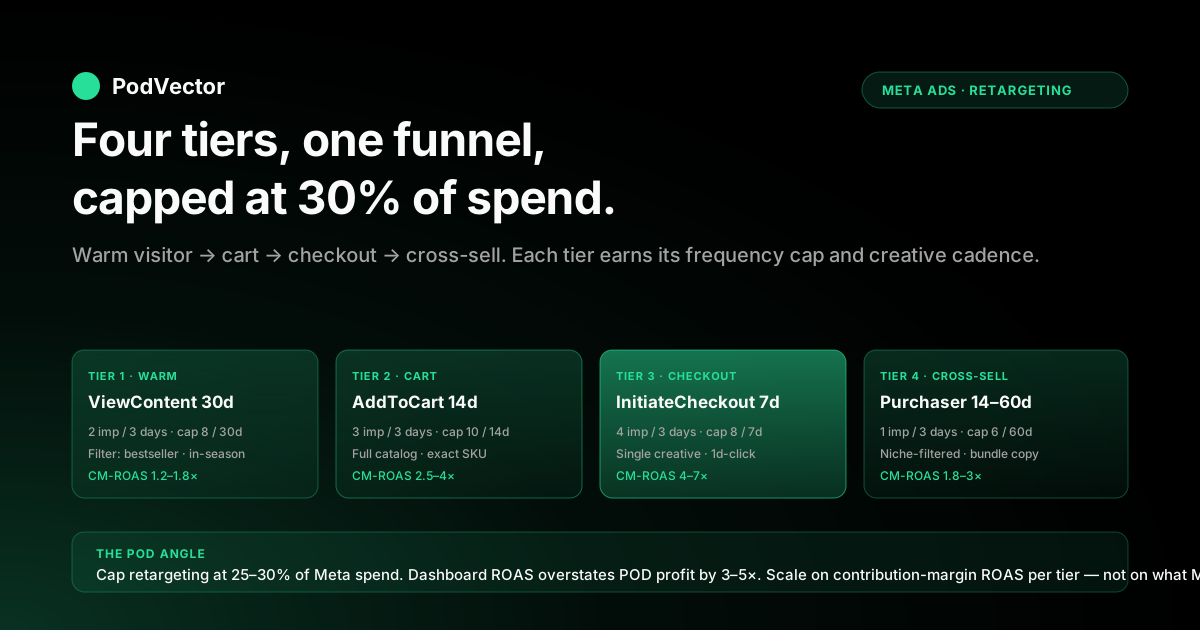
- Tier 1 — Warm visitors (ViewContent 30 days, exclude Purchase 30 days). Audience size on a POD store doing $20K/month in revenue typically lands at 25,000–60,000 users depending on traffic mix. Creative angle: discovery-style carousel highlighting the design family the user browsed, with a soft social-proof message ("ships in 3–5 days," "5,000 sold last month"). Optimization event: ViewContent → Purchase 7-day click. Frequency cap: 2 impressions per 3 days.
- Tier 2 — Cart abandoners (AddToCart 14 days, exclude Purchase 14 days, exclude InitiateCheckout 14 days). Audience size: 1,500–6,000 users. The exclude-InitiateCheckout filter pushes deeper-intent users into Tier 3 where the creative is different. Creative angle: the exact SKU added to cart, with a reassurance message — shipping speed, return policy, sizing chart link. Optimization event: Purchase 7-day click. Frequency cap: 3 per 3 days.
- Tier 3 — Checkout abandoners (InitiateCheckout 7 days, exclude Purchase 7 days). Audience size: 400–1,500 users. The hottest pre-purchase tier. Creative angle: single-creative variant featuring the cart's primary SKU, "still in your cart" or "secure checkout in 60 seconds" copy, optional small incentive (5–10% code) only if contribution margin allows. Optimization: Purchase 1-day click + 1-day view. Frequency cap: 4 per 3 days.
- Tier 4 — Post-purchase cross-sell (Purchase 14–60 days). Audience size: cumulative 30-day Purchaser Custom Audience minus 14-day fresh-buyers. Creative angle: complementary niche items, bundle pricing, "complete the look" copy. Optimization: Purchase 7-day click. Frequency cap: 1 per 3 days.
The four tiers run as four separate ad sets inside one campaign — or four campaigns if budget allocation needs to be locked per tier (recommended at $5K+/month total Meta spend). Each ad set runs Advantage+ Catalog Ads against the catalog-filter rules in the catalog filters section below.
The exclusion chain that keeps tiers from cannibalizing
The exclusion chain is the single highest-leverage thing in this entire playbook and the most commonly skipped step. Without it, the same user appears in multiple tiers simultaneously, the auction bids against itself, and impressions get spent serving a checkout abandoner the same generic discovery carousel that the warm-visitor tier is also serving. CPM rises, frequency rises, dashboard ROAS rises (because the same user converted somewhere), and contribution-margin ROAS falls.
The exclusion chain that prevents cannibalization on a four-tier retargeting setup:
- Tier 1 (warm): include ViewContent-30d, exclude AddToCart-30d, exclude InitiateCheckout-30d, exclude Purchase-180d.
- Tier 2 (cart): include AddToCart-14d, exclude InitiateCheckout-14d, exclude Purchase-30d.
- Tier 3 (checkout): include InitiateCheckout-7d, exclude Purchase-30d.
- Tier 4 (cross-sell): include Purchaser-14-60d, exclude Purchase-14d (so fresh buyers get a delivery-experience window before being re-pitched).
The exclusions stack so each user lives in exactly one tier at a time, and the highest-intent tier they qualify for wins them. A user who viewed a product, added it to cart, and started checkout is exclusively in Tier 3 — not Tier 1 + Tier 2 + Tier 3 simultaneously. That clarity is what makes per-tier ROAS measurement actually meaningful and the per-tier scaling decisions in the scaling rules section tractable.
Catalog filters: keeping low-margin POD SKUs out of retargeting
The POD-specific retargeting failure that no generic Shopify guide covers is the unit-economics drift that happens when retargeting serves the SKU the user happens to have viewed — even if that SKU has 28% contribution margin and a "do not advertise" flag in the operator's spreadsheet. Advantage+ Catalog Ads will personalize whichever SKU the user touched, regardless of margin profile. The fix is catalog-side: filter the retargeting catalog feed so low-margin SKUs are not eligible to be served.
The filter convention that works for most POD stores — same convention used in the Shopify dynamic Facebook ads product feed strategy — is to populate the five custom_label fields and apply them at the ad-set Catalog Filter level:
- custom_label_0 = base-cost tier. Values: under-$10, $10-$15, $15-$25, $25+. Retargeting tiers 2 and 3 (cart, checkout) include all tiers because the user has already chosen the SKU. Tier 1 (warm visitor) and Tier 4 (cross-sell) exclude $25+ unless the AOV at that tier supports it.
- custom_label_1 = niche or design family. Cross-sell (Tier 4) filters to complementary niches only — buyers of a "vintage band tee" niche see other vintage band tees, not unrelated home decor SKUs.
- custom_label_2 = provider. Printify, Printful, SPOD, Gelato. Useful when one provider has stockout or quality issues and needs to be temporarily filtered out of all paid traffic.
- custom_label_3 = season tag. Filter out off-season SKUs from Tier 1 warm-visitor retargeting (no point serving a Halloween tee on December 28th) while keeping seasonal SKUs eligible for Tier 2/3 where the user explicitly added one.
- custom_label_4 = bestseller flag. top-10, top-50, longtail. Tier 1 warm-visitor retargeting excludes longtail SKUs; tiers 2/3 keep all SKUs eligible because the user has already engaged with whatever is in the audience.
The asymmetric filter rule across tiers is the trick most operators miss: hotter retargeting tiers serve the full catalog because the user has already self-selected the SKU; colder retargeting tiers and cross-sell filter aggressively because the dynamic algorithm is the one selecting the SKU and it does not know your margin structure.
Creative cadence and frequency caps for POD apparel
POD apparel has a longer consideration cycle than impulse-buy categories — buyers compare designs, check sizing, look at reviews, abandon, return after a few days. A retargeting frequency cap calibrated to a 24-hour impulse-buy window over-saturates the POD shopper inside three impressions and CTR collapses. The cadence that fits the POD apparel cycle:
- Tier 1 (warm visitor): 2 impressions per 3 days, max 8 impressions over 30 days. This window matches the POD consideration cycle without bleeding into ad fatigue.
- Tier 2 (cart abandoner): 3 per 3 days, max 10 over 14 days. Higher cap because the user is closer to converting and the audience pool is small.
- Tier 3 (checkout abandoner): 4 per 3 days, max 8 over 7 days. Highest cap, shortest window — convert in week 1 or release the audience.
- Tier 4 (cross-sell): 1 per 3 days, max 6 over 60 days. Light touch — these are existing customers and over-frequency damages the lifetime relationship.
Creative refresh cadence — assets entering and leaving the rotation — runs on a separate clock from frequency caps. The cadence that prevents the 4–6 week creative decay every Advantage+ Catalog Ads campaign hits:
- Weekly creative drop, 3–5 new variants per ad set. Rotate across asset type weekly: lifestyle photography → headline copy → video angles → social proof framings.
- Bi-weekly retirement: variants below 0.5% CTR or above 1.5× the campaign's median CPA over a 7-day window get paused. The threshold is calibrated to the campaign's overall performance, not an absolute number.
- Monthly winners tournament: top 3 variants by attributable purchase volume re-enter the rotation as fresh starting points the following month. This compounds the winners across cycles instead of letting them age out.
Single-creative ad sets — Tier 3 specifically — are exempt from the rotation. Bottom-of-funnel performs best with one creative variant per audience because the message is "the exact item you nearly bought" and variant rotation introduces noise into a high-intent decision.
Post-iOS14 signal loss and how POD stores hit it hardest
iOS 14.5+ App Tracking Transparency (ATT) opt-outs reduce Meta's deterministic signal on iOS Safari traffic by 60–80% depending on niche. Retargeting audiences populate from website events, so signal loss directly shrinks every Custom Audience by the unmeasured proportion. POD stores hit the ATT problem harder than inventoried stores for two structural reasons.
First, POD niches skew apparel and lifestyle, which over-index on iOS Safari users (the demographic most likely to opt out of ATT). A men's tools niche on Shopify might run 40% iOS / 60% Android+desktop; a women's apparel niche typically runs 65% iOS / 35% Android+desktop, and the apparel iOS cohort opts out of ATT at higher rates than the tools iOS cohort. Second, POD AOV ($25–$45 typical) puts orders below the threshold where Meta's modeled-conversion algorithms (Aggregated Event Measurement, modeled attribution) generate clean estimates — modeled attribution works better at $80+ AOV.
The mitigation stack that recovers most of the lost signal:
- CAPI with high-quality user_data. The single biggest lever. CAPI can re-attribute events that Pixel missed because the iOS user opted out, as long as hashed email and phone data flow server-to-server. The native Shopify channel handles this; tag-manager-driven setups need explicit configuration.
- Aggregated Event Measurement (AEM) configured with the right 8 events ranked by business value. Purchase, InitiateCheckout, AddToCart, Lead, ViewContent, and 3 custom events. The order matters because iOS users on opted-out devices only attribute the highest-priority event that fired in the session.
- 7-day click + 1-day view attribution window. Default since iOS 14.5+. Anything wider relies on increasingly modeled data; anything narrower loses too many real attributions on the POD apparel consideration cycle.
- Modeled audience expansion. Meta now supplements deterministic Custom Audiences with modeled lookalike-style expansions when the source audience falls below threshold. This recovers some of the warm-visitor audience size but increases noise at the bottom of the audience pool — Tier 1 retargeting absorbs this fine; Tiers 2/3 should not rely on modeled expansion.
The CAPI + AEM + 7-day-click setup typically recovers retargeting CPA to 1.1–1.3× of pre-iOS14 levels rather than the 1.5–2× degradation Pixel-only POD stores experience. The integration walkthrough is the prerequisite section of the complete guide to Meta Ads + Shopify integration for POD.
Dashboard ROAS vs contribution-margin ROAS by tier
Meta's reporting interface shows a "Purchase ROAS" or "Website Purchase ROAS" — the ratio of Meta-attributed purchase value to ad spend. For a POD store, that number overstates contribution-margin ROAS by 3–5× because four costs never enter Meta's calculation:
- Printify or Printful base cost on each item (35–55% of retail).
- Shipping shortfall on free-shipping promo orders (typical $2–$5 per order on apparel).
- Shopify transaction fee (2.9% + $0.30 per order on the standard plan).
- Refund and reprint rate (2–5% on POD apparel from sizing, color, or print-quality issues).
The ROAS gap shows up unevenly across the four retargeting tiers. The healthy contribution-margin ROAS targets that decide whether each tier is creating or destroying money:
- Tier 1 (warm visitor): dashboard 3–5×, contribution-margin healthy at 1.2–1.8×. Below 1.0× contribution-margin, the tier is funding traffic that converts but doesn't profit; pause and audit catalog filter.
- Tier 2 (cart abandoner): dashboard 6–10×, contribution-margin healthy at 2.5–4×. The biggest ROAS gap of the four tiers because the audience converts at high rates but the orders skew toward whatever SKUs the cart-abandoner had — including any low-margin SKUs that slipped through catalog filtering.
- Tier 3 (checkout abandoner): dashboard 8–15×, contribution-margin healthy at 4–7×. Highest ROAS tier and tightest gap because the audience self-selected high-intent.
- Tier 4 (cross-sell): dashboard 4–7×, contribution-margin healthy at 1.8–3×. Mid-tier ROAS gap; cross-sell economics depend heavily on the bundle price uplift relative to base-cost stack.
The minimum measurement loop for per-tier contribution-margin ROAS is the same loop covered in the complete guide to Meta Ads ROAS and attribution for POD: pull Meta-attributed purchases by ad set nightly, join to Shopify orders by order ID, subtract item-level base cost from Printify or Printful order data, subtract Shopify fees and expected refund rate, and compute contribution-margin ROAS per ad set. The loop runs in 30–45 minutes per day in a manual spreadsheet at the spend level where the four-tier setup starts to matter ($1,000+/month in Meta spend); Victor automates the same loop against live data and surfaces the per-tier contribution-margin ROAS as a live number.
Scaling rules: when retargeting is the wrong layer to push
The most common scaling mistake on a POD retargeting setup is doubling the retargeting budget when its dashboard ROAS looks attractive. Retargeting has a hard audience-size ceiling tied to upstream prospecting volume — once you have served the warm pool 2–3 times in 7 days, additional budget buys impressions on the same fatigued visitors and CPA climbs sharply. The right move when retargeting ROAS looks healthy is almost always to scale prospecting harder, which feeds more users into the top of the retargeting funnel and lifts retargeting volume without lifting retargeting frequency.
The scaling rules that work across most POD stores running the four-tier retargeting setup:
- Cap retargeting at 25–30% of total Meta spend. Above this share, frequency rises and CPA degrades. The remaining 70–75% goes into prospecting (cold, broad, lookalike) which feeds the retargeting tiers.
- Within retargeting, allocate roughly 50% to Tier 1 (warm), 25% to Tier 2 (cart), 15% to Tier 3 (checkout), 10% to Tier 4 (cross-sell). The audience-size differences across tiers force this allocation; pushing more budget into Tier 3 above audience size hits diminishing returns within days.
- Scale the tier that is below its target spend share and above its contribution-margin ROAS threshold. Pause the tier above target share and below ROAS threshold. The dashboard ROAS by itself is a misleading scaling signal because Tier 3 can show 12× dashboard ROAS while the audience is shrinking by 20% per week from purchase-driven exclusion.
- Refresh creative weekly per the cadence above. Most POD operators who hit a "retargeting ROAS plateau" after week 6 are looking at creative fatigue, not audience exhaustion. Fresh creative on the existing audience usually recovers ROAS within 5–10 days.
- Once retargeting ROAS recovers post-refresh, re-evaluate whether the prospecting layer is the actual bottleneck. Most stores running healthy four-tier retargeting are bottlenecked on prospecting volume, not retargeting strategy. The cross-channel scaling decisions live in the complete Meta Ads playbook for print-on-demand sellers.
POD-specific retargeting failure modes
Six failure modes show up repeatedly on POD retargeting setups, listed roughly in the order they appear as a store scales:
- Pixel-only without CAPI. Symptom: retargeting audiences populate at 60–70% of true size; CPA looks 30–40% worse than reality. Fix: enable CAPI through the native Shopify channel.
- No exclusion chain across tiers. Symptom: same user served the same generic carousel from 3 different ad sets simultaneously, frequency rises, CTR drops. Fix: implement the exclusion chain in the exclusion chain section.
- Low-margin SKUs eligible in retargeting catalog. Symptom: blended retargeting ROAS at 5× dashboard, contribution-margin ROAS at 0.9× because the algorithm is serving 28%-margin SKUs to cart abandoners. Fix: custom_label_0 base-cost-tier filter at the ad-set level.
- Frequency cap calibrated to impulse-buy windows. Symptom: CTR drops 30%+ by week 2, CPA rises proportionally. Fix: extend frequency caps to the POD apparel consideration cycle (cadence in the creative cadence section).
- Doubling retargeting budget when ROAS looks attractive. Symptom: spend doubles, revenue rises 30%, frequency rises 80%, ROAS collapses by week 2. Fix: scale prospecting instead, hold retargeting at 25–30% of total spend.
- Dashboard ROAS as the scaling input. Symptom: spend scales 50% month-over-month, gross revenue scales 30%, bank deposits flat or declining. Fix: contribution-margin ROAS as the only scaling input, computed per tier nightly.
FAQs
How long after iOS 14 should Facebook retargeting take to set up for Shopify POD?
End-to-end the setup runs 4–6 hours of operator time on a POD store with the native Shopify channel already installed: 30 minutes for CAPI verification and event match quality validation, 60 minutes for the four Custom Audience rules and exclusion chain, 90 minutes for the catalog custom_label fields and ad-set Catalog Filter rules, 60 minutes for the four ad sets with creative variants, 30 minutes for the AEM event ranking and 7-day-click attribution window. The bulk of the time is creative production, not platform configuration.
How much should I spend on Facebook retargeting for a Shopify POD store?
Cap retargeting at 25–30% of total Meta spend. A POD store at $5,000/month total Meta spend allocates $1,250–$1,500 to retargeting split across the four tiers (50/25/15/10 split).
At lower spend levels — under $2,000/month — collapse the four tiers into two (warm and cart) until audience sizes are large enough to justify per-tier ad sets. The bottleneck on retargeting spend is upstream prospecting volume, not retargeting budget; pushing more dollars into retargeting without scaling prospecting hits the audience-size ceiling within 7–10 days.
What's a good ROAS for Facebook retargeting on a Shopify POD store?
Dashboard-reported ROAS varies sharply by tier: warm visitors 3–5×, cart abandoners 6–10×, checkout abandoners 8–15×, cross-sell 4–7×. The healthy contribution-margin ROAS — the number that actually decides whether the tier is profitable — is roughly 30–50% of dashboard ROAS depending on base-cost stack: warm 1.2–1.8×, cart 2.5–4×, checkout 4–7×, cross-sell 1.8–3×. Use contribution-margin ROAS for scaling decisions, not dashboard ROAS.
Should I run Advantage+ Catalog Ads or manual retargeting ads?
Advantage+ Catalog Ads for the SKU-personalization on tiers 1, 2, and 4. Tier 3 (checkout abandoner) sometimes performs better with single-creative manual ads because the highest-intent moment benefits from a single clean message rather than dynamic permutation across the cart's items.
Run both Tier 3 setups (Advantage+ Catalog and single-creative manual) for two weeks side-by-side and keep the winner per niche. The architecture deep-dive on dynamic ads lives in the Facebook dynamic product ads Shopify strategy.
How do I retarget Shopify visitors who didn't convert without iOS 14 cutting off most of the audience?
The mitigation stack: enable Conversions API with high-quality user_data (hashed email, phone) flowing server-to-server, configure Aggregated Event Measurement with the 8 most-valuable events ranked correctly, use 7-day click + 1-day view attribution as the default window, and accept Meta's modeled audience expansion on Tier 1 (warm visitor) where the noise is tolerable. The combined setup recovers retargeting CPA to 1.1–1.3× of pre-iOS14 baseline for most POD niches.
Do I need a separate retargeting app for Shopify, or is the native Facebook channel enough?
The native Facebook & Instagram Shopify channel handles Pixel + CAPI, basic catalog sync, and ad creation for most POD stores. Third-party apps (AdNabu, Cropink, Flexify) become useful when (a) you need richer custom_label population for catalog filtering, (b) you need supplementary feeds for variant-level ad logic, or (c) the native Pixel + CAPI setup has match-quality issues that a tag-manager-driven setup can fix. Start with the native channel, add a third-party app only when you hit a specific limitation.
How long should I run retargeting before judging the strategy is working?
14 days minimum, 28 days for confidence per tier. Each ad set needs to clear Meta's learning phase (typically 50 conversion events) before per-tier ROAS data is reliable.
For a POD store doing $30–$80/day per retargeting ad set, learning phase usually completes day 7–10 and per-tier ROAS stabilizes by day 14. Pausing or scaling before that window is acting on noise.
What's the difference between retargeting and remarketing?
The terms are functionally interchangeable in 2026 — Google historically used "remarketing" for the same activity Meta and most other platforms call "retargeting." Both refer to running paid ads to users who previously interacted with your site or app. The only meaningful distinction left is platform-specific UI vocabulary: Google Ads says "remarketing audiences," Meta says "Custom Audiences from website events." The strategy and economics are identical.
Run the four-tier retargeting setup against contribution-margin ROAS, not Meta's dashboard
The strategy in this guide only works when each retargeting tier is judged against its real contribution-margin ROAS — Meta-reported numbers inflate by 3–5× for POD stores because Printify or Printful base costs, Shopify fees, and apparel refund rates never enter Meta's calculation. Victor joins Meta, Shopify, and your provider's base-cost feeds into one live contribution-margin number per tier and per creative variant — so the scaling decision on each layer of the retargeting funnel is on the right number from day one. And see your retargeting tiers the way the bank account sees them.
Try Victor free