
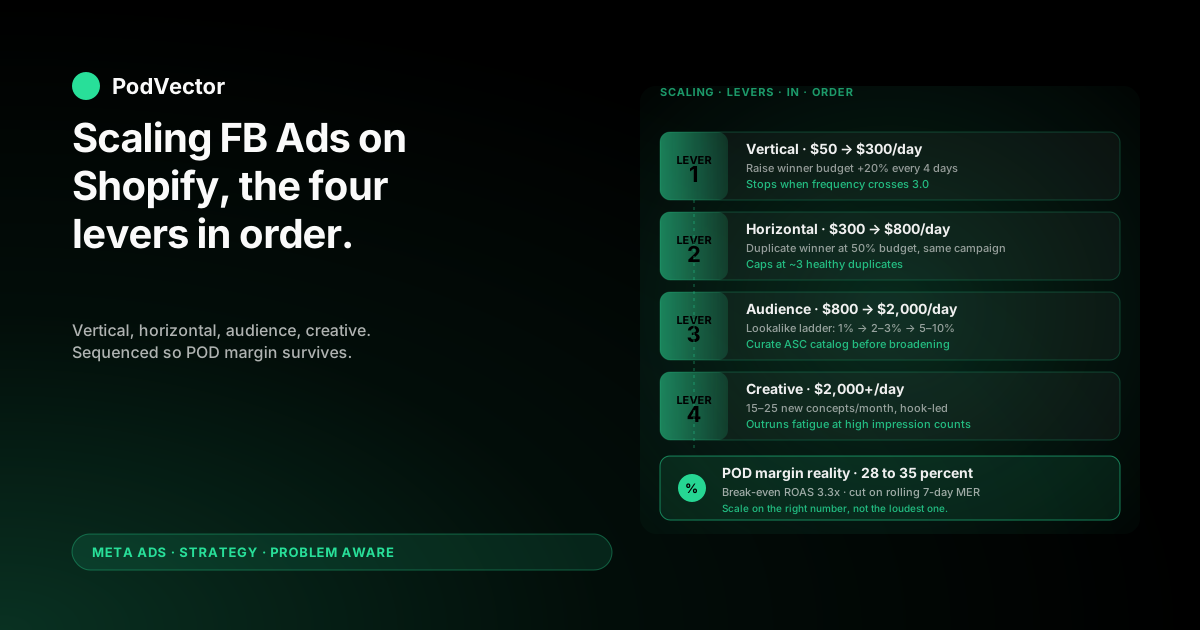
Quick Answer: Scaling Facebook ads for a Shopify print-on-demand store is not the same problem as scaling for an owned-inventory store. The 28–35% contribution margin after Printify or Printful supplier costs makes every reckless budget bump a margin event, not a growth event.
The rule that survives is small, frequent, and conditional: raise budget on a winning ad set by 20% every 4 days, only while the rolling 7-day blended ROAS stays above your POD-adjusted bar (usually 3.3–4.5x). Cut on the rolling number, not yesterday's spike.
This article walks the four scaling levers — vertical, horizontal, audience, creative — in the order they should fire, the dashboard you watch while scaling, and the five quiet mistakes that drain POD profit faster than the platform reports.
Why scaling Facebook ads for Shopify breaks differently in POD
Search "how to scale Facebook ads for Shopify" and the advice converges fast: increase budget 15–20% every few days, expand lookalikes, run Advantage+ Shopping Campaigns, push creative volume. DigitalDarts, AdRoll, and EasyApps' complete 2026 guide all land in the same neighbourhood, and they're all directionally right.
They're written for stores that own their inventory at 50–60% gross margin. POD doesn't. After Printify or Printful supplier costs, your contribution margin lives between 28% and 35%.
That 20-point gap rewrites every scaling assumption.
Break-even ROAS is roughly twice what generic guides assume
An owned-inventory Shopify store at 55% margin breaks even around 1.8x ROAS. A POD store at 30% margin breaks even around 3.3x.
So when a generic article calls 2.5x ROAS "healthy," it is. For them. For you, it is the platform charging you to manufacture a loss.
Most "my Shopify Facebook ads aren't profitable" support threads from POD operators trace back to scaling at this gap — the campaign was always losing money; scaling just made the loss bigger faster.
Meta optimises toward orders that look big to Meta, not big to you
Meta's purchase optimisation reads the order subtotal it sees inside the Pixel and CAPI events. For POD that subtotal includes the supplier cost — so the algorithm pushes traffic to whichever orders generate the largest receipt, regardless of how much margin sits underneath.
When you scale, this gets worse. Bigger budget gives Meta more rope to chase the orders that look biggest to it, which are not always the orders you make the most contribution on.
Scaling without correcting for this means you're paying Meta to buy you the wrong customers faster.
Variance flips a winner to a loser at smaller swings
At 55% margin, a 10% drop in ROAS still leaves a profitable ad set. At 30% margin, the same 10% drop pushes the ad set under break-even.
POD scaling has to be more sensitive on the cut decision than the raise decision. Most operators do the opposite — they raise quickly and let losers ride.
The pre-scaling check: what has to be true first
Before you touch a budget slider, three things have to be verified. Skip any of them and the scaling math is fiction.
1. Server-side events match browser events within 10%
Open Meta Events Manager and look at Purchase events for the last 7 days. The Server column (CAPI — Meta's server-side conversion channel) should land within 10% of the Browser column (Pixel).
If Server is blank, CAPI isn't actually firing through Shopify's Facebook channel app, and you're scaling on iOS-shrunk data. If Server is double Browser, you have duplicate events inflating every ROAS number on the dashboard.
Either way, your scaling decisions are being made on numbers that don't represent reality.
2. The ad set has cleared 30 conversions in 7 days
Meta's learning phase needs roughly 50 conversions per ad set per week to exit. POD averages a $30–$50 AOV, so an ad set running at $50/day will not produce enough purchase signal to exit learning until conversion rate and creative both work.
If you scale an ad set that's still in learning, the budget bump resets the phase. The 30-conversion floor is the earliest signal that the ad set has stable performance worth raising.
3. The 7-day blended ROAS is at least 1.3x your break-even
Not yesterday's ROAS. Not the campaign-best day. The trailing 7-day blended number against your POD-adjusted break-even.
If break-even is 3.3x, scale only ad sets at 4.3x+ on rolling 7-day. The buffer absorbs the dip that always follows a budget raise — Meta partially re-enters learning when budget changes by more than 20%, and ROAS softens for 2–4 days while it stabilises.
Without the buffer you'll cut what would have been a winner, because the post-raise dip looks like the ad set breaking.
The four scaling levers, in order
Most scaling failures are not lever-choice problems. They're lever-order problems. The right sequence:
| Order | Lever | Spend range | What it does |
|---|---|---|---|
| 1 | Vertical (raise budget on the existing winner) | $50 → $300/day per ad set | Tests whether the audience-creative combo holds at higher delivery |
| 2 | Horizontal (duplicate the winner into a parallel ad set) | $300 → $800/day combined | Reduces frequency on the original audience, preserves learning |
| 3 | Audience expansion (lookalike laddering, Advantage+ broadening) | $800 → $2,000/day | Finds the next pool when the original audience saturates |
| 4 | Creative volume (10–20 new concepts/month at scale) | $2,000+/day | Replaces fatigued ads before they tank the account |
Operators trying to skip vertical and jump straight to creative volume burn money on testing concepts that would have died in the first audience anyway. Operators stuck on vertical past $300/day flatten frequency and watch CPMs climb without understanding why.
The order is the order for a reason. Each lever solves a problem the next one creates.
If you haven't yet built the foundation that makes scaling possible, work the 90-day Facebook Ads for Shopify rollout first — the lever sequence above assumes Phase 1–3 of that playbook are already done. The bigger picture sits in the complete Meta Ads playbook for POD sellers, which frames where scaling fits inside the full account architecture.
Vertical scaling: the +20% / 4-day rule
Vertical scaling means raising budget on an ad set that's already winning. The numbers that matter:
The cadence: +20% per 4 calendar days
Larger jumps trigger Meta's learning re-entry. The platform treats a budget change of more than ~20% as a meaningful enough delivery shift to reconsider its bidding model.
Smaller, more frequent jumps slip under the threshold. Four days between raises gives the algorithm enough purchase signal at the new spend tier to recalibrate without flinching.
Stricter operators run +15% / 3 days. The principle is identical — small, frequent, never resetting.
The cut rule: rolling 7-day, not the last 24 hours
POD ROAS bounces. A weekday-to-weekend shift can move daily ROAS by a full point even on a steady ad set.
Make the cut decision on rolling 7-day blended ROAS against POD-adjusted break-even. If trailing 7-day drops below break-even for two consecutive days, halve the budget. If it stays under for four days, kill the ad set.
The two-stage cut prevents you from killing winners on noise and prevents you from running losers for a week hoping they recover.
The ceiling: where vertical stops working
Most POD ad sets cap out somewhere between $200 and $400/day before frequency climbs above 3.0 on the original audience. Once frequency crosses 3.0 the same people see the same ad too often, CPM rises, and ROAS softens regardless of how the creative is performing.
The ceiling is your cue to switch from vertical to horizontal. Don't push vertical further to "see if it holds" — it's the lever-order error.
Horizontal scaling: duplicating winners without cannibalising
Horizontal scaling means cloning a winning ad set into a parallel one. The new copy keeps the same creative and audience but starts at half the budget of the original.
Why duplicate instead of raising the original further
Two ad sets sharing the same audience compete in Meta's auction. Ordinarily that's wasteful. But it splits delivery across two learning phases, lets you A/B-test variations of the same creative-audience combo, and lowers per-ad-set frequency by spreading impressions across two delivery streams.
The trade-off is real auction overlap. Set it up correctly and the overlap costs ~5–10% in efficiency, which is acceptable when the alternative is a vertical raise that crashes ROAS by 25%.
The duplication recipe
Duplicate the winning ad set inside the same campaign (not a new one — campaign budget logic matters). Drop the budget on the duplicate to 50% of the original. Leave the audience and creative identical.
Run for 7 days. Compare the two ad sets' CPA. If both stay within 15% of each other, scale the duplicate vertically using the +20%/4-day rule. If the duplicate massively underperforms, the issue is auction overlap rather than the creative — kill the duplicate and try the audience expansion lever instead.
When horizontal stops being enough
Three healthy horizontal duplicates of the same ad set is roughly the practical ceiling. Beyond that, you're cannibalising your own auction without adding incremental scale. That's the trigger for audience expansion.
Audience expansion: lookalike laddering and Advantage+
By the time you need this lever, you're spending $800+/day. The original audience is saturated. New pools are required.
Lookalike laddering
Build lookalikes off your highest-quality customer audience — last-90-day purchasers, ideally seeded through a Custom Audience pulled from the Shopify customer list. Ladder the percentages:
- 1% lookalike — closest to your buyers, highest CPM, best ROAS at small scale
- 2–3% lookalike — bigger pool, slightly lower fit, used when 1% saturates
- 5–10% lookalike — used when 1–3% caps out; expect ROAS to soften 20–30% from the 1%
Don't run all three simultaneously inside one campaign. They overlap in the auction. Run them sequentially: 1% until it saturates, then 2–3%, then 5–10%. Track CPA per percentage so you know where the diminishing returns start.
Advantage+ Audience and Advantage+ Shopping Campaigns
Advantage+ Audience is Meta's broad AI-targeted layer that uses modeled signals from the Pixel and CAPI events. Advantage+ Shopping Campaigns (ASC — Meta's all-in-one automated campaign that combines prospecting and retargeting) is the campaign-level equivalent.
For POD at scale ($1,500+/day), one ASC campaign carrying 60–70% of budget plus a manual retargeting campaign carrying the rest is the most common structure. The catch: ASC will optimise toward the same revenue-weighted signal that overweights high-supplier-cost SKUs. Curate the catalog feed so ASC only ever sees the SKUs you actually want it to push, instead of letting it find the largest-receipt orders by default.
For the deeper integration mechanics — how the Shopify catalog feeds ASC, how the dynamic feed updates, what to curate before scaling — see the complete guide to Meta Ads + Shopify integration for POD.
Custom audience seeding from Shopify
Push three audiences from Shopify into Meta:
- All purchasers, last 180 days
- High-AOV purchasers (top quartile by order value), last 180 days
- Email subscribers who have not yet purchased, last 90 days
Each becomes a lookalike seed. The high-AOV seed produces the most expensive but highest-fit lookalike — usually worth the extra CPM for prospecting.
Creative volume: how many concepts per spend tier
At small scale, creative iteration is a quarterly project. At scale, it's a weekly one. The reason: Meta's auction punishes ad fatigue brutally above $1,000/day, because high impression counts saturate the audience faster.
The volume-by-spend table
| Daily spend | New concepts / month | What "concept" means here |
|---|---|---|
| $0–$200 | 2–4 | One hook, one product, two variations |
| $200–$800 | 5–10 | Different hook angles, same product line |
| $800–$2,000 | 10–15 | Hook angles, product variations, format mix (video, carousel, single image) |
| $2,000+ | 15–25 | Full creative pipeline with weekly winner-replacement |
What to test, in order of impact
Most operators test the wrong thing first. The ranked impact list:
- Hook (first 3 seconds of video, headline of static) — biggest swing, test first
- Product mockup style — lifestyle vs flat lay vs on-model has 30–50% CTR differences
- Format — video vs static vs carousel; usually one wins per niche
- Copy length — short vs long captions; rarely the unlock
Burn the testing budget on hooks and mockups. Copy and format are the polish tier.
POD-specific: design vs. ad creative is the wrong frame
The design (the t-shirt graphic) is locked into the SKU. The ad creative (the ad image or video) is what Meta serves. They're different jobs.
A great design with a weak hook will lose to a mediocre design with a strong hook. Don't conflate the two when reading creative test results — a "design that didn't work" might be a hook that didn't work.
The scaling dashboard: what to watch hourly, daily, weekly
Scaling without an instrumentation layer is gambling. The cadence matters as much as the metrics.
Hourly (only on raise days)
Frequency on the raised ad set. Cost per click. Spend pace against the new budget cap.
If frequency jumps above 3.5 within 6 hours of a raise, the audience is too small for the new spend tier — pull the raise back and switch to horizontal.
Daily
Trailing 3-day blended ROAS per ad set. CPM trend. Click-through rate trend.
Watch for CPM creeping up day-over-day on the same audience — that's saturation arriving early. Pre-empt it by triggering the next lever before ROAS actually breaks.
Weekly
Trailing 7-day blended ROAS against POD-adjusted break-even. MER (Marketing Efficiency Ratio — total revenue divided by total ad spend across all platforms, not just Meta-reported revenue divided by Meta-reported spend) compared to last week. Per-SKU contribution margin against the SKUs Meta is actually pushing.
The per-SKU layer is where most POD operators discover Meta has been pushing the wrong winners. Two SKUs with identical $40 prices can have $26 vs $7 supplier costs from Printify; Meta cares about neither, and the dashboard exists to surface that gap.
The attribution mechanics behind why platform-reported ROAS overstates Meta's contribution at scale are unpacked in the complete guide to Meta Ads ROAS and attribution for POD. If you're scaling without a clear answer to "how much of this revenue would have happened anyway," that piece is the prerequisite read.
Why MER beats Meta-reported ROAS at scale
Meta-reported ROAS attributes more revenue to Meta than Meta actually drove, because of view-through windows, cross-channel halo, and iOS data gaps. The bigger your spend, the bigger the over-attribution.
MER ignores the attribution model entirely — it's just total revenue / total spend across all paid channels. If MER is healthy and Meta-reported ROAS is dropping, you're fine. If Meta-reported ROAS looks great and MER is sliding, Meta is taking credit for purchases it didn't drive.
This is the metric scaling operators eventually anchor on. The earlier you start, the less catching up you do later.
Five quiet mistakes that bleed POD margin while scaling
1. Scaling on Meta-reported ROAS without checking MER
Already covered above, but the most common single failure mode. Meta-reported 4x with MER at 1.1x means you're growing revenue and shrinking profit at the same time — exactly the trap POD's thin margin punishes hardest.
2. Letting ASC pick the wrong winners from a wide catalog
Advantage+ Shopping Campaigns will optimise toward whichever SKUs produce the largest-looking orders. For POD that's often the highest-supplier-cost SKUs. Curate the catalog feed to a hand-picked 8–15 SKU shortlist before scaling ASC, not after.
3. Raising budget the same day creative is changed
Two changes at once means you can't tell which one caused the shift. Stagger them by at least 4 days. Raise budget on Monday, swap creative on Friday, evaluate the next Monday.
4. Killing ad sets on a single bad day
Day-level POD ROAS variance can hit 40% without anything actually being wrong. Use the rolling 7-day, two-stage cut rule. Operators who watch the daily number burn through winners on noise.
5. Adding spend without adding creative volume
$2,000/day on three creatives runs them into fatigue inside two weeks. The creative pipeline has to scale with the budget. The volume-by-spend table above is the floor, not the target — running below it guarantees the account hits a wall regardless of how good the audience targeting is.
FAQs
What's a realistic ROAS target when scaling Facebook ads for a Shopify POD store?
4.5x+ on prospecting, 6x+ on retargeting, blended 5x. POD's 28–35% contribution margin makes 3.3x the literal break-even line, so scaling needs a buffer above that for refunds, supplier price changes, and seasonality. Stores running at "industry-standard" 2.5–3x ROAS targets are scaling losses without realising it.
How fast can you actually raise budgets?
+20% per 4 days is the safe ceiling — stays under Meta's learning re-entry threshold and gives the algorithm enough conversion signal at the new spend tier to recalibrate. Some operators push to +25% per 3 days; +50% in a single jump almost always tanks ROAS for a week. The smaller the raise, the smaller the post-raise dip.
When should you switch from manual campaigns to Advantage+ Shopping Campaigns?
Around $1,500/day total Meta spend, when manual ad sets start saturating their audiences faster than horizontal duplication can absorb. ASC is also useful earlier (~$500/day) for retargeting if your funnel is wide. The catch for POD: ASC will optimise toward whichever SKUs Meta sees as biggest, regardless of your actual margin per SKU. Curate the catalog before turning it on.
How do you know if an ad set is in learning phase?
Meta labels it directly inside Ads Manager — look for the "Learning" status next to the ad set name. The phase exits at roughly 50 conversions in 7 days. Scaling an ad set still in learning resets the phase, so wait for "Active" status before any vertical raise.
Should you scale by raising the campaign budget or the ad set budget?
Ad set budget on individual winners until you have 2–3 proven ad sets in the same campaign. Then switch to Campaign Budget Optimisation (CBO) and let Meta distribute. Starting with CBO too early hides which ad set is actually winning — you scale a campaign instead of a winner.
What's the relationship between Shopify's reporting and Meta's reporting?
Shopify's revenue is the source of truth — it's what actually hit the till. Meta's revenue is its attribution model's estimate of what it caused. The gap is normal and grows with view-through windows and iOS opacity. Use Shopify revenue to compute MER and let Meta's number be a directional input, not a P&L number.
Where does scaling fit in the wider Meta Ads strategy stack?
Scaling is the back half of a sequence. The front half is account architecture, foundation, and prospecting — covered across the Meta Ads strategy cluster and the broader Meta Ads topic hub. If your prospecting layer isn't producing 4.5x+ on at least one ad set, the scaling levers in this article will not save it; the fix is upstream.
How does scaling Facebook ads for POD differ from scaling Google Shopping for POD?
Google Shopping intent is high (people searching for the product) so ROAS targets are tighter and creative iteration matters less. Meta is interruption traffic — lower intent, looser ROAS, much higher creative volume requirement. Most POD stores run both; Meta drives demand creation, Google captures the bottom-of-funnel demand Meta created.
Scale on the right number, not the loudest one
Meta's ROAS is one number. Shopify's revenue is another. Printify or Printful's supplier cost is a third. Profit per SKU is the one that decides whether scaling actually grows your business.
PodVector AI's AI employee Victor connects all three. You ask "is this ad set actually profitable after Printify cost?" and Victor answers with live numbers from your unified data warehouse — not a delayed export, not a yesterday-end snapshot. Victor answers and acts on what he sees — with your approval.
Try Victor free