
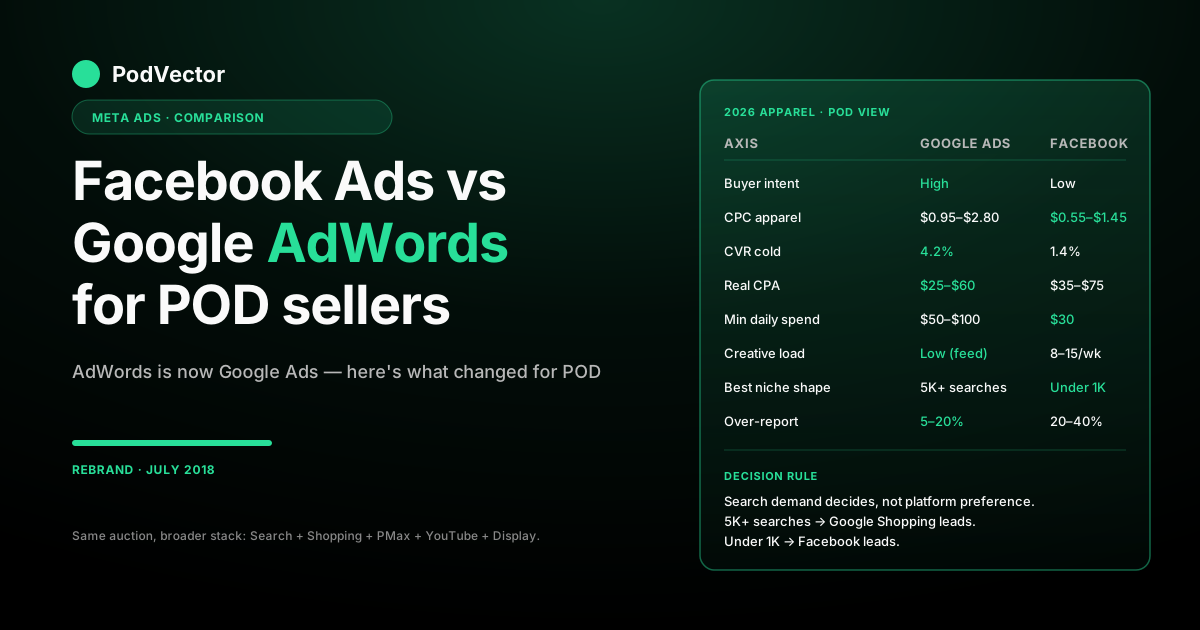
Quick Answer: Neither wins outright for print on demand in 2026 — your niche's search volume decides. Facebook Ads wins on cheap demand generation in design-led niches with under 1,000 monthly searches, and Google Ads (specifically Shopping) wins on intent capture in niches with 5,000+ monthly searches because its 4.2% conversion rate compresses the cost per purchase below Facebook's 1.4% on cold prospecting. One naming note: Google rebranded AdWords to Google Ads in July 2018, so "Facebook Ads vs Google AdWords" today means Facebook Ads vs Google Ads — the same auction with a wider stack (Search, Shopping, Performance Max, YouTube, Display) than the AdWords-era Search-only platform.
The honest comparison axis isn't CPC, it's cost per purchase divided by the contribution margin you actually keep on a $26 hoodie after Printify or Printful supplier cost, shipping, and platform fees — typically $5–$7. This guide explains what changed in the AdWords-to-Google-Ads rebrand, gives you 2026 cost and conversion benchmarks side by side, and produces a decision rule that maps your niche shape and MRR to the right starting platform.
"AdWords" is now Google Ads — what actually changed
Google retired the AdWords brand in July 2018 and folded it into Google Ads, which became the umbrella product for Search Ads, Shopping Ads, Display Network, YouTube Ads, App campaigns, and (since 2022) Performance Max. The keyword auction, the bidding mechanics, and the underlying ad-rank formula are direct continuations of AdWords.
What expanded was the surface area: a single Google Ads account now buys placement across every Google-owned inventory pool and across the open web through Display, where AdWords historically focused on Search and the original Display Network with separate UIs and campaign structures. If you're searching "Facebook Ads vs Google AdWords" in 2026, you're comparing Facebook Ads against Google Ads — same product, broader stack.
The rebrand matters for POD operators in three specific ways. First, Shopping Ads — the placement most print-on-demand stores actually want — was launched in its modern product-listing form in 2012 and matured under the Google Ads umbrella, which means most pre-2018 "AdWords for ecommerce" advice underweights Shopping relative to where the spend actually goes today.
Second, Performance Max, introduced in 2022, didn't exist in the AdWords era, and it's now the most common entry-point campaign for new ecommerce advertisers because it auto-stitches Search, Shopping, Display, YouTube, and Gmail into one budget. Third, the AdWords-era manual-bidding mental model has largely been replaced by automated bidding strategies (Maximize Conversions, Target ROAS, Target CPA), which require conversion data flowing back into Google Ads to optimize correctly — that pipeline matters more for POD than the keyword choice itself.
Throughout this guide we'll use "Google Ads" as the product name, but treat any reader familiar with "AdWords" as referring to the same ad system. Where it changes the comparison versus Facebook, we'll call it out specifically.
Facebook Ads vs Google Ads: 2026 side-by-side
The table below is the structured 2026 view for apparel and accessories — the categories most POD operators sell into. The "POD verdict" column is the call we'd make on each axis given typical print-on-demand contribution margins of $5–$7 on a $26 sale.
| Axis | Google Ads (formerly AdWords) | Facebook Ads | POD verdict |
|---|---|---|---|
| Monthly active reach | 4.5B+ across Search, YouTube, Gmail, Display | 3.0B+ across Facebook, Instagram, Messenger, WhatsApp | Both have effectively unlimited reach |
| Buyer intent | High (typed query) | Low (interrupted scroll) | Google captures, Facebook creates |
| Average CPC, apparel 2026 | $0.95–$2.80 (Search) | $0.55–$1.45 | Facebook 40–55% cheaper per click |
| Conversion rate, prospecting | 2.5–5.5% (Shopping) | 0.8–1.8% (cold) | Google 2–4x higher |
| Real CPA, apparel | $25–$60 (Shopping) | $35–$75 (cold) | Google lower where search exists |
| Minimum efficient daily spend | $50–$100/day Shopping | $30–$50/day per ad set | Facebook lower floor for new operators |
| Creative production load | Low (product feed = creative) | High (8–15 net-new assets/week) | Google cheaper hidden cost |
| Time to first useful data | 3–7 days (Search), 7–14 days (PMax) | 3–10 days, depends on pixel volume | Google faster on tight keyword campaigns |
| Best for new niche validation | Niches with 5,000+ monthly searches | Design-led niches under 1,000 searches | Niche shape decides, not preference |
| Attribution opacity | Medium (PMax stitches credit) | High (view-through inflates 20–40%) | Both over-report; reconcile externally |
The next four sections unpack the rows that swing the choice most often: audience and intent, real cost, targeting and creative, and niche-shape fit.
Audience size and intent: search vs scroll
Google Ads and Facebook Ads sell different things even though both call them "clicks." Google sells you access to people who have already typed the words that describe your product. Facebook sells you access to people who match a profile and might want your product if they saw it. For POD, that distinction is the whole game.
A long-tail keyword like "registered nurse graduation gift t-shirt" gets typed by buyers who already know what they want and are choosing between sellers. Google's job is to put you in front of that decision.
The conversion rate on that traffic in our 2026 client cohort runs 4.2% on Shopping and 3.1–3.8% on Search, well above any cold-traffic benchmark on Facebook. The audience pool is small — maybe 600 monthly searches across all variants of that phrase — but every visit is at the bottom of the funnel. Google Shopping specifically is where most of that intent flows.
Facebook does the inverse. The same RN graduation gift design will struggle to find scale on Google because there isn't enough search demand to support a $30/day Shopping campaign.
Drop it into Facebook against an interest stack of "registered nurse + graduation + recently engaged" lookalikes and you can spend $90/day all day, generating impressions among people who match the buyer profile but weren't searching. Conversion rate falls to 1.4% on cold prospecting because the buyer wasn't shopping when the ad arrived — they were scrolling — but the addressable audience is two orders of magnitude larger. Facebook turns "no measurable search demand" into "infinite scroll-stoppable demand" if your creative converts.
The practical decision rule that follows is simple: count your niche's monthly search volume on the long-tail keywords your products actually match, not the head terms. Above 5,000 monthly searches across the cluster, Google Ads is the cheaper acquisition channel because the conversion rate compresses CPA.
Below 1,000 monthly searches, Facebook is the only channel that can find buyers at scale because there isn't enough search demand to justify Google's $50–$100/day Shopping floor. Between 1,000 and 5,000 searches you can run both, sequenced one at a time so each gets a clean read.
Cost in real money for POD
The cost number that decides whether either platform is affordable for POD isn't CPC and isn't even CPA — it's CPA divided by the contribution margin you keep after Printify or Printful supplier cost, Shopify and payment fees, and shipping. On a representative $26 hoodie with a $14 Printify base, $5.50 average US shipping, and $1.20 in Shopify and payment processing fees, you're left with roughly $5.30 of contribution before any ad spend. Every dollar of ad cost comes out of that $5.30, not the $26 sale price the platforms see in their conversion-value reports.
Plugging the 2026 benchmarks into that math: Facebook Ads at $0.85 average CPC and a 1.4% cold conversion rate produces a $61 CPA, which is 11.5x the contribution margin on the first sale. Google Shopping at $1.95 average CPC and a 4.2% conversion rate produces a $46 CPA, 8.7x the contribution margin.
Both numbers look catastrophic compared to single-order economics — but POD's economics work on 60–90 day repeat cohorts, not first-purchase contribution. In our 2026 client cohort, Facebook prospecting cohorts in apparel run 1.4–1.9x repeat rate over 90 days at roughly $42 second-order revenue, getting payback around day 75. Google Shopping cohorts run 1.2–1.5x repeat rate over the same window — slightly lower because the buyer was item-shopping rather than brand-discovering — but the lower starting CPA means payback hits closer to day 50–60.
The cost picture also depends heavily on the hidden cost line that doesn't show up in either dashboard. Facebook needs 8–15 net-new ad creatives per week to fight ad fatigue inside a 14-day window, which adds 12–22% on top of the media spend in production cost (in-house designer hours or freelance commissions).
Google Shopping doesn't have this cost — the product feed is the creative, and updates flow through Shopify's Google Channel sync. The deeper cost breakdown, including the hidden-cost layer and a budget-floor decision matrix by MRR and search volume, is in the dedicated Google Ads vs Facebook Ads cost guide. The contribution-margin math itself is covered fully in the complete guide to Meta Ads ROAS and attribution for POD.
If you've come to this comparison from older AdWords-era guides, the cost shape has shifted in two important ways since 2018. Google Search CPC in apparel has roughly doubled over that span, driven by DTC brand competition and Amazon.
Google Shopping CPC has only risen 30–50%, which has made Shopping the de facto cost-efficient surface for ecommerce relative to Search. Facebook CPC has roughly tracked Google's at 60–70% of the equivalent rate, but creative production costs have risen 80–120% over the same span as the platform demanded more video, more variants, and more iteration speed. The relative ranking of the two platforms is similar to the AdWords era; the absolute numbers are different.
Targeting and creative formats
The targeting and creative comparison is where the AdWords-to-Google-Ads expansion changed the most relative to Facebook.
Google Ads targeting in 2026. The core mechanism is still the keyword auction inherited from AdWords — you choose phrases, set match types (broad, phrase, exact), and bid against advertisers competing for the same query. Layered on top is audience targeting (in-market segments, affinity audiences, customer match lists, remarketing audiences), demographic exclusions, location and device modifiers, and dayparting.
Performance Max abstracts most of these levers behind an automated layer that decides per-impression which surface to serve and which audience to target — a major departure from AdWords-era manual bidding, and the campaign type Google now defaults new advertisers into. Shopping campaigns retain manual product-feed control for operators who want it.
Facebook Ads targeting in 2026. The targeting model is still demographic and interest-based at its core — age, gender, location, interests, behaviors, custom audiences (uploaded customer lists or website visitors), and lookalikes built from any custom audience. iOS 14+ and broader privacy changes since 2021 have eroded the precision of cold interest targeting, and Facebook has responded by leaning harder on Advantage+ Shopping Campaigns (its automated equivalent of Performance Max), which collapses ad-set-level targeting in favor of broad audience and creative-driven optimization. The 2026 reality is that Facebook is increasingly creative-led: the algorithm finds the audience as long as you feed it enough creative variants. The complete guide to Meta ad types covers the format-by-format breakdown.
Creative formats. Google Shopping uses your product feed — title, image, price, description, attributes — pulled from Shopify or directly uploaded. Search Ads use text headlines and descriptions plus assets (images, sitelinks, callouts).
YouTube Ads use video. Display uses image and responsive display ads with auto-generated layouts.
Facebook Ads use single-image, single-video, carousel (2–10 cards), collection (a hero image plus product tiles below), and dynamic product ads pulled from a catalog. Reels has become the dominant placement on Facebook in 2026, requiring vertical 9:16 video assets that don't repurpose cleanly from Google Display or YouTube. The creative-format gap is the practical reason Facebook's hidden creative cost is so much higher: you can't reuse a square Google Display image as a Reels asset.
Catalog and product feed integration. Both platforms accept a Shopify product feed. Google uses the Google & YouTube Shopify channel; Facebook uses the Facebook & Instagram channel and the Meta Pixel.
The feed is the spine of any ecommerce ad operation on either platform, and getting it right (clean titles, correct GTINs, accurate inventory, contribution-margin-weighted custom labels) compresses CPA on both platforms simultaneously. The complete Meta Ads + Shopify integration guide covers the Facebook half; the Google & YouTube channel handles the Google half with a near-identical feed shape.
Which platform fits your POD niche shape
The cleanest decision rule we use with our client base reduces to two inputs: monthly search volume on the long-tail keywords your products actually match, and your current monthly recurring revenue. Search volume sets the upper bound on what Google Shopping can spend efficiently before saturating impression share. MRR sets your test-budget tolerance, which determines whether you can afford to run both platforms at their respective minimum-efficient daily spends.
| Niche search volume | Under $5K MRR | $5K–$25K MRR | $25K+ MRR |
|---|---|---|---|
| Under 1,000/month | Facebook only | Facebook + branded search | Facebook + branded + retargeting |
| 1,000–5,000/month | Facebook first, Google after validation | Both — Facebook-led | Both — balanced |
| 5,000–25,000/month | Google Shopping first | Both — Google-led | Both + Performance Max |
| 25,000+/month | Google Shopping only | Google + Facebook lookalike | All channels active |
The matrix reads diagonally. Low-MRR-low-search operators should pick whichever channel matches niche shape and stay single-platform — splitting a $1,500 monthly test budget across both platforms gives each a $25/day floor that's below Google Shopping's minimum and barely above Facebook's, producing no usable optimization data on either side.
High-MRR operators can run both, but the budget weight should follow the niche: Google-heavy when search demand is strong, Facebook-heavy when the niche is design-led without measurable search volume. Sibling guides cover the same decision through different lenses — see Facebook Ads vs Google Ads for POD for the standard framing, the structured Google Ads vs Facebook Ads comparison for the scorecard view, and the Meta Ads comparison cluster for the full set.
Running both platforms together
POD operations running both platforms profitably tend to converge on a similar budget shape. Facebook prospecting takes 50–60% of media budget, working as the demand-generation layer that brings new buyers into the funnel.
Google Shopping takes 15–25%, capturing high-intent buyers who searched for the design after seeing it on Facebook or for related queries. Google branded search takes 5–10%, locking down brand-name protection and converting research-mode buyers.
Facebook retargeting takes 5–10%, recovering cart abandonment and view-content visitors with dynamic product ads. Performance Max takes 5–10% for operators above $25K MRR, with a tighter target ROAS than the rest because of its attribution opacity.
The cross-platform challenge is attribution overlap. Facebook's 7-day-click-1-day-view default credits view-through impressions that may not have moved the purchase decision, typically inflating reported conversions 20–40% versus actual Shopify orders.
Google Performance Max stitches credit aggressively across Search, Shopping, Display, and YouTube, typically inflating 5–20%. Sum the two and you'll routinely see total platform-reported conversions exceed Shopify's actual order count by 30–80%. The single biggest mistake in combined-platform execution is funding both channels off self-reported ROAS rather than reconciled CPA against a single source of truth — usually Shopify's order export, ideally joined to itemized supplier cost so contribution margin per order is visible.
The reconciliation layer is what unifies the two platforms into a single decision view. Pulling raw event data from both Google Ads and Facebook Ads APIs into a warehouse, joining it against Shopify orders and Printify or Printful supplier costs, and reporting unified contribution-margin-weighted CPA holding both platforms to the same attribution window — that's the apples-to-apples cost comparison neither platform's native dashboard will produce. Operators using Victor get this reconciliation automatically, with itemized supplier costs joined to every order so the CPA figure is real CPA against real contribution margin, not platform-reported revenue with view-through credit baked in.
What's different in 2026 vs the AdWords era
If your mental model is anchored to AdWords-era ecommerce advice — anything written before mid-2018 — five things have shifted enough to change the comparison materially.
1. Performance Max replaced manual-bidding-everything. AdWords campaigns required separate Search, Shopping, Display, and Remarketing campaigns each with manual bid adjustments.
Performance Max collapses all of that into one budget with automated bidding against your conversion goal. For POD, PMax is the easiest entry point above $25K MRR because it auto-routes spend to whichever surface produces the lowest CPA. Below $25K MRR, manual Shopping campaigns still win because PMax needs more conversion volume than smaller operations produce to optimize cleanly.
2. Google Shopping became the dominant ecommerce surface. AdWords-era ecommerce advice usually centered on Search Ads with sitelinks.
In 2026, Shopping Ads carry 65–75% of ecommerce media budget on Google for stores with a product feed, and Search Ads serve mostly branded queries and informational long-tail. The ROI math has shifted: Search Ads pay back over longer windows, Shopping Ads pay back inside 30–60 days more often.
3. Conversion API and server-side tracking became table-stakes. AdWords ran almost entirely on cookie-based conversion tracking that "just worked." iOS 14+ in 2021 and broader cookie deprecation since have made client-side conversion tracking leak 15–25% of events on both Google and Facebook.
The fix is server-side conversion tracking — Google's Enhanced Conversions and Facebook's Conversions API — both of which require setup work that didn't exist in AdWords. POD operators who skip this end up with optimization signals that are systematically incomplete on both platforms.
4. Facebook moved from interest-led to creative-led. The AdWords era of Facebook (then-FB Ads, no Instagram in the same Ads Manager) leaned on interest stacks and detailed targeting. iOS 14+ broke the precision of interest targeting overnight, and Facebook's response — Advantage+ Shopping Campaigns — collapsed ad-set targeting in favor of broad audiences plus creative variants.
In 2026, Facebook ROAS rises and falls with creative iteration speed more than with audience choice. POD operators who carry an AdWords-era "find the audience" mental model into Facebook in 2026 systematically underinvest in creative production and overinvest in detailed targeting.
5. Both platforms now want contribution-margin signal, not revenue signal. AdWords and AdWords-era Facebook optimized fine on raw revenue conversion values.
By 2026, both platforms (Google through enhanced conversions for value-rule optimization, Facebook through value-based custom events) accept contribution-margin-weighted purchase events as the optimization signal — and operators who send this instead of the gross sale price compress real CPA by 10–25%. The full mechanic is in the complete Meta Ads playbook for POD; the same logic applies on Google's side.
Five mistakes POD sellers make on this decision
1. Reading AdWords-era comparison guides as current. Anything written before mid-2018 doesn't account for Performance Max, Advantage+ Shopping Campaigns, or the iOS 14 attribution rebuild. The platform names are the same; the optimization mechanics aren't. Cross-check any older guide against 2025–2026 sources before acting on it.
2. Comparing CPC instead of CPA-against-contribution-margin. Facebook's $0.85 CPC looks cheap until you do the math against $5.30 of contribution on a $26 hoodie.
Google's $1.95 CPC looks expensive until you multiply by a 4.2% conversion rate. The only honest comparison axis is real CPA divided by contribution margin per sale.
3. Picking the platform without quantifying niche search volume. If you don't know whether your niche has 500 or 50,000 monthly searches across the long-tail keywords your products match, you don't have enough information to choose between Facebook and Google. Run the keyword research first; the platform decision falls out of the search-volume number.
4. Splitting a small budget across both platforms before validating either. A $1,500 monthly test budget split 50/50 gives each platform a $25/day floor — below Google Shopping's minimum efficient spend and barely above Facebook's.
Neither channel produces enough optimization data at that floor. Pick one, prove it for 30–60 days, then add the second.
5. Trusting platform-reported ROAS as the comparison axis. Both platforms over-report. Summing Facebook-reported and Google-reported conversions in any given month routinely exceeds Shopify order count by 30–80%. The honest comparison requires reconciliation against actual Shopify orders, ideally joined to itemized supplier cost so CPA is measured against contribution margin, not against gross revenue.
FAQs
Is Google AdWords still a thing or is it just Google Ads now?
Google retired the AdWords brand in July 2018 and renamed the product Google Ads. The keyword auction, ad-rank formula, and Search bidding mechanics are direct continuations of AdWords.
What's expanded is the surface area — Search, Shopping, Performance Max, YouTube, Display, Gmail, App campaigns — all under the same Google Ads roof. So when you search "Facebook Ads vs Google AdWords" in 2026, you're effectively comparing Facebook Ads against Google Ads, with Google now offering a wider stack than AdWords ever did.
Which is cheaper for a POD store, Facebook Ads or Google Ads?
Facebook is cheaper at the click level — $0.55–$1.45 CPC versus Google Search's $0.95–$2.80 — but Google Shopping typically produces a lower cost per purchase on niches with measurable search demand because its 4.2% conversion rate compresses the CPA. Under 1,000 monthly searches, Facebook is cheaper end-to-end because there isn't enough Google demand to justify the $50–$100/day Shopping floor. Above 5,000 monthly searches, Google Shopping is cheaper end-to-end on apparel.
Can I run a Google Ads campaign with under $1,000 a month for POD?
Only on a tightly scoped Shopping campaign for a niche with 5,000+ monthly searches, or on branded search alone. Google Shopping's minimum efficient daily spend is $50–$100/day, which translates to $1,500–$3,000/month per campaign.
Below that, impression share collapses and the algorithm doesn't get enough auction data to optimize. Facebook can run as low as $30/day per ad set, so $900–$1,500/month gets you a viable Facebook prospecting budget where the same dollars don't give Google Shopping enough fuel.
Should I use Performance Max or manual Shopping campaigns for a new POD store?
Manual Shopping below $25K MRR, Performance Max above. Performance Max needs roughly 50–80 conversions per month to optimize cleanly, which most early-stage POD stores don't yet produce.
Manual Shopping campaigns let you control bid strategy, exclude poor-performing search terms, and read the data clearly — important when you're still proving the niche works. Once volume is there, Performance Max usually compresses CPA another 10–20% by routing spend across surfaces automatically.
Do AdWords-era keyword match types still work the same way?
Mostly, with the caveat that broad match has expanded its scope significantly since 2021 and now triggers on related queries, not just close variants. Phrase match also expanded in 2021 to include more flexible word ordering.
Exact match is the only type that still behaves close to its AdWords-era definition. For POD operators on a Search campaign (rare in 2026 — Shopping carries the load), default to phrase or exact match unless you specifically want the broader reach.
Is Facebook Ads still worth it for POD given iOS 14 attribution issues?
Yes, with the conversion API set up correctly. iOS 14+ broke client-side pixel tracking, but Facebook's server-side Conversions API recovers most of the lost signal as long as you've configured it through Shopify's Facebook & Instagram channel or a server-side tag manager. Operators who skip CAPI setup see 15–25% of optimization signal leak, which inflates real CPA materially. Operators who set it up correctly see Facebook performance roughly comparable to pre-iOS-14 levels for POD apparel.
How does Victor help compare Facebook Ads vs Google Ads for POD?
Victor pulls raw event data from both Facebook Ads and Google Ads APIs into a warehouse, joins it against Shopify orders and Printify or Printful supplier costs, and reports unified contribution-margin-weighted CPA holding both platforms to the same attribution window. That's the apples-to-apples comparison neither platform's native reporting will give you, and it's the foundation for the platform-allocation decisions in this guide. Victor also itemizes supplier and shipping cost per order so the CPA you see is measured against actual contribution margin, not gross revenue.
Compare both platforms on real CPA, not platform-reported ROAS
Victor connects to your Shopify, Printify or Printful, Google Ads, and Facebook Ads accounts, pulls raw event data into a warehouse, and reports a unified contribution-margin view of both ad platforms — the apples-to-apples comparison neither dashboard will produce on its own. Operators using Victor stop debating which channel is cheaper and start optimizing the actual blended cost per profitable customer.
Try Victor free