
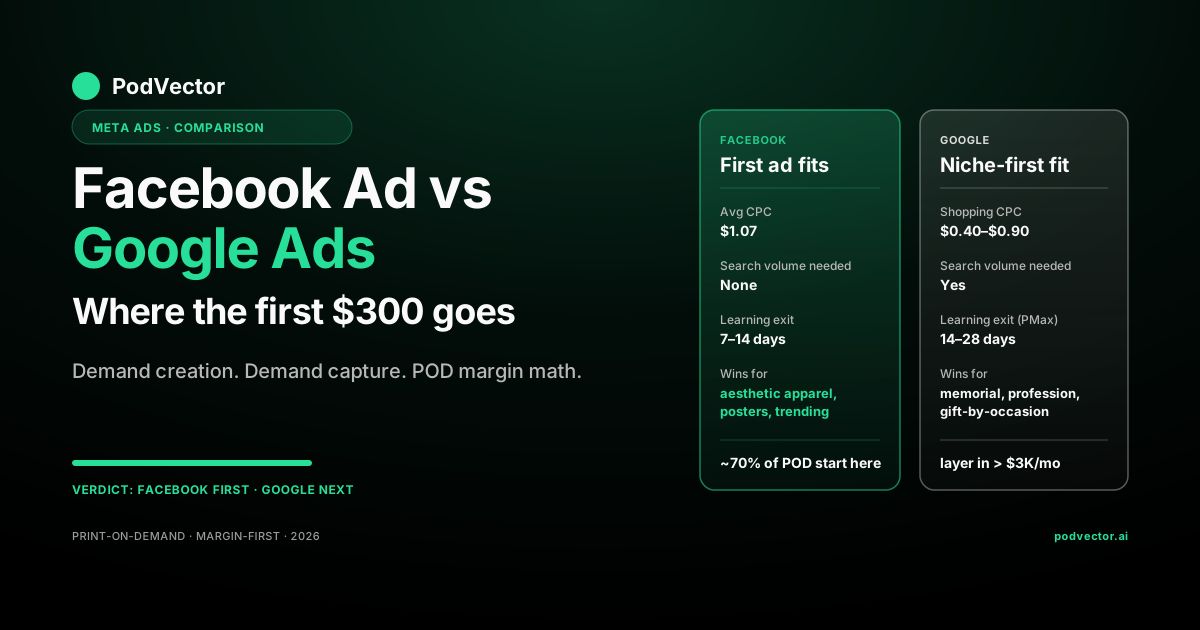
Quick Answer: If you're choosing between running a single Facebook ad or setting up Google Ads for a print-on-demand store, the right pick depends on whether your designs already have search demand. Most POD designs don't.
For a brand-new POD catalog under $1K/month spend, one Facebook ad in an Advantage+ Shopping campaign produces signal faster, cheaper, and at lower learning-phase risk than any Google Ads build. E-commerce CPC averages run roughly $1.07 on Meta (sources put it anywhere from $0.62 to $1.72) vs $2.69–$5.26 on Google Search, and Meta doesn't need search volume to fire.
For POD niches with real intent — memorial, profession humor, breed-specific apparel, gift-by-occasion — Google Ads (especially Shopping at $0.40–$0.90 CPC) eventually wins on margin per order. But that comes after the first $3K/month of monthly spend, not before. Below that, start with one Facebook ad. Above it, run both, and reconcile the numbers against your real Shopify margin instead of either dashboard.
"My first ad" is the real question
The phrase "Facebook ad vs Google Ads" usually shows up at one specific moment. A POD operator has a Shopify store, 10–60 SKUs from Printify or Printful, maybe a few organic orders, and is staring down their first paid acquisition decision.
It's not a strategy question yet. It's a "where do I put my first $300?" question. And the honest answer depends on three things that most comparison articles never ask.
One — does your design have search demand right now? Two — what's your contribution margin per order after the Printify or Printful charge, the Shopify processing fee, and the shipping line item? Three — how fast do you need signal back?
The rest of this guide answers those three for both platforms, then tells you what to do at each budget tier.
What a Facebook ad actually is for POD
"Facebook ad" usually means an ad served on Meta's family of apps — Facebook feed, Instagram feed, Stories, Reels, Messenger, and Marketplace. The ad manager is the same. The targeting model is the same. So "Facebook ad" and "Meta ad" are functionally interchangeable for our purposes.
Meta's targeting fires on demographics, interests, behaviors, and lookalike modeling. None of those require a buyer to have searched anything. That's the structural feature that matters for POD.
What a single Facebook ad looks like for POD
The most common starting build is a single Advantage+ Shopping campaign — Meta's auto-targeted commerce campaign type — pointed at a Facebook product catalog synced from Shopify. The ad creative is usually the design preview on a model or a lifestyle shot. The campaign auto-distributes across placements and learns which combinations convert.
Average CPC across e-commerce sits at $1.07. POD-specific campaigns trend slightly higher ($1.10–$1.40) because creative quality matters and most starter creatives are mediocre. Stable signal arrives 7–14 days into spend at $30–$60/day.
What Facebook does well for POD specifically
Three things. First, it generates demand for designs nobody is searching for yet — which is most POD designs. Second, the visual format puts the design in front of the buyer at full-bleed scale, which is the entire conversion mechanism for apparel and home decor. Third, the learning phase is forgiving enough to escape on a small budget.
What it doesn't do well: capture buyers who already typed an exact gift phrase into Google. That's the missing half.
What Google Ads actually is for POD
Google Ads spans Search (text ads on the search results page), Shopping (the product-image cards above search results), Display (banner ads on partner sites), YouTube, and Performance Max — Google's all-in-one auto-distributed campaign type that places ads across all of the above.
For POD operators, the four formats that matter are Shopping, Search on the few buying-intent keywords your designs map to, Branded defense (a campaign on your own store name), and Performance Max — but only above $3K/month total ad spend.
What Google Ads looks like for POD
The minimum viable Google build is one Shopping campaign feeding from Google Merchant Center, plus a small Branded defense campaign on your store name. Shopping CPCs run $0.40–$0.90 for POD apparel, well below Search's $2.10–$3.20. The product image, price, and variant name show up directly in the result, so buyers click already pre-qualified on look and budget.
Stable signal arrives 14–28 days into spend, and Performance Max specifically usually wants $3K/month before its model has enough conversion data to optimize. Below that, Performance Max either thrashes or simply fails to deliver impressions.
What Google does well for POD specifically
Capturing buyers who already know what they want. Memorial gifts ("memorial gift for grandma loss"), profession humor ("nurse mug funny"), breed-specific apparel ("border collie mom shirt"), gift-by-occasion phrases — these get searched, and Google captures them at high conversion rate.
Branded defense is a separate, cheap, high-ROAS Google advantage. As soon as your POD store gets organic traction, arbitrage sellers and competitors will bid on your brand name. A $0.30–$0.80 CPC defense campaign protects orders that would otherwise leak.
What it doesn't do well: launch demand for a brand-new design with zero search history. Display can serve impressions, but it can't generate qualified buyers without intent signal.
Side-by-side: cost, intent, learning, format
Below is the comparison stripped to the dimensions a POD operator actually has to budget against.
| Dimension | Facebook ad (Meta) | Google Ads |
|---|---|---|
| Average CPC (e-commerce) | $1.07 ($0.62–$1.72 by source) | $2.69–$5.26 Search · $0.40–$0.90 Shopping |
| Conversion model | Demand creation (interest + lookalike) | Demand capture (query intent) |
| Needs search volume? | No | Yes (for Search and Shopping) |
| Min spend to escape learning | $30–$60/day, 7–14 days | $100/day, 14–28 days (PMax) |
| Reported conversion rate | ~1.85% | ~4.40% |
| "True" rate after attribution reconcile | ~1.0–1.4% (25–45% shrinkage) | ~3.7–4.2% (5–15% shrinkage) |
| Creative format | Visual-first, full-bleed | Text-first (Search) · small image (Shopping) |
| Best for cold POD designs | Yes | No |
| Best for intent-driven gift queries | No | Yes |
| iOS 14.5 attribution loss | 15–25% on default Shopify pixel | Minimal (mostly logged-in Google users) |
Two patterns to keep in mind. The CPC gap and the conversion-rate gap partially cancel each other — Google's higher conversion rate on Search compensates for the higher click cost. The bigger structural gap is intent vs no-intent, and that's the one that decides which platform fires for your specific catalog.
The POD margin math nobody else runs
Generic "Facebook vs Google" articles benchmark CAC against an imagined $60–$120 average order value. POD doesn't have that AOV. Most POD apparel and accessories sit between $19.99 and $34.99, with the contribution margin per order — what's left after Printify or Printful's charge, the Shopify processing fee, and shipping — running $3 to $8.
That number changes everything. A $25 CAC on a $100 AOV product with $40 contribution margin is fine. The same $25 CAC on a $24.99 t-shirt with $5 contribution margin is a structural loss.
What that means for the platform pick
Cheaper CPC matters more for POD than it does for the rest of e-commerce. Every $0.50 saved on a click is, in proportional terms, eight to ten times more valuable to a POD operator than to a $100-AOV brand.
This is the reason most POD operators under $1K/month should default to Facebook regardless of what the conversion-rate numbers say. Facebook's ~$1 CPC keeps the math viable on $5 contribution margin orders. Google Search's $2.69–$5.26 doesn't — and that gap has only widened as Search CPCs climbed through 2026.
Google Shopping is the exception. Shopping CPCs at $0.40–$0.90 land below Facebook's average — but only with a clean Merchant Center feed (variant titles, GTIN-or-MPN data, consistent design preview images). POD operators with thin product metadata get rejected, throttled, or simply outbid. Fix the feed before you fight the auction.
The Printify and Printful difference
Printify and Printful charge differently for the same blank, and both charge differently again for the same product across regions. A Bella+Canvas 3001 from a US Printify provider runs $9.50–$11.50 base; the same garment from Printful runs $12.95–$14.50. On a $24.99 retail price, that's a $2–$3 contribution-margin difference per order before any ad cost.
This difference disappears in any analytics that uses a fixed COGS assumption. If your CAC tooling assumes $10 cost per shirt and you're actually paying $14.50 from Printful, every campaign looks 30% more profitable than it really is. Reconciling against the real per-order cost is what reveals which platform is actually winning — and it's why dashboard ROAS misleads POD operators specifically.
Which platform wins by POD niche
The right platform depends on whether your buyers express demand as a search phrase or as a feed reaction.
| POD niche | Start with | Why |
|---|---|---|
| Memorial / sympathy | High-intent search the same week of need; conversion rate compensates for higher CPC | |
| Profession humor (nurse, teacher) | Both, Google first | Gift-buyers Google specific phrases; Facebook scales bulk awareness in profession groups |
| Breed / pet-specific | Both, equal weight | Breed names get searched; Facebook's pet-interest segments scale once a winner is found |
| Aesthetic / abstract apparel | Zero search volume; the design is the demand | |
| Trending / micro-niche | Speed of demand creation matters more than search capture in the trend window | |
| Wall art / posters / home decor | Visual-first format converts cold; Google text-first underperforms | |
| Mugs (gift-occasion) | "Funny coffee mug for boss" gets searched at scale; gift intent is high | |
| Personalized / custom name | Facebook then Google | Facebook's targeting nails the persona; Google captures the few who search by occasion |
The pattern holds: when buyer intent expresses as a search phrase, Google wins. When the design is the demand signal, Facebook wins. Don't fight the niche — fight the platform that matches it.
If you only run one ad: the Facebook walkthrough
For roughly 70% of POD catalogs starting out, the first ad belongs on Facebook. Here's the minimal viable build.
Step 1 — connect the catalog
Sync your Shopify product catalog into a Facebook product feed via the Meta sales channel app. Verify products show up in Commerce Manager with correct images and prices. Catalog hygiene matters more than most operators realize — if 30% of your products show "missing image," your ad delivery will be lopsided toward the 70% that look right.
Step 2 — set up CAPI
Conversions API (CAPI — Meta's server-side data feed that supplements the browser pixel) recovers most of the iOS 14.5 attribution loss. On Shopify, the easiest path is the official Meta sales channel's server-side mode. Without CAPI, you'll lose 15–25% of attributable orders to attribution gaps, and your ad will look worse than it actually is.
Step 3 — launch one Advantage+ Shopping campaign
Advantage+ Shopping is Meta's auto-targeted commerce campaign — it picks audiences, placements, and creatives without you specifying. Set the budget at $30–$60/day. Use 5–10 creatives at launch (each design preview as a separate ad). Don't add manual interest targeting to start; Advantage+ outperforms manual targeting at low spend.
Step 4 — let it learn for 14 days
The temptation is to pause underperformers on day three. Don't. The model needs ~50 conversions to exit the learning phase, and pausing too early resets the clock. Read results at day 14. Cut creatives below the 25th percentile of click-through rate. Refresh.
Step 5 — reconcile against Shopify margin
Don't trust the in-platform ROAS number. Pull Shopify orders for the campaign window, subtract the Printify or Printful cost line items, subtract Shopify fees and shipping, and compute contribution margin per order. Divide by ad spend to get true ROAS. It will be 30–60% lower than Meta's number. That's the number you scale on, not the dashboard.
When to add Google Ads (and what to skip)
Google enters the picture as either a niche-specific first move (intent-driven catalogs) or a second-platform layer (everyone else, above $3K/month).
Add Google first if your niche is intent-driven
If your top-selling SKUs map to phrases people search 100+ times a month — memorial, profession, breed, gift-by-occasion — start with Google instead of Facebook. The niche tells you that buyers will type the phrase before they buy, and that's exactly Google's wheelhouse.
The minimal build is one Shopping campaign and one Branded defense campaign. Skip Search until you've validated which exact phrases convert. Skip Performance Max until you're above $3K/month — its learning phase is unforgiving below that.
Layer Google in once Facebook is producing stable signal
For everyone else, Google enters at $3K/month total ad spend. By that point, Facebook has produced enough conversions to identify your top-selling designs, and Google Shopping can pick up the buyers who saw the design on Facebook and then went to Google to research.
Branded defense gets added the same week. As soon as your store has organic traction, someone will bid on your name — usually an arbitrage seller running ads back to your own products with affiliate links stripped out. $50–$150/month on Branded defense closes that leak.
What to skip on Google for a long time
Skip the Display Network. Skip YouTube ads unless you have video creative built specifically for it. Skip Performance Max under $3K/month — it eats budget without producing signal. Skip Search on broad-match keywords; POD landing pages don't earn the quality scores to compete on broad match against Amazon and Etsy.
Running both without burning the budget
Above $3K/month, "use both" is correct. But the role of each platform has to be specified or you'll just double-spend on the same buyers.
Facebook = top of funnel. Cold prospecting, Advantage+ Shopping for catalog-wide testing, lookalike scaling once a creative wins, retargeting for cart abandoners.
Google = bottom of funnel. Shopping for the catalog, Search on the 20–40 keywords your top sellers actually rank for, Branded defense, and Performance Max only above $3K/month with a clean feed.
As a starting split, a new POD store running both should weight roughly 60–70% to Facebook and 30–40% to Google, then flip toward Google as the catalog matures and more SKUs accumulate search history. That's the consensus opening ratio across the general e-commerce guides — but treat it as a day-one default, not a target.
Budget allocation is not a fixed ratio. It's whichever platform's marginal CAC is lower this week. If Facebook's marginal CAC for the next $500 is $18 and Google's is $34, the next $500 goes to Facebook regardless of what last quarter's split looked like — or what the 60/40 starting rule said.
The decision requires a daily-fresh per-platform CAC measured against actual Shopify margin, not platform-reported CAC. That's the part most POD operators don't have.
The number that decides which platform wins
Both Meta and Google ad managers report ROAS in their own dashboards. Both numbers are inflated. Meta's is inflated by view-through attribution and the iOS 14.5 signal gap. Google's is inflated by last-click attribution that gives Google credit for buyers Facebook actually generated.
The number that actually decides which platform should get tomorrow's $500 is contribution margin per channel, this week, after Printify or Printful costs. Computing it requires three pieces.
One — a live data warehouse (Snowflake, Redshift, Databricks, or equivalent) that holds Shopify orders, Printify and Printful cost line items, Meta spend and conversions, and Google spend and conversions in a single schema. Two — a refresh job that updates the warehouse hourly or daily so yesterday's data is available before today's budget decision. Three — a query layer that joins the tables to compute contribution margin per order, then rolls up to channel-level CAC and ROAS using your own attribution rules — not Meta's or Google's.
For a solo POD operator, that's typically 4–8 weeks of build plus ongoing maintenance. For an agency-managed account, it's a six-figure infrastructure project. Most POD operators never build it and end up making budget decisions on platform-reported ROAS that overstates real channel margin by 30–60% combined.
The alternative is an AI employee that already pulls Shopify, Printify, Printful, Meta, and Google into one live warehouse and answers margin questions in plain English. Victor by PodVector AI does exactly that. Victor answers "what's my actual blended CAC across Meta and Google this week, net of Printify costs?" in chat. Victor can also pause campaigns whose marginal CAC has crossed your threshold — with your approval — rather than just flagging them.
For wider context, our Meta Ads vs alternatives hub frames the whole channel landscape, the cost comparison handles the per-click economics, the effectiveness comparison drills into which channel actually delivers margin, and the advantages breakdown lists the per-platform wins. The when-to-use guide handles platform selection by scenario. The Meta Ads topic hub and Meta vs alternatives cluster hold the rest. For an outside agency view, the AdsGo 2026 guide is a solid non-POD reference.
FAQs
If I can only run one ad, should it be Facebook or Google?
For about 70% of POD catalogs, Facebook. The exception is intent-driven niches — memorial, profession, breed, gift-by-occasion — where Google captures buyers who already typed the phrase. Default to Facebook for aesthetic apparel, trending, posters, and home decor. Default to Google for memorial and gift-by-occasion.
How much do I need to spend to know if a Facebook ad is working for POD?
$30–$60/day for 14 days, roughly $420–$840 total, lets one Advantage+ Shopping campaign accumulate the ~50 conversions needed to escape Meta's learning phase. Cutting earlier produces unreliable signal because the model hasn't optimized yet.
Why does my Facebook ad look better in the dashboard than in Shopify?
Two reasons. View-through attribution gives Meta credit for buyers who saw the ad but converted later through a different channel. And the default Shopify pixel-only setup leaks 15–25% of attributable orders to iOS 14.5 privacy changes, so Meta's own number is also undercounting some real wins. Net effect: Meta-reported ROAS typically overstates real margin contribution by 25–45%. Reconcile against actual Shopify orders and Printify or Printful costs.
Is Google Ads actually too expensive for POD under $1K/month?
For Search, yes. The $2.10–$3.20 POD-specific CPC range eats a daily budget in 30 clicks, and Performance Max can't escape its learning phase below $3K/month total spend. For Shopping, no — Shopping CPCs at $0.40–$0.90 are competitive with Facebook, but only with a clean Merchant Center feed. Most POD operators under $1K skip Google entirely until budget reaches $1K–$3K.
Can I run a Facebook ad without setting up a pixel?
Technically yes. Practically no. Without the pixel and CAPI, Meta's optimization model has nothing to learn from, and you're paying for impressions that the algorithm can't improve. A Facebook ad on POD without CAPI typically performs 30–50% worse than the same ad with proper signal feedback. Set up the pixel and CAPI before launching, not after.
Do I need both Facebook and Google to scale a POD store?
Not until $3K/month spend. Below that, one platform run cleanly outperforms two platforms run thinly. Above $3K, the platforms cover different parts of the funnel (Facebook for demand creation, Google for demand capture) and the marginal CAC of each starts to matter for daily budget decisions.
What's the single biggest mistake POD operators make picking between Facebook and Google?
Picking based on which one their friend recommended. The right pick is determined by whether your specific catalog has search demand and what your contribution margin per order actually is — not by anecdote. Aesthetic-design POD with $5 contribution margin and zero search demand should never start on Google. Memorial-niche POD with $8 contribution margin and 500+ monthly searches should never start on Facebook.
How fast can I tell which platform is winning?
Reliably, 14 days with proper attribution. The dashboard answer at day 3 is misleading because both platforms are still in learning. The honest answer at day 14, reconciled against Shopify margin and Printify or Printful costs, will tell you whether the platform's marginal CAC is below your contribution margin per order. If yes, keep spending. If no, pause and try the other platform with the same budget.
The right platform is whichever one delivered margin this week
Facebook says one thing. Google says another. Your bank balance says a third. Victor by PodVector AI pulls Shopify, Printify, Printful, Meta, and Google into one live warehouse and answers "which platform's first ad is actually delivering margin this week, after costs?" in plain English — so your first $300 (and your next $30K) goes to the channel that's actually working.
Try Victor free