
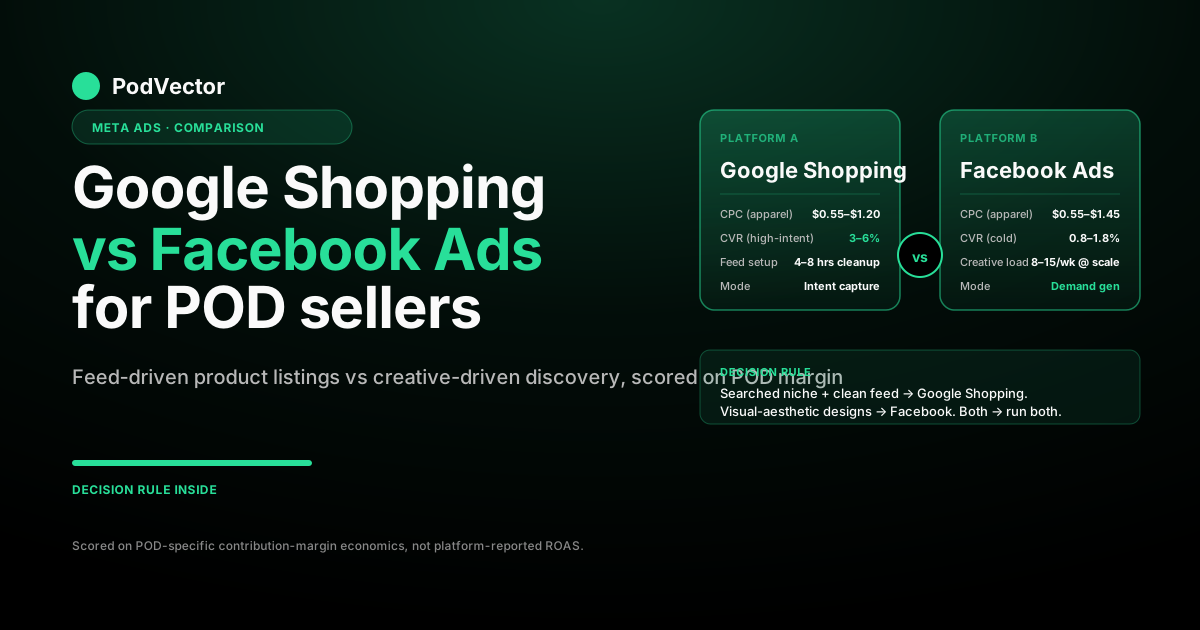
Quick Answer: For most print-on-demand sellers in 2026, the honest answer is "Facebook Ads first to find your design winners, then layer Google Shopping on those proven SKUs once your product feed is clean." Facebook wins on creative-driven discovery for niche designs nobody is searching for yet, and on lower minimum efficient spend (~$30/day vs Google Shopping's ~$50–$100/day floor). Google Shopping wins on bottom-of-funnel intent, conversion rate inside searched niches (3–6% vs Facebook's 0.8–1.8% cold), and on capturing branded-and-category demand that Facebook prospecting creates.
The real fight isn't "which platform is better" — it's whether your POD feed is clean enough for Google Shopping to even accept it, and whether your contribution margin after Printify or Printful supplier costs survives each platform's CPC. This guide compares the two against POD's actual unit economics, names the niches where each one wins, and gives you a decision rule you can apply this week.
Why this comparison is different for POD
Most "Google Shopping vs Facebook Ads" articles — including the well-circulated Shopify breakdown and the AdNabu quick guide — assume a standard ecommerce shape. Fixed COGS, 60–80% gross margins, a small SKU lineup, and predictable supplier costs.
Print on demand inverts every one of those assumptions. Your supplier cost varies by garment, supplier, color, size, and ship-to country. Your contribution margin after the Printify or Printful base, shipping, payment processing, and platform fees usually lands between 20% and 35%.
You launch new designs faster than any platform's algorithm can fully learn them. Your SKU count is in the hundreds, often thousands. None of the standard comparisons hold once you plug in real POD numbers.
That structural mismatch matters because Google Shopping and Facebook Ads each break in a different place when forced through POD economics. Google Shopping breaks at the feed: Printify and Printful default product exports trip Google Merchant Center disapprovals roughly half the time. Facebook breaks at the margin math: a 1.8% cold conversion rate against a $1.10 CPC needs about 60 clicks per sale, which on a $5.30 contribution-per-unit POD product is structurally underwater before retargeting kicks in.
The second thing POD changes is the relative value of each platform's strongest signal. Google Shopping's strength is intent capture against shoppers already searching for "german shepherd dad t-shirt" — conversion rates in high-intent POD niches frequently run 3–6%. Facebook's strength is interrupt-driven discovery — great when your design is visually striking and your niche audience is large but not actively searching. The "best" platform isn't the one with cheaper CPCs in some abstract benchmark. It's the one whose strength matches the shape of your specific designs' demand.
The third thing POD changes is the cost of a wrong bet. A direct-to-consumer brand spending $5,000 on the wrong channel has burned a test budget against healthy margins. A POD seller burning the same $5,000 without a baseline of true contribution margin can finish the month with negative contribution and no diagnostic clarity on why.
That's why this comparison leads with economics. Every section below holds Google Shopping and Facebook Ads against the unit economics POD operators actually face.
Head-to-head: the comparison table
Here is the side-by-side scored against POD's specific structural needs. Numbers are 2026 ranges from public benchmark data and our own client cohort. The verdict column is the POD-specific call.
| Factor | Google Shopping | Facebook Ads | POD verdict |
|---|---|---|---|
| Avg CPC (apparel/accessories) | $0.55–$1.20 | $0.55–$1.45 | Roughly even on raw CPC |
| Conversion rate, cold | 3–6% (high-intent search) | 0.8–1.8% (cold prospecting) | Shopping wins where search exists |
| Targeting model | Search query + product feed | Interest, lookalike, behavior, age | Different jobs; not directly comparable |
| Minimum efficient daily spend | $50–$100 per Shopping campaign | $30 per ad set | Facebook lower floor; better under $5K MRR |
| Creative volume burden | Low (clean product feed = creative) | High (8–15 net-new creatives/week) | Shopping cheaper to operate at scale |
| POD feed approval pain | High (Printify defaults often disapproved) | Low (DPA tolerates most catalogs) | Facebook easier to launch on day one |
| Best for | Searched niches, branded demand capture | Visual designs, audience-discovery niches | Different tools, not direct substitutes |
| Attribution honesty | Tighter; first-party data clearer | Looser since iOS 14.5; CAPI helps | Shopping more honest, especially post-iOS |
| Scaling ceiling | Capped by niche search volume | Capped by creative supply and audience saturation | Facebook scales further if creative pipeline holds |
The single most important row in that table is the one nobody else mentions: POD feed approval pain. Google Shopping requires a Google Merchant Center feed that passes a long checklist of attribute requirements. Default exports from Printify and Printful trip those checks regularly enough that "set up Google Shopping" is often a 4–8 hour feed-cleaning project before any spend goes live.
Facebook's Dynamic Product Ads (DPA) tolerate a much wider range of catalog quality. That asymmetry alone is why a meaningful number of POD sellers who "tried Google Shopping" actually never made it out of the feed-disapproval loop.
Cost: CPC, CPM, and what they mean at 25% margin
Looking at platform CPCs without holding them against POD margin is the single most common mistake in this comparison. Here's the math that matters.
Take a representative POD product: a $26 hoodie with a $14 Printify base, $5.50 shipping, $1.20 payment processing, and roughly $0.30 of platform fees. Contribution margin before any ad cost is about $5.00. That's the entire ad budget per sale.
Run that against Google Shopping's $0.85 average CPC at a 4% conversion rate: 25 clicks per sale, $21.25 in ad cost. The math is structurally underwater on first sale by about $16.
Run the same product against Facebook's $1.05 cold CPC at 1.4% conversion: 71 clicks per sale, $74.55 in ad cost. Underwater by about $70 on first sale, requiring 14x repeat purchase to recover. POD's repeat-purchase rate runs 8–12%.
Both platforms look like a structural disaster against contribution margin on first sale. But the comparison isn't first-sale ROAS — it's blended customer lifetime contribution after design-portfolio repeat-purchase, retargeting, and email recovery. With proper retargeting and a typical POD customer ordering 1.4–2.1 times across a full design portfolio, blended customer contribution typically hits $11–$18 against fully-loaded acquisition cost in the $9–$16 range.
That's the honest CPC-to-margin math, and it's why the platform CPC comparison alone is meaningless without knowing your design pipeline, retargeting setup, and repeat-purchase rate. For a deeper drill into platform cost economics, the cluster's Google Ads vs Facebook Ads cost guide covers the full cost-comparison framework, and the complete guide to Meta Ads ROAS and attribution covers how to reconcile reported numbers against actual contribution.
Intent capture vs interrupt-driven discovery
The single biggest functional difference between these two platforms is the customer state at the moment of ad exposure.
Google Shopping intercepts shoppers actively typing product-related queries into the search bar. By the time a shopper sees your Shopping ad, they have already named the product category, the design theme, or the gift recipient ("german shepherd dad shirt"). That signal is gold for POD niches with measurable search volume.
Facebook Ads interrupt people doing something else entirely — scrolling between friends' photos, watching a Reel, reading a comment thread. There's zero pre-existing intent. The ad has to do all the work of creating both want and click in 1.5 seconds of thumb-stop time.
The implication for POD is sharper than for general ecommerce. POD designs split into two structural buckets: searched-for (occupations, hobbies, named pets, holidays, sports teams) and discovered (visual aesthetic, abstract design, viral creative angles). Google Shopping wins decisively on the first bucket. Facebook wins decisively on the second.
If your design portfolio is heavy on searched themes — "nurse appreciation," "german shepherd dad," "labrador mom," "pickleball funny saying" — Google Shopping will outperform Facebook on the same dollar inside that traffic. If your portfolio is heavy on visual aesthetic — minimalist line art, abstract patterns, design-first apparel — Facebook's interest and lookalike targeting will outperform Google because nobody is searching for the design theme.
This is also why most successful POD shops eventually run both platforms: their design portfolio is mixed, and sending each design to its strongest channel beats forcing the whole portfolio through one platform's strength. The cluster's complete Meta Ads playbook for POD walks through how to segment your design library by audience-discovery type.
The product feed problem nobody warns POD sellers about
This is the section nobody else in the comparison SERP writes, because non-POD sellers don't hit it. POD sellers hit it on day one of trying Google Shopping.
Google Merchant Center requires a product feed with strict attribute compliance. Default Printify and Printful catalog exports — whether you sync via a Shopify app or directly — routinely trip the following disapprovals:
- Image policy violations. POD apps often export product mockups with multiple variants composited into a single image. Google requires a single primary product on a clean background. Mockups with text overlays, watermarks, or multi-product staging get auto-disapproved.
- Variant attribute mismatches. Color and size variants need consistent attribute values across the feed. POD apps occasionally export the same color as "Heather Grey," "heather-grey," and "Heather Gray" across different products. Google flags inconsistency.
- GTIN missing or incorrect. POD products often lack manufacturer GTINs. The fix is setting
identifier_existstono, but the default export usually omits the field entirely, which trips a separate warning that suppresses Shopping placements. - Misleading promotion flags. POD apps sometimes export the supplier's MSRP as the compare-at price, generating "discount appears misleading" disapprovals when the supplier MSRP isn't your actual customer-facing price history.
- Shipping calculation mismatches. POD shipping is supplier-dependent and ship-to-country-dependent. Default feeds often export a single flat shipping rate that mismatches actual checkout shipping, triggering "shipping cost discrepancy" disapprovals.
The real-world consequence: a POD seller who takes a Saturday afternoon to "set up Google Shopping" usually spends the first 4–8 hours fixing feed disapprovals before any ad serves. Most don't make it past hour 3 and write off Google Shopping as "doesn't work for POD."
Facebook's Dynamic Product Ads (DPA) tolerate a much wider catalog quality range. The standard Shopify–Facebook integration syncs your catalog with minimal cleanup, and DPA will retarget on whatever data it has rather than refusing to serve. That asymmetry is why most POD sellers' first paid channel is Facebook even when their niche is search-heavy.
The cluster's complete guide to Meta Ads + Shopify integration for POD covers the Facebook side of the catalog plumbing. The Shopify dynamic Facebook ads product feed strategy walks the DPA-specific feed setup that Facebook tolerates better than Google.
Creative: Google's automation vs Meta's volume treadmill
Once your feed is clean, Google Shopping's creative is essentially solved: Google pulls product image, title, price, and rating from your feed, then auto-formats the listing across Shopping placements, the main SERP, YouTube Shopping, and Discover. You write product titles and descriptions once and let Google's machine learning rotate them.
Facebook is the opposite. Cold prospecting on Meta requires a continuous pipeline of net-new creative — typically 8–15 fresh creatives a week at scaled spend. Each ad set's audience saturates within 5–14 days, and creative fatigue collapses CTR and pushes CPMs up 30–60% when you don't refresh.
For a POD seller running a one-person shop or a two-person team, this creative-volume burden is the single largest hidden operating cost of running Facebook Ads at scale. A reasonable rate for a freelance ad-creative producer is $80–$200 per asset; a CapCut-and-iPhone in-house workflow runs roughly 4–6 hours per week of operator time. That's real money or real hours that doesn't appear in the platform's reported cost.
Google Shopping has no equivalent treadmill. Once the feed is approved and the campaign is structured, the creative cost scales with new SKUs added to the feed, not with weekly creative refresh. For POD shops with hundreds of designs, that scales beautifully — Google is in some sense the most "automated" channel a POD seller can run, after the feed work is complete.
The flip side: Google Shopping has zero ability to tell a brand story or build emotional connection. It's a product-listing engine. Facebook's creative latitude — video, carousel, lookalike-driven storytelling, user-generated content — is structurally where brand affinity gets built. POD sellers who care about repeat-purchase rates and brand recognition need Facebook for the brand-building work that Google literally cannot do.
Attribution: which platform is more honest with POD sellers
Both platforms claim credit for sales they didn't drive. The question is which one drifts further from truth in the POD context.
Facebook's reported ROAS overstates true ROAS by 15–40% for most POD stores in 2026. The drivers are model-level: post-iOS 14.5, Meta relies more heavily on probabilistic modeling, view-through attribution windows, and Conversions API event matching that doesn't always reconcile cleanly to actual orders.
Google Shopping's reported ROAS overstates true ROAS by 5–20% — meaningfully tighter. Google Shopping conversions are last-click by default (with optional data-driven attribution), and the source data is server-side query and click data that doesn't depend on browser cookies for most signal capture.
For POD sellers operating on 20–35% contribution margin, attribution drift isn't an academic concern — it's the difference between a profitable channel and an invisibly bleeding channel. A 30% Meta drift on a reported 2.5x ROAS means true ROAS is 1.75x. On 25% margin, that channel is barely break-even before retargeting.
The same 30% drift on a reported 4.2x Google Shopping ROAS would still mean true ROAS of 2.94x — comfortably profitable. The narrower drift on Google Shopping is one of the strongest practical reasons margin-constrained POD sellers should default to Google when their niche has search volume.
The cluster's complete guide to Meta Ads ROAS and attribution for POD covers the reconciliation methodology — comparing reported numbers against bank-deposit revenue weekly is the only way to know what's actually working.
Niches where each platform actually wins
The clearest way to make this decision is to look at your design portfolio against where each platform structurally wins. Here are the patterns we see consistently in our POD client cohort.
Google Shopping wins decisively on:
- Occupation niches (nurse, teacher, firefighter, mechanic, trucker). High search volume, gift-giving intent, repeatable buyer patterns.
- Pet breed niches (german shepherd, labrador, golden retriever, dachshund). Owners search for breed-specific designs explicitly.
- Hobby niches with search volume (pickleball, gardening, woodworking, fly fishing). Searches like "funny pickleball shirt" convert at high rates.
- Gift-occasion niches (mother's day, father's day, retirement, graduation). Calendar-driven search spikes that Google captures perfectly.
- Sports team adjacency (city-specific, college-specific, position-specific). Always-on search demand from fan bases.
Facebook Ads wins decisively on:
- Visual-aesthetic apparel (minimalist art, abstract patterns, design-first apparel). Nobody searches; everyone scrolls past.
- Trending-meme designs with 2–6 week life cycles. Facebook's discovery loop catches the wave faster than Google's keyword crawl.
- Lifestyle-identity niches (van life, homesteading, plant parent, book lover) where the audience is emotionally tribe-marked but doesn't actively search.
- New-niche audience discovery. Lookalike audiences find buyers Google's keyword model can't reach yet.
- Anything dependent on creative storytelling — brand build, founder story, behind-the-scenes manufacturing content.
Notice the pattern: Google Shopping wins where the buyer has an articulable category in mind. Facebook wins where the buyer doesn't yet know the design exists. Most POD shops with a mature design portfolio have designs in both buckets, which is why the most common end-state is running both platforms with channel-specific SKU allocation.
The decision rule by MRR stage and niche search volume
Here is the rule we apply with our own POD client cohort, based on MRR stage and niche search volume. Treat it as a starting point, not a law.
- Pre-revenue / under $2K MRR. Start Facebook Ads. Lower minimum efficient spend, faster creative-discovery loop, and Google Shopping's feed-cleaning overhead is hard to justify before you've proven a SKU sells. Use $30/day across two creative-test ad sets.
- $2K–$10K MRR, niche has 5K+ monthly searches on a primary design term. Add Google Shopping at $50–$100/day on your top 3–5 SKUs. Spend the first two weekends getting the feed clean. This is usually the highest-leverage channel addition a POD store under $10K MRR can make.
- $2K–$10K MRR, niche has under 1K monthly searches. Stay Facebook-primary. Don't fight Google Shopping for traffic that doesn't exist. Layer Facebook retargeting and Advantage+ Shopping instead.
- $10K–$30K MRR, mixed-niche store. Run both. Facebook for prospecting and creative discovery, Google Shopping for high-intent capture on searched designs, and a small Google Brand search campaign to defend your branded SERP.
- $30K+ MRR. Both platforms plus TikTok. Past this band Meta's audience saturation and Google Shopping's search-volume cap individually constrain growth; the answer is platform diversification, not single-platform optimization.
For the structured walk through every channel POD operators consider — not just Google Shopping and Facebook — the cluster's pillar guide on Meta Ads vs alternatives for POD compares all eight realistic options against POD unit economics.
Running both: the integrated playbook
Most scaled POD stores end up running both platforms because they cover different parts of the funnel. The integrated playbook we deploy and recommend has four moving pieces.
Facebook does prospecting and creative discovery. Top-of-funnel cold audiences, broad lookalikes, interest-cluster targeting, Advantage+ Shopping for proven SKUs. The job here is finding new customers and validating which creative angles work. Budget allocation typically runs 50–65% of paid spend at $5K–$15K MRR, dropping to 35–45% as Google Shopping scales.
Google Shopping captures the demand Facebook creates. When a Facebook prospecting creative goes well, branded searches and category-adjacent searches spike on Google within days. Google Shopping should be running on those queries before the Facebook campaign starts so the spillover converts cleanly. Budget allocation: 25–40% at most MRR stages.
Facebook retargeting plus Google RLSA catch the overlap. Visitors who saw a Facebook creative and didn't convert often search Google in the next 24–72 hours for variations. Google RLSA bids more aggressively on those repeat searchers; Facebook retargeting catches the ones who scroll back. Budget allocation: 10–15%.
Google Search defends branded keywords. Once your store has any meaningful brand recognition, competitor stores and POD aggregators bid on your brand terms. A small ($150–$400/month) branded-search campaign is the cheapest defensive moat available. Budget allocation: 2–5%.
The hard part of running both platforms isn't the campaign structure — it's reconciling which channel actually drove which sale, since both platforms claim credit for the same conversions. The cluster's Google Ads vs Facebook Ads strategy guide walks the integrated-channel playbook in more detail, and the Google Ads vs Facebook Ads comparison covers the broader Google Ads (not just Shopping) angle.
Five mistakes POD sellers make in this comparison
Across hundreds of POD sellers we've reviewed, five mistakes show up over and over when picking between these two platforms.
- Treating Google Shopping as plug-and-play. Default Printify or Printful feeds get disapproved roughly half the time. Budget the Saturday for feed cleanup before deciding the channel "doesn't work."
- Comparing reported ROAS as if both numbers mean the same thing. A 3.0x reported on Meta and a 3.0x reported on Google Shopping are not the same. Meta's drift is meaningfully larger. Reconcile both against bank-deposit revenue weekly before comparing.
- Underestimating Meta's creative-volume burden. Stores benchmarking Meta against Google on dollars-in-dollars-out frequently exclude the labor cost of producing 8–15 creatives a week. When that cost gets folded back into per-design profitability, Google often wins outright in searched niches.
- Picking one platform and refusing to add the second. Past $5K MRR, the two platforms cover different parts of the funnel. Refusing to add the complement leaves money on the table that competitors who run both will capture.
- Not pricing in true contribution margin per channel. A campaign hitting 2.5x reported ROAS on a 25%-margin POD product needs about 4.0x reported to be break-even after itemized Printify or Printful supplier costs. Most POD sellers who think they're profitable on Meta haven't run that math.
For the structured Meta-specific deep dive, the complete Meta Ads playbook covers the campaign structures we recommend across MRR stages. The Meta Ads topic hub indexes every supporting article in this cluster, and the Meta Ads comparison cluster has the platform-by-platform deep dives.
FAQs
Is Google Shopping or Facebook Ads cheaper for print on demand?
Raw CPCs are roughly even ($0.55–$1.20 on Google Shopping vs $0.55–$1.45 on Facebook for apparel). On cost-per-acquisition, Google Shopping is meaningfully cheaper in niches with measurable search volume because its conversion rate runs 3–6% vs Facebook's 0.8–1.8% cold. The "which is cheaper" answer depends entirely on whether your niche has searches, which is why the platform comparison can't be answered without naming the niche.
Should a new POD seller start with Facebook Ads or Google Shopping?
If you have less than $2K in MRR and no proven design winners yet, start with Facebook. The minimum efficient daily spend is lower (~$30 vs Google Shopping's ~$50–$100), Facebook's creative-discovery loop helps you find winning designs faster, and you avoid the feed-cleanup overhead that derails most POD sellers' first Google Shopping attempt. Add Google Shopping once you have proven SKUs and a niche with measurable search volume.
Why do Printify and Printful product feeds get disapproved on Google Shopping?
Default exports trip Google Merchant Center checks on image policy (mockups with multi-product composites or text overlays), variant attribute consistency (color name inconsistency across products), GTIN handling (missing the identifier_exists=no flag), promotion flags (using supplier MSRP as compare-at price), and shipping cost mismatches. Cleaning these takes 4–8 hours of feed work per Saturday before the channel will serve.
What's the realistic ROAS to expect on each platform?
For POD apparel and accessories in 2026, prospecting Meta campaigns typically report 1.6x–2.4x ROAS, retargeting reports 4.5x–8x, and Google Shopping in proven niches reports 2.8x–4.2x. Reported numbers overstate true ROAS by 15–40% on Meta and 5–20% on Google. The only number that matters for thin-margin POD is contribution-margin ROAS — reported numbers minus drift, divided by your true CAC, not the platform's claimed CAC.
Can I run both platforms on a $1,500/month budget?
Yes, but barely. A practical $1,500/month split is roughly $900 on Facebook (one prospecting ad set + one retargeting ad set, $30/day combined) and $600 on Google Shopping ($20/day on your top 3 SKUs). Below this budget, focus on a single platform first — splitting too thin under-funds both into noise.
How does Google Shopping handle POD's high SKU count?
Standard Google Shopping campaigns scale fine to thousands of SKUs once the feed is clean — Google's bidding model treats each product line as a separate auction unit. The practical limit isn't SKU count; it's how many SKUs have meaningful search volume to bid against. A POD store with 800 designs typically finds that 30–60 SKUs do 80% of Shopping revenue, which is also the SKU set worth optimizing product titles and descriptions for.
Does Performance Max replace standard Google Shopping for POD?
Not yet for most POD stores under $20K MRR. Performance Max became legitimately workable for POD in 2025 with brand exclusions and audience signals, but it over-rotates into branded search if you don't fence it, and its placement opacity makes diagnosing what's working harder. We recommend starting with standard Google Shopping for the diagnostic clarity, then evaluating Performance Max once you have a baseline ROAS to compare against.
How does iOS attribution affect this comparison?
iOS-driven signal loss hurt Meta meaningfully more than Google Shopping. Meta's attribution model relied on third-party-cookie-equivalent event signals; Google Shopping's relies more on first-party search-and-click data. Properly configured Conversions API recovers a meaningful portion on Meta, but reported ROAS still drifts more than Google's. For thin-margin POD sellers, that drift is a strong practical reason to lean Google Shopping when the niche permits.
Stop comparing platform CPCs. Track real contribution by channel.
Every POD seller arguing Google Shopping vs Facebook is arguing platform-reported numbers. The number that actually matters — true contribution margin per channel after itemized Printify or Printful supplier costs — almost nobody tracks live. Victor connects directly to your Shopify, Printify, Printful, Meta, and Google ad accounts, runs the reconciliation in a live data warehouse, and answers "which platform earned me a dollar today?" instead of "which platform claimed it earned me a dollar." and see your real channel-level profit before your next ad-budget reallocation.
Try Victor free