
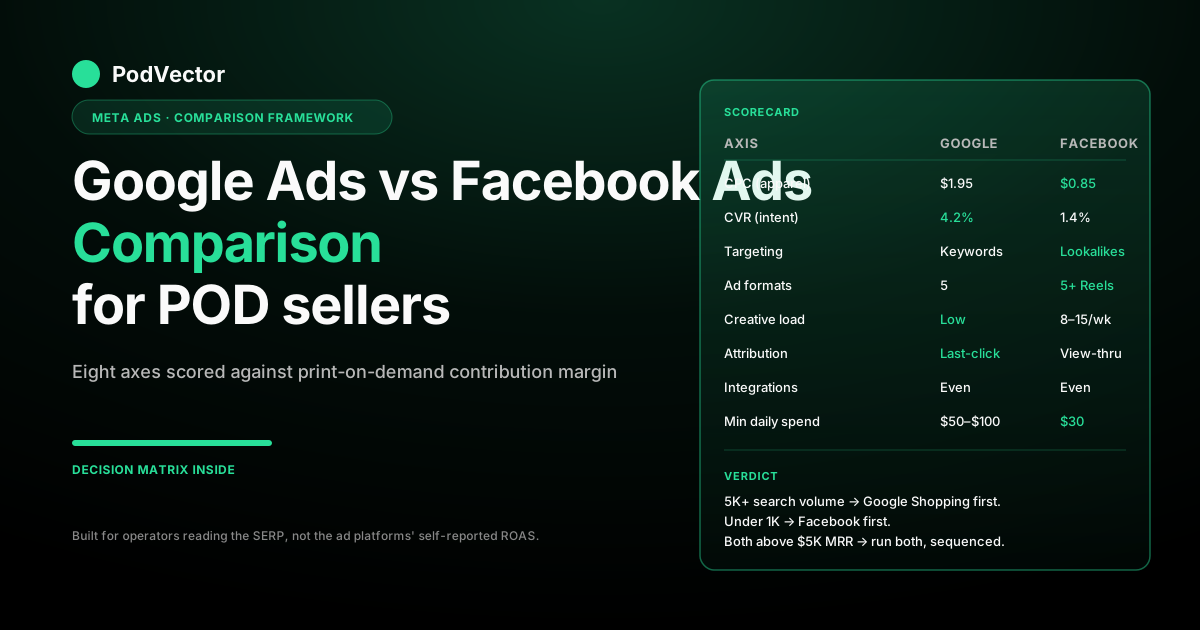
Quick Answer: A useful Google Ads vs Facebook Ads comparison for print-on-demand sellers needs eight axes, not the usual four — cost per click, conversion rate, audience targeting, ad formats, attribution, creative volume burden, supplier-cost compatibility, and minimum efficient daily spend. On those eight axes Google Ads wins for high-intent niches with 5,000+ monthly searches and a tight SKU lineup that fits Google Shopping's product feed cleanly.
Facebook Ads wins for new niches without search volume, broad-appeal designs, and operators under $5K MRR who can't fund a $50–$100/day Google Shopping floor. The honest comparison answer for most POD operators is "run both, but in a specific order: Facebook first, Google second once you've validated the niche has demand and your contribution margin can absorb the higher CPC." This guide gives you the structured side-by-side, fills in 2026 benchmarks, and ends with a decision matrix you can apply to your own niche in under fifteen minutes.
How to actually compare these platforms for POD
Most published Google Ads vs Facebook Ads comparisons — including the widely cited Shopify breakdown, the WordStream guide, and the in-depth AgencyAnalytics roundup — are written for businesses with fixed cost of goods, 60–80% gross margins, and small SKU counts. None of those assumptions hold for print on demand, and that means the standard comparison framework returns the wrong answer for most POD operators.
A POD seller pricing a $26 hoodie has roughly $14 going to the Printify or Printful base, $5.50 to shipping, and $1.20 to platform fees, leaving about $5.30 of contribution margin before any ad spend. That structural reality changes which axes of the comparison actually matter.
Cost per click matters, but only in relation to your specific contribution margin. Conversion rate matters, but only in conjunction with intent type.
Targeting matters, but only as a function of whether your niche has search volume or not. Comparing platforms on platform-reported metrics in isolation tells you almost nothing about which one will actually print money on a print-on-demand P&L.
This comparison uses eight axes, weighted for POD economics: cost (CPC and CPM at apparel benchmarks), conversion rate (split by intent type), audience targeting capability, ad format variety, attribution honesty against POD's multi-touch reality, creative volume burden against your design pipeline, supplier-cost compatibility against feed integrations, and minimum efficient daily spend against your current MRR. Each axis is scored against the contribution margin a POD seller actually defends, not the gross-margin assumption a typical DTC brand operates against. By the time you finish the comparison sections below, you'll have a decision rule you can apply to any individual niche or product line you launch.
The full side-by-side comparison table
Here is the comparison at a glance. Numbers are 2026 ranges from public benchmark data and our own POD-operator client cohort. The "POD verdict" column is the call we'd make on each axis given typical print-on-demand contribution margins.
| Comparison axis | Google Ads | Facebook Ads | POD verdict |
|---|---|---|---|
| Average CPC (apparel) | $0.95–$2.80 | $0.55–$1.45 | Facebook cheaper at the click level |
| Average CPM (apparel) | $30–$60 Search / $3–$9 Display | $11–$26 | Compare CPA, not CPM |
| Conversion rate, prospecting | 2.5–5.5% (high-intent search) | 0.8–1.8% (cold prospecting) | Google wins where search volume exists |
| Buyer intent | High (active search) | Low to moderate (interest + lookalike) | Niche-dependent, not universal |
| Audience targeting | Keywords, in-market, demographics | Interests, lookalikes, behaviors, custom | Facebook deeper; Google narrower but sharper |
| Ad formats | Search, Shopping, Display, Video, PMax | Image, Video, Carousel, Collection, Reels | Facebook richer for visual designs |
| Creative volume burden | Low — feed is the creative | High — 8–15 net-new assets/week at scale | Google wins for high-SKU operators |
| Attribution honesty | Last-click on search; PMax less clear | Aggressive view-through credit | Google more honest at default settings |
| Shopify integration | Native via Google & YouTube channel app | Native via Facebook & Instagram channel | Both first-class on Shopify |
| Printify/Printful feed compatibility | Strong — clean GTIN handling | Strong — catalog imports cleanly | Even on integrations |
| Minimum efficient daily spend | $50–$100/day per Shopping campaign | $30/day per ad set | Facebook lower floor |
| Time to first conversion data | 3–7 days (Search), 7–14 days (PMax) | 3–10 days, depends on pixel volume | Google faster for keyword-targeted niches |
| Best for new niches | No, requires existing search demand | Yes, can manufacture demand | Facebook wins for design-led niches |
| Best for proven niches | Yes, captures existing intent | Yes, scales reach | Run both, in that order |
That table is the comparison framework. The sections below dive into the four axes that swing the decision most often for POD operators: cost, features, performance, and integrations.
Cost comparison: CPC, CPM, and CPA against POD margins
Cost per click in apparel and accessories runs roughly $0.95–$2.80 on Google Ads and $0.55–$1.45 on Facebook Ads in 2026. Those numbers vary heavily by niche specificity — "german shepherd dad t-shirt" runs cheaper on Google than "men's t-shirts" because the long tail has thinner competition, and a Facebook lookalike against a 30-day-purchaser seed audience usually clears 35–50% lower CPM than broad cold prospecting.
CPC alone, though, is a misleading comparison axis. What matters for POD is CPA — cost per acquisition — divided into the contribution margin you keep after Printify or Printful supplier cost, shipping, and platform fees.
The arithmetic looks like this on a typical $26 hoodie with a $5.30 contribution margin. Facebook at $0.85 average CPC and a 1.4% conversion rate produces a $60.71 CPA, meaning every conversion costs roughly 11x your contribution margin.
Google Ads at $1.95 CPC and a 4.2% conversion rate on a high-intent niche keyword produces a $46.43 CPA, roughly 8.8x your contribution margin. Both numbers look terrible at the unit level — and they should, because POD doesn't make money on first-purchase contribution.
POD makes money on second-and-third-purchase repeat rates against zero re-acquisition cost, plus first-purchase orders containing two or three items that share fixed shipping. The honest comparison is "which platform's CPA pays back fastest against your repeat cohort," and that answer depends on your specific niche's repeat-purchase pattern.
If you don't yet know what your true contribution margin looks like itemized by Printify or Printful supplier — most operators don't — that's a prerequisite for any meaningful Google vs Facebook decision. A guide we wrote on Meta ads ROAS and attribution for POD covers the contribution-margin math in detail, including the supplier-cost split that Shopify's native reporting hides. Two related comparisons in the same cluster — the broader Google Ads vs Facebook Ads guide and the cost-focused Facebook Ads vs Google Ads breakdown — go deeper on the unit-economics arithmetic.
Features comparison: targeting, formats, and integrations
Targeting capabilities differ in kind, not just degree. Google Ads targets intent: somebody types "cottagecore mushroom sweatshirt" and your Search or Shopping ad appears against that query.
The targeting is narrow but precise, anchored to a keyword that's a near-explicit purchase signal. Facebook Ads targets identity and behavior: somebody who recently engaged with three pages about cottagecore decor, follows two cottagecore creators, and lives in a $50K+ household. The targeting is broad and probabilistic, anchored to inference rather than declared intent.
For POD, the features comparison shakes out by niche shape. If your niche has clear search demand — measurable via Google Keyword Planner, Ahrefs, or even just Amazon's autocomplete — Google's intent-targeting wins because you're catching purchase-ready buyers at the moment of consideration. If your niche is design-led, where buyers don't search for your specific aesthetic but recognize it visually when scrolling, Facebook's behavior-and-interest targeting wins because Google can't show your ad to somebody who never typed a relevant query.
Ad format breadth tilts toward Facebook for visual-first products. Carousel ads showing five t-shirt designs in one swipeable unit, collection ads opening into a full mobile shopping experience, and Reels placements that ride organic-video distribution all give POD designs a richer canvas than Google's Search and Shopping units, which are constrained to a product image, title, price, and short description. Google Performance Max closes some of that gap by surfacing assets across YouTube, Discover, and Display, but PMax also obscures attribution in ways covered in the performance comparison section below.
Integration depth is even on Shopify — both platforms have first-class channel apps that sync your product catalog, install conversion pixels, and pipe order data back. Printify and Printful both handle GTIN and product feed exports cleanly for both platforms. The differentiator on integrations isn't platform support, it's how cleanly your contribution-margin data flows into either ad platform's optimization signal — and that's a topic the complete guide to Meta Ads + Shopify integration for POD covers in depth.
Performance comparison: conversion rate and ROAS
Conversion rate is where the comparison gets interesting. Google Ads on high-intent keywords produces 2.5–5.5% conversion rates in our POD client cohort, with the upper end on long-tail niche queries where a buyer typing the phrase is almost pre-qualified.
Facebook Ads on cold prospecting runs 0.8–1.8%, with the upper end on warm lookalike audiences against a recent-purchaser seed. Those raw numbers favor Google by a 3–5x multiple, but the comparison is incomplete without the volume side.
Google's high conversion rate operates on a smaller addressable pool. A niche with 5,000 monthly searches and a 30% impression share at decent ad rank gives you maybe 1,500 monthly impressions to convert against.
Even at a 5% conversion rate that's 75 conversions per month — a real business but capped by search volume. Facebook's lower conversion rate operates on a much larger addressable pool. The same niche audience inferred via interest and lookalike targeting might be 2 million people, and even at a 1.2% conversion rate against the 1–3% of those you'll actually reach, you can drive 240–720 conversions per month before saturating the audience.
ROAS comparison is even trickier because both platforms report it differently. Google reports last-click ROAS by default in Search, with PMax stitching across channels in ways that often double-count.
Facebook reports a 7-day-click-1-day-view default that gives credit to view-throughs Google ignores entirely. A Google-reported 4.0x ROAS on a POD store and a Facebook-reported 4.0x ROAS on the same store are not the same thing — Facebook is including impressions that may have contributed nothing to the actual purchase decision. Honest cross-platform performance comparison requires a unified attribution model that holds both platforms to the same standard, which is why operators running both eventually need a tool that pulls both platforms' raw data into a single contribution-margin view.
Integration comparison: Shopify, Printify, Printful
On Shopify, both Google and Facebook offer first-party channel apps that handle catalog sync, pixel installation, and order data feedback. Google's Google & YouTube channel handles product feeds for Shopping and Performance Max; Facebook's Facebook & Instagram channel handles catalog and conversion API data. Setup time for a clean integration on either is roughly 30–60 minutes for an operator who knows what they're doing.
Printify and Printful both export clean product catalogs that work well with both platforms. The integration nuance for POD is product variant handling: a single t-shirt design might have 12 size-color combinations, each a separate variant in your Shopify catalog.
Both ad platforms can handle variant-level feeds, but Facebook's catalog tool is slightly more forgiving when product titles or descriptions exceed Google's strict character limits. Google Shopping disapproves more aggressively when GTINs are missing or malformed, which can happen with Printify base products that haven't been mapped correctly.
The deeper integration consideration is what happens once data is in your ad platform. Both Google and Facebook optimize toward the conversion signals you send them — but the signals themselves matter.
If you're sending raw "purchase" events with a constant value of $26 on the hoodie example, both platforms optimize for revenue, which is wrong because you're paying $14 to your supplier. The right signal is contribution-margin-weighted conversions, which neither platform calculates natively.
Operators using Victor can pipe true contribution margin from your warehouse back into both platforms via their respective conversion APIs, optimizing the algorithms toward profit rather than gross revenue. That's the comparison axis nobody else in the SERP covers, because nobody else has the underlying data infrastructure to pull it off.
Use case comparison: when each platform wins
Each platform wins decisively in specific situations. Google Ads wins when your niche has measurable search demand — typically 5,000+ monthly searches on the head term plus a long-tail pool of related queries — and when you have a tight enough SKU lineup that Google Shopping's feed-driven format works. Examples in our client cohort include occupational-pride apparel ("nurse t-shirt for women," "welder dad gift"), fandom and franchise designs in licensed categories where buyers know the show or game name, and gift-occasion products ("anniversary gift for husband") where intent is unambiguous and time-bounded.
Facebook Ads wins when your niche is design-led, when buyers don't yet know they want what you're selling, or when search volume is below the 1,000-monthly-searches threshold that makes Google Shopping economically uninteresting. Examples include aesthetic-driven categories like cottagecore, dark academia, or specific art styles that don't map cleanly to search queries; lifestyle and identity products where the design's visual signal is what triggers purchase; and brand-new niches where you're effectively testing whether demand exists at all. Facebook's interest-and-lookalike machinery is genuinely better than Google's at finding buyers who haven't yet declared they're shopping.
Both platforms together win when your niche has both search demand and design-led upside, which is most operators in the $5K–$50K MRR range. The pattern that works best in our client base is Facebook for top-of-funnel demand generation and product-launch testing, Google Shopping and branded search for capturing the buyers who saw a Facebook ad, didn't click immediately, and went to Google to look up the brand or product an hour later. That hand-off pattern — covered in detail in our complete Meta Ads playbook for POD sellers — is the highest-leverage configuration for most operators once they're past initial niche validation.
The decision matrix for POD operators
Use this matrix to decide where to start. The inputs are your niche's search demand and your current monthly recurring revenue; the output is the platform sequence that maximizes your odds of payback inside the first 60 days.
| Niche search volume | Under $5K MRR | $5K–$25K MRR | $25K+ MRR |
|---|---|---|---|
| Under 1,000/month | Facebook only | Facebook only, test Google branded | Facebook + Google branded |
| 1,000–5,000/month | Facebook first, Google after validation | Both, Facebook-led | Both, balanced |
| 5,000–25,000/month | Google Shopping first | Both, Google-led | Both, Google-led + Facebook for new launches |
| 25,000+/month | Google Shopping only | Google Shopping + Facebook lookalike | Both, plus YouTube and Reels for brand |
The matrix is opinionated on purpose. Trying to run both platforms simultaneously under $5K MRR with thin niche search demand wastes 60–70% of your test budget on whichever channel you didn't actually need.
Skipping Facebook entirely above $25K MRR with strong search demand misses lookalike-based scaling once Google Shopping saturates against the search volume ceiling. The honest decision rule is: pick the platform that fits your niche's structural shape, prove it works, and only add the second platform once the first one is profitable enough to fund the test.
Running both: the combined strategy
Operators running both platforms profitably tend to follow the same architectural pattern. Facebook handles cold prospecting against interest and lookalike audiences.
Google Shopping captures branded and high-intent search from people who saw a Facebook ad and went to look up the product. Google Branded Search captures direct brand searches for trademark protection and conversion of buyers in research mode.
Google Performance Max gets a smaller percentage of total budget and is held to a higher CPA threshold because of its attribution opacity. Facebook retargeting handles cart abandonment and view-content visitors with dynamic product ads pulling from the same Shopify catalog.
Budget allocation in our client cohort lands roughly at 50–60% Facebook prospecting, 15–25% Google Shopping, 5–10% Google Branded, 5–10% Facebook retargeting, and 5–10% PMax for operators above $25K MRR. Those weights shift toward Google for higher-search-demand niches and toward Facebook for design-led niches with weak search. The combined-strategy details — including budget caps, KPI thresholds, and the attribution-stitching logic — are covered in the complete Meta Ads vs alternatives comparison for POD, and you can browse all the side-by-side breakdowns in our Meta Ads comparison cluster or step up to the broader Meta Ads topic hub for ad types, ROAS, and strategy guides.
The single biggest mistake in combined-strategy execution is failing to attribute correctly across both platforms. Each platform claims credit aggressively in its own reporting, and the sum of self-reported conversions almost always exceeds total Shopify orders by 30–80%.
Without a unified attribution model holding both platforms to the same window and weighting, you end up over-funding whichever platform reported more last week and under-funding whichever platform actually drove the demand. That's the gap unified data-warehouse-based attribution closes — pulling both platforms' raw event data into a single timeline against actual Shopify orders, then weighting credit by your own logic rather than each platform's self-serving default.
Five mistakes POD sellers make in this comparison
1. Comparing CPC instead of CPA against contribution margin. Facebook's $0.85 CPC looks cheap until you do the math against $5.30 of contribution margin on a $26 hoodie. CPC is a leading indicator at best; CPA divided by contribution margin is the only number that tells you whether the channel actually pays back.
2. Trusting platform-reported ROAS without cross-checking. Both platforms over-report. Google's PMax stitches credit aggressively across channels, and Facebook's 7-day-click-1-day-view window includes view-throughs that may not have moved the purchase decision. Honest ROAS comparison requires holding both platforms to the same window and reconciling against actual Shopify orders.
3. Picking based on absolute CPA, not payback period. POD's economics work when first-order contribution covers acquisition cost over 60–90 days, not on day one. A higher absolute CPA on Google can be the better channel if the cohort it brings has a 1.6x repeat rate inside 90 days.
4. Running both before validating either. Splitting a $1,500 monthly test budget across both platforms gives each platform a roughly $25/day floor — below the minimum efficient spend on Google Shopping and barely above the minimum on Facebook. Pick one, prove it works, then add the second.
5. Optimizing toward "Purchase" instead of contribution margin. Both platforms optimize toward whatever conversion signal you send them.
Sending raw purchase events with constant revenue values trains the algorithm to bring you any buyer at any price, including buyers whose orders lose money after Printify supplier cost. Contribution-margin-weighted conversions fix this, but only if your data infrastructure supports it.
FAQs
Is Google Ads or Facebook Ads better for POD on Shopify?
Neither is universally better. Google Ads is better for proven niches with 5,000+ monthly searches and tight SKU lineups; Facebook Ads is better for new or design-led niches without measurable search demand. Most POD operators above $5K MRR run both, with Facebook leading prospecting and Google Shopping capturing the buyers who saw a Facebook ad and searched for the brand.
What's a realistic CPA on Facebook vs Google for a POD store?
In our 2026 client cohort, Facebook prospecting CPA on apparel runs $35–$75 depending on niche specificity and creative quality. Google Shopping CPA on the same products runs $25–$60 when search volume is sufficient to keep impression share high. Both numbers look high relative to a single $26 sale, which is why POD operators have to think about payback in 60–90 day cohorts rather than first-order economics.
Can I just run Google Shopping for a POD store and skip Facebook?
Yes, if your niche has strong search demand (5,000+ monthly searches on head terms plus a healthy long tail). The risk is that Google Shopping has a hard volume ceiling — once you're at 80%+ impression share, adding more budget mostly inflates CPC rather than driving additional conversions. Operators at scale almost always need Facebook to add demand-generation reach beyond the search volume ceiling.
How do I know if my niche has enough search volume for Google Ads?
Run your top 10 keywords through Google Keyword Planner or Ahrefs. If the head term plus the top 5 long-tail queries combined have 5,000+ monthly searches and the top SERP is dominated by other Shopify or marketplace stores (rather than only Etsy listings or content sites), Google Shopping is worth testing. Below 1,000 combined monthly searches, Facebook is almost always the better starting point.
What's the minimum daily budget to compare both platforms fairly?
$50/day per ad set on Facebook for two ad sets ($100/day Facebook total) plus $75/day on a single Google Shopping campaign. That's $175/day or roughly $5,250/month for a clean head-to-head test, which is realistic for operators above $15K MRR but heavy below that. Under $15K MRR, sequence the test instead of running both — pick the platform that fits your niche, prove it for 30–60 days, then add the second.
How does Victor help compare Google Ads vs Facebook Ads performance?
Victor pulls raw event data from both Google Ads and Facebook Ads APIs into a warehouse, joins it against your actual Shopify orders and Printify or Printful supplier costs, and reports unified contribution-margin-weighted CPA and ROAS holding both platforms to the same attribution window. That's the apples-to-apples comparison neither platform's native reporting will give you, and it's the foundation for every other comparison decision in this guide.
Get the cross-platform comparison Victor builds automatically
Victor connects to your Shopify, Printify or Printful, Google Ads, and Facebook Ads accounts, pulls raw event data into a warehouse, and reports a single unified contribution-margin view of both ad platforms — not the platform-reported ROAS that double-counts. Operators using Victor stop debating "which is better" and start optimizing the actual blended cost per profitable customer.
Try Victor free