
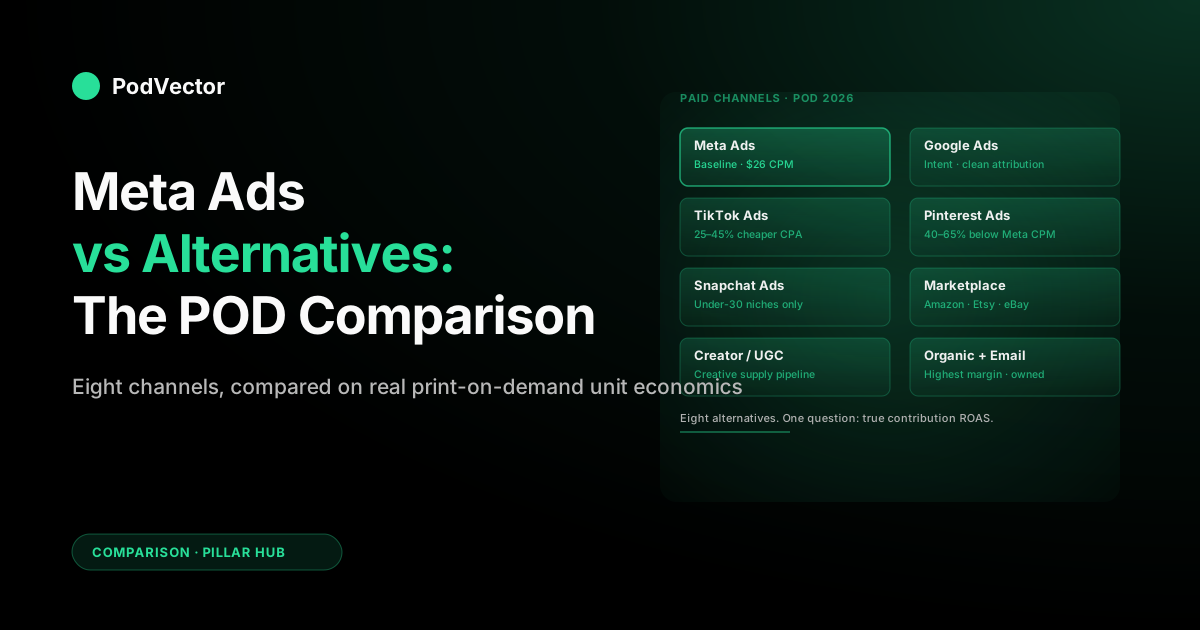
Quick Answer: For POD sellers in 2026, Meta Ads is still the default paid channel for demand generation — but it is no longer the default cheapest one, and its post-iOS attribution still routinely overstates true ROAS in ways that POD's thin contribution margins punish harder than almost any other ecommerce vertical. The right question is not "Meta vs one alternative." It is which mix of Meta, Google Shopping, TikTok, Pinterest, Snap, marketplace ads, influencers, and organic search fits your specific product, audience, and MRR stage — and whether you can measure each platform's real contribution rather than its dashboard number.
According to Triple Whale's benchmark analysis covering over 5,900 brands (August 2025–July 2026), TikTok CPM fell to a median of $4.08 while Meta's overall median sits at $15.06 — a real gap, though TikTok CPMs are rising, up roughly 16% year-over-year per Hawky.ai's 2026 data. Meanwhile, Trackbee's 2026 cross-platform cost report shows Pinterest CPMs starting around €3, making it one of the cheapest reach channels for visual ecommerce niches. The correct channel mix for your store depends on your product category, your audience's age and platform habits, and your capacity to feed each platform's creative requirements.
This guide walks each platform against POD unit economics, shows where each one wins and where it breaks, and gives you a channel-mix framework that scales from $0 to $100K MRR without torching contribution margin.
Why POD changes the "best ad platform" question
Almost every "Meta vs Google vs TikTok" comparison on the first page of search results is written for a direct-to-consumer brand that looks nothing like a print-on-demand business. The template audience has fixed COGS, warehouse inventory, comfortable gross margins, and a tight SKU lineup that gets iterated seasonally.
POD is the opposite shape. Your cost of goods is itemized per order, varies by supplier, garment, print method, size, color, and ship-to country, and never lives inside any ad platform's dashboard.
Your contribution margin after Printify or Printful's supplier line, shipping, payment processing, and platform fees is a thin slice of revenue even on a good month — and that slice is the number every channel below gets graded against. Your SKU count is in the hundreds and you test designs, not just angles.
That structural mismatch changes the arithmetic of every ad-platform comparison. Suppose a DTC brand with fixed COGS on a mid-priced product sees a strong reported ROAS on Meta: that typically translates to healthy contribution per dollar of ad spend — genuinely profitable even with modest attribution drift.
A POD seller on the same campaign selling a Printify hoodie with a high supplier cost plus shipping and platform fees delivers a fraction of that contribution per dollar of ad spend at the same reported ROAS. The dashboard can pat you on the back while you slowly bleed margin.
The same platform math holds on Google Shopping, the same on TikTok, the same on Pinterest. The dashboards all overstate in the same direction, but they overstate at different rates because their attribution models differ — which is why cross-platform comparison is so genuinely hard for POD sellers and so rarely done honestly. According to Trackbee's 2026 ad cost benchmarks, "cheapest is the wrong question" because each platform buys a fundamentally different type of intent: Google buys high-intent search, Meta buys reach and retargeting, and TikTok buys discovery-stage attention.
The second thing POD changes is the relative value of each platform's strongest signal. Meta's strength is demand generation against interest and lookalike audiences — great when your design's appeal is broad but visually interrupting. Google's strength is intent capture for existing searches — great when your niche has real search volume ("dachshund dad t-shirt," "nurse practitioner christmas mug").
TikTok's strength is viral discovery of novel products — great when you're designing fast and a single video can ignite a long-tail of copycat searches. Pinterest's strength is inspiration with a long purchase cycle — great for evergreen apparel categories where shoppers save a pin in March and convert in November. The "best" platform is the one whose structural strength matches the shape of your specific product's demand, and every POD store has a different shape.
The third thing POD changes is the cost of the wrong bet. A DTC brand that spends $5,000 exploring a new channel that doesn't work has absorbed a test cost against healthy margins. A POD seller that spends $5,000 exploring TikTok Ads with no baseline of true contribution margin can end the month with negative contribution and no way to know whether the channel is structurally wrong or just under-optimized. That is why this comparison guide leads with economics, not features.
Every alternative below gets walked against your real unit economics, not against any platform's reported ROAS. See also our net profit margin benchmark for POD to understand the contribution floors that make each channel viable at your store's stage.
The 8 real alternatives to Meta Ads for POD
The useful alternative set for a POD seller in 2026 contains eight distinct options. Five are paid advertising platforms with direct analogues to Meta's auction model. Three are paid-adjacent channels that live outside the "platform vs platform" framing but absorb the same budget dollars and compete for the same sales. All eight deserve seat time in this comparison because almost every scaled POD operator runs three or four concurrently.
- Google Ads — Search, Shopping, Performance Max, YouTube. The other half of the paid-acquisition duopoly.
- TikTok Ads — In-feed video, Spark Ads, TikTok Shop ads. A major paid channel for POD discovery, with a rising cost curve in 2026.
- Pinterest Ads — Promoted Pins, Idea Pins, shoppable pins. The most POD-native visual platform for evergreen categories.
- Snapchat Ads — AR lenses, Snap Ads, Story Ads. Underpriced in 2026 for niches with young audiences.
- Marketplace ads — Amazon Ads, Etsy Ads, eBay Promoted Listings. High-intent but you're not building your brand.
- Influencer / UGC creator ads — Whitelisted creator posts, affiliate deals, paid partnerships. The creative-volume antidote.
- Organic search, content, and email — SEO, YouTube, owned email. Slow, cumulative, highest LTV.
- Emerging channels — Reddit Ads, YouTube Shorts Ads, Threads Ads, connected-TV. Early-mover territory.
A serious comparison evaluates each on four POD-specific axes: true contribution-margin ROAS, creative-volume burden, attribution reliability on iOS, and time-to-learn to first profitable campaign. We'll use that four-axis lens throughout. For the supporting matchup articles in this cluster, see Google Ads vs Facebook Ads: which is best for POD sellers, Google Ads vs Facebook Ads cost comparison, and when to use Google Ads vs Facebook Ads.
Meta Ads: the baseline you're comparing to
Meta Ads — Facebook, Instagram, and the Meta Audience Network combined — is the baseline against which every POD seller benchmarks every other platform, because for most stores it's the first channel that scales past $5K/month in spend. That's not accidental. Meta owns the richest interest and behavioral signal set in paid advertising, its creative formats (static, carousel, reel, collection, dynamic product) cover the full creative spectrum most POD stores produce, and its Shopify integration is the most mature of any platform.
Where Meta wins for POD
- Creative format breadth. POD design testing requires iterating fast on visual concepts. Meta absorbs static images, reels, carousels, collection ads, and dynamic catalog ads all from one campaign structure. No other platform gives you this range with one creative ingestion process.
- Interest-plus-lookalike targeting that actually works. Meta's detailed targeting, despite multiple iOS-driven setbacks, remains the best on the open internet for finding people who bought a dachshund mug last Christmas or joined a firefighter spouse group last month. For niche POD designs, no other platform matches the granularity.
- Advantage+ Shopping Campaigns (ASC). Meta's automated campaign type has moved the needle for many POD stores since 2023. It removes most of the ad-set-level optimization work and handles creative rotation at scale — but it requires tight pixel/CAPI setup to work and benefits from server-side tracking. According to Trackbee's 2026 benchmarks, browser pixels miss roughly 30–60% of conversions, inflating real CPA on every platform including Meta.
- Retargeting depth. Meta's pixel-plus-CAPI retargeting against viewed-product, abandoned-cart, and repeat-customer audiences is more mature than any other platform's, and retargeting is where many POD stores capture a large share of their paid revenue at a fraction of prospecting CPA.
- AI-driven ad creation is accelerating. Meta has indicated it aims to enable fuller automation of ad creation and targeting using AI by the end of 2026, per AdManage's 2026 platform analysis. This raises the ceiling for stores that can feed the system good creative inputs — but also raises the floor for governance, naming, and approval workflows.
Where Meta breaks for POD
- iOS attribution drift. Meta's default 7-day click + 1-day view attribution overstates true incremental revenue consistently. For a POD store with thin contribution margins, that attribution overstatement is frequently the difference between profitable scale and margin erosion.
- Creative-volume treadmill. Meta's algorithm burns through creatives fast. A POD store spending meaningfully on Meta needs a steady flow of net-new creative variants weekly. Producing that without an in-house creator is the number-one scaling bottleneck POD sellers hit.
- CPM inflation in dense verticals. According to Triple Whale's benchmark analysis across over 5,900 brands (August 2025–July 2026), Meta's overall median CPM sits at $15.06. New entrants compete against DTC brands with multiples of your contribution margin.
- Learning-phase cost. Every new campaign structure re-enters learning. Meta's conversion-volume threshold punishes small POD budgets. Many POD stores under $8K MRR can't afford Meta's minimum efficient test size.
For a deeper walk of Meta's campaign structure specifically tuned to POD economics, our complete Meta Ads playbook for print-on-demand sellers is the companion piece to this comparison.
Alternative 1: Google Ads (Search, Shopping, Performance Max, YouTube)
Google Ads is the most frequently paired complement to Meta, and for many POD niches it's actually the correct first paid channel rather than Meta. Google's strength is intent capture — somebody already typed "german shepherd mom t-shirt" into the search bar. That intent makes Google's attribution cleaner, its learning phase shorter, and its break-even math kinder to POD margins in categories with real search volume. According to pmax.online's analysis of €2.1M of ecommerce spend in Q1 2026, a Google Shopping click is "4–8x more expensive than a TikTok click, but also 4–10x more likely to convert" — making CPA (not CPM) the only honest comparison unit for ecommerce.
Where Google wins over Meta for POD
- Intent captures margin that demand generation burns. Google Search and Shopping buyers are already shopping. In high-intent POD niches, search clicks convert at multiples of Meta prospecting clicks because the shopper self-selected by typing the query. That conversion-rate gap compounds into lower CPA and cleaner true-contribution math.
- Attribution is more honest. Google's tag-based measurement is less iOS-distorted than Meta's event-based pixel. What Google says drove a click is usually what drove a click — and Trackbee's 2026 benchmarks confirm that server-side tracking with first-party enrichment is now essential for all platforms, but Google's stack was designed for it first.
- Google Shopping auto-generates creatives from your feed. For POD stores with hundreds of SKUs, this alone is reason enough. You don't need to produce platform-native creatives at scale to run Shopping — your product feed is the creative.
- Performance Max has become legitimately workable for POD. After years of being opaque, PMax in 2026 offers segment-level insights and brand exclusions that let POD sellers run it without hemorrhaging budget into irrelevant searches or brand cannibalization.
Where Google breaks for POD
- Search volume caps category size. Google only works where people search. Niche POD designs — the viral quote t-shirt, the inside-joke hoodie — have zero search volume until they go viral somewhere else. Google cannot create demand, it can only capture it.
- Shopping feed complexity. A clean Google Shopping feed with correct GTINs, category taxonomy, and availability signals is non-trivial for POD stores. Many Printify and Printful integrations dump incomplete feeds that Google penalizes.
- Budget floor for Shopping learning. Shopping campaigns need meaningful spend against a single campaign structure to exit the initial learning phase. Stores splitting limited daily budgets across too many campaigns never stabilize.
- Google Ads write automation is still human-executed. If you use an AI tool to propose Google Ads changes, verify that the tool reads rather than autonomously writes — ad-platform-side budget and bid writes are not standard even in advanced operator stacks.
See our dedicated guide on industry-standard Google Ads campaign strategy for print-on-demand on Shopify for the full campaign architecture. If you're still deciding which of the two to start with, the short answer: if your niche has meaningful monthly search volume on your top keyword clusters, start with Google Shopping. If it has minimal searches, start with Meta.
Alternative 2: TikTok Ads
TikTok Ads was the channel most POD sellers underspent on relative to its ROAS potential through 2024 — but its cost advantage is now materially eroding. According to Triple Whale's benchmark analysis covering over 5,900 brands (August 2025–July 2026), TikTok CPM fell to a median of $4.08 — still meaningfully cheaper than Meta's $15.06 median — but Hawky.ai's 2026 TikTok benchmark data shows CPMs rising roughly 16% year-over-year, with ecommerce cohort CPMs in Triple Whale's first-party data reaching $13.26. The gap between TikTok and Meta is real but narrowing, and Trendtrack's 2026 CPM comparison confirms "the TikTok vs Meta CPM gap is real but shrinking." Treat TikTok's cost advantage as a window, not a permanent law.
TikTok's creative-to-click path is shorter because the video does the work Meta's thumb-stop relies on, and its Spark Ads format lets you boost organic TikTok content you've already validated for free. For POD stores with a strong design point of view or a founder comfortable on camera, TikTok remains a high-leverage channel — provided the audience fit is right.
Where TikTok wins over Meta for POD
- Lower CPMs still translate to lower CPA in the right niches. According to Hawky.ai's 2026 data citing Lebesgue, TikTok's median CPC runs around $0.50 against roughly $1.72 on Facebook. In apparel niches targeting under-35 audiences, TikTok still frequently delivers cheaper acquisition than Meta — though the discount narrows every year.
- Creative virality compounds organically. A winning TikTok creative on paid also wins organically. On Meta, organic reach of a paid post is negligible. On TikTok, a paid creative can spark follows, shares, duets, and long-tail organic views that keep earning after the campaign ends.
- Spark Ads let you boost real content. You can promote an organic TikTok post (yours or an authorized creator's) as an ad, which keeps native format and routinely outperforms studio-produced video.
- TikTok Shop closes the loop. Printify and Printful both offer TikTok Shop integrations. In-app checkout removes the click-out friction that hurts Meta conversion.
- Conversion rates in apparel are competitive. According to Hawky.ai's 2026 benchmark data from Triple Whale, top ecommerce categories including apparel and home goods clear conversion rates above 2.4% on TikTok — relevant for POD niches in those categories.
Where TikTok breaks for POD
- Attribution is rougher than Meta's. TikTok's pixel is less mature, its view-through model credits aggressively, and the gap between reported and true ROAS is frequently worse than Meta's. Per Triple Whale's 2026 data, "treating TikTok as a low-cost conversion engine requires careful vertical fit and realistic expectations about what the platform's attribution can and cannot measure." POD sellers need to be more skeptical of TikTok dashboard numbers, not less.
- Creative must be native, fast, and many. Studio-produced "ad" content dies on TikTok. You need creators, UGC, or a founder-on-camera approach, and you need multiple net-new concepts per week minimum. Static and carousel don't exist here.
- Audience demographic mismatches many POD niches. As Trendtrack's 2026 analysis notes, "TikTok's audience skews younger" — brands targeting Gen Z and young millennials find TikTok delivers relevant attention quickly. If your best buyer is a 55-year-old nurse, TikTok is not your prospecting channel.
- Platform risk has partially receded but not disappeared. The 2025 US ownership resolution reduced regulatory overhang. However, Trendtrack's 2026 CPM analysis notes that ongoing uncertainty "influences how advertisers schedule budgets and bid aggressively." Channel concentration on TikTok still carries tail risk Meta doesn't.
Alternative 3: Pinterest Ads
Pinterest is the most structurally POD-friendly platform that almost no POD seller takes seriously, which is precisely why it's such an opportunity. As TLinky's 2026 alternatives roundup notes, Pinterest users "go to the platform to find inspiration, get ideas, and plan future purchases" — and a Promoted Pin "looks like native content and can be saved to a user's board, giving it an incredibly long lifespan." For evergreen POD categories — wedding, holiday, hobby, profession, mom life, fitness, home décor — Pinterest's long purchase cycle is a feature rather than a bug. A pin saved in July for a Thanksgiving design converts in November against zero new ad spend.
Where Pinterest wins over Meta for POD
- Among the cheapest CPMs across major platforms. According to Trackbee's 2026 cross-platform ad cost benchmarks, Pinterest CPMs cluster near the bottom of the major platforms — around €3 — making it one of the lowest-cost reach channels for visual ecommerce categories. An impression bought cheaply that converts months later beats a premium impression that expires in two weeks.
- Long attribution windows reflect real buying behavior. Pinterest's long default click and engagement attribution windows mirror how pin-save-and-buy behavior actually works. For evergreen POD designs, Pinterest attribution is more honest than Meta's.
- Creative reuses well. A single vertical product image performs on Pinterest for months to over a year. Pinterest does not demand the high-volume creative treadmill Meta and TikTok do.
- Keyword-plus-interest targeting. Pinterest blends search-intent signal with interest-graph signal, which is exactly the hybrid POD niches need. TLinky's 2026 platform roundup categorizes Pinterest as "best for: eCommerce (visual products like home decor, fashion, food, DIY) and long-term planning niches" — a near-exact description of POD's best categories.
Where Pinterest breaks for POD
- Volume ceiling. Pinterest simply cannot scale a POD store to $50K MRR alone in most categories. It's a supplementary channel, not a primary one, for all but the most visually evergreen niches.
- Weaker bottom-of-funnel. Pinterest is planning and saving, not impulse buying. Retargeting on Pinterest underperforms relative to Meta and Google.
- Audience demographic skew. US female 25–54 is Pinterest's dominant audience. If your POD niche is male-dominant or aged 18–24, Pinterest is not your primary lever.
- Conversion-event setup matters. The Pinterest tag, enhanced match, and conversions API still aren't as mature as Meta's, and getting clean conversion signal into Pinterest's optimization remains the top friction point. Server-side tracking is essential — Trackbee's 2026 benchmarks note browser pixels miss roughly 30–60% of conversions across all platforms.
Alternative 4: Snapchat Ads
Snapchat Ads is the most underpriced channel in 2026 for POD sellers targeting under-30 audiences, and the most oversold for everybody else. Snap's CPMs in POD-adjacent categories consistently undercut Meta's, its AR lens formats genuinely differentiate for apparel brands that can produce try-on experiences, and its pixel-plus-CAPI setup has matured enough that attribution is no longer the circus it was in 2022.
That said: Snapchat only works if your audience lives on Snapchat. For POD niches targeting college-age, early-20s, or teen-adjacent buyers (meme shirts, gamer gear, sorority/fraternity apparel, Gen Z fandom designs), Snap is frequently cheaper and faster-learning than Meta. For anything 35+, it's a waste of test budget.
Creative requirements: vertical 9:16 video, fast-cut, platform-native, with overlays and captions. Static images can work in Story Ads but underperform. Budget floor: enough to collect meaningful conversion data over two to four weeks. Time to first profitable campaign: two to four weeks if your audience fit is right, indefinite if it isn't.
Alternative 5: Marketplace ads (Amazon, Etsy, eBay)
Marketplace ads are a different category entirely from the social and search platforms above, and a POD seller's decision to invest in them depends on whether you sell on-platform or drive traffic to your own Shopify store. Three different marketplaces, three different realities.
Amazon Ads
For POD sellers on Amazon Merch on Demand or Amazon FBA (via Printify-to-FBA or Printful-to-FBA flows), Sponsored Products ads are structurally required. The intent is high, the audience is pre-qualified as shoppers, and the attribution is clean because it's on-platform. As TLinky's 2026 platform guide notes, Amazon is "the ultimate bottom-of-the-funnel platform" — you are "targeting a user who is already on Amazon with their credit card in hand, actively searching for a product to buy." Margins — while thinner than your own store — are predictable. The downside: you're building Amazon's customer relationship, not your own.
Etsy Ads
For POD sellers on Etsy (direct Printify-to-Etsy or Printful-to-Etsy), Etsy Ads is close to a tax rather than a choice. Turning it off hurts organic visibility because Etsy's algorithm lightly favors advertised listings. Budget is automatic and capped at your daily limit, and blended returns on Etsy Ads tend to run thin but stable — a cost of doing business on the platform more than a growth lever. For more on the Etsy-to-Shopify economics, see our piece on dropshipping from Etsy to Shopify.
eBay Promoted Listings
Niche. Relevant for POD sellers who list on eBay for clearance or seasonal overflow. Not a primary channel strategy for most POD operators.
The core strategic tension: marketplace ads lock you into the marketplace's fee structure and customer list. Meta, Google, TikTok, and Pinterest drive traffic to your owned Shopify store where the customer becomes a retargetable asset, email subscriber, and potential repeat buyer. That owned-channel value compounds over time in ways marketplace sales cannot replicate.
Alternative 6: Influencer and UGC creator ads
Influencer marketing is not technically an "ad platform," but it competes for the same budget and frequently produces the highest-ROAS creatives that eventually get repurposed as paid Meta and TikTok content. As ReferralCandy's 2026 ecommerce channel guide notes, "creators give you the reach and social proof of paid social without the auction volatility." For POD stores in 2026, treating creator partnerships as a creative-supply pipeline rather than a standalone channel is usually the correct framing.
How POD sellers use creators in 2026
- Gifted seeding. Ship product to micro-creators (under 25K followers) in your niche. Expect a portion to post organically. Whitelist the best performers as paid ads.
- Paid UGC briefs. Pay creators per deliverable for platform-native video or photo content that doesn't require them to post — you own the asset and run it as paid media.
- Whitelisted / Spark Ads partnerships. Creator posts run as paid ads from their handle with your budget. Deals are usually structured as a flat fee plus a few weeks of paid amplification rights.
- Affiliate or commission deals. Commission on trackable sales, usually on code or link basis. Works well for evergreen POD categories with repeat buyers. ReferralCandy's 2026 guide recommends offering a unique code and landing page, paying per sale — a model that aligns creator incentives with your contribution margin rather than just reach.
The correct way to read creator spend is as a creative-cost center that de-risks your Meta and TikTok performance, not as a channel to be ROAS-tracked in isolation. A creator video that enables months of Spark Ads on TikTok is creative-volume insurance and should be budgeted that way.
Alternative 7: Organic search, content, and email
Unpaid channels absorb operator time rather than ad spend, but they compete for the same growth budget and they frequently deliver better long-run LTV than any paid channel. For POD stores in competitive niches, ignoring organic growth is a decision to stay rented on paid traffic forever.
SEO and content for POD
Printify, Printful, and Gelato all publish extensive blog content targeting upper-funnel keywords because they capture sellers, not end buyers. The opportunity for POD stores themselves is narrower but real — niche-specific informational content ("gift ideas for welders," "german shepherd owner christmas gifts") that ranks, gets saved to Pinterest, and funnels to product pages over a six- to eighteen-month horizon. Building this content layer also compounds with your paid channels: organic rankings reduce your blended CPA by covering queries where paid CPCs are expensive. For a framework on how to structure POD on Shopify for long-term organic and paid efficiency, see our guide to PodVector AI's strategy for print-on-demand.
Email and SMS
POD stores with real repeat-purchase behavior (holiday gifters, hobbyist collectors, niche community members) build Klaviyo lists that deliver a meaningful share of revenue at near-zero variable cost. For any POD store above $5K MRR, email is non-optional. It's the highest-margin channel in your entire mix and the only one you fully own. Victor reads your Klaviyo data too, so you can see your list health and email revenue right alongside your Meta and Google spend, all in one place — no digging through separate tabs.
YouTube and long-form content
A niche POD founder with a camera and patient time horizon can build a YouTube channel that eventually sells product on autopilot. The time investment is massive, the payoff is slow, but it's one of the few channels that compounds indefinitely without ad spend — and YouTube content doubles as pre-roll ad inventory if you later run YouTube Shorts Ads.
Alternative 8: Emerging channels (Reddit, YouTube Shorts, Threads)
Three emerging channels deserve a mention for POD sellers in 2026, less because they're currently core to the mix and more because early-mover economics sometimes make them worth a modest exploratory test:
- Reddit Ads. Subreddit-level targeting is uniquely precise for niche POD designs. If your design targets r/BeardedDragons or r/NursingStudent, Reddit's 2026 ad stack is more targeted than Meta for that community at a fraction of the CPM. Downside: creative requires community-native voice or you get downvoted into the floor.
- YouTube Shorts Ads. The vertical video play from Google. Attribution runs through Google's stack, which is cleaner than Meta's on iOS. The audience skews slightly older than TikTok's. Worth a test if you already have vertical creative, since creative assets built for TikTok translate directly.
- Threads Ads. Meta opened Threads inventory to advertisers during 2025, and by mid-2026 the auction is still thin. Early movers see low CPMs before the platform normalizes, and campaign management rides on the Meta Ads Manager stack you already run. Test-worthy, not strategy-worthy, in 2026.
The full POD comparison table
Summarizing every platform above on the four POD-specific axes that actually predict economics. CPM/CPC benchmarks are sourced from Triple Whale's August 2025–July 2026 analysis (5,900+ brands) and Trackbee's 2026 cross-platform cost report where noted — treat them as directional ranges, not fixed targets, since your vertical and creative quality shift outcomes significantly.
| Platform | POD true-ROAS potential | Creative burden | iOS attribution | Time to profitable |
|---|---|---|---|---|
| Meta Ads | High, with tight margin discipline | Heavy (many variants/week) | Materially overstated | 3–8 weeks |
| Google Shopping / PMax | High in niches with search volume | Low (feed-driven) | Clean | 2–6 weeks |
| Google Search | High in branded + intent niches | Low (text + extensions) | Clean | 1–4 weeks |
| TikTok Ads | Very high if audience fits; CPM rising (up ~16% YoY per Hawky.ai) | Heaviest (native video, many/week) | Most overstated of the majors | 2–6 weeks |
| Pinterest Ads | Moderate, slow compound | Light (pins reuse) | Long-window, honest | 6–12 weeks |
| Snapchat Ads | Very high for under-30 niches | Medium (vertical video) | Overstated, improving | 2–5 weeks |
| Amazon Ads | Moderate, platform-locked | Minimal | Clean (on-platform) | 1–3 weeks |
| Etsy Ads | Thin, near-mandatory | None (listings) | Clean | Immediate |
| Influencer / UGC | Indirect via creative supply | External (creators) | Mixed | 4–12 weeks |
| Reddit Ads | High in hyper-niche subs | Medium (community-native) | Clean | 3–6 weeks |
| YouTube Shorts | Moderate, growing | Medium (vertical video) | Clean (Google stack) | 4–8 weeks |
Which platform wins by product category
The correct platform depends more on what you sell than on any general benchmark. Five common POD category archetypes, each with a different correct channel mix:
Niche identity apparel (profession, hobby, breed, fandom)
Examples: "dachshund mom" shirts, "ICU nurse" hoodies, "D&D dungeon master" tees. Primary: Meta Ads interest targeting. Secondary: Pinterest for evergreen designs, Reddit for hyper-niche subs, Google Search for branded terms. TikTok can work if the niche has a creator ecosystem. This is the canonical POD audience shape and Meta is still the best channel for broad interest-driven prospecting.
Gift-occasion apparel and accessories
Examples: "Best grandpa ever" mugs, "Mother of the bride" shirts, "Class of 2026" hoodies. Primary: Google Shopping and Search. Secondary: Meta retargeting plus Pinterest for evergreen gifting. People actively search for these. Google captures the intent cleanly; Meta makes most sense for retargeting and visual ad angles. For context on how checkout completion rates affect gift-occasion economics, see our average checkout completion rate benchmark.
Trend-driven or viral designs
Examples: Meme shirts, pop-culture reference designs, season-of-the-moment quotes. Primary: TikTok. Secondary: Meta Reels. Virality is the only economic model that works here, and only TikTok produces virality efficiently at low cost relative to reach. Google has no search volume for the design until it's already famous.
Home décor and wall art
Examples: Canvas prints, posters, custom maps, family-name signs. Primary: Pinterest. Secondary: Google Shopping, Meta for retargeting. Pinterest is where people plan their home renovations and holiday décor. TLinky's 2026 platform roundup specifically categorizes Pinterest as best for "home decor" ecommerce. Attribution window favors the long consideration cycle inherent to these categories.
Gen Z / college-age designs
Examples: Sorority/fraternity, gamer, meme-culture, anime fandom. Primary: TikTok + Snapchat. Secondary: Meta (Instagram specifically), Reddit for fandoms. Meta's audience skews older than your customer; Snap and TikTok both run cheaper here. As Trendtrack's 2026 analysis notes, "brands targeting Gen Z and young millennials often find TikTok delivers relevant attention quickly — usually at lower CPMs."
Channel mix by MRR stage
Beyond product category, the right channel mix evolves as your MRR and operator capacity grow. A reasonable progression for a POD store scaling from zero to $100K MRR:
$0–$3K MRR: validate and learn
One channel, fully. Either Meta (if niche has visual appeal but no search volume) or Google Shopping (if niche has search volume). Do not split. Goal: first sales from paid at any contribution margin, just to prove the funnel works and collect creative signal. Focus on getting your Shopify-side product economics right — pricing, free-shipping threshold, and SKU margin — before scaling any channel. Our guide to increasing AOV covers the store-side levers that make your paid channel economics viable.
$3K–$10K MRR: add one complement
Your winning channel plus either Meta (if you started Google) or Pinterest (if you started Meta). Start seeding creators with gifted product. Build your Klaviyo list. Goal: scale the winner, and discover what the secondary channel actually delivers at true contribution margin — not dashboard ROAS.
$10K–$30K MRR: three-channel stack plus retargeting
Meta + Google + Pinterest or TikTok, with proper cross-platform retargeting. Email is now a serious channel at a meaningful share of revenue. First structured creative pipeline, either internal or via UGC creators. Goal: stable true contribution margin across the stack, not just reported ROAS on Meta. Consider CRO techniques at this stage — lifting your site conversion rate compounds every paid channel simultaneously.
$30K–$100K MRR: platform mastery plus experimentation budget
Core three channels fully scaled, plus a portion of monthly budget allocated to emerging-channel tests (Reddit, Snap, YouTube Shorts, Threads). Influencer program running continuously. Attribution infrastructure (CAPI, enhanced conversions, post-purchase surveys, server-side tracking) is a line item, not a side project. Goal: channel diversification that de-risks Meta-dependency and builds a moat on every true-contribution lever. Compare your blended net margins against the POD net profit margin benchmark to confirm the stack is actually working.
The tooling layer: picking a platform vs. running it
There are two different "comparison" questions hiding inside every "best Meta ads" search, and conflating them wastes money. The first is which platforms to run — the Meta-vs-Google-vs-TikTok decision this whole guide is about. The second is which tool you use to actually run them day to day.
Most 2026 "Meta ads alternatives" results have quietly shifted to that second question. They line up AI ad managers — AdManage, Madgicx, Revealbot, AdEspresso, Smartly — and score them on creative generation, rule-based automation, and bulk editing. AdManage's 2026 platform roundup notes that "Meta aims to enable fuller automation of ad creation and targeting using AI by the end of 2026," making platform-native AI a moving target in the comparison.
That tooling layer matters more for POD than for most verticals, for two reasons. The creative treadmill is brutal — a Meta store at meaningful daily spend needs many net-new variants a week, and a TikTok presence needs more. And every tool in those roundups optimizes inside one platform's dashboard, against the same overstated ROAS this guide keeps warning you about.
What a single-platform tool can't do for POD
A rule-based Meta tool will pause an ad set when reported ROAS drops below a threshold. It cannot know that a reported ROAS is actually negative true contribution once Printify supplier cost, shipping, and fees come out — because the supplier line never enters Meta's dashboard. So it optimizes confidently toward the wrong number.
It also can't move budget between platforms. When Pinterest is quietly out-earning Meta on true contribution this week, a Meta-only automation tool has no lever to pull. The cross-platform reallocation — the single highest-leverage move in a multi-channel POD mix — sits outside its field of view.
Where an AI employee fits
This is the gap PodVector AI's Victor is built for. Victor is not another dashboard or a single-platform rule engine — he is an AI employee who sees your Meta Ads and Google Ads data alongside your Shopify catalog and your itemized Printify/Printful costs all together, so he can show you the true profit behind each move before he suggests it. He can take action for you too: on Shopify (repricing SKUs to a target margin, adjusting your free-shipping threshold, setting up a BOGO discount, bulk updating prices, creating collections), and with your approval, in Google Ads, Meta Ads and Klaviyo as well. Nothing runs until you approve it.
Because he reads every platform's spend against your real, itemized supplier costs, the action he proposes is keyed to true contribution, not dashboard ROAS. "Here's why your Meta blended return looks healthy but your net margin is below benchmark — and here's the Shopify-side reprice that fixes it, approve?" is a move no single-platform ad tool in the roundups can make. For the full picture of how Victor fits into the POD operator stack, see the PodVector AI strategy guide for print-on-demand and the supplier cost comparison that shows how Printify costs vary in ways that affect which channels are actually viable at your margin.
How to compare platforms without lying to yourself
Every platform above will show you a dashboard ROAS that, in isolation, overstates the contribution that platform is actually generating. The only way to compare platforms honestly is to reconcile every platform's reported revenue against your actual bank-account contribution — itemized against Printify or Printful supplier costs, shipping, processing, platform fees, and returns. That reconciliation is the thing nobody in the generic "Meta vs Google" content covers, and it's the thing that determines whether you keep your business or slowly bleed out while the dashboards tell you everything is fine.
A critical infrastructure note: according to Trackbee's 2026 ad cost benchmarks, browser pixels miss roughly 30–60% of conversions. This means server-side tracking with first-party enrichment is now baseline infrastructure, not an advanced feature — and without it, every platform's CPA looks artificially high, skewing your cross-platform comparison from the start.
Three concrete practices make cross-platform comparison honest:
- Post-purchase surveys as a source of truth. "How did you hear about us?" on the thank-you page, tracked in Klaviyo or a dedicated tool, will consistently credit each paid platform with less than its own dashboard claims — TikTok usually more inflated than Meta. That gap is your real attribution adjustment.
- Blended true-contribution MER, not per-platform ROAS. Track your total contribution margin against total ad spend across every platform, weekly. If blended MER (Marketing Efficiency Ratio) on true contribution is under 1.0x, every platform is losing money regardless of what its dashboard says.
- Incrementality testing at scale. Pause each platform's prospecting campaigns for 7 days, one at a time, and measure what happens to total sales. The platforms whose pause barely moves total revenue were overstating their contribution the whole time. This is unpleasant, slow, and the only thing that tells you the truth.
The brutal thing about POD economics is that the margin buffer that lets DTC brands ignore attribution drift isn't there. A generic ecommerce business with high gross margin can afford to pay Meta for the credit it doesn't deserve. A POD business at thin contribution cannot. As pmax.online's 2026 analysis of €2.1M in ecommerce spend concludes, "CPA (or, better, CAC payback) is the only honest" comparison unit — reported ROAS per platform is structurally misleading. Honest cross-platform comparison is not optional for POD operators; it's the single most valuable analytical practice at every stage of growth. See also the complete guide to Meta ad types for POD sellers for how ad format selection interacts with attribution quality.
FAQs
Is Meta Ads still worth it for POD sellers in 2026?
Yes, for most POD stores, if you have tight margin discipline and run it against true contribution rather than dashboard ROAS. Meta is still the best single channel for interest-driven POD prospecting. But it should almost never be your only channel past $10K MRR, and it should never be run without post-purchase survey validation of what it's actually delivering. According to Triple Whale's 2026 benchmark data, Meta's overall median CPM is $15.06 — high enough that POD's thin contribution margins leave little room for attribution error.
Should I switch from Meta Ads to TikTok Ads?
Not "switch" — add. The right question is whether TikTok should be your second channel (or third) given your audience fit and creative capacity. According to Hawky.ai's 2026 TikTok benchmark data, TikTok CPMs are rising roughly 16% year-over-year, so the cost advantage is real but shrinking. For POD niches with under-35 buyers and a founder comfortable on video, TikTok still tends to deliver cheaper acquisition per click than Meta per Lebesgue's data (cited in Hawky.ai 2026). For POD niches with older buyers or no video capacity, it's a waste. Test with a defined budget over four weeks to decide.
What's the cheapest ad platform for POD sellers?
On raw CPM: Pinterest and Reddit are cheapest in most POD-adjacent categories. According to Trackbee's 2026 cross-platform ad cost report, Pinterest CPMs cluster near €3 at the low end of the major platforms. True-contribution CPA terms: depends entirely on your niche. Pinterest for evergreen home décor and gifting, Google Shopping for search-intent categories, Reddit for hyper-niche community designs. "Cheapest" without specifying audience and intent is meaningless — as Trackbee's 2026 report notes, "cheapest is the wrong question" because cost only makes sense next to intent.
Can I run a POD store on organic marketing alone?
Technically yes; practically only in narrow cases. Etsy stores with strong SEO-aware listings and tight niche positioning can reach meaningful MRR on organic plus Etsy Ads alone. Shopify stores almost always need paid traffic to escape the zero-traffic gravity well. Organic is a long-term moat, not a launch strategy.
How much should a POD store spend on ads total?
As a rule of thumb for the Meta-plus-Google baseline: a higher share of revenue in early stages, trending toward a lower share of revenue above $30K MRR as retargeting, email, and brand search take over a larger share of conversions. If your paid spend consistently exceeds revenue at thin contribution margins, your contribution margin math is broken — not just your campaigns. Use the POD net profit margin benchmark to calibrate what healthy looks like at your stage.
What's the difference between Meta ROAS and true ROAS for POD?
Meta's reported ROAS is revenue divided by ad spend, using Meta's attribution model. True ROAS for POD should be contribution margin divided by ad spend, where contribution margin is revenue minus supplier cost (Printify or Printful), shipping, payment processing, platform fees, and returns. A high reported ROAS can mask negative true contribution when supplier and shipping costs are high relative to your retail price — the classic POD trap. Victor reads your itemized Printify/Printful costs alongside your Meta spend to surface this gap directly, rather than leaving you to calculate it in a spreadsheet.
Do I need different creative for each platform?
Yes, meaningfully. Meta rewards hybrid static+short-video; TikTok demands native vertical video; Pinterest rewards vertical images with overlay text; Snapchat rewards fast-cut vertical video. Cross-posting identical creative to every platform consistently underperforms platform-native creative. Creative strategy is channel strategy. The one exception: vertical video built for TikTok translates reasonably well to YouTube Shorts Ads and Meta Reels, making it the highest-leverage creative format to invest in if you're building out a multi-channel stack.
How do I choose between Google Shopping and Meta Ads if I can only afford one?
Search volume test. Open Google Keyword Planner. Enter your three best product-describing keyword phrases. If the combined monthly search volume is above 5,000 in your target country, start with Google Shopping — you have demand to capture. If it's below 1,000, start with Meta — you need to create demand. Between 1,000 and 5,000, Meta first, then add Google Shopping in month three. See our Google Ads campaign strategy guide for POD on Shopify for how to structure the Shopping campaign once you're ready.
Let Victor work your channel mix — with your approval
Every platform above shows you an ROAS number that's wrong. Picking the right mix is only half the job; keeping it honest across Meta, Google, Pinterest, and the rest is the other half.
Victor is an AI employee, not a dashboard. He reads your Meta Ads and Google Ads data alongside your Shopify catalog and Printify/Printful order costs — every platform's spend against your real, itemized supplier costs, shipping, and fees — and proposes the next move with the true-contribution math behind it. Then he executes the Shopify-side work himself, whether that's repricing your worst-margin SKUs, adjusting your free-shipping threshold, or setting up a discount — only after you approve.
No more optimizing toward lies. And put a margin-aware AI employee on your store in under ten minutes.
Try Victor free