
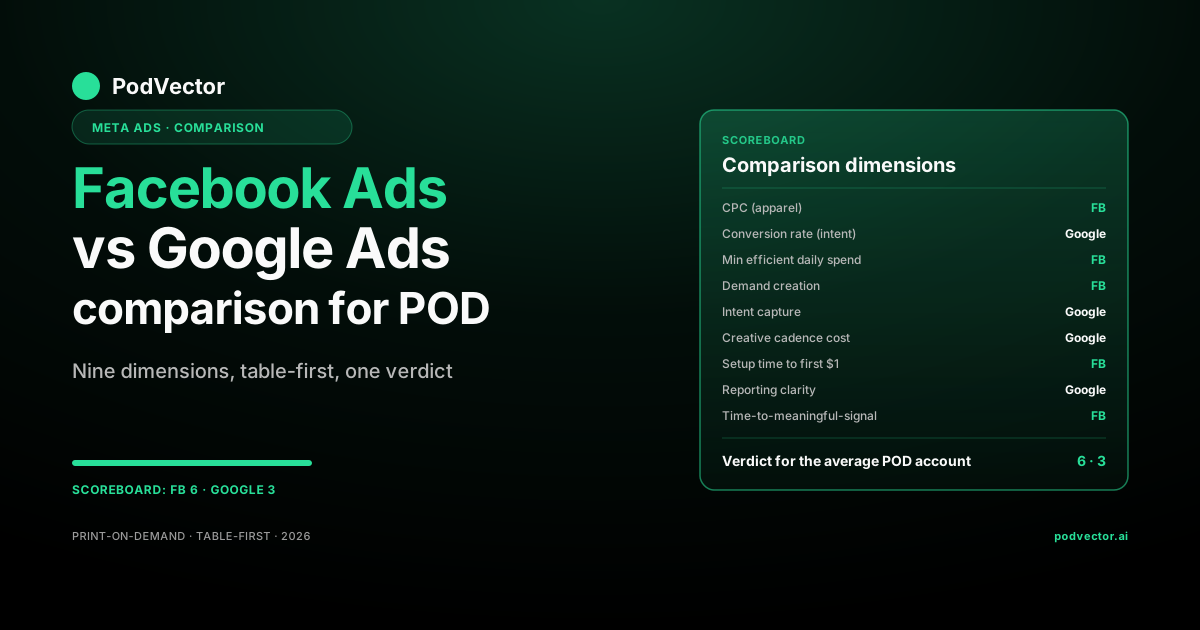
Quick Answer: A side-by-side comparison of Facebook Ads vs Google Ads for print-on-demand comes down to nine variables: minimum spend, CPC, conversion rate, learning-phase volume, creative cadence, feed dependency, targeting model, attribution window, and reporting clarity. On six of the nine, Facebook is the better fit for the average POD seller in 2026.
Google wins decisively on the remaining three — high-intent search niches, shopper-intent capture, and same-day return on tightly fed Shopping campaigns. The honest verdict isn't "pick one." It's: spend 70–80% on the platform whose structural strength matches your niche shape, and run a smaller always-on test on the other so you don't lose feel for it.
This comparison is built table-first. Skim the tables to get the answer; read the sections to understand why each row scored the way it did and what changes the answer for your specific niche.
The headline comparison scoreboard
Most Facebook-vs-Google comparison articles bury the answer under 4,000 words of platform history. We're going to invert that. Here is the scoreboard for the average POD seller — under $50K monthly revenue, contribution margins between 20% and 35%, design-led brand without strong branded-search volume.
The "winner" column reflects the platform that fits the average POD account on that dimension. Niche-specific exceptions are unpacked in the sections below.
| Comparison dimension | Facebook Ads | Google Ads | Winner for POD |
|---|---|---|---|
| Average e-commerce CPC | $0.90–$1.40 | $2.10–$3.20 | |
| Conversion rate (cold prospecting) | 0.8%–1.8% | 2.5%–5.5% | Google (intent) |
| Minimum efficient daily spend per campaign | ~$30 | $50–$100 (Shopping/PMax) | |
| Demand creation for new designs | Strong (interest + lookalike) | Weak (no search volume yet) | |
| Demand capture on intent queries | Weak | Strong | |
| Creative volume required per week | 8–15 net-new variants | 2–4 image/title refreshes | Google (less work) |
| Setup time before first $1 spent | ~2 hours | 4–12 hours (feed + Merchant Center) | |
| Reporting and attribution clarity | Modeled, post-iOS noisy | Mostly deterministic on-platform | |
| Time-to-meaningful-signal | 4–7 days at $50/day | 7–14 days at $75/day |
Six of nine for Facebook, three of nine for Google. That's the headline. The reason "primary on Meta, supporting on Google" is the consensus 2026 POD playbook isn't that Google is bad — it's that the criteria a typical POD account scores against weight toward Facebook's structural strengths.
For the 20% of POD sellers running designs in high-search-intent niches (memorial gifts, profession apparel, pet-breed-specific designs with clear search demand), the verdict flips. The Google Shopping vs Facebook Ads breakdown covers the Shopping-specific math in detail.
Cost comparison: CPC, CPM, and minimum efficient spend
Cost-per-click is the headline most comparison articles lead with — and it's the most misleading number in this whole conversation. Headline CPC matters less than the CPC-times-conversion-rate product, which is your effective cost per acquisition. Below is the side-by-side that actually predicts what you'll spend per sale.
| Cost metric | Facebook Ads (POD apparel) | Google Ads (POD apparel) |
|---|---|---|
| Average CPC | $0.90–$1.40 | $2.10–$3.20 (Search), $0.95–$2.80 (Shopping) |
| Average CPM | $11–$22 (US 18–65) | $8–$15 (Display), N/A (Search/Shopping) |
| Conversion rate (cold) | 0.8%–1.8% | 2.5%–5.5% (intent queries) |
| Effective cost per purchase | $50–$175 | $38–$130 (intent), $80–$250 (broad) |
| Minimum daily spend that produces signal | ~$30/day per ad set | $50/day Shopping, $75/day PMax |
| Days to learning phase exit | 4–7 days at $50/day | 7–14 days at $75/day |
| Cost of a failed test ($1K budget) | 1 hard "no-go" call | Possibly inconclusive (under-fed) |
Reading this table the right way: Facebook's lower CPC doesn't translate into a uniformly lower cost-per-purchase. Google's higher CPC is offset by a 2–3x higher conversion rate on intent queries.
Where Facebook's structural advantage shows up isn't headline CPC — it's the lower minimum efficient spend. A POD seller with $1,500/month in ad budget can run three Facebook tests a month at $30/day for two weeks. That same $1,500 funds barely one Google Shopping campaign at $50/day for a month.
Targeting comparison: how each platform finds POD buyers
The two platforms locate buyers using opposite signals. Facebook infers interest from behavior; Google reads intent from typed queries. Neither is "better" — they're tools for different jobs.
| Targeting capability | Facebook Ads | Google Ads |
|---|---|---|
| Demographic targeting | Detailed (age, gender, parental status, etc.) | Limited (mostly remarketing-derived) |
| Interest targeting | ~10,000+ interests, behaviors, life events | Audience segments (in-market, affinity) |
| Keyword/query targeting | None | Core capability (Search, Shopping) |
| Lookalike from purchasers | Strong (1%–10% LAL from CRM/Pixel) | Customer Match + Similar Audiences |
| Custom audiences from website | Pixel-based, 180-day window | Tag-based, up to 540 days |
| Geo targeting (POD ship-to) | Country, state, city, radius | Country, state, city, radius |
| "They saw my design and wanted it" job | Strong | Weak (no query exists) |
| "They were already shopping for it" job | Weak | Strong |
For most POD designs the buyer didn't wake up searching for "labrador dad t-shirt birthday gift." They saw the design in their feed, recognized themselves, and bought.
That's interest-driven discovery, and Facebook's targeting model is built for it. Google can serve those same buyers — but only after they decide to type something into a search bar, which most POD-niche buyers never do.
The exception is the meaningful subset of POD niches with real search volume: memorial designs ("memorial gift for mom who passed"), profession apparel ("registered nurse t-shirt"), and breed-specific pet designs that people actively gift-shop for. In those niches Google's intent-capture economics often beat Facebook's. The Google Ads vs Facebook Ads breakdown walks through which niches typically have search volume worth chasing.
Creative comparison: format, cadence, and asset reuse
The creative cost of running each platform is wildly different, and most comparison articles ignore it. For a POD account, creative is operational cost, not just media cost.
| Creative dimension | Facebook Ads | Google Ads |
|---|---|---|
| Primary ad formats | Single image, video, carousel, collection, reels | Text, Shopping listing, image, video, responsive display |
| Net-new creatives needed per week (scaling) | 8–15 | 2–4 (titles + images) |
| Asset reuse from existing POD mockups | Direct (mockup is the ad) | Direct for Shopping; rework for Display/YouTube |
| Ad copy creative weight | Medium (hook + body + CTA) | High for Search (RSA headlines); low for Shopping |
| Video required for scale? | Increasingly yes (Reels, ASC video) | Optional (YouTube only) |
| Algorithm fatigue cycle | Fast — top creative tires in 3–5 weeks | Slow — Shopping ads run for months |
| Cost of a "no creative this week" | CPM creep, frequency rises, ROAS drops | Minimal (Shopping handles it) |
This is the single most underrated dimension of the comparison. Facebook's lower CPC comes attached to a creative-volume treadmill that consumes either operator hours or paid designer hours every single week.
If your design team produces ten new mockups a week anyway, that's a free input. If you're a solo seller with five hero designs and no time to create more, Facebook's economics quietly reverse — your CPC stays low, but ROAS decays as your single creative fatigues.
Google Shopping is the opposite. Once your feed is clean, the same product listing can run for six months without creative refresh and improve over time as the campaign collects conversion data. For solo POD sellers with strong evergreen niches, this is a massive structural advantage Facebook can't match.
Funnel-stage fit: where each platform earns its keep
Different funnel stages reward different platforms. Here's where each platform contributes meaningfully and where it's structurally weak.
| Funnel stage | Facebook Ads fit | Google Ads fit |
|---|---|---|
| Cold prospecting (no awareness) | Strong (broad interest + lookalike) | Weak (needs typed query) |
| Branded search ("[brand] hoodie") | N/A | Strong and cheap (CPC under $0.50) |
| Category search ("dog dad shirt") | Weak | Strong (Shopping, Search) |
| Retargeting site visitors | Strong (Pixel audiences, dynamic product ads) | Strong (Display, YouTube, RLSA) |
| Cart abandonment recovery | Strong (DPA, ASC) | Strong (Display + Shopping remarketing) |
| Repeat-customer cross-sell | Strong (Customer File LAL + retargeting) | Medium (Customer Match) |
| New-design launch hype | Strong (Reels, video, Stories) | Weak (no demand exists yet) |
Facebook is structurally stronger at the top of the funnel for POD because POD is a category where designs create demand rather than respond to it. Google is stronger at the bottom — the existing-purchase-intent capture moments Facebook physically cannot reach.
The two platforms don't substitute for each other; they cover different stages of the buyer's journey. The question isn't "which is better" — it's "which stages am I trying to cover this quarter and which platform reaches them at the lowest cost."
Feed and tracking: setup cost and ongoing maintenance
The biggest hidden difference between the two platforms is what it takes to get to a clean first dollar of spend. Facebook setup is fast; Google Shopping setup is the most failure-prone part of the whole POD-paid-media stack.
| Setup or maintenance task | Facebook Ads | Google Ads |
|---|---|---|
| Pixel/tag installation | 1 hour (Shopify integration) | 1 hour (GTM) |
| Product feed required? | Optional (Catalog improves DPA) | Required for Shopping/PMax |
| Merchant Center policy review | N/A | Common rejection point for POD |
| Conversion API server-side setup | Recommended (CAPI — server-side conversion API) | Recommended (Enhanced Conversions) |
| Catalog/feed maintenance per month | 1–2 hours (POD apps automate most) | 4–8 hours (title quality, GTIN handling) |
| Time to first $1 of spend (clean) | ~2 hours | 4–12 hours typical |
| Risk of policy disapproval | Medium (creative-policy violations) | High (image quality, GTIN, restricted categories) |
Facebook gets you to first spend in an afternoon. Google Shopping commonly takes a week of feed iteration before anything is approved.
POD-specific catalogs trip Merchant Center on three things: image quality (Printify and Printful mockup files sometimes fail compression checks), promotional overlay rules (any text on the design itself can be flagged), and GTIN handling (POD products don't have manufacturer GTINs and need correct "GTIN does not apply" identifiers).
None of these are deal-breakers. They are real ramp-up costs that don't show up in headline CPC comparisons. Budget the time before you commit to a Google-primary playbook.
AI campaign types: Advantage+ vs Performance Max
By 2026 the real comparison isn't manual Facebook vs manual Google — it's each platform's AI-automated campaign type. Both now push you toward a black-box product that picks audiences, placements, and bids for you.
Meta's is Advantage+ Shopping (ASC — an AI campaign that auto-targets and auto-places your catalog ads). Google's is Performance Max (PMax — one campaign that spans Search, Shopping, YouTube, Display, and Gmail from a single asset group). Knowing how each behaves on a POD account decides how much control you keep.
| Automation dimension | Meta Advantage+ Shopping (ASC) | Google Performance Max (PMax) |
|---|---|---|
| What it auto-controls | Audience, placement, creative mix | Channel, bid, placement, asset combo |
| Minimum spend to learn | ~$50/day for stable signal | $75–$100/day across all channels |
| Creative inputs needed | Many (it tests a deep creative pool) | Feed + a handful of assets per group |
| Feed dependency | Catalog improves it, not required | Required — feed quality is everything |
| Reporting transparency | Limited (blended new vs returning) | Low — channel-level data is partly hidden |
| Best for the POD seller who… | Has a steady creative pipeline | Has a clean feed and evergreen designs |
| Biggest risk | Spends into returning customers you'd win anyway | Dumps budget into cheap Display junk traffic |
The honest read for POD: these tools work, but they trade control for convenience. ASC quietly over-credits itself by re-buying customers who'd have returned anyway, and PMax will drift spend into low-quality Display unless you cap it with feed-only or channel exclusions.
Use them once you have a baseline from manual campaigns to check them against — not as your first campaign. Without a manual benchmark, you can't tell whether the AI found new buyers or just claimed credit for existing ones.
This is exactly the reconciliation a POD operator should automate. Victor watches both ASC and PMax against your real Shopify orders and supplier costs, flags when a campaign is re-buying returning customers or leaking into junk placements, and proposes the budget shift — then executes it once you approve, so the AI campaigns stay honest instead of grading their own homework.
Niche-by-niche verdict for POD operators
The comparison answer changes by niche. Below is the call most POD operators settle on for the dominant niche categories, based on niche shape, design lifecycle, and search-volume profile.
| POD niche | Best primary platform | Why |
|---|---|---|
| Pet-breed apparel (dog dad/cat mom shirts) | Pure interest discovery; minimal branded search | |
| Memorial gifts (sympathy mugs, in-loving-memory) | High search intent at moment of need | |
| Profession apparel (nurse, teacher, trucker) | Split — try Google first | Search volume exists for occupation queries |
| Hobby/fandom designs (anime, fishing, gaming) | Design-led discovery; weak search volume | |
| Personalized/custom products | Facebook + Google retargeting | Discovery on Meta, capture on Google |
| Holiday occasion (Halloween, Christmas tee) | Facebook with Google PMax late-cycle | Demand-creation early; intent capture late |
| Profession-specific gear with branded niche term | Operator-typed queries; high conversion | |
| Trend/viral designs | Algorithmic distribution; speed matters |
The pattern is consistent. Niches where the buyer already typed something into a search bar favor Google. Niches where the buyer needs to be shown the design before they know they want it favor Facebook. Match the platform to the niche shape; don't flip a coin between platform features.
For the broader case on running both platforms at the same time, the complete Meta Ads playbook for print-on-demand sellers covers structure, naming, and budget pacing once both platforms are live.
Unit economics: when "cheaper CPC" stops mattering
The unit-economics filter is where most POD operators get the comparison wrong. CPC and conversion rate matter, but the number that decides whether the channel is profitable is contribution margin per order after Printify or Printful base, shipping, payment processing, and platform fees.
| Line item | Example POD hoodie ($26 sale) |
|---|---|
| Sale price | $26.00 |
| Printify supplier base | −$14.00 |
| Shipping cost (US, ground) | −$5.50 |
| Payment processing (~2.9% + $0.30) | −$1.05 |
| Platform fee (Shopify or Etsy) | −$0.78 |
| Contribution before ad cost | $4.67 |
That $4.67 is your real ceiling on cost-per-acquisition before each new sale loses money. A $1.20 Facebook CPC at a 1.2% conversion rate produces a $100 cost-per-purchase — far above that ceiling.
A $2.50 Google Shopping CPC at a 4% conversion rate produces a $62.50 cost-per-purchase — also above. Both platforms can lose money on the same hoodie if the comparison is run on headline CPC alone.
The fix is bundle economics: average order value of two-plus items, upsell pricing, and product mix that lifts the contribution per order. The cost-per-purchase ceiling on a $52 two-item order is roughly twice as forgiving as on a $26 single-item order. Many POD shops fix the comparison by fixing the cart, not the channel.
This is exactly the kind of math an AI employee should be running on your live numbers in real time, not your spreadsheet. Victor connects to your Shopify, Printify or Printful, and ad accounts, and gives you the actual contribution-margin-per-order math by SKU, by ad campaign, by day — so the channel comparison stops being theoretical and starts being grounded in your numbers.
The decision rule: pick a primary in two questions
Skip the platform feature lists. Two questions decide the comparison for almost every POD account.
| Question | If yes… | If no… |
|---|---|---|
| 1. Does my niche have meaningful search volume on a free keyword tool? (≥1,000/mo on a head term) | Lean Google primary | Lean Facebook primary |
| 2. Can I produce 8+ net-new creatives per week without burning out? | Facebook can scale | Google PMax / Shopping is the lower-effort path |
Two yeses → run both, with Meta primary because the upside is bigger. Two nos → run Google Shopping with low creative refresh and tight feed work; do not start on Facebook.
One of each → run the platform whose answer was yes, give it 60–90 days, then layer the other once you have clean attribution baselines on the first.
Running both: the 70/20/10 split most POD sellers should run
The honest answer for most POD accounts above $5K MRR is that you should be running both platforms. The split that tends to work in 2026 looks like this.
| Budget bucket | Allocation | Purpose |
|---|---|---|
| Primary platform (Meta for most, Google for intent niches) | 70% | Scale your best-performing structure |
| Secondary platform (the other one) | 20% | Capture coverage and stay learning |
| Test budget (new creative, new audiences, new niches) | 10% | Replenish the tested-winner pipeline |
The 20% on the secondary platform is the part most operators skip. They go all-in on Meta, lose channel diversification, and end up exposed when Meta's CPMs spike or attribution windows shift.
Conversely, operators who go all-in on Google miss the demand-creation engine that builds the audience pool Google then captures three weeks later. Branded-search volume on Google often comes directly from Facebook impressions earlier in the funnel.
For the multi-channel picture beyond Meta and Google, the Google Ads vs Facebook Ads vs LinkedIn Ads breakdown covers when a third channel makes sense for POD.
Mistakes that ruin every Facebook-vs-Google comparison
1. Comparing CPC instead of cost per purchase
Headline CPC is the most-quoted, least-useful number in this conversation. Cost per purchase is what your bank account cares about, and it's a function of CPC times conversion rate.
Google's higher CPC against a 4% conversion rate frequently beats Facebook's lower CPC against a 1% conversion rate. Always compare on cost per acquisition, never on click cost alone.
2. Forgetting the creative-volume tax
Facebook's "lower" CPC is partly subsidized by your creative production cost. If you don't have a steady creative pipeline, that subsidy reverses — your CPC stays low, your ROAS slides, and you blame the platform.
Build a weekly creative cadence before you scale Meta, or run Google Shopping where the creative cost is structurally lower.
3. Ignoring the feed-work cost on Google
POD Google Shopping accounts often spend two weeks of operator time before the first dollar of spend is approved. Merchant Center policy rejections on image quality, promotional overlays, and GTIN handling are the norm, not the exception.
Plan for it. The accounts that succeed treat feed-work as setup investment, not as ongoing surprise tax.
4. Over-trusting platform-reported ROAS
Both platforms over-attribute. Facebook's modeled conversions inflate ROAS by 20%–60% depending on view-window settings; Google's last-click attribution under-credits Meta's contribution to the same purchase.
Reconcile against actual revenue in your e-commerce platform weekly. The real comparison is on net-new revenue per dollar, not on what either platform's dashboard declares.
5. Comparing on bad attribution windows
Comparing a 7-day-click Facebook ROAS against a 30-day Google last-click ROAS is comparing two different numbers. Standardize on the same attribution window across both platforms before drawing conclusions.
Or, more honestly, blend platform-reported ROAS with first-party revenue data from your store and use that blended number as the ground truth.
FAQs
Are Google Ads cheaper than Facebook Ads for POD?
On headline CPC, no — Google's average CPC across e-commerce is roughly 2x Facebook's. On cost-per-acquisition for high-intent niches, Google often wins because its conversion rate is 2–3x higher on those queries. The honest answer depends on niche, not on platform.
Should I start with Facebook or Google as a new POD seller?
Start with Facebook for most POD niches because the lower minimum efficient daily spend lets a small budget run multiple tests. Start with Google Shopping if your niche has clear search volume (memorial, profession-specific, breed-specific gift-shop terms) and you can budget the feed-setup time.
Can I run both platforms with a $1,500/month budget?
Yes, but not equally well. A reasonable split at that level is $1,000 to your primary platform and $500 to the secondary, then evaluate ROAS at 30 days. Below $1,500/month, focus on the one platform that wins your two-question decision rule above and don't split.
Which platform reports more accurate conversion data?
Google Search and Shopping report mostly deterministic conversion data from clicks (with Enhanced Conversions reducing the gap from privacy-protected sessions). Facebook's data is more modeled post-iOS 14.5, with conversion APIs (CAPI — server-side data sharing) helping but not eliminating the gap. Cross-check both against your store-side revenue weekly.
Does Google Ads work for low-margin POD products?
It can if your average order value supports a $40–$80 cost-per-purchase ceiling. Below that, Google Shopping economics get hard fast. The fix is usually bundle pricing, upsells, and average-order-value lifts — not switching platforms.
How long should I test each platform before deciding?
Plan on 30 days minimum per platform with at least $1,500 in spend on each to clear learning-phase volume requirements. Below that, the data isn't statistically meaningful. Above that, you have enough signal to call winner, loser, or "needs creative refresh."
What's the best AI tool to compare Facebook vs Google performance for POD?
You want a system that pulls live data from both platforms, joins it to actual order data from Shopify and supplier costs from Printify/Printful, and returns true contribution-margin ROAS by channel — not platform-reported ROAS. Victor is built exactly for that: a POD-native AI employee that connects to all the relevant accounts and answers the channel-comparison question with your real numbers, by SKU and by campaign.
Stop comparing platforms on dashboards that disagree
Facebook says one thing. Google says another. Your Shopify dashboard says a third. Reconciling takes hours, the spreadsheet is always two days stale, and the channel-allocation decision keeps slipping.
Victor connects to Meta Ads, Google Ads, Shopify, Printify, and Printful, joins them into one source of truth, and answers questions like "what's my true contribution-margin ROAS by platform this week" in seconds — by SKU, by campaign, by day. And stop arbitrating between three dashboards that don't agree.
Try Victor freeFor the full Meta Ads picture for print-on-demand, see the Meta Ads topic hub and the Meta Ads comparison cluster hub.