
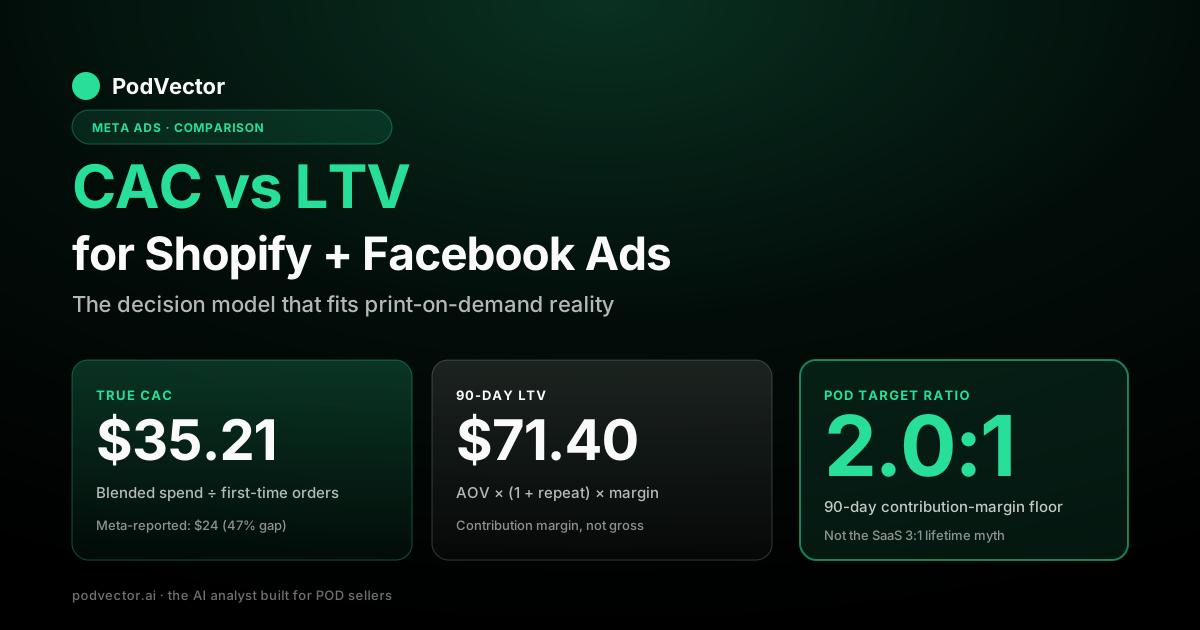
Quick Answer: Neither a pure CAC-led nor a pure LTV-led model wins for print-on-demand. Run a CAC-led model (cap acquisition cost per channel, defend the floor) for the first 90 days of a new account or niche, then graduate to an LTV-led model (let CAC scale to a multiple of lifetime value) once you have a real repeat curve.
The decision frame that actually fits POD in 2026 is a contribution-margin LTV:CAC ratio of 2.0:1 over 90 days — not the textbook 3:1 over the customer lifetime. POD's thin margins, slow repeat cadence, and Facebook's noisy attribution make a long-window LTV model dangerous when you're spending real money this month.
Below: how to build both models for Shopify + Meta, why the CAC number Facebook reports is usually wrong, and which channel-allocation rule actually grows the bank account.
CAC-led vs LTV-led: side-by-side scoreboard
Most articles teach CAC and LTV like they're complementary. They are — but at a daily decision-making level you still pick one as the lead metric. The lead metric is the one you cap, defend, and report against. The other is a sanity check.
Here's the operator-level scoreboard for which model fits which kind of POD account.
| Decision dimension | CAC-led model | LTV-led model |
|---|---|---|
| Lead metric | Cost per acquired customer | Lifetime contribution per customer |
| What you cap | Max CAC per channel | Min LTV:CAC ratio over a window |
| Time to confidence | 7–14 days | 60–180 days |
| Cash-flow risk | Low — you stop fast when CAC drifts | High — you spend ahead of repeat revenue |
| Best for | POD stores under $50K/month, single-channel Meta | POD stores with proven repeat behavior + 3+ months data |
| Hidden failure mode | Caps too low, starves Facebook learning phase | Believes platform-reported CAC is real CAC |
| Where it shines | Defending margin during volatile CPM weeks | Justifying scale when payback math is sound |
Most POD sellers running Shopify + Meta should be CAC-led for the first 90 days of a new account or a new niche. Move to an LTV-led model only after you have a real repeat curve and a real attribution baseline — usually 90+ days of data and at least one repeat-purchase cohort to look at.
The trap is the opposite path: starting LTV-led on day one because a podcast told you "ecommerce is a 3:1 LTV:CAC game." That's true at maturity. It's not true the week you launch your first design.
Why textbook CAC:LTV math breaks for POD
The 3:1 LTV:CAC benchmark you'll see on every SaaS blog assumes three things that don't apply to POD:
| Assumption (SaaS / typical ecommerce) | POD reality | What it does to your model |
|---|---|---|
| 50–70% gross margin per sale | 20–35% contribution margin after Printify/Printful + shipping + fees | LTV is ~half what a generic ecommerce model returns |
| Customers re-buy 4–8x in year one | POD apparel buyers re-buy 1.2–1.8x in year one | LTV stretches over 18–24 months, not 6 months |
| Reported CAC ≈ true CAC | Facebook over-reports purchases by 20–60% post-iOS 14.5 | Reported CAC looks great while real CAC is bleeding |
| Average order value $80–$200 | POD AOV typically $28–$55 | Even a "good" CAC eats most first-order margin |
| One product line, predictable repeat | Design-driven catalogue, repeat is design-by-design | Aggregate LTV averages hide which designs actually retain |
If you copy the 3:1 ratio and plug in Facebook's reported CAC plus a 12-month LTV, you'll feel like you're winning while losing money. The ratio looks great. The bank balance disagrees.
The fix is twofold: shrink the LTV window to 90 days for decision-making, and replace platform-reported CAC with blended CAC computed from your actual order data. Both fixes happen at the data layer, not the spreadsheet layer.
Building the true CAC model for Shopify + Facebook
True CAC for a POD store is not the number Meta's dashboard shows. It's a blended ratio between total acquisition spend and net new customers in your Shopify orders table over the same window.
The formula that actually matches your bank account
True CAC = (All ad spend across all channels in window) ÷ (Net new Shopify customers in window).
"Net new" means first-time orders, not orders. A repeat purchase is LTV revenue, not acquisition revenue. Most POD operators conflate the two and end up with a CAC that drops as their store ages — which feels good but isn't acquisition efficiency improving.
What goes in the numerator
| Cost line | Include? | Why |
|---|---|---|
| Meta Ads spend (incl. test budget) | Yes | Direct acquisition channel |
| Google Ads / TikTok Ads spend | Yes | Same — even if you "blame" Facebook for the order, dollars left the account |
| Influencer / UGC creator fees | Yes | Pure acquisition cost |
| Email tool subscription | No (operates on existing customers) | That's retention cost, allocated against LTV not CAC |
| Creative production | Yes if outsourced; track separately if in-house | Real cash out the door |
| Shopify subscription | No | Fixed overhead, not variable acquisition |
The line POD operators get wrong most often is creative production. If you pay an editor or buy stock motion templates, that's CAC, not "marketing overhead." A $400/month creative subscription distributed across 60 acquisitions is a $6.66 hidden CAC layer.
What goes in the denominator
Pull "first-time customers" from Shopify's customer report or by querying the orders table for distinct emails whose earliest order falls inside the window. Don't trust Meta's "purchases" event — it counts modeled and view-through conversions that often don't appear as orders in your store.
The cleanest version of this lives in a single source of truth — your Shopify data, the Meta API, and your Printify/Printful supplier costs joined together. The complete guide to Meta Ads + Shopify integration for POD walks through the integration plumbing.
Worked example
Suppose you spent $4,200 on Meta and $800 on creative tools in the last 30 days. Shopify shows 142 first-time customers in that same window. True CAC = $5,000 ÷ 142 = $35.21.
If Meta's Ads Manager reports a $24 cost per purchase, that's a 47% over-report. That's the gap you're modeling against, not the dashboard number.
Building an honest LTV model for POD
The textbook LTV formula — AOV × purchase frequency × customer lifespan × gross margin — is fine for a yoga-pants store. It misleads on POD because POD purchase frequency hides huge variation by design and by season.
A POD-shaped LTV formula
Use this version: LTV (90-day, contribution-margin) = AOV × (1 + 90-day repeat rate) × contribution margin %.
Three things that change vs. the textbook version:
| Variable | Textbook | POD-shaped |
|---|---|---|
| Purchase frequency | Annual or "lifetime" | 90-day repeat rate (decision-window matched) |
| Margin | Gross margin (revenue – COGS) | Contribution margin (revenue – COGS – shipping – payment fees – ad allocation) |
| AOV | Trailing 12 months | Trailing 30 days, refreshed weekly (catches design-mix shifts) |
Why 90 days, not 12 months
The LTV number you use to make scaling decisions has to match the cash-flow cycle you're spending in. POD operators running Meta Ads pay invoices weekly. The relevant LTV is whatever revenue arrives within the window where the credit card payment matters.
A 12-month LTV is a strategic planning number. A 90-day LTV is the number you bid against. Operators who confuse the two over-spend in months 4–9 and then panic when working capital tightens.
POD-specific repeat rate benchmarks
| POD niche shape | Typical 90-day repeat rate | What drives it |
|---|---|---|
| Gift apparel (memorial, profession, breed) | 10–15% | One-shot gifting purchase, low repeat by design |
| Hobby/identity apparel (fishing, gaming, fandom) | 22–30% | Buyers collect; designs refresh keeps them returning |
| Drinkware + apparel mixed catalogue | 25–35% | Cross-category lifts repeat; AOV varies more |
| Print-on-demand subscription (rare) | 50%+ | Built-in repeat by product structure |
If you're in gift apparel and projecting a 30% repeat rate, your model is wrong. Look at your Shopify customer report and pull the actual rate before plugging it into LTV math. Most operators discover their real repeat is half what their model assumed.
The CAC:LTV ratio that actually fits POD
Now we can build the ratio with both sides honest. Using true CAC (blended, store-side) and contribution-margin 90-day LTV, here's what good looks like for a POD account on Shopify + Meta.
| LTV:CAC ratio (90-day, contribution-margin) | What it means for POD | Action |
|---|---|---|
| Below 1.0:1 | Each acquisition loses contribution margin in the decision window | Cut spend or fix margin/repeat before adding budget |
| 1.0:1 – 1.5:1 | Break-even on the window; relying on year-2 revenue to be profitable | Hold; work on AOV and repeat before scaling |
| 1.5:1 – 2.0:1 | Healthy for a young POD account; cash-flow safe | Scale spend at 10–20% week-over-week if learning phase allows |
| 2.0:1 – 3.0:1 | Strong; either margins or repeat are working | Scale aggressively; test new audiences and creators |
| Above 3.0:1 | Either too efficient (under-spending vs. demand) or measurement is wrong | Audit attribution; lift spend to find the real ceiling |
The reason 2.0:1 over 90 days is the right floor for POD — not 3.0:1 over a lifetime — is contribution margin. A SaaS business with 80% gross margin makes a 3:1 ratio comfortable. A POD store with 28% contribution margin needs more LTV per CAC dollar to clear the same absolute profit-per-acquisition.
If your contribution margin is healthier than 35% (often true on drinkware, mugs, or higher-AOV apparel), you can run leaner: 1.7:1–1.8:1 is acceptable. Below 25% margin, push toward 2.5:1 before scaling.
Modeling Facebook-reported CAC vs blended CAC
Meta's CAC number is computed inside Meta's pixel and Conversions API plus modeled "post-iOS" attribution. Your store's CAC is computed in your orders table. They will not match. The question is which one to bid against.
| CAC source | What it measures | Use for | Don't use for |
|---|---|---|---|
| Meta Ads Manager — cost per purchase | Purchases attributed by Meta within the attribution window | Campaign-level optimization decisions | True profitability or scaling decisions |
| Blended CAC (total spend ÷ first-time orders) | Real new customers divided by all acquisition spend | Scaling decisions, P&L planning, board updates | Within-campaign optimization (too aggregate) |
| UTM-tagged CAC by source | First-time orders whose first session came from a tagged source | Channel attribution (Meta vs Google vs TikTok) | Replacing blended CAC; misses untagged paid impact |
| MMM-style modeled CAC | Statistical lift attribution across channels | Quarterly budget allocation | Daily decisions; too slow |
For most POD operators the right answer is two CACs running in parallel: Meta Ads Manager's cost per purchase for campaign optimization (because that's what Meta's algorithm is also optimizing toward) and blended CAC from Shopify for scaling and profit decisions.
The reconciliation between the two is where almost all CAC vs LTV modeling errors hide. If Meta says $24 and Shopify says $35, the gap is your real-world signal that algorithm-level optimization isn't translating to balance-sheet acquisition. The complete guide to Meta Ads ROAS and attribution for POD covers the attribution-window standardization that makes the gap interpretable.
Channel allocation: where the next dollar goes
The best CAC vs LTV model in the world is useless if it only tells you "Meta is your only channel." The point of the model is to answer the allocation question — Meta vs Google vs TikTok vs creator partnerships — using your numbers, not a generic benchmark.
| Channel | Typical POD CAC | 90-day LTV uplift signal | When to allocate next dollar |
|---|---|---|---|
| Meta Ads (Facebook + Instagram) | $28–$55 blended | Drives initial purchase + retargeting repeat | Default primary channel for design-led POD |
| Google Shopping / Search | $32–$70 blended | Higher AOV intent buyers; lower repeat driver | When niche has real search volume (memorial, profession, breed) |
| TikTok Ads | $22–$48 blended | Lower AOV, higher impulse first-purchase | When you can produce 10+ vertical video creatives weekly |
| Creator partnerships (UGC + posts) | $18–$60 blended | Often best 90-day LTV — buyers from creators repeat at higher rates | When Meta CAC is rising and creative is your bottleneck |
| Email + SMS (retention) | ~$0 incremental CAC | Multiplies LTV directly | Always — invest before lifting paid spend further |
The decision rule: spend the next marginal dollar on the channel whose contribution-margin LTV:CAC ratio is highest at current scale and whose marginal cost per acquisition isn't degrading week over week. Both conditions matter — a channel with a great ratio but rising CAC is usually saturating.
For the head-to-head comparisons, see the Google Ads vs Facebook Ads for Shopify breakdown, the budget comparison, and the three-way Google + Facebook + LinkedIn breakdown for niche-specific allocation logic.
For the timing and structure calls behind those splits, see when to use Google Ads vs Facebook Ads, the case for investing in Google Ads vs Facebook Ads, and the CBO vs ABO ROAS breakdown. To wire Facebook cleanly into your store ops, the Facebook Ads tools that integrate with Shopify and the broader Facebook Ads with Shopify strategy for POD cover the plumbing.
A 60-minute build plan for your CAC vs LTV model
Here's the sequence to go from "I have Shopify and Meta accounts" to "I have a working CAC vs LTV decision model" in roughly an hour.
Minutes 0–15: pull true CAC
Open Shopify's customer report. Filter to first-time customers in the last 30 days. Note the count. Sum Meta + Google + TikTok ad spend in the same 30-day window. Add creative-tool subscriptions. Divide. That's your blended CAC.
Compare it to Meta's reported cost per purchase. The gap is your attribution-noise reality.
Minutes 15–30: pull contribution margin
Pick three top-selling SKUs. For each, compute: retail price minus Printify/Printful cost minus shipping minus 2.9% + 30¢ payment fee. Average across the SKUs weighted by units sold. That's your contribution margin %.
If the answer is below 25%, fix margin before fixing acquisition. No CAC model saves a structurally unprofitable AOV.
Minutes 30–45: pull 90-day repeat rate
In Shopify, filter customers whose first order was 90+ days ago. Of those, count how many have placed a second order. Divide. That's your 90-day repeat rate.
Plug it into the POD-shaped LTV formula: AOV × (1 + repeat rate) × contribution margin %. That's your 90-day contribution-margin LTV.
Minutes 45–60: compute the ratio and set the cap
Divide your 90-day LTV by your true CAC. If you're above 2.0:1, you have room to scale. If you're between 1.5:1 and 2.0:1, hold and improve AOV or repeat. Below 1.5:1, cut paid spend before anything else.
Set a Meta Ads CAC cap that — given the gap between Meta-reported and blended — corresponds to a 2.0:1 ratio after the gap. If your gap is 40%, your Meta-reported CAC cap should be roughly 1.4× tighter than your true-CAC math suggests.
Mistakes that wreck CAC vs LTV models for POD
1. Trusting Meta's reported cost per purchase as CAC
It's not CAC — it's "cost per pixel-fired purchase event," which over-counts. Always reconcile against Shopify orders weekly. Shopify is the source of truth for the denominator; Meta is the source of truth for the numerator.
2. Using gross margin instead of contribution margin
Gross margin ignores shipping, payment fees, and ad allocation. For POD, those are 8–14 points of additional cost. A "60% gross margin" t-shirt is often a 28% contribution-margin t-shirt. Build LTV on contribution.
3. Annualizing LTV before you have repeat data
Multiplying first-month repeat rate by 12 to get an annual LTV gives you a number that looks great and predicts nothing. Cap your model at 90 days until you have at least one cohort with 6 months of repeat history.
4. Pricing repeat into CAC justification too early
"Our CAC is $40 but the LTV is $120 over 18 months" is a fine board-deck slide. It's a terrible bidding rule on Meta this week. The bank account doesn't carry an 18-month note. Bid against 90-day economics; report the longer LTV separately for strategy.
5. Modeling at the store level when designs vary 5x in margin
If your catalogue mixes $26 t-shirts at 22% margin with $48 hoodies at 38% margin, an aggregate CAC:LTV ratio hides the truth. Build the model per design family or per AOV tier. The aggregate hides which designs are subsidising which.
6. Forgetting that Facebook's algorithm optimizes against its own definition
Meta optimizes against Meta-reported purchases. You report against blended CAC. The two pull in different directions over weeks. The fix isn't to override Meta's optimization — it's to re-target campaigns against the conversion event that best correlates to your true new customers (often "purchase + new buyer audience exclusion" rather than raw "purchase").
7. Skipping the channel-allocation step
A single-channel CAC:LTV model can be perfect and still leave 30% of profit on the table because you never tested another channel. The model is a budget-allocation tool, not just a Meta-cap tool. Run the math across at least Meta + one alternative every quarter.
FAQs
What's a good LTV:CAC ratio for a POD store on Shopify + Facebook?
2.0:1 over 90 days using contribution margin and blended CAC. Not 3.0:1 over the customer lifetime — that benchmark comes from SaaS and assumes 60–80% gross margin and predictable annual repeat, neither of which describes POD.
Should I use Facebook's reported CAC or my Shopify-derived CAC?
Both, for different jobs. Use Meta's number to optimize within Meta. Use Shopify-derived blended CAC to make scaling and profitability decisions. The reconciliation between the two — usually a 20–60% gap — is the data that tells you whether Meta's pixel is over- or under-attributing for your account.
How do I pick contribution margin vs gross margin for the LTV formula?
Always contribution margin for POD. Gross margin ignores shipping, payment processing fees, and ad allocation, all of which are real cash outflows that hit before retention revenue arrives. Contribution margin matches what's actually available to fund acquisition.
How long should the LTV window be for POD decision-making?
90 days for spending decisions, 12 months for strategy and board reporting. If you bid against 12-month LTV at week one, you'll over-spend through the cash-flow trough before retention revenue actually arrives. Match the window to the decision.
What if my POD niche has very low repeat (gift apparel)?
You're effectively running a single-purchase economy. Cap CAC at no more than 50% of contribution margin per first order, push hard on AOV (bundles, upsells, cross-category items), and accept that LTV-led models don't apply to your shape. CAC-led with a tight cap is your model.
Can I just use Shopify's built-in customer LTV report?
It's a starting point but it uses revenue, not contribution margin. For a real CAC:LTV decision you need to multiply Shopify's reported LTV by your contribution margin %, then cap the window at 90 days. The raw number from Shopify will overstate LTV by 2–3x for typical POD margins.
How does iOS 14.5 affect this whole model?
It widens the gap between Meta-reported CAC and blended CAC. Before iOS 14.5, gaps were usually 5–15%. Post-iOS, 30–50% gaps are normal. The fix is to build the blended-CAC view from Shopify orders rather than trying to "fix" Meta's number — it's not broken, it's just measuring something different than what your bank account measures.
What's the best way to act on all of this without three spreadsheets that disagree?
You want an AI employee that already holds your Meta, Google, Shopify, and Printify/Printful data in one live warehouse — and moves on it. Victor computes contribution-margin LTV:CAC by channel, by SKU, by cohort from your real numbers.
Then he proposes the move — tighten a Meta CAC cap, shift the next dollar to the channel with the best 90-day ratio, pause a campaign whose blended CAC is bleeding — and executes it once you approve.
Let Victor bid Meta against numbers your bank account agrees with
Meta says one CAC. Shopify says another. Google says a third. Your spreadsheet is two days stale by Tuesday. Meanwhile the spend keeps running.
Victor connects to Meta Ads, Google Ads, Shopify, Printify, and Printful, joins everything into one live data layer, and computes your true contribution-margin LTV:CAC by channel, SKU, and day.
Then he acts on it — reallocating spend to the best-ratio channel, tightening CAC caps, and pausing campaigns that bleed margin — asking for your approval before each move. And hand off the bidding math to an employee, not a spreadsheet.
Try Victor freeFor the broader Meta Ads picture, see the Meta Ads topic hub and the Meta Ads comparison cluster hub. For external CAC:LTV background, Shopify's own guide to LTV:CAC ratios covers the textbook framing this article adapts to POD reality.