
Quick Answer: The textbook difference is that Google Ads captures existing demand (people typing "border collie mom shirt" into search) while Facebook Ads creates demand by interrupting the feed. That framing is right but generic. For print-on-demand sellers, the differences that actually move money are narrower and stranger.
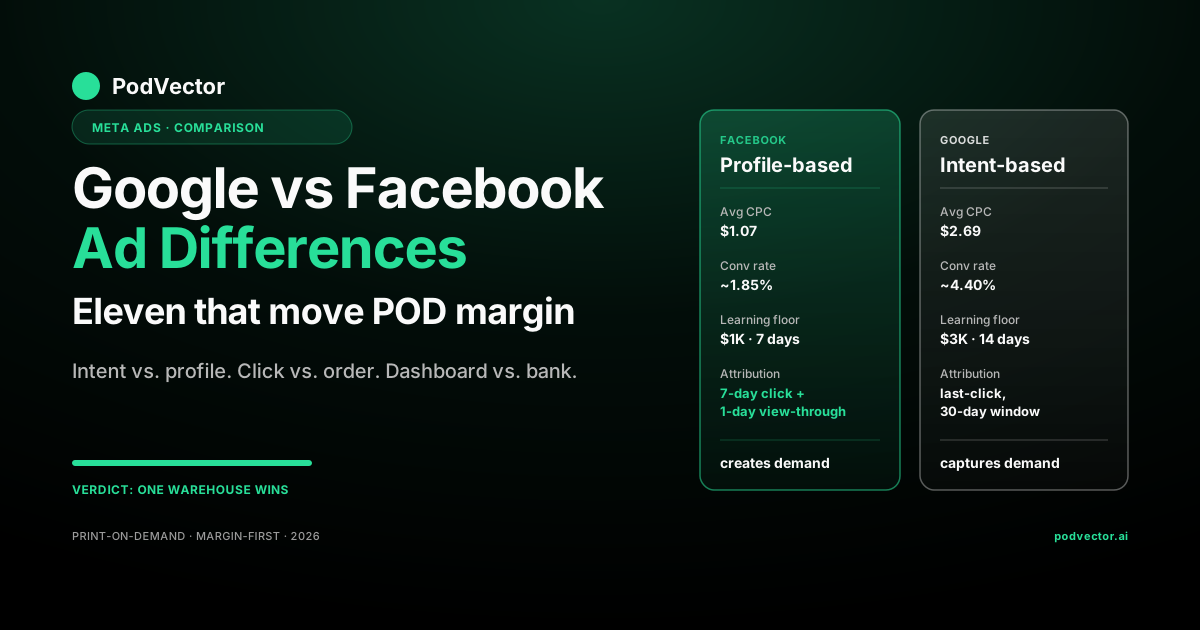
Eleven differences matter for POD: intent vs. profile targeting, $2.69 vs. $1.07 average CPC, last-click vs. view-through attribution, query-driven vs. lookalike audience modeling, Search/Shopping/PMax vs. Feed/Reels/Advantage+ ad formats, minutes vs. days for the conversion path, $3K/14-day vs. $1K/7-day learning phase, near-instant vs. 30-90 day creative refresh cycles, GTIN-or-MPN vs. catalog feed mechanics, mostly-intact vs. iOS-degraded signal, and one-warehouse-of-truth vs. two-platforms-double-counting attribution.
None of those differences declare a winner on their own. They declare which catalog, which budget tier, and which seller skill set each platform fits. The rest of this article walks every difference through the POD margin lens, then lands on a decision matrix you can run against your own catalog this afternoon.
The core difference: intent vs. profile
Strip away the dashboards and the bid strategies, and the foundational difference between the two platforms is one line. Google Ads serves an ad to a user who has already typed what they want. Facebook Ads serves an ad to a user who fits a profile and happens to be scrolling.
WordStream phrased it well a decade ago and the line still holds: Google helps you find new customers, while Facebook helps new customers find you. Everything else — the cost differences, the format differences, the attribution differences — flows downstream from that one mechanic.
For print-on-demand, this difference is unusually consequential because most POD designs have zero monthly searches when they launch. A new aesthetic apparel drop, a new mug graphic, a new home-decor SKU — Google's keyword auction has nothing to fire on because no one has typed the design's hook yet. Facebook's profile-based targeting doesn't need that history. It can serve impressions to "women 35–54 interested in border collies" on day one without a single prior search.
Conversely, if your top-selling SKUs map to phrases people actively type — "memorial gift for grandfather," "nurse mug funny," "retirement gift for teacher" — Google captures that intent more cheaply than Facebook can manufacture it. Intent already exists. Pay to be in front of it.
This is the difference that decides almost every other downstream choice. Read the rest of this article through that lens.
How targeting actually works on each platform
The targeting machinery looks similar on the surface — both platforms let you define audiences, exclude users, and layer demographics. Underneath, they're different machines.
Google: keyword auctions and audience layers
Google's primary targeting unit is the keyword. You bid on phrases; the auction matches your bid against your Quality Score (Google's relevance score combining click-through-rate, ad copy quality, and landing-page experience) to decide whether your ad shows. Modern Google campaigns add audience layers on top — in-market segments, custom intent, remarketing — but the keyword stays primary for Search and Shopping.
Performance Max (PMax — Google's all-in-one auto-targeted campaign type) blurs this by letting Google's model choose where to serve across Search, Shopping, Display, YouTube, Gmail, and Maps. You give it a goal and assets; it finds the conversion. This is closer to Facebook's Advantage+ model but trained on Google's signal pool, which is heavily intent-weighted.
Facebook: profile graphs and lookalikes
Facebook's primary targeting unit is the user profile. You define an audience by demographics, interests, behaviors, custom audiences (uploaded customer lists), or lookalike audiences (Meta's algorithmic clones of your existing buyers). The auction then matches your bid against expected action rate to decide whose feed your ad enters.
Lookalike audiences are Facebook's signature targeting move. Upload 200+ verified Shopify buyers and Meta builds a 1–10% population that statistically resembles them. For POD, this is the most reliable cold-acquisition tool either platform offers. Google has nothing structurally similar — its remarketing is real, but lookalike modeling on intent signal alone produces thinner audiences.
The practical difference
Google targeting requires you to know what your buyers type. Facebook targeting requires you to know what your buyers are. POD operators with mature niches (memorial, profession, breed) usually know the keywords. POD operators selling aesthetic, abstract, or trending designs usually know the demographic but not the keyword. Pick the platform whose targeting unit you can actually populate.
Cost structure: CPC, CPM, and the metric that hides between them
The headline number everyone quotes: Google's average CPC of $2.69 vs. Facebook's $1.07. That's a 2.5x difference and it's the one POD operators latch onto first. It's also the most misleading number in the comparison.
CPC is the price of a click. POD margin lives in the price of an order — cost per acquisition (CPA). CPA is a function of CPC and conversion rate, and the two platforms have different conversion-rate dynamics that partly cancel the CPC gap.
Google's reported conversion rate for paid search runs around 4.40% on average, with POD-friendly Shopping campaigns often clearing 3–5%. Facebook's reported conversion rate sits around 1.8–2.2% for Advantage+ Shopping. So while Google charges more per click, it converts more clicks into orders.
The math, run cleanly:
- Google: $2.69 CPC ÷ 4.40% CVR = ~$61 CPA
- Facebook: $1.07 CPC ÷ 1.85% CVR = ~$58 CPA
For a $24.99 POD shirt with $8 contribution margin, both numbers are cataclysmic — neither platform produces a profitable cold-acquisition order at those defaults. The CPA difference is roughly $3, well within margin-of-error for any single campaign.
This is why CPC alone is the wrong question. The real cost difference is in the variance: Facebook's CPC is more stable across niches; Google's CPC swings hard between Search ($2.10–$3.20) and Shopping ($0.40–$0.90). Picking the right Google sub-format moves CPC by 4x. Picking the right Facebook objective moves CPC by maybe 30%.
For a deep-dive on the cost mechanics, our 2026 cost comparison walks through every line item.
Ad format libraries and which POD creatives fit each
The two platforms expose different ad-format libraries, and POD products fit them unevenly.
Google's POD-relevant formats
Search text ads serve when intent exists. They work well for memorial, profession, and gift-by-occasion niches and poorly for everything else. Shopping ads (the product-image cards at the top of search results) are the highest-leverage Google format for POD — they show your design preview, price, and variant directly in the result. Performance Max bundles the rest into one auto-distributed campaign and is the most volatile of the three for POD.
YouTube and Display ads exist as Google formats but rarely move POD margin. They consume budget faster than they generate orders for most apparel and home-decor catalogs.
Facebook's POD-relevant formats
Feed image ads remain the workhorse format. Carousel ads (multiple products in one swipeable card) work for shops with strong design libraries. Reels ads (short-form video in the Reels feed) have been Meta's fastest-growing surface and now drive the cheapest CPMs for POD apparel. Advantage+ Shopping campaigns auto-distribute creative across feed, stories, Reels, and Marketplace; for POD they're typically cheaper than running each placement manually.
Facebook's Catalog Sales objective requires a product feed similar to Google Shopping, but the feed quality bar is lower — Meta will run ads on partial metadata where Google will reject the feed entirely.
The format difference that matters most
Visual fit. POD designs sell on aesthetic — the design itself is the product. Facebook surfaces the design at full size on a paused-thumb feed; Google Shopping surfaces it at thumbnail size next to nine competitor results. For purely aesthetic apparel, Facebook's format gives the design more visual real estate. For intent-driven apparel where the buyer is comparison-shopping, Google's format places it in the comparison set.
Conversion speed and sales cycle
Speed is a real, structural difference between the two platforms.
Google's typical conversion path: a buyer types a phrase, clicks an ad, and decides within minutes. The full sales cycle for a $24.99 POD shirt sold via Google Shopping often closes inside an hour. Same-day attribution captures the entire cycle.
Facebook's typical conversion path: a buyer scrolls Reels, sees an ad, maybe clicks, browses, leaves without buying. Three days later, a retargeting ad pulls them back; they add to cart, abandon, return five days later via email recovery, and finally purchase on day six or seven. The full sales cycle commonly stretches 5–14 days.
This difference compounds in attribution. Google's last-click model fits a one-hour cycle cleanly. Facebook's seven-day click and one-day view-through windows fit a multi-touch cycle but inflate when retargeting campaigns serve impressions to users who would have purchased anyway. The slower cycle is also the more attributively-noisy cycle.
For POD operators planning daily budgets against weekly cash flow, the speed difference matters operationally. Google produces a faster feedback loop — you'll know within 48 hours whether a Search campaign has signal. Facebook needs 7–10 days before the picture stabilizes. Plan budget windows to match.
Attribution: last-click vs. view-through and why both lie
Attribution is where the two platforms diverge most cleanly — and where most POD operators get the worst numbers in their dashboard.
Google attributes primarily on last-click. Click an ad, buy within the click window (typically 30 days), and Google takes credit. This model overstates Google's contribution when a user discovered the product via Facebook days earlier and merely returned via a branded Google search. The classic phantom-attribution loop.
Facebook uses a 7-day click and 1-day view-through window by default. View-through means an impression — the user saw the ad but didn't click — within 24 hours of conversion still gets credit. This inflates Facebook's reported orders for any retargeting campaign that runs frequency on existing site visitors, who would have converted anyway.
The numerical impact, rough but consistent across POD accounts we see:
- Google's reported orders shrink ~5–15% when reconciled against Shopify last-click order data
- Facebook's reported orders shrink ~25–45% when the same reconciliation runs
- Combined, the two platforms claim 130–160% of the orders that actually arrived
That over-counting is the single biggest reason POD operators run unprofitable budgets without realizing it. Both platforms optimize against their own definition of conversion. Neither speaks to your bank account directly.
The fix is unifying attribution at a layer above the ad managers. Our ROAS and attribution guide for POD walks through that build in detail.
Learning phase mechanics and minimum spend
Both platforms have a learning phase — the period during which their auto-bidding model collects enough conversion data to optimize. The mechanics differ.
Google's learning phase
Performance Max needs roughly 30–60 conversions in 30 days to exit learning cleanly. For POD selling at $24.99 AOV, that requires consistent daily spend of $80–$130 — call it $3,000/month minimum to give PMax room to converge. Below that threshold, PMax thrashes between asset combinations without converging, and CPA inflates 30–60% above the steady-state.
Search and Shopping have lower thresholds. A tightly-themed Search campaign on 5–10 keywords can stabilize at $30–$50/day if the keywords have steady volume. Shopping on a clean feed can stabilize at the same level. So sub-$3K/month POD operators on Google should usually skip PMax and run manual Search + Shopping.
Facebook's learning phase
Advantage+ Shopping needs roughly 50 conversions per ad set in 7 days to exit learning. At POD AOV, that's $30–$60/day — typical stabilization at $1,000–$1,800 monthly spend. The faster, lower-spend exit is one of Facebook's largest practical advantages for sub-$3K POD budgets.
The difference compounds: Facebook's lower learning-phase threshold means smaller POD operators get usable signal sooner. Google's higher threshold means many sub-$3K POD accounts never escape learning at all on PMax and abandon Google entirely, when they should have run manual Search instead.
Creative refresh cycle and production load
How often you need new creative is a difference most comparison articles ignore. It matters more for POD than for almost any other category because POD operators ship designs constantly anyway.
Facebook creative fatigues fast. A high-performing Reel typically loses 30–50% of its CTR within 14–21 days as Meta saturates the audience. Most POD accounts running profitably on Facebook ship 4–8 new creatives per week to keep the pipeline fresh. The good news: every new POD design is a creative candidate, so production load aligns with the catalog cadence.
Google creative fatigues slowly. A Shopping feed runs the same product images for months without performance decay because the audience rotates per query. Search ad copy refreshes maybe quarterly. The production load is dramatically lower; the trade-off is Google has fewer levers when performance flatlines.
The practical difference: a POD operator on Facebook is also a content shop. A POD operator on Google is also a feed-hygiene shop. Pick the operational cost you'd rather pay.
Privacy and signal degradation
iOS 14.5's App Tracking Transparency hit Facebook harder than Google. Facebook's targeting and attribution depend on cross-app behavioral signal that iOS now restricts; Google's depend mostly on within-search-and-Chrome signal that iOS doesn't touch as cleanly.
The signal recovery story:
- Conversions API (CAPI — Meta's server-side conversion feed): recovered most of the lost signal for stores that wired it up properly. Default Shopify pixel-only POD stores still leak 15–25% of attributable orders.
- Enhanced Conversions on Google: recovered some Search and Shopping signal for operators with first-party email/phone hashes flowing.
- Server-side tagging via GTM: recommended for both platforms but rarely implemented on solo POD shops.
The post-iOS difference: Facebook's lookalikes and retargeting still work but require more spend per conversion to stabilize. Google's intent capture barely changed. For POD operators choosing where to start in 2026, the privacy gap is one more vote in Google's column for intent-rich niches.
POD-specific differences nobody else writes about
Generic comparison articles never reach these. They matter.
Variant attribution
Most POD shops sell the same design across 6–10 size and color variants. Google Shopping treats each variant as a separate row in the feed, which can fragment performance signal and inflate CPCs because variants compete in the same auction. Facebook's catalog handles variants as siblings under a parent product, which keeps the signal joined. POD shops with deep variant catalogs see meaningfully cleaner Facebook reporting because of this.
Provider cost variability
Printify and Printful charge different base costs for the same blank, and within each provider the cost varies by print provider for Printify and by location for Printful. Neither ad platform sees that variability. Both platforms optimize against revenue, not contribution margin. So a campaign Google or Facebook calls "winning" can be losing money once Printify routes the order to a higher-cost provider for stock reasons. This is the difference both platforms hide hardest.
Trending niche velocity
POD has a relentless cadence of trending designs — a Taylor Swift moment, an election-year political tee, a viral TikTok meme. Facebook's profile graph picks up trends within 48–72 hours; Google's keyword auction picks them up only once buyers actually start searching, which lags by 7–14 days. For trending POD, Facebook is the only viable demand channel during the spike window. Google catches up after the trend has matured.
Decision matrix: which difference matters for your shop
Map your situation against this matrix to pick the platform whose differences favor you.
- Niche: intent-rich (memorial, profession, breed, gift-by-occasion). Google's intent-vs-profile difference favors you. Start with Google Shopping + targeted Search.
- Niche: aesthetic, abstract, or trending. Facebook's profile-targeting difference favors you. Start with Advantage+ Shopping + Reels.
- Budget: under $1,000/month. Facebook's lower learning-phase threshold matters most. Single platform, single objective, until spend climbs.
- Budget: $1,000–$3,000/month. Facebook primary, Google manual Search/Shopping for branded defense and intent niches. Skip PMax.
- Budget: $3,000+/month. Run both. Allocate weekly based on marginal CAC against actual Shopify margin, not platform-reported ROAS.
- Catalog: 5+ designs shipped weekly. Facebook's creative-fatigue difference fits your operational cadence.
- Catalog: stable hero SKUs. Google's lower creative-refresh load fits your operational cadence.
- Operator: solo, no analyst. Facebook is more forgiving on feed quality; learning-phase signal lands faster.
- Operator: agency-managed or in-house team. Run both, expect to spend the team's time mostly on creative for Facebook and feed/Search for Google.
For the broader pillar view, the Meta Ads vs alternatives hub ties this matrix into the rest of the channel landscape.
The difference that disappears once you unify the data
Every difference above is real on the platforms' own terms. They're real differences in mechanics, cost, attribution, and audience access. But there's one difference that quietly disappears the moment you unify the data: the difference between "what Google says happened" and "what Facebook says happened."
Both numbers, separately, are wrong. Google over-credits last-click. Facebook over-credits view-through. Add the two reported ROAS together and you get a phantom number 30–60% larger than what actually hit Shopify.
The fix is structural. Pull Shopify orders, Printify and Printful cost line items, Meta spend and conversions, and Google spend and conversions into one live data warehouse — Snowflake, Redshift, Databricks, or equivalent. Run your own attribution rules at that layer. Compute contribution margin per order net of provider cost. Roll up to channel-level CAC and ROAS using rules you trust.
For a solo POD operator, that's typically 4–8 weeks of build plus ongoing maintenance. For an agency-managed account, it's a six-figure infrastructure project.
The alternative is an AI employee that already pulls Shopify, Printify, Printful, Meta, and Google into one live warehouse and answers margin questions in plain English. That's what Victor by PodVector AI does. Victor answers "what's my real blended CAC across Meta and Google this week, net of Printify costs?" in chat. Victor can also pause campaigns whose marginal CAC has crossed your threshold — with your approval — rather than just flagging them.
For the related cluster reads, the effectiveness comparison drills into which channel actually delivers margin, the advantages comparison covers per-platform wins, and the which-is-best comparison handles the headline question. The complete Meta Ads playbook covers the Meta side end to end. The Meta vs alternatives cluster and Meta Ads topic hub hold the rest. For an outside view of the same comparison, the WordStream piece is the canonical non-POD reference.
FAQs
What's the single biggest difference between Google Ads and Facebook Ads for POD?
Intent vs. profile. Google fires on what buyers type; Facebook fires on what buyers are. For POD, that decides whether the platform can even serve your design — most new POD designs have zero search demand, which means Google has nothing to bid against until the trend matures.
Is Facebook always cheaper than Google for POD?
Per click, yes — $1.07 vs $2.69 on average. Per acquired order, no. Google's higher conversion rate often closes the CPA gap to within $5. The cost difference that matters is variance, not average: Google Shopping at $0.40–$0.90 CPC is cheaper than Facebook for intent-rich POD niches.
What's the practical difference between Performance Max and Advantage+ Shopping?
Both are auto-distributed commerce campaigns. PMax needs 30–60 conversions in 30 days to converge — roughly $3K/month minimum at POD AOV. Advantage+ Shopping needs ~50 conversions per ad set in 7 days — roughly $1K–$1.8K/month. The minimum-spend difference is the operational one most POD operators feel.
Why do Google and Facebook report different order counts for the same Shopify store?
They use different attribution windows and different credit-assignment logic. Google attributes mostly on last click within 30 days. Facebook uses a 7-day click and 1-day view-through window. Combined, the two platforms self-report 130–160% of the orders that actually arrived. The difference is structural, not a bug — neither platform talks to the other.
Which platform's targeting is harder to learn?
Google's keyword auction has a steeper initial learning curve — match types, negative keywords, Quality Score, bid strategies. Facebook's audience builder is friendlier on day one but harder to debug when performance drifts because the model is more opaque. Allow 4–6 weeks to be competent on either.
How does the iOS 14.5 difference affect POD specifically?
Facebook signal degraded more, but POD operators selling visual products still rely on Facebook for cold acquisition because Google can't generate demand for designs with no search volume. The pragmatic POD response is wiring up CAPI (Meta's server-side conversion feed) properly to recover most of the signal, then accepting a 15–25% attribution leak on iOS users as a fixed cost.
Do the differences flip at higher budgets?
Some do. Above $5K/month, Google's PMax stabilizes and the cost-difference advantage Facebook held at lower budgets narrows. Above $10K/month, the platform-by-platform difference matters less than the unified-attribution layer above them. Below $3K, Facebook's structural advantages dominate.
Should I run Google and Facebook simultaneously to neutralize the differences?
Only if your budget is large enough to escape both platforms' learning phases at the same time — typically $3K+/month combined. Below that, splitting starves both platforms of signal and produces noisy data on both. Pick one, run it cleanly, add the second when spend supports both.
Does the conversion-speed difference change how I should structure budget windows?
Yes. Google produces usable signal in 48–72 hours; Facebook needs 7–10 days. Plan campaign reviews on different cadences for each platform. Pulling a Facebook campaign on day 3 because it looks slow is a common, expensive mistake.
What's the most overlooked difference between the two platforms for POD?
Variant attribution. POD shops sell deep variant catalogs (size × color × style), and Google Shopping fragments signal across each variant row while Facebook's catalog joins variants under a parent product. The reporting difference compounds at scale and is the single biggest reason POD operators see "cleaner" Facebook numbers even when Google produces equivalent margin.
Differences live on the platforms. Margin lives in the warehouse.
Google says one number. Facebook says another. The bank says a third. Victor by PodVector AI pulls Shopify, Printify, Printful, Meta, and Google into one live data warehouse and answers "which platform's difference actually delivered margin in the last 7 days?" in plain English — so you stop reconciling two dashboards and start spending against the only number that compounds.
Try Victor free