
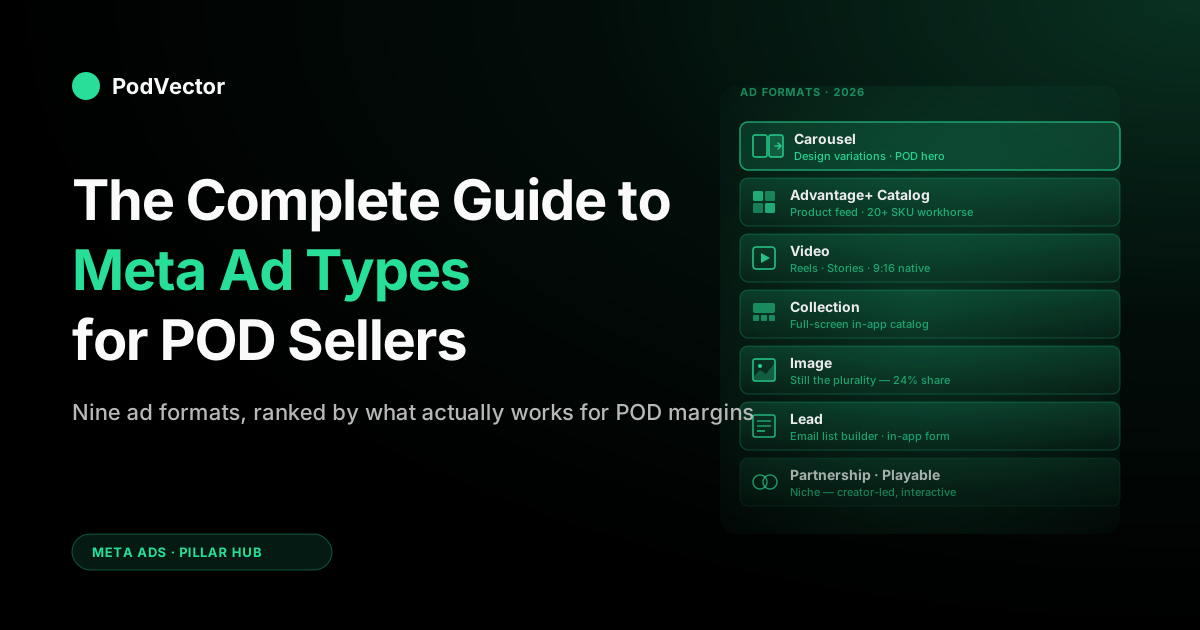
Quick Answer: Meta Ads in 2026 has four core creative formats — image, video, carousel, collection — and a handful of specialized ones (Advantage+ Catalog, Lead, Click-to-Message, Partnership, Playable). For print-on-demand sellers, three formats matter on day one: carousel for design variations, Advantage+ Catalog for stores with 20+ SKUs, and video for creative-led scaling.
Advantage+ Shopping Campaigns (ASC) is now Meta's default campaign type for ecommerce and has absorbed most manual sales-campaign setups. The bigger trap isn't format choice — it's running ASC against POD margins without itemized supplier-cost visibility, which turns Meta's reported ROAS into a number that has nothing to do with whether you actually made money.
Why POD breaks generic Meta Ads advice
Most "complete guide to Meta ad types" articles are written for one of two audiences: direct-to-consumer brands with fixed COGS that ship from a warehouse, or lead-gen businesses measuring cost-per-form-fill. Print-on-demand fits neither model.
Your costs are itemized per order — supplier price, shipping, platform fee, product variant — and none of those numbers appear in Meta Ads Manager. That mismatch is the single biggest reason POD sellers pour money into Meta while their dashboard says everything is fine.
Here's the concrete version. Meta reports ROAS as revenue divided by ad spend.
For a DTC brand with $8 COGS on a $30 product, a 3x ROAS means roughly $22 of contribution per $10 of ad spend — call it $14 net of COGS. Healthy.
For a POD seller running the same campaign on a Printify hoodie, the supplier cost is $18, the shipping is $5.50, and the platform fee on top is another $2 — leaving $4.50 of contribution per $10 of ad spend. Meta's interface shows 3x ROAS in both cases. One business is profitable; the other is paying Mark Zuckerberg to slowly drain the bank account.
The format and campaign-type recommendations in this guide are framed around that reality. The right choice for a POD seller is not always the one a generic Meta tutorial recommends, and the floor for "this ad is working" is much higher than the Ads Manager dashboard suggests. For the full breakdown of how we recommend reconciling Meta's reported numbers against true margin, see our complete guide to Meta Ads ROAS and attribution for POD.
Formats vs. placements vs. campaign types in 2026
Meta Ads has four separable layers that generic guides routinely conflate. Getting this taxonomy straight is the prerequisite for making good decisions.
- Objective — what you're trying to achieve. Meta consolidated to six objectives: awareness, traffic, engagement, leads, app promotion, sales. For POD, "sales" covers 90% of budget.
- Campaign type — how Meta runs the campaign. The default for ecommerce is now Advantage+ Shopping Campaigns (ASC); manual sales campaigns still exist but are being quietly de-prioritized.
- Ad format — the creative unit. Image, video, carousel, collection, plus specialized types (Advantage+ Catalog, Lead, Click-to-Message, Partnership, Playable).
- Placement — where the ad appears. Facebook Feed, Instagram Feed, Stories, Reels, Threads, Marketplace, Messenger, WhatsApp Status, Audience Network.
A single ad is a combination of all four: a sales-objective ASC campaign, with carousel format, shown in Instagram Feed. You pick each layer independently, and the right answer at each layer depends on what you're selling and how you're measuring profit.
The rest of this guide walks the format layer — what each one is, what changed in 2026, and the specific POD considerations that the generic guides miss. If you only have time for four sections, read carousel, Advantage+ Catalog, video, and collection. That's 95% of what matters for a POD store.
Image ads
Single-image ads are the simplest format: one static creative, one headline, one description, one CTA. Still the highest-volume format on Meta by delivery count, and still the format that produces the plurality of conversions for most ecommerce accounts — industry surveys in 2026 put single-image ads at 24% of top-performing Meta creative, the highest share of any format.
Why image ads still work for POD
POD is a visually-driven category. A strong design on a well-shot mockup, with clean typography and a scroll-stopping color palette, outperforms most attempts at elaborate video creative.
Image ads also give Meta's algorithm the cleanest signal for which design is actually doing the work — there's no "did they watch past second 3" ambiguity. For a POD store testing 20 new designs per week, image ads let you learn what's winning faster than any other format.
Image ad specs for POD in 2026
- Aspect ratios — 1:1 (feed), 4:5 (feed, dominant in 2026), 9:16 (Stories/Reels placement when image-only). Meta will serve what you upload but crops aggressively for unused ratios. Upload at least 1:1 and 4:5.
- Resolution — 1080x1080 minimum, 1200x1500 for 4:5. Mockup images rendered at supplier resolution (Printify's default) are usually fine; upscaled or compressed JPGs look bad at Reels size.
- Text overlay — Meta removed the 20% text rule in 2020 but still throttles delivery on heavy-text creative. For POD, the design often is the text (typography shirts, quote mugs). Use a clean product-only shot as the ad creative and let the caption do the selling copy.
Video ads
Single-video ads dominate Stories and Reels placements and are the fastest-growing format across Meta's surfaces in 2026. The sweet spot for most sales-objective campaigns is 15–30 seconds. POD sellers who treat video as optional are ceding share of the surfaces where Gen Z and millennial buyers actually spend their time.
Why video is increasingly non-negotiable for POD
Two forces make video mandatory in 2026. First, Meta's delivery algorithm now heavily favors video across Feed, Reels, and Stories — static creative gets delivered, but at materially higher CPMs. Second, Reels placements deliver the lowest CPMs on Meta's network, but they only accept vertical video. A POD store that sticks to image-only ads is paying a premium for worse placements.
The catch for POD sellers is creative production. Unlike DTC brands with hero products, POD stores often have hundreds of designs across a range of niches — you can't shoot custom video for each.
The working pattern: UGC-style creator video for the top 5–10 designs, plus Meta's Advantage+ Creative video-from-image tool for the long tail. Image-to-video generation is good enough in 2026 to keep cost per video under $5 for catalog-scale output.
Video specs and bidding for POD
- Aspect ratios — 9:16 for Reels/Stories (primary), 1:1 for feed. Upload both; Meta serves whichever matches the placement.
- Length — 15s hooks for Reels, up to 30s for feed. Longer video is rarely worth it for POD; the decision is made in the first 2 seconds.
- Sound — 80%+ of Reels viewers have sound on. Audio matters. For Feed, most views are sound-off, so captions or on-screen text are still required.
For a deeper look at how Meta video specifically drives POD revenue, see Facebook video ads for ecommerce: strategy for POD and Shopify Facebook video ads integration strategy for POD.
Carousel ads
Carousel ads show 2–10 swipeable cards in a single ad unit, each with its own image or video, headline, and landing URL. Industry data in 2026 has carousel as the top-performing format for ecommerce and product-catalog campaigns. For POD specifically, carousel is arguably the highest-leverage format you can run.
Why carousel is uniquely good for POD
A POD design catalog is built for carousels. Each card can be a different design in the same niche, a different colorway of the same design, or a different product type (tee, hoodie, mug, poster) featuring the same graphic.
That's three variations of the same ad, each tailored to a different part of the audience, with the algorithm learning which card drives the click per user — all within a single creative upload. Generic carousel ads treat the format as "show more products." For POD, the format becomes "show the same design on every product someone might want to buy it on."
Carousel structure that works for POD
- Card 1 — the hero. Best-performing design in the niche on your best-performing product. This card gets the most impressions regardless of how the others perform.
- Cards 2–5 — design variations. Same niche, different designs or colorways. Test different price points here — Meta's algorithm will bias toward the price tier that converts for each user.
- Cards 6–10 — product variations. Same design, different product type. This is where carousel quietly lifts AOV: the user clicked for the tee but bought the hoodie.
Optimize the headline on each card individually. Meta reports per-card metrics in Ads Manager, which lets you surgically kill underperforming cards without burning the ad's learning.
Collection ads
Collection ads are a full-screen mobile experience: a cover image or video, followed by a grid of product tiles pulled from your catalog. Tapping the ad opens an Instant Experience — effectively a Meta-hosted mini-landing-page — that loads instantly inside the Facebook or Instagram app. For ecommerce advertisers, the format combines the scroll-stopping power of a carousel with the catalog depth of a dynamic product ad.
The 2026 changes you need to know
Meta made several collection-ad changes in late 2025 and early 2026 that break older guides. Single-media ads and Advantage+ Catalog collection ads on Facebook Feed no longer show a display URL in the footer as of March 2026.
Instagram Explore collection ads were deprecated — the placement still exists for other formats, but not collection. Collection ads were quietly moved out of the default Ads Manager ad-level picker for some account types; you now build them through the Advantage+ Catalog flow for most sales objectives.
When collection ads beat carousel for POD
Carousel is better when the user needs to compare 3–5 specific variations. Collection is better when you want to drop someone into your full catalog experience without forcing them to leave the app. For POD stores with a deep niche catalog (100+ designs in a category), collection ads let you surface the top products while the Instant Experience exposes the long tail — which is where a lot of POD revenue actually lives, since users drill past the top-sellers to find something less common.
Advantage+ Catalog ads (dynamic product ads)
Advantage+ Catalog is Meta's product-feed-driven ad format — previously known as Dynamic Product Ads or DPA. Meta pulls products from a catalog you maintain in Commerce Manager (typically synced from Shopify via Meta's channel app), matches users to products based on browsing and intent signals, and automatically generates the ad unit. No manual creative upload per product; the algorithm picks which product to show which user.
Why Advantage+ Catalog is essential for POD stores with depth
For POD stores with more than ~20 active SKUs, Advantage+ Catalog becomes the highest-leverage format on Meta by a wide margin. The reason is that manual ad creation doesn't scale against a POD catalog — a 500-design store would need 500 separate ads, and you can't possibly know in advance which design will resonate with which user.
Advantage+ Catalog solves that by letting Meta's ML decide. The format shines at retargeting (abandoned-cart product recovery) and at top-of-funnel when you have enough pixel signal for Meta to find look-alike audiences.
The product-feed gauntlet for POD
Advantage+ Catalog is only as good as your product feed. POD stores routinely under-invest here:
- Title quality — "Unisex Tee" tells Meta nothing. "Vintage 1970s Cardiology Heart Anatomy T-Shirt" does. Front-load the searchable keywords; Meta's ML reads them.
- Image quality — default Printify mockup images often fail to stand out in Feed. Lifestyle mockups or flat-lay product shots measurably outperform generic white-background renders.
- Price and availability accuracy — the feed must match the product page. Meta flags mismatches aggressively, and flagged products stop being served.
- Custom labels for margin tiers — split products into margin buckets via custom_label fields. This lets you set different ROAS targets per tier — which is the only way to prevent Meta from optimizing into your lowest-margin SKUs.
For the deeper playbook, see Shopify dynamic Facebook ads product feed strategy for POD and Facebook dynamic product ads Shopify strategy for POD.
Lead ads
Lead ads use an in-app instant form that opens when the user taps the CTA. Fields can be pre-filled from the user's Meta profile (name, email, phone), which dramatically increases completion rates.
No external landing page needed, no tracking-pixel dependency, no form friction. Average cost-per-lead in 2026 runs 30–50% lower than traffic-to-landing-page campaigns for equivalent audiences.
Where lead ads fit for POD
Most POD sellers ignore lead ads because they read "lead" and assume the format is for B2B SaaS or lead-gen businesses. That's a mistake.
Lead ads are the single best way for a POD store to build an email list at low cost, and your email list is the highest-margin channel in your entire business. Specific use cases:
- Pre-launch list building — a new design drop, a seasonal collection, a niche expansion. Run a lead ad with "be first to know when the drop goes live" and 10–15% discount on the first order.
- Niche-specific segmentation — run separate lead ads per niche (dog owners, runners, engineers). Tag each lead with the niche, then segment email flows accordingly. Your open rates will double versus a generic list.
- VIP re-engagement — target past purchasers, offer an early-access perk. Converts repeat buyers into a loyalty segment at negligible cost.
Meta-to-Shopify integration matters here: leads only help if they flow into your ESP automatically. See Facebook lead ads Shopify integration strategy for POD for the specific wiring.
Click-to-Message ads
Click-to-Message ads open a direct conversation with the brand in Messenger, Instagram Direct, or WhatsApp when the user taps the CTA. Instead of sending the user to a product page, you're routing them into a conversation — sometimes with a human, more often with a chatbot or agentic flow.
The POD use case (mostly an international one)
In the US and Europe, click-to-message is a minor format for POD. In Southeast Asia, Latin America, and parts of the Middle East, it's one of the highest-converting formats on Meta, period — WhatsApp is the default shopping channel, and Meta has invested heavily in making WhatsApp Business a full commerce platform.
If your POD store ships to those regions, skipping WhatsApp ads leaves real money on the table. If you're US/EU-only, click-to-message is a format to test once, deprioritize, and revisit when you expand geographically.
Partnership ads
Partnership Ads — rebranded from Branded Content in 2024 — let you run paid ads from a creator's handle with your budget and targeting. The ad shows the creator's username, but the media, targeting, and optimization happen in your Ads Manager account. For categories where user-generated and creator content performs disproportionately, partnership ads are the format that actually lets you scale that content into paid distribution.
Why POD sellers should be using this more
POD stores are uniquely well-suited to creator collaborations. A niche-design store (say, dog-breed-specific tees) can partner with niche creators (dog-breed-specific Instagram accounts) and run partnership ads from their handle featuring the co-designed product.
The creator lends credibility and aesthetic; your store handles fulfillment. The partnership-ad format turns that collaboration from an organic-only play into a scaled paid channel. The workflow: creator posts organic content with the design, you boost their post as a partnership ad, Meta's algorithm learns which creators and which designs drive conversion, you double down on the winners.
Playable ads
Playable ads are mini-interactive experiences that render inside the ad unit — tap to try a filter, play a short game, rotate a product. Originally built for gaming and mobile-app advertisers, playable is a minor format for ecommerce but becoming more relevant in 2026 as Meta pushes "interactive ads" as a general category.
For POD, playable is not a priority format in 2026. Worth keeping on the roadmap for brands that invest in creative differentiation — a "design your own" interactive ad unit is technically feasible — but for most POD operators, time is better spent getting carousel, Advantage+ Catalog, and video working first.
Advantage+ Shopping Campaigns (the campaign type)
Advantage+ Shopping Campaigns (ASC) is Meta's AI-driven ecommerce campaign type — the Meta equivalent of Google's Performance Max. ASC is now the default for sales-objective campaigns in 2026 and the campaign type Meta pushes most aggressively. It handles targeting, creative selection, budget allocation across placements and ad formats, and bid optimization automatically.
How ASC relates to ad formats
ASC is a layer above formats. You still upload individual creative units — images, videos, carousels, collections — and ASC mixes and matches them across audiences and placements.
The right mental model: formats are the ingredients, ASC is the chef. A well-run ASC campaign for a POD store has a mix of image, video, and carousel creative, plus a fully synced Advantage+ Catalog feed for dynamic retargeting.
The ASC trap for POD sellers
ASC optimizes to Meta's reported ROAS. For POD, that's the wrong target.
An ASC campaign hitting 3.5x reported ROAS on a Printify catalog with 60% supplier costs is losing money. Until you can feed ASC a signal that represents true margin per conversion (either via enhanced conversions with a margin-weighted value parameter, or by building a reporting layer outside Meta that reconciles actual profit per ad-attributed order), ASC will happily scale you into unprofitable SKUs.
This is the single biggest reason POD accounts look "successful" in Meta while the bank account says otherwise. For the mechanics of fixing this, see the Meta Ads ROAS and attribution guide.
How POD sellers should pick formats
A decision framework that collapses the format-choice problem into three questions:
- How many SKUs are live? Under 20, start with carousel + image. Over 20, Advantage+ Catalog is non-negotiable — you can't manually manage that much creative rotation.
- What's your creative-production capacity? If you can produce video (even UGC-style creator content), Reels-native 9:16 video should be 30–50% of your creative mix. If you can't, stick with image + carousel until you can. Don't use Meta's image-to-video tool as your only video source; the quality is fine as a gap-filler but not as a primary format.
- How important is retargeting vs. prospecting? If most of your Meta budget is retargeting site visitors, Advantage+ Catalog dominates. If it's cold prospecting, carousel and video with strong top-of-funnel creative win. ASC blends both automatically, which is why it's the default.
Recommended stack by seller stage
Stage 1 — new store, under $5K MRR
- Image + carousel ads under a single ASC campaign, $30–$50/day.
- One video hook (creator-shot UGC or Advantage+ Creative generated) as a test.
- Skip Advantage+ Catalog until pixel has at least 50 purchases on file. Before that, the feed-driven optimization has nothing to work with.
- Primary metric — cost per purchase vs. your true (not reported) break-even. If you don't know your true break-even per design/product combo, that's the thing to fix before scaling spend. Start with our break-even ROAS guide.
Stage 2 — growing store, $5K–$30K MRR
- ASC with all four core formats (image, video, carousel, collection) running in parallel.
- Advantage+ Catalog retargeting campaign separate from ASC, for site visitors in the last 14 days.
- Lead ads for email list building, targeted at niche audiences aligned with your top-converting designs.
- Primary metric — true margin per order by product category, tracked outside Meta's interface. If you're still optimizing toward reported ROAS at this stage, you're probably funding loss-making SKUs.
Stage 3 — scaling store, $30K+ MRR
- ASC + manual sales campaigns running in parallel. Manual campaigns for product lines where you need tighter audience or creative control; ASC for everything else.
- Partnership ads with creators in your top niches.
- Click-to-message in WhatsApp-heavy markets if you ship internationally.
- Itemized profit tracking by design, supplier, and ad set — at this scale, the difference between "growing profitably" and "growing into bankruptcy" lives in the per-SKU cost data, and neither Meta's dashboard nor generic Shopify analytics will surface it for you.
Common mistakes POD sellers make with Meta Ads
Optimizing toward Meta's reported ROAS
Meta's ROAS = revenue / ad spend. POD's actual ROAS = (revenue − supplier cost − shipping − fees) / ad spend. Until those two converge in your reporting, every ASC tROAS target you set is aimed at the wrong number. Most POD sellers discover this six months in and realize they've been scaling unprofitable designs at 3.5x reported ROAS.
Treating video as optional
Static-only POD accounts in 2026 are paying a CPM premium, missing Reels placements entirely, and losing share of voice on Instagram to video-native competitors. Video doesn't have to be expensive — UGC creator content plus image-to-video augmentation is a realistic catalog-scale path. But "we don't do video" is no longer a viable stance.
Running Advantage+ Catalog without feed cleanup
Most POD sellers' product feeds out of the box have generic titles, missing GTINs, mismatched pricing, and no custom labels for margin tiers. Advantage+ Catalog optimization is directly proportional to feed quality. Two hours of feed work — front-loading titles with buyer queries, adding margin-tier custom labels, normalizing product types — typically delivers more lift than any bidding-strategy change.
Ignoring creative fatigue on carousel
Carousel ads hit creative fatigue faster than single-image because each card burns through a sub-audience at its own pace. A carousel that looks "fine" on aggregate CTR may have card 2 in terminal decline while cards 5–7 are still fresh. Audit by card weekly; retire tired cards and replace them rather than letting aggregate drift hide the problem.
Launching partnership ads without a margin plan
Partnership ads tend to shift creator economics toward revenue-share arrangements, which for POD can look attractive until the creator's cut plus the supplier cost plus the ad spend adds up to more than the sale price. Model the full margin stack before any partnership deal — a 15% creator revenue share on a POD product with 40% supplier cost and 25% ad spend leaves 20% for you before refunds and platform fees, which is thin.
Not auditing ASC by ad set or creative cluster
A single ASC campaign reporting 3.5x ROAS can hide three clusters of creative: one at 5x on a specific niche (great), one at 3x on generic designs (break-even after costs), one at 1.8x on a slow-turning category (bleeding money). Audit by ad set or creative cluster, not just by campaign. For a deeper view of how this plays out in agency-managed accounts, see Facebook ads agency for ecommerce: what POD operators should know.
FAQs
Which Meta ad format should a POD seller start with?
Carousel, configured with your top-performing design as card 1 and 4–6 related designs or product variants as follow-up cards. For most POD sellers under $5K MRR, carousel inside an ASC campaign is the right day-one format — you get algorithmic audience targeting, per-card performance data, and automatic rotation. Add single-image and single-video once carousel is working.
Is Advantage+ Shopping Campaigns (ASC) better than manual sales campaigns for POD?
For most sellers under $30K MRR, ASC delivers better aggregate results but worse audience transparency. Run ASC as your primary sales campaign; run a parallel manual campaign only if you have a specific audience or creative you need to isolate (e.g., high-margin niche with tight targeting). Above $30K MRR, parallel manual campaigns become more valuable for asset-level control.
How much should a POD seller spend on Meta Ads to start?
ASC needs roughly 50 conversions per campaign per week to optimize meaningfully, which at typical POD AOVs and conversion rates is $1,500–$3,500/month. Below that budget, Meta's algorithm doesn't have enough data to optimize, and you'll spend without learning. If you can't commit to that budget for at least 60 days, focus on organic channels (TikTok, Pinterest, email) until you can.
Why is my ASC ROAS good but my bank account empty?
Meta's ROAS counts gross revenue against ad spend. It excludes Printify or Printful supplier cost, shipping cost, platform fees, and refunds.
For POD, those costs eat 50–70% of revenue. A 3.5x reported ROAS is often a 1.1x true ROAS — basically break-even, or negative depending on the SKU mix.
The fix is itemized cost tracking that reconciles supplier costs against each ad-attributed order. Generic Shopify analytics doesn't do this for POD; see our comparison of best print-on-demand profit tracking apps for the category landscape.
Should POD sellers use carousel or collection ads?
Both, for different jobs. Carousel is the day-one format — cheap to produce, easy to test, per-card analytics.
Collection ads come into play once you have a deep catalog and want to drop users into an in-app mini-store experience. For stores with fewer than 50 designs, carousel alone is usually enough. Above 50, layer collection ads on top for prospecting campaigns.
What's the difference between carousel ads and Advantage+ Catalog?
Carousel is manually built — you pick the 2–10 cards, the order, the headlines. Advantage+ Catalog is algorithmically built — Meta picks which products to show which users based on your feed and their behavior.
Use carousel when you have a specific narrative (a niche drop, a seasonal collection, a top-5 roundup). Use Advantage+ Catalog when you want to surface the long tail of your catalog without manually managing it. Most mature POD accounts run both, for different objectives.
Are Meta Ads worth it for a small POD store on Shopify?
Below ~$3K MRR, usually no — your pixel data is too thin for ASC to optimize well, your margin visibility is usually too thin, and your time is better spent on organic acquisition and product validation. Above $3K MRR with confirmed unit economics and at least $1,500/month of ad budget, yes.
The deciding factor is rarely the format; it's whether you can see real margin per order. For the broader question of whether to pay for help, see our guide to Google Ads services for POD — the agency economics apply similarly to Meta.
How does Meta Ads compare to Google Ads for POD?
Different jobs. Google Ads (especially Performance Max and Shopping) capture demand — people already searching for the product or category.
Meta Ads create demand — putting visually-led creative in front of people who weren't looking but might be interested. Most successful POD stores use both: Google for capture, Meta for discovery. For the equivalent breakdown on the Google side, see the complete guide to Google ad types for POD sellers.
Do I need a Meta Ads agency for my POD store?
Most POD sellers under $30K MRR shouldn't pay for an agency — retainers ($2K–$8K/month) eat the margin a small POD account can support, and the work involved (ASC configuration, feed cleanup, conversion tracking, creative rotation) is well-documented and within a careful operator's reach. Above $30K MRR, the math shifts; an agency that genuinely understands POD's cost structure can pay for itself.
The catch is finding one. Most ecommerce agencies optimize for reported ROAS, which for POD is the wrong target. See Meta Ads agency for Shopify: what POD operators should know for the operator's perspective.
What's the role of AI in Meta Ads for POD in 2026?
Meta's AI runs the campaign — ASC, Advantage+ Catalog, Advantage+ Creative, auction bidding — and that's mostly working as advertised. The AI gap for POD sellers isn't on the Meta side; it's on the post-campaign analysis side.
Knowing which ASC creative cluster, which carousel card, which Advantage+ Catalog product is actually profitable after itemized supplier costs is where AI delivers the highest leverage for POD specifically. That's the category PodVector AI is in. Victor sees every order, every ad dollar and every supplier cost together, so he can tell you which products and ads are really making you money. You ask "which Meta carousel ad made real money this month after Printify costs" and get an answer grounded in your actual data, not Meta's reported revenue.
What happens if my Meta ads get disapproved for IP reasons?
The ad stops serving and, for repeat offenses, your ad account can be restricted. POD sellers get flagged most often for: trademarked characters or logos, sports team references, song lyrics, university mascots, and celebrity likeness.
The fix is to either remove the disputed designs from your Meta catalog and ad creative (cleanest) or rewrite titles, descriptions, and product imagery to remove the trademark proximity (slower). Don't appeal the same ad twice without changes — Meta's reviewers track repeat appeals, and the second rejection often triggers broader account scrutiny. For external context on format specifications and Meta's 2026 rule changes, WordStream maintains a regularly-updated guide to Facebook ad types that catalogs the current placement-level requirements.
See your real Meta Ads ROAS — after Printify costs, not before
Meta's ROAS report counts revenue. For POD sellers, that number says almost nothing about whether the campaign made money. PodVector AI's AI agent, Victor, reconciles itemized Printify and Printful costs against each ad-attributed order, then answers plain-English questions like "which carousel card on my ASC campaign is actually profitable this month" — live, against your real store data. And stop optimizing toward a number that doesn't pay your bills.
Try Victor free