
Quick Answer: For most print-on-demand stores there is no single best platform — the winning play is a mix: Facebook Ads to create demand for visual products, Google Ads (Shopping + branded search) to capture buyers already searching, and Microsoft Ads (formerly Bing Ads) as a low-cost search supplement for older, desktop-heavy, and occupation-driven niches.
Each wins on a different axis. Facebook wins on creative reach for image-led products (where POD lives), Google wins on conversion intent, and Microsoft Ads wins on raw CPC efficiency — its clicks run roughly 30% cheaper than Google's for the same query, plus it carries LinkedIn-based job and industry targeting no other search engine offers.
This guide compares all three platforms head-to-head against POD's actual economics — 20–35% contribution margin, supplier-priced SKUs, image-driven creative — and shows which platform earns budget at which store size.
Why this comparison breaks differently for POD
Most three-way ad-platform comparisons are written for B2B SaaS, ecommerce in general, or local services. Their default conclusion is “use all three for full-funnel coverage.” That advice is fine when your gross margin is 70%+ and your average order value is over $100.
Print-on-demand operates on different physics. Average order value lands at $25–$45. Supplier cost from Printify or Printful claims 50–70% of revenue before you've paid the ad bill. Contribution margin after shipping, payment processing, and platform fees usually sits between 20% and 35%.
That margin envelope changes every cost equation. A $0.45 Google CPC at 1.5% conversion costs $30 per sale — borderline workable on a $35 t-shirt. A $0.20 Bing CPC at the same conversion rate costs $13 per sale — clearly profitable. A $1.50 Facebook CPC at 1% costs $150 per sale — only viable if AOV climbs above $80 or you bank on repeat purchase.
So the question for POD operators isn't “which platform is best in general.” It's which platform's cost structure clears your margin floor for the specific niche, AOV, and buyer profile you're selling into.
Side-by-side: Bing vs Google vs Facebook for POD
Here's the comparison axis-by-axis. Numbers reflect typical print-on-demand store performance in 2026, not aggregate cross-industry benchmarks.
| Axis | Microsoft Ads (Bing) | Google Ads | Facebook Ads |
|---|---|---|---|
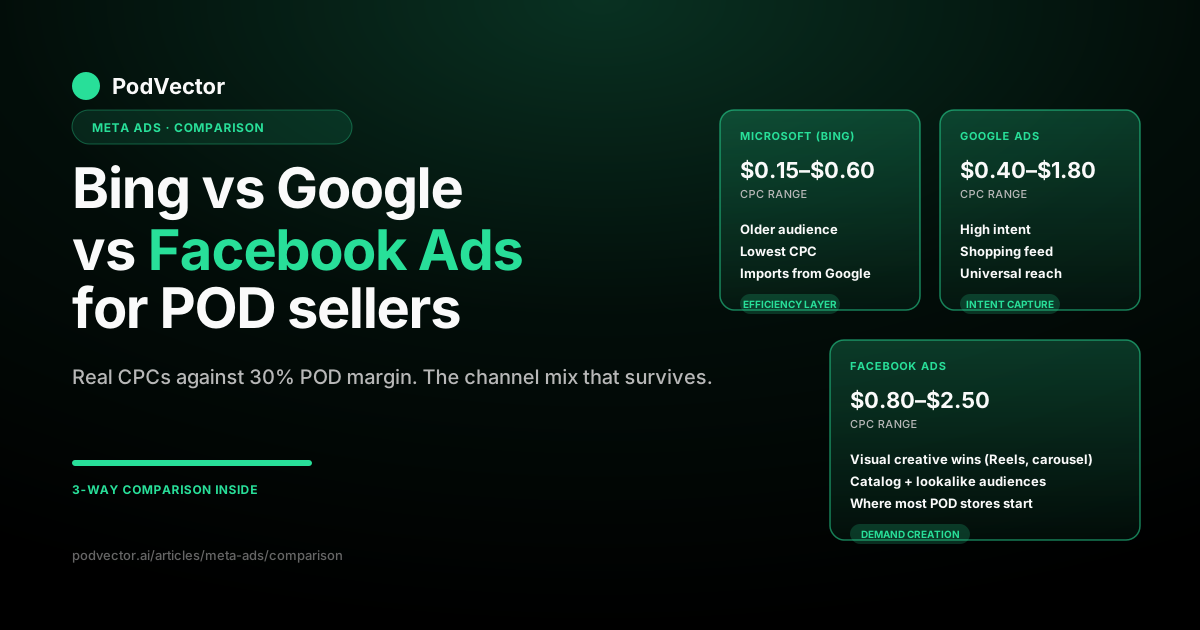
| Typical CPC for POD niches | $0.15–$0.60 | $0.40–$1.80 | $0.80–$2.50 |
| Search vs social model | Search (intent-based) | Search + Shopping + Display | Social feed (interest-based) |
| Buyer intent signal | High (typed query) | High (typed query) | Medium (interest + lookalike) |
| Audience size | ~1B monthly searches (US) | ~8.5B daily searches (global) | ~3B monthly active users |
| Audience skew | Older, desktop, higher income | Universal | Mobile-first, broad demographics |
| Unique targeting lever | LinkedIn profile targeting (job function, industry, company) | In-market & search intent audiences | Interest + lookalike + retargeting depth |
| Catalog / product feed ads | Microsoft Shopping (mirrors Google feed) | Google Shopping (mature) | Meta Catalog (mature) |
| Visual creative formats | Limited (Shopping image, text) | Limited (Shopping image, text) | Strong (Reels, Stories, carousel) |
| Minimum viable daily budget | $10–$20 | $30–$50 (Shopping) | $20–$30 (manual campaigns) |
| Setup overhead for new POD store | Lowest (import from Google) | Medium (Merchant Center + feed) | Medium (Pixel + Catalog + creative) |
| Best POD use case | Desktop/older niches, low-cost search supplement | Branded search, high-intent niches | Visual product launches, scaling demand |
The pattern reads cleanly. Bing and Google share intent; Bing offers cheaper inventory but smaller volume. Facebook plays a different game entirely — it's where you create demand for products people didn't know they wanted. For POD, you usually need both halves: search to capture and social to create.
Microsoft Ads (Bing) for POD: where it earns its slot
Microsoft Ads is the channel most POD sellers ignore until they realize it's running 30–40% cheaper than Google for nearly identical traffic. The Microsoft Search Network covers Bing, Yahoo, AOL, DuckDuckGo, and a chunk of Microsoft properties — roughly one billion monthly US searches.
The audience skews older, more desktop-heavy, and higher-income than Google's. For most POD niches, that's a feature, not a bug. Memorial-themed products, grandparent-gift designs, faith-based apparel, hobby niches with an older demographic (gardening, RVing, classic cars), and patriotic merch all over-index on Bing.
Microsoft Ads also carries one targeting lever no other search engine has: LinkedIn profile targeting. You can layer on a buyer's job function, industry, or company on top of a keyword bid. That's quietly powerful for occupation-pride POD — nurse, teacher, engineer, trucker, welder, accountant designs — where you can put a “proud RN” shirt in front of healthcare-industry searchers specifically. It's a B2B feature most POD sellers never think to use, and it's free incremental precision on top of an already-cheap click.
The setup cost is the lowest of the three. Microsoft Ads has a one-click import from Google Ads that pulls campaigns, ad groups, keywords, and a Shopping feed across in a few minutes. You don't have to rebuild the campaign — you migrate it and let it run at lower CPCs.
Where Bing falls short: scale. The audience is smaller, so even a well-optimized campaign caps out at maybe 20–30% of what an equivalent Google campaign delivers in volume. For a POD store doing $5K/month in revenue, Bing might add $800–$1,500 of incremental sales — meaningful, not transformational.
The honest framing: Bing Ads is an efficiency play, not a growth play. Run it after Google Ads is profitable, expect to spend 10–20% of your Google budget there, and treat the lower CPCs as found money — not a primary engine.
Google Ads for POD: where it earns its slot
Google Ads is the highest-intent channel of the three. Someone typing “dachshund mom shirt” or “custom retirement gift mug” is much closer to buying than someone scrolling Instagram. For POD niches with proven search demand, Google Shopping does the heavy lifting.
The two formats POD sellers actually need: Shopping (product feed ads in the search results and Shopping tab) and branded search (defending your store name from competitor bids). Standard text search ads can work for high-AOV niche keywords, but they rarely scale economically because of intense bidding.
For a deeper breakdown of where Google Ads outperforms Facebook on a POD margin envelope, see Google Ads vs Facebook Ads for POD sellers. For the full Google Ads strategy stack, the complete Google Ads playbook for POD covers Shopping setup end-to-end.
Google's main weakness for POD is creative. Shopping ads show a single product image, a title, and a price. There's no room for storytelling, brand voice, or design context. If your products win on emotional resonance — most POD niches do — Google undersells you compared to a Reels or carousel ad on Facebook.
The other weakness: cost discipline. PMax (Google's automated everything-bundled-together campaign type) burns budget fast on POD if you don't constrain it with negative keywords, audience signals, and clean conversion data. A Performance Max campaign without guardrails can spend 60% of its budget on garbage queries and Display Network filler.
Facebook Ads for POD: where it earns its slot
Facebook Ads (and Instagram, sharing the Meta ad system) is where POD businesses are typically built. Image-driven products, creator-led niches, and design-as-product pitches all play to Meta's strengths: high-quality visual creative formats, fine-grained interest targeting, and a buyer who wasn't searching but is open to discovery.
Reels, Stories, carousel ads, and dynamic catalog ads (Advantage+ Shopping) all give POD sellers room to show their actual product in context — on a model, in a flat-lay, in a lifestyle scene. That matters because POD competes on design taste more than on price or specs.
The cost structure cuts both ways. Facebook CPCs run higher than Bing or Google for most niches in 2026, but conversion rates from interest-targeted traffic on properly tested creative often beat search-only campaigns once you account for retargeting and view-through conversions. The trick is the “properly tested creative” part — Facebook ROAS lives or dies on creative iteration speed.
The honest weakness: post-iOS 14 attribution. Facebook's reported ROAS in Ads Manager has been unreliable since 2021 because Apple's App Tracking Transparency cut Meta's view of conversion events. Facebook now models a meaningful slice of attribution rather than measuring it. POD operators who trust the in-platform ROAS without reconciling against shop-level data routinely overspend by 20–40%.
For more on the underlying CBO/ABO budget allocation question that affects Facebook ROAS stability, see Meta Ads CBO vs ABO for POD.
Cost math: CPC, CPM, and POD margin
Here's the unit-economics math against a typical POD product: $35 AOV, 30% contribution margin after supplier cost, shipping, and processing fees. That leaves $10.50 of contribution per order to absorb ad spend before the order goes underwater.
| Platform | Typical CPC (POD niche) | Conversion rate (warm traffic) | Cost per acquisition | Verdict at 30% margin |
|---|---|---|---|---|
| Microsoft Ads (Bing) | $0.30 | 1.8% | ~$17 | Slightly above margin floor; profitable with repeat purchase |
| Google Shopping | $0.65 | 1.5% | ~$43 | Loss on first order; profitable only with $80+ AOV or LTV |
| Facebook Ads | $1.20 | 1.2% | ~$100 | Significant loss on first order; bank on retention/upsell |
This math is brutal in isolation. None of the three is reliably profitable on the first transaction at $35 AOV unless your conversion rate, AOV, or both are well above the typical POD baseline. That's not a flaw in the platforms — it's the structural reality of POD margin.
The implication: channel mix isn't about picking the cheapest CPC. It's about engineering AOV (bundles, multi-piece sets, premium tiers), repeat purchase, and email/SMS lifetime value so the blended CAC across all three channels makes sense over a 90–180 day window. For a deeper POD-specific cost breakdown, see the Google Ads vs Facebook Ads cost comparison.
Audience fit: which platform reaches which POD buyer
Not every POD niche is equally distributed across the three platforms. Matching your buyer profile to the platform that over-indexes on it is one of the few moves that compounds.
Microsoft Ads (Bing) over-indexes on: US-based buyers age 45+, desktop users, professionals in finance/healthcare/government, Microsoft-loyal households, parents and grandparents shopping for family gifts. POD niches that fit cleanly: memorial products, military/veteran apparel, faith-based merch, gardening/RV/outdoors, classic-car hobby, retirement gifts.
Google Ads over-indexes on: universal demographics, mobile-and-desktop split, intent-driven research buyers. POD niches that fit: anything with high search volume and brand recognition (occupation pride apparel, sports fan merch, breed-specific pet gifts), niches where the buyer types a specific query.
Facebook Ads over-indexes on: mobile-first buyers, ages 25–55, high creative-discovery patterns, broad interest segments, lookalike-trainable patterns. POD niches that fit: design-led apparel (graphic tees, statement prints), trending niches (current events, pop culture), creator/community-driven brands, anything where the product wins on visual stop-the-scroll energy.
If your niche fits one platform's audience profile cleanly, that's where you start. If it fits across two or three, the order is usually Facebook to create demand, Google to capture intent, Bing to skim efficiency.
Channel mix by store stage
The right mix isn't constant — it changes as the store grows. Treating channel allocation as a stage-dependent decision avoids the common mistake of starting on all three channels at once and running each one too thin to learn anything.
Stage 1: $0–$1K/month revenue. Run Facebook Ads only. The store doesn't have enough conversion data to feed Google's algorithms or fill the CPCs Bing needs to hit volume. Spend $20–$50/day on creative testing and proving product-market fit. Skip Google and Bing entirely until you have repeat purchase signal.
Stage 2: $1K–$10K/month. Add Google Ads — but only branded search and Shopping, not text search. Branded search defends store traffic from competitors at near-zero cost. Shopping captures the buyers who saw a Facebook ad, didn't buy, and later searched the product on Google. Budget split: 70% Facebook, 25% Google Shopping, 5% branded search.
Stage 3: $10K–$50K/month. Add Microsoft Ads via Google import. Now you have enough conversion volume that Bing's smaller audience pays meaningful traffic. Budget split: 60% Facebook, 25% Google, 10% Bing, 5% retargeting overlap.
Stage 4: $50K+/month. Diversify into TikTok, Pinterest, and YouTube alongside the core three. At this stage, channel concentration risk matters more than maximum efficiency on any one platform. For a broader read on where Meta competes against everything else, see Meta Ads vs alternatives: the complete comparison for POD.
Measuring all three channels against the same number
Running three platforms simultaneously creates a measurement problem that kills more POD businesses than bad creative does. Each platform reports its own “ROAS” against its own attribution window, against its own modeled conversions. None of them sees the customer's full path.
A typical example: Facebook Ads Manager reports 2.4x ROAS on a campaign. Google Ads reports 3.1x ROAS on a separate campaign. Microsoft Ads reports 4.2x. Adding those up suggests you're tripling your money. Your Shopify dashboard shows total revenue is up 15% on a 60% increase in ad spend — actual blended ROAS of 1.8x. Two of the three platforms double-counted conversions. One missed half its retargeting credit.
The fix isn't picking the “right” platform's number. It's reconciling all three against a single source of truth — usually a unified data warehouse that joins ad spend from every platform to actual Shopify orders, Printify or Printful supplier costs, and shipping/processing fees per SKU. Modern POD operators do this in Snowflake, BigQuery, Redshift, Databricks, or via an analytics layer that sits on top of those.
This is why PodVector AI built Victor: an AI employee that reads ad spend across every channel, supplier costs from Printify and Printful, and Shopify revenue, then answers questions like “what's my real blended ROAS this week” or “which campaign is profitable after supplier cost” without you opening four tabs. Victor answers and acts on those answers — with your approval — pausing the unprofitable campaign, reallocating to the profitable one.
For a deeper attribution-specific breakdown, see the complete guide to Meta Ads ROAS and attribution for POD. For more comparisons across platforms, browse the full Meta Ads comparison cluster or the broader Meta Ads topic hub.
FAQs
Is Bing Ads actually worth running for a print-on-demand store?
Yes, but only after Google Ads is already profitable. Bing's CPCs run 30–40% cheaper, the audience skews older and higher-income (which fits memorial, faith-based, and grandparent-gift POD niches well), and you can import existing Google campaigns in one click. Expect Bing to add 10–25% incremental volume on top of Google, not replace it.
Can I just run all three platforms from day one?
No. A new POD store doesn't have enough conversion data to train Google's PMax or Bing's Smart Shopping algorithms, and spreading $30/day across three platforms means each campaign starves before it learns. Start with Facebook Ads only, prove product-market fit, then add Google at $1K/month revenue and Bing at $10K/month.
Why is Facebook ROAS so much higher in Ads Manager than my Shopify dashboard shows?
Post-iOS 14.5, Facebook models a significant share of conversion attribution rather than directly measuring it. The platform also counts view-through conversions in a 1-day window that often credits Facebook for orders Google or organic actually drove. Most POD operators see a 20–40% gap between Facebook's reported ROAS and shop-truth blended ROAS. Facebook Ads vs Google Ads performance for POD covers the reconciliation playbook.
What's the cheapest of the three to start with?
Microsoft Ads has the lowest CPCs, but the lowest minimum viable budget belongs to Facebook Ads — you can run a useful creative test for $20/day. Google Shopping needs $30–$50/day to gather enough impression data, and Bing's small audience size means a $10/day budget runs out of inventory before it learns. Cheapest CPC and cheapest entry-point are different metrics.
Does Google Shopping work without a Printify or Printful product feed integration?
Technically yes — you can upload a manual feed from Shopify — but you'll spend hours fixing GTIN errors, image rejections, and price mismatches. Most POD sellers use a Shopify-to-Merchant-Center sync app that pulls Printify or Printful product variants automatically. If your supplier cost changes, the feed must update or you'll bid on a price you can't deliver.
How do I split a $1,000 monthly ad budget across all three?
At a $1,000/month spend, you're at Stage 2. Allocate roughly $700 to Facebook (creative testing + retargeting), $250 to Google (branded search + Shopping for proven products), and $50 to Bing as an efficiency layer. If any of those isn't beating its cost target after 30 days, kill it and reallocate, don't average it out.
Do I need different creative for Bing, Google, and Facebook?
For Microsoft Shopping and Google Shopping, the product feed image and title do most of the work — they share the same source feed. For text search ads, copy can be near-identical. Facebook is the outlier: feed-and-Reel creative is a different format entirely (vertical, native, scroll-stopping) and demands its own creative pipeline. Don't recycle Shopping images as Facebook ads — they convert poorly.
Stop Reconciling Three Platforms by Hand
You're running Facebook, Google, and Microsoft Ads. Each platform reports a different ROAS. Your Shopify dashboard tells a fourth story. Printify and Printful supplier costs aren't in any of those numbers.
Victor is the AI employee that reads spend from every ad channel, supplier costs from your POD provider, and orders from Shopify, then answers “what's actually profitable this week” in plain English. Facebook says one thing. Google says another. Bing says a third. Victor tells you the real number.
Try Victor free